Chapter 7
Material Handling Principles,
Equipment, and System Design
1
2
3
4
3
4
4
4
1
7.9 Exercises
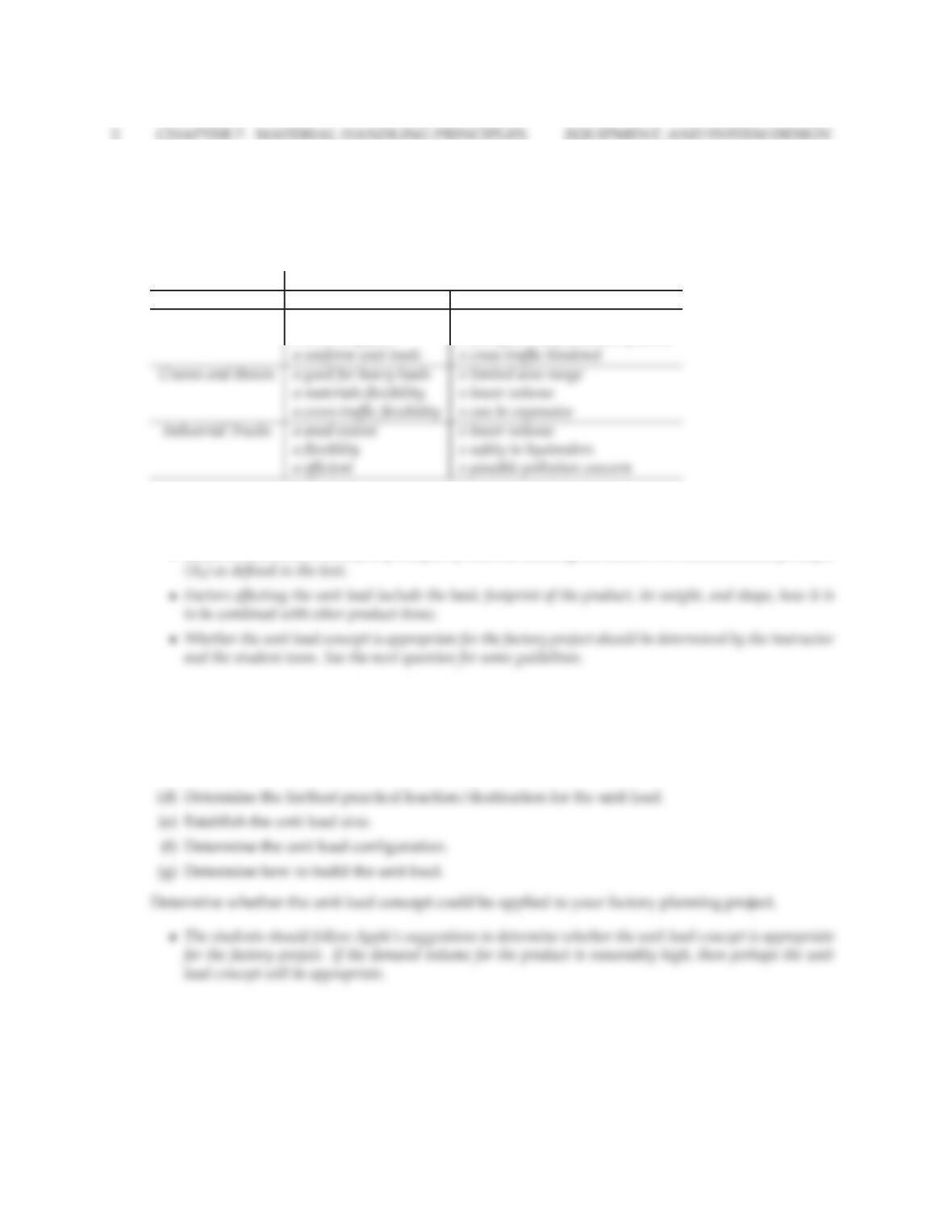
1. What are the three basic types of material handling systems? Create a table of advantages and dis-
advantages for each type of system, with at least three items for each type of system.
Device Advantages Disadvantages
Conveyors o volume of flow o restricted floor area
o control of flow o disruptive to production if down
2. What in your own words is a unit load? What factors influence the formulation of a unit load? Is the
unit load concept appropriate in your factory design project?
•Student should relate to the first principles of material handling and discuss the standardization principle
3. Apple suggests the following 7-step procedure to design a unit load:
(a) Determine whether the unit load concept is applicable.
(b) Select the unit load type (i.e. platform, sheet, rack, container)
(c) Identify the most remote source of a potential unit load.
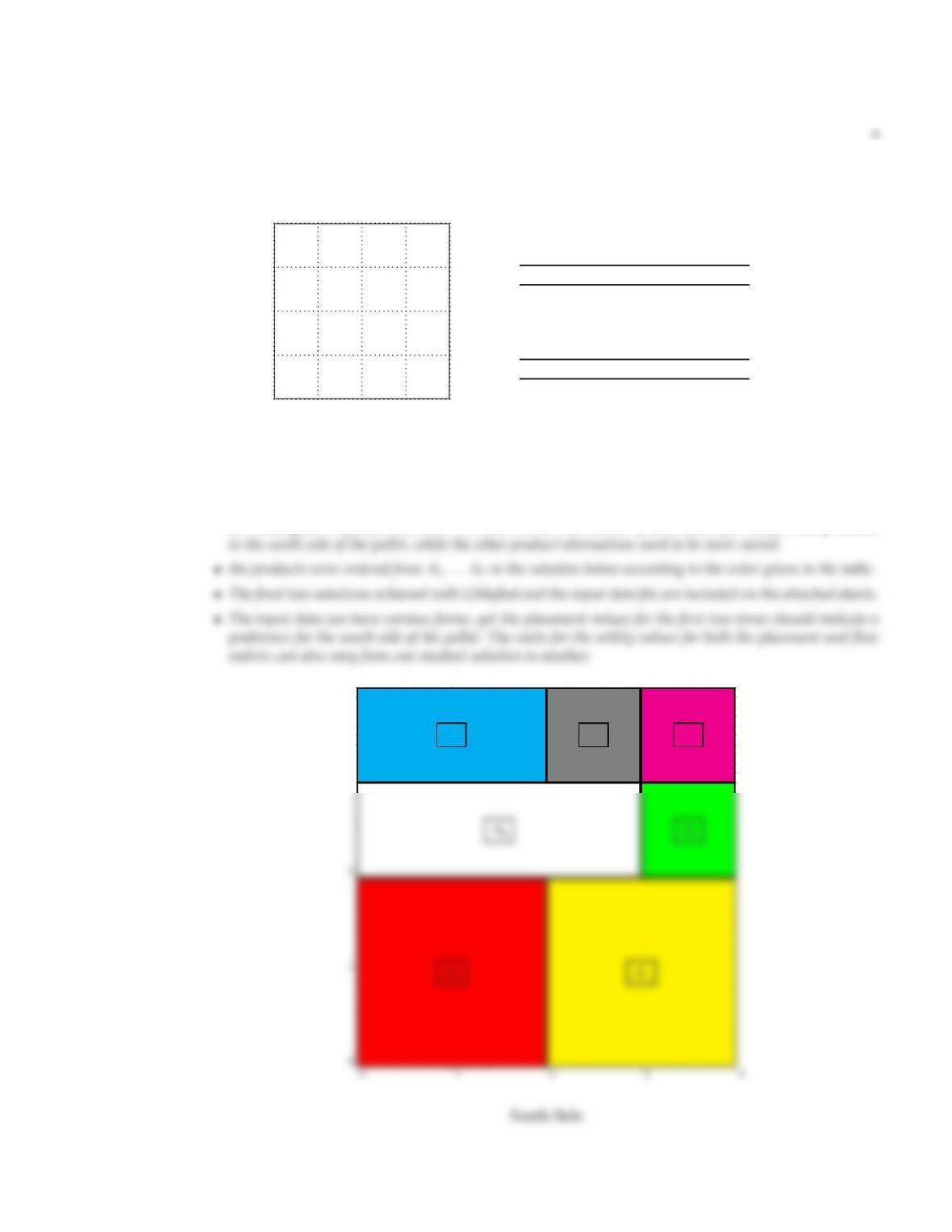
4. Below is a 48”x48” pallet. We have 7 products to be arranged on the pallet.
0 1 2 3 4
0
1
2
3
4
South Side
# of products size of product
2 2’ x 2’
3 1’ x 1’
1 1’ x 3’
1 1’ x 2’
Totals: 7 16 sq. ft.
Determine the best arrangement of products on the pallet where the first two products need to be on
the south side of the pallet for flow reasons and the 3 (1’x1’) should be adjacent to the first two prod-
ucts. Use GMaflad to help you find the optimal solution. Is there more than one optimal solution?
•This is a surprisingly difficult optimization problem because the pallet is constrained and there are differ-
ent rectangular shapes for the items. One can restrict the number of alternatives for the first two products
3
4
A7A5A4
5. Give examples of each of the 8principles of material handling as defined in our textbook.
•Planning P: Coordinating the layout of the mhs with the layout of the factory.
•Automation A: Automating a feeding mechanism normally done by hand by an operator.
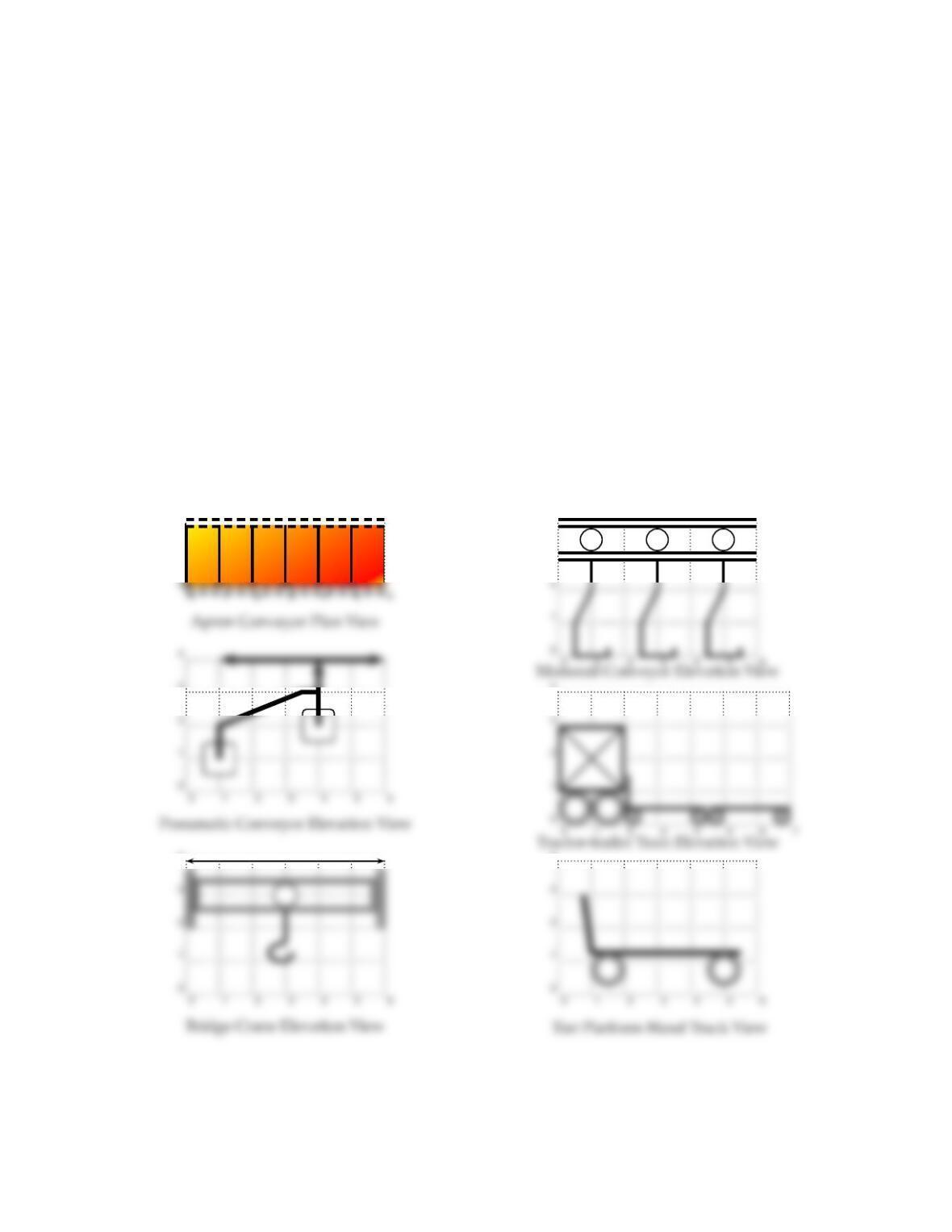
6. Differentiate between the following material handling equipment items and give at least three ad-
vantages and disadvantages for each type.
•Spiral chute vs. pneumatic conveyor: A spiral chute is a gravity fed conveyor while a pneumatic
conveyor is vacuum powered.
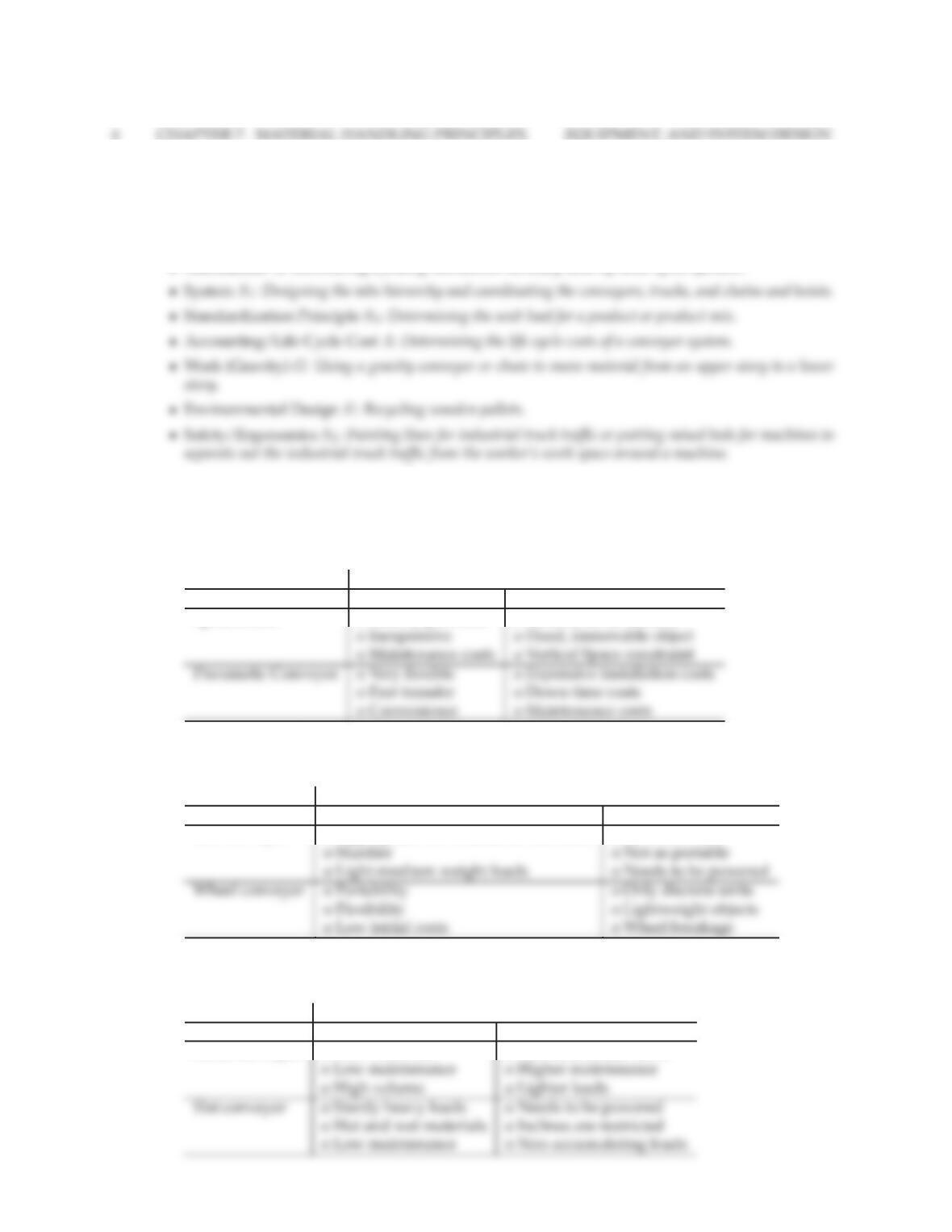
Device Advantages Disadvantages
Spiral Chute o Gravity powered o Little material control
•Belt conveyor vs. wheel conveyor: A belt conveyor is a powered conveyor linked by a continu-
ous metallic or fabric material for non-accumulating loads. A wheel conveyor can be a portable,
inexpensive device for lightweight accumulating items.
Device Advantages Disadvantages
Belt conveyor o Appropriate for continuous materials o Not as flexible
•Roller conveyor vs. slat conveyor: A roller conveyor accommodates individual unit loads that
can accumulate and that can be powered or operate by gravity. A slat conveyor is for heavy
loads and is powered.
Device Advantages Disadvantages
Roller conveyor o Low initial cost o Can accumulate items
5
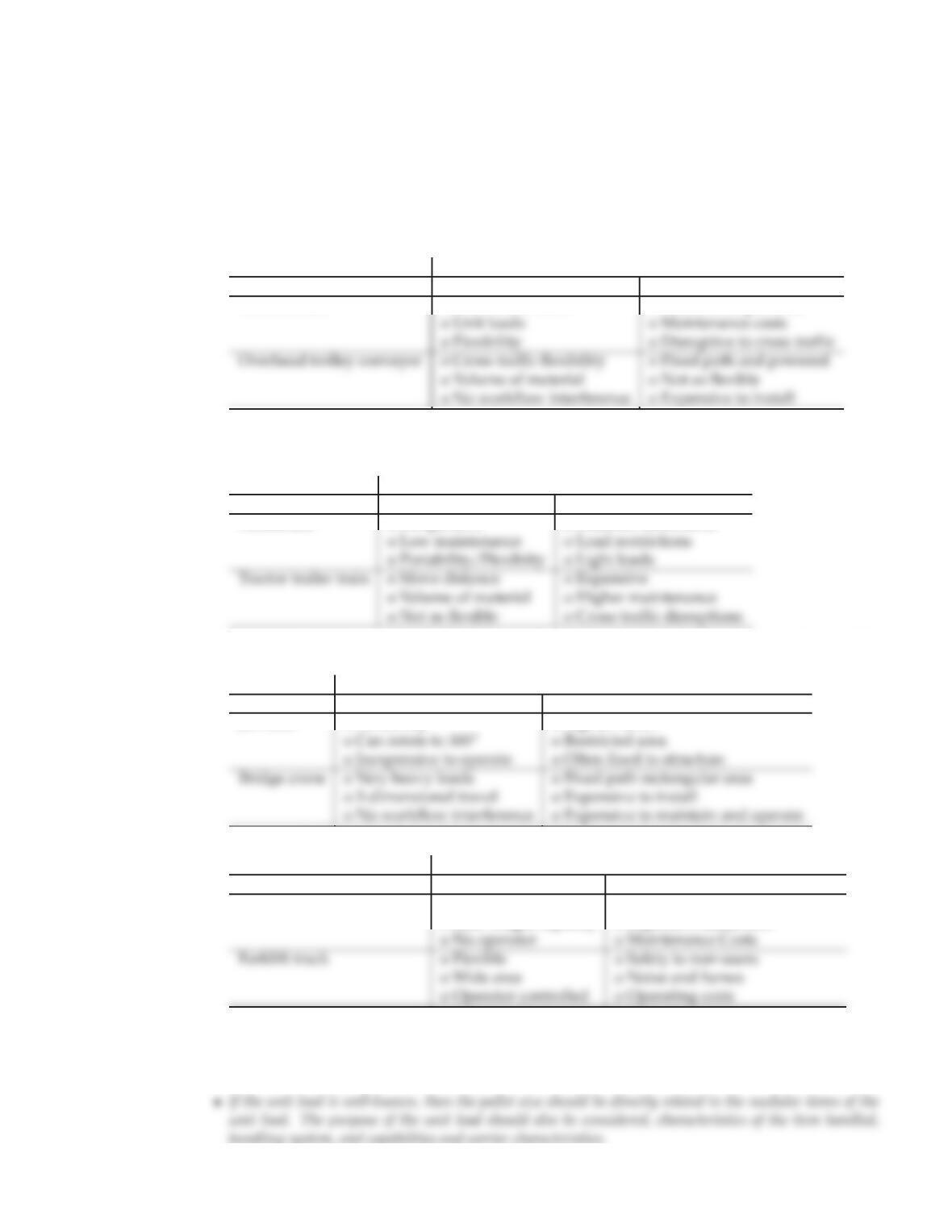
•Forklift truck vs. overhead trolley conveyor: Forklift trucks are wide area devices used for mov-
ing item intermittently. Overhead trolley conveyors are fixed path equipment and independent
of the floor area where forklifts need to operate.
Device Advantages Disadvantages
Forklift truck o Wide-area extent o Needs to be powered
•Handtruck vs. tractor trailer train: A hand truck is one of the simplest devices to move material
short distances whereas a tractor trailer train can move material over longer distances but must
be operator controlled and powered.
Device Advantages Disadvantages
Handtruck o Inexpensive o Distance restrictions
•Jib hoist vs. bridge crane: A jib hoist is a smaller device than a bridge crane that can be portable
whereas a bridge crane is a rigid but very capable device for moving heavy loads.
Device Advantages Disadvantages
Jib hoist o Portability o Lighter loads
•Automated guided vehicle vs. forklift truck
Device Advantages Disadvantages
Automated guided vehicle o Controlled moves o Constrained to track geometry
o Item weight capacity o Expensive initial cost
•
7. What factors should be considered in choosing the size of a pallet to be used in a factory setting?
8. Visit a local factory and describe the various material handling devices/systems that you observe.
Use a digital camera to record the type of system and possibly include the pictures in your factory
project report.
•This of course is best done during a plant tour related to some stage of the project. After Section II, Section
9. # Forklift trucks A warehouse uses forklifts to move pallets from receiving to shipping and back
again. It takes a forklift around 1 minute to pick up and deposit a pallet and 6 minutes to travel from
receiving to shipping and vice versa. The warehouse operates 5 days per week, eight hours per day.
At a minimum, the warehouse manager must be able to move 3000 pallets from receiving to shipping
per week. The number of forklifts needed to meet the warehouse manager’s pallet demand is most
nearly?
10. Layout Space for MHS A factory produces 15,000 cellular phones per day. The dimensions of each
cell phone are 5×2.5×2.5inches. Management wishes to have one week (5 days) supply in stock.
One hundred cell phones are packed in a carton that forms a unit that may be stacked 7cartons high.
Determine the floor space required in the warehouse to accommodate the five days supply of cell
phones.
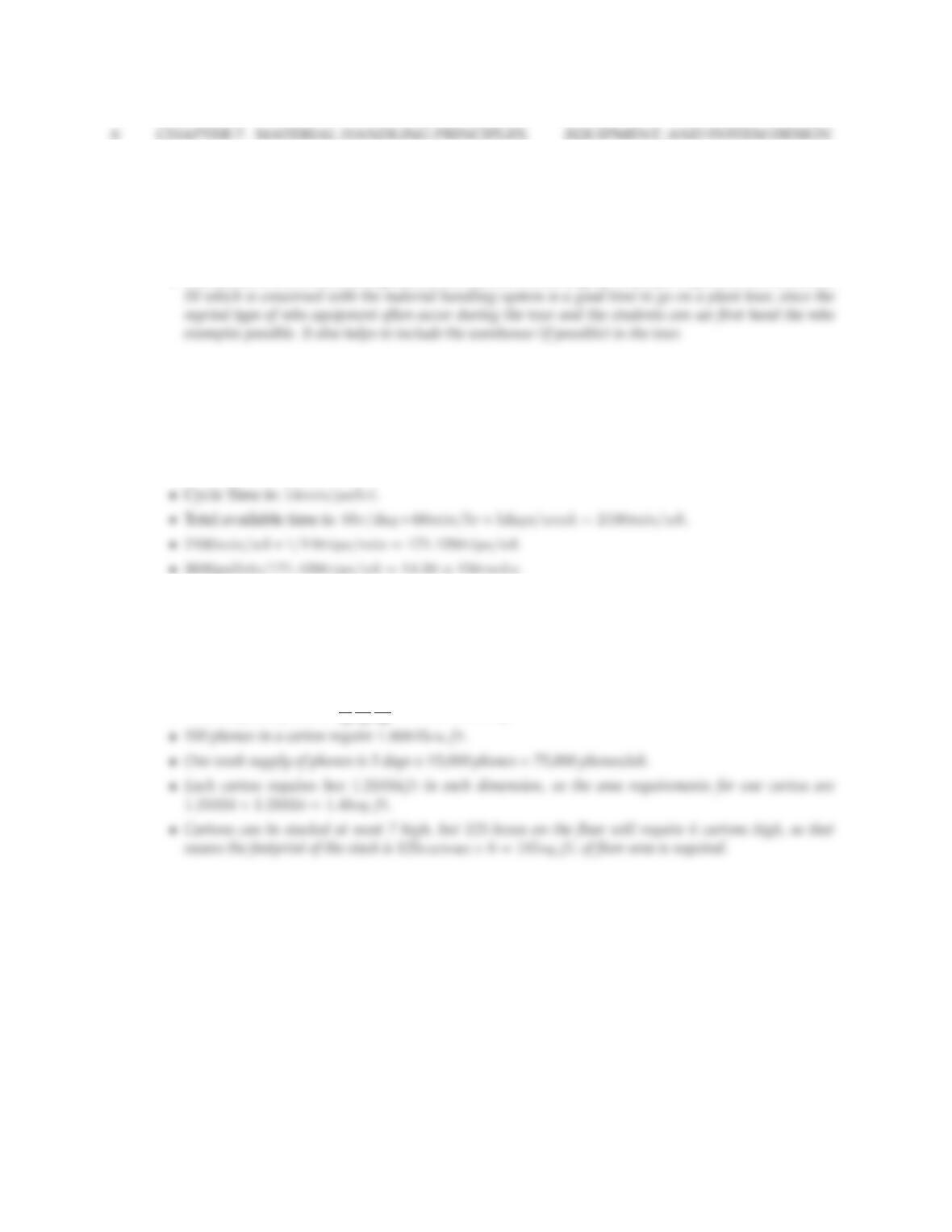
•Volume of each phone is 5
12
2.5
12
2.5
12 = 0.0180845cu.ft.