CHAPTER 6
1. What is decision-making? Why decision-making is important in systems engineering?
1) The resources involved in systems design are always limited. One of the most important
2) System engineering design process itself is an iterative decision-making process. Systems
engineers make decisions for a living: from the development of the requirements,
2. What are the elements for decision-making? Give a decision-making example and specify
1) Has a goal
3. What are the basic steps involved to make a decision?
1) Identify the problem, outline the goals to achieve; these goals serve as criteria for
3) Based on the data collected, generate the alternatives to achieve the goals. An alternative
is a candidate solution for the problem;
5) Evaluate the alternatives using the model. Based on the decision criteria, the best
4. Discuss why using model is important for solving decision-making problems.
Decision-making usually involves complexity and uncertainty; often it is not feasible to
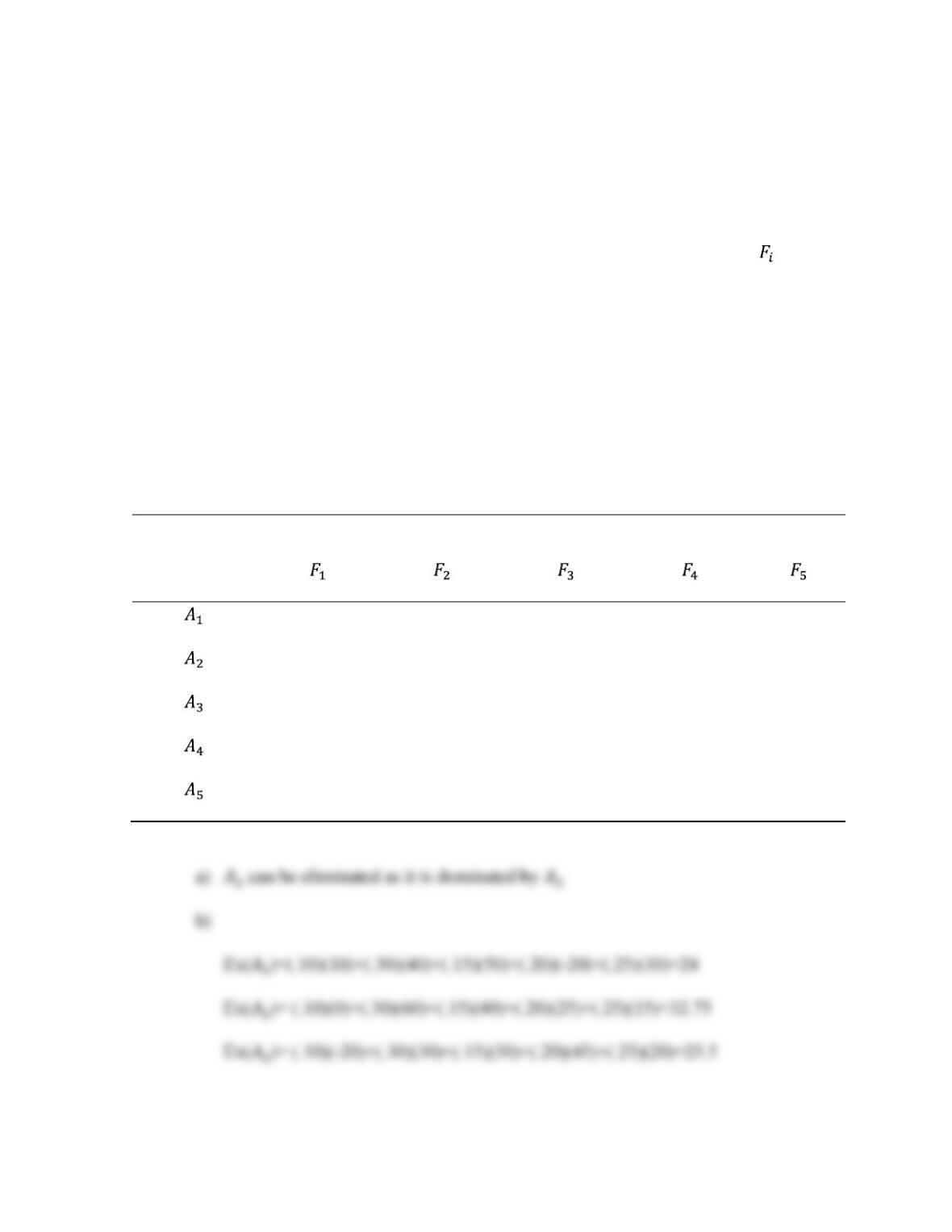
5. A company is trying to determine what project of the five potential ones to bid on in
order to maximize the profit. The payoff matrix is illustrated as follows (in thousands
dollars). The probabilities for the possible futures are shown above each future in
parenthesis.
From the above payoff matrix, find
a) Which alternative is being dominated so that it can be eliminated from the list?
b) What alternative should be chosen if we use expected value criterion?
(.10) (.30) (.15) (.20) (.25)
10 40 50 -20 30
0 60 40 25 15
-20 30 30 45 20
20 50 10 50 35
-15 20 35 15 10
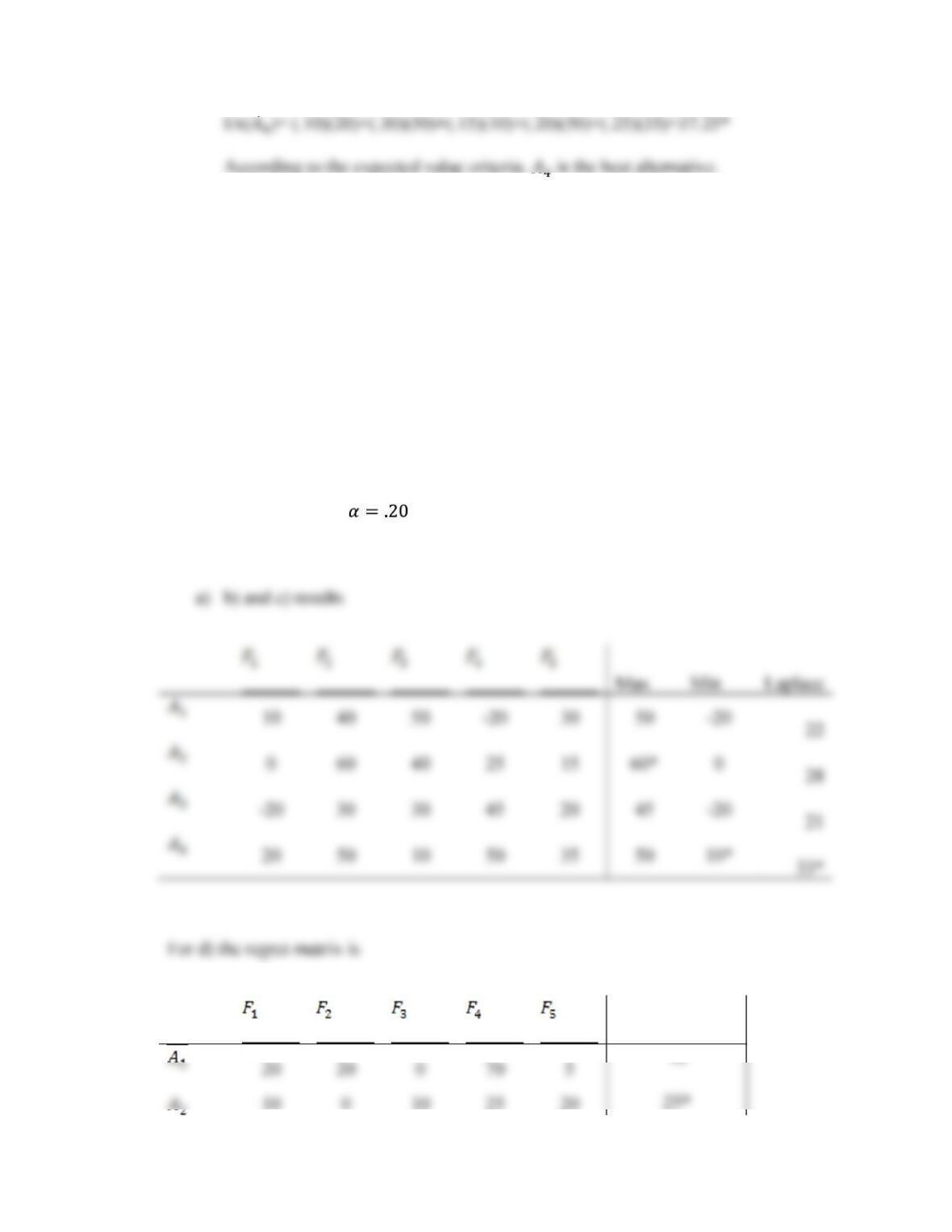
6. Based 5), if the probabilities for all the five futures are not known, what alternative shall
be chosen based on
a) Maximax criterion
b) Maximin criterion
c) Laplace criterion
d) MiniMax regret criterion
e) Hurwicz criterion if
Max regret
7. What is utility? Why utility theory is used to assess human decision-making behavior?
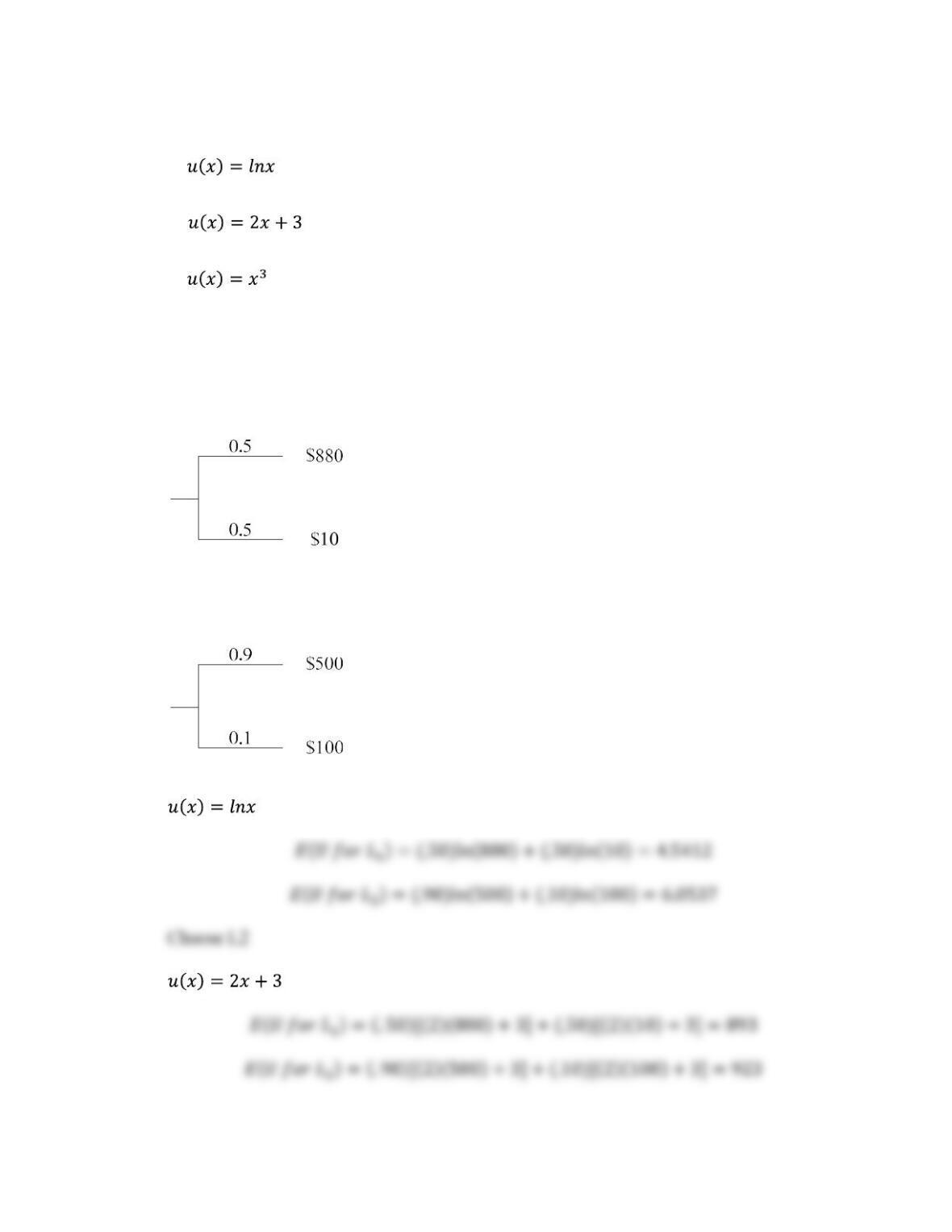
8. If my utility function is
a)
b)
c)
How would choose between the following two lotteries?
1
L
And
2
L
a)
b)
c)
9. For 7 a), b) and c. Am I risk seeking, risk neutral or risk adverse person?
10. The Human Factors and Systems (HFS) department is trying to determine which of two
Printers to purchase. Both machines will satisfy the department’s needs.. Machine 1 costs
$1500 and has a warranty contract, which, for an annual fee of $120, covers all the
repairs. Machine 2 costs $2000, and its annual maintenance cost is a random variable. At
present time, the HFS department believes there is a 30% chance that the annual
maintenance cost for machine 2 will be $50, a 30% chance it will be $100 and a 40%
chance it will be $150. Before the purchase decision is made, the department can have a
certified technician to evaluate the quality of machine 2. If the repairer believes that
machine 2 is satisfactory, there is a a 70% chance that its annual maintenance cost will be
$50, and a 30% chance it will be $100; if the repairer believes that machine 2 is
unsatisfactory, there is a 20% chance that the annual maintenance cost will be $50, a 50%
chance it will be $100 and a 30% chance it will be $150. Currently it is expected that
there is a 50% chance that the technician will give a satisfactory report, and the repairer
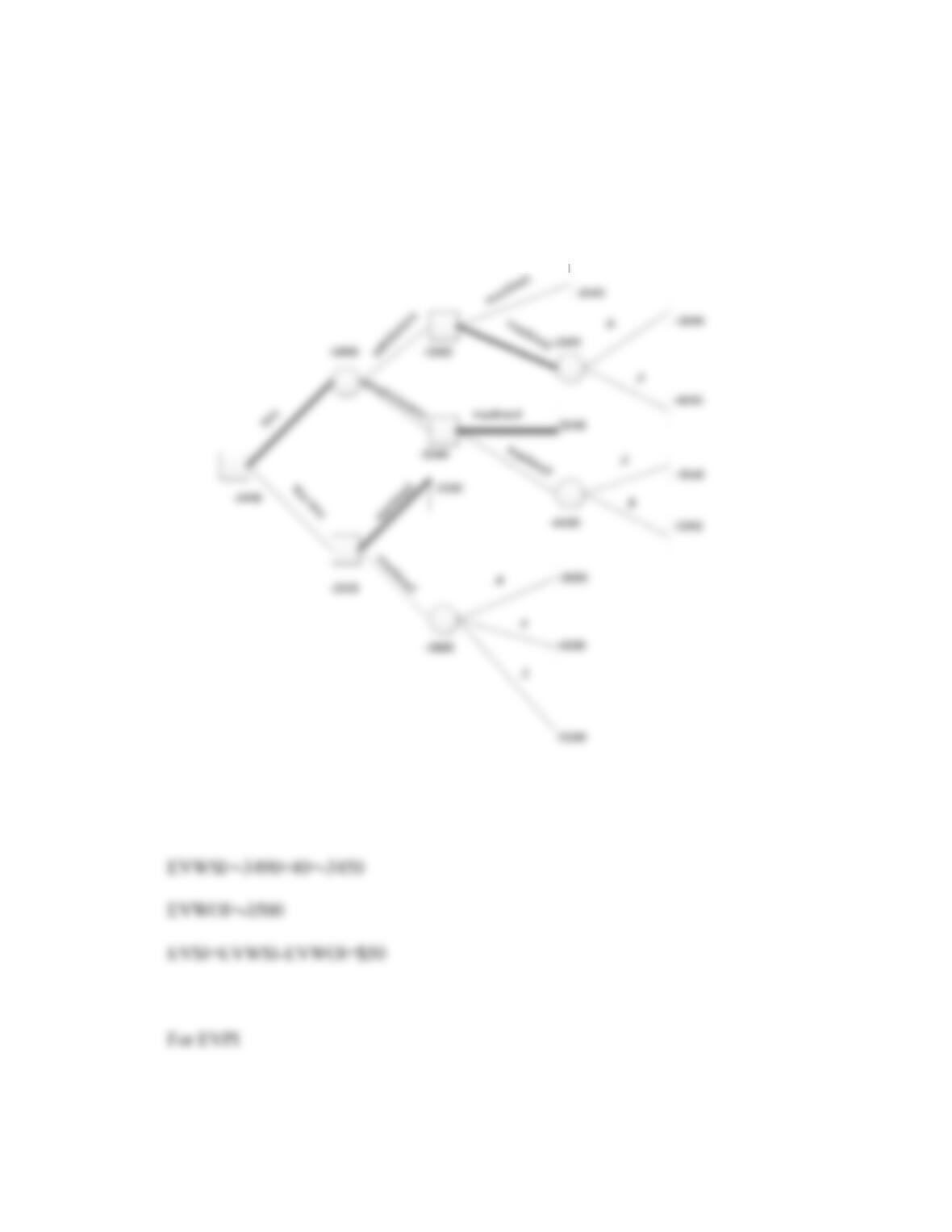
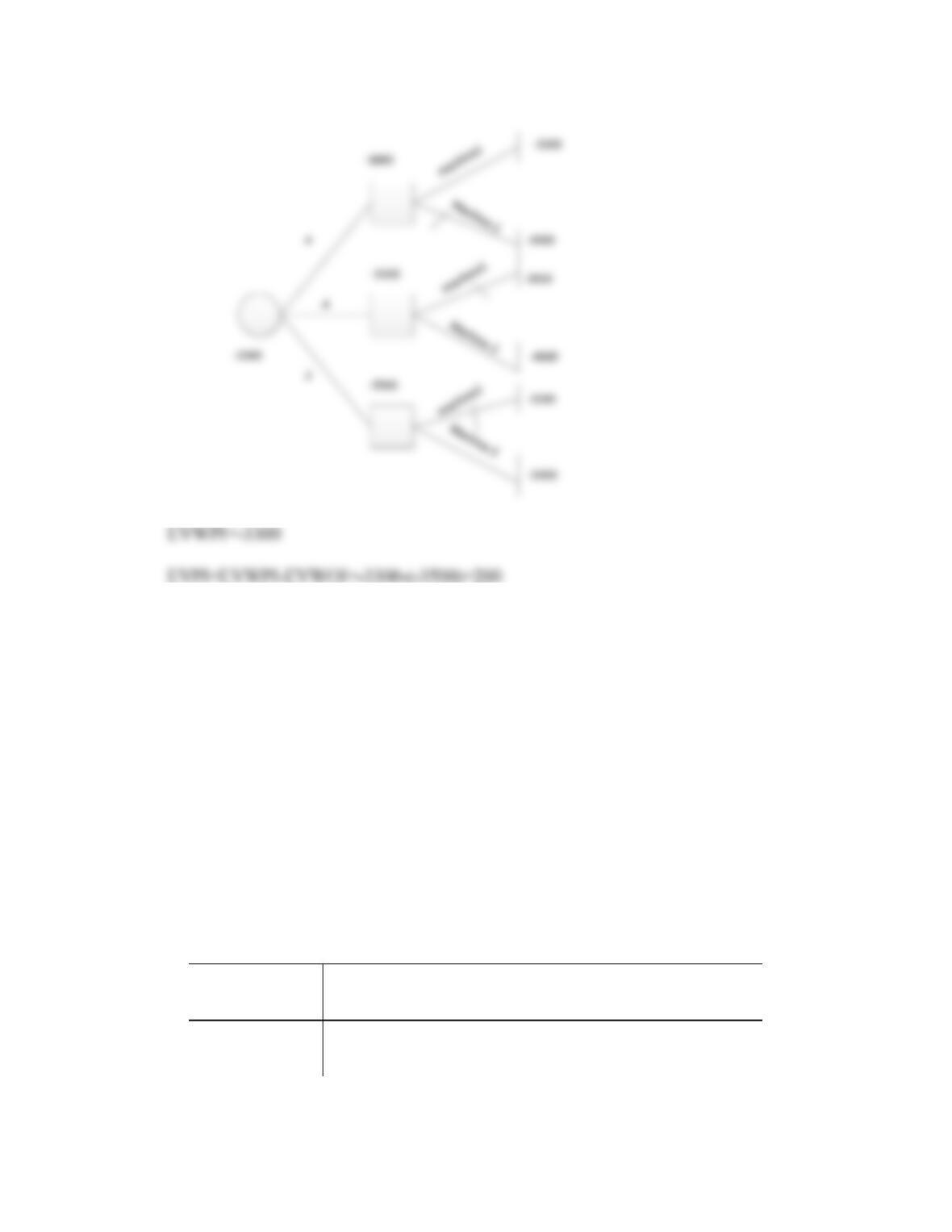
will charge $50, what should HFS department do? What is EVSI and EVPI? Construct a
decision tree to help HFS find the solution.
Decision tree
Hire the repairman.
11. The human factors department at HFS Corp is trying to hire a regional manager for its
newly opened branch in Daytona Beach, Florida. Based on the job duties and description,
the hiring team has determined to use the following 4 criteria to make the selection:
Educational background (EB), prior experience (PE), reference and recommendation (RR)
and long term career goal (CG). Since these criteria are not equally important to the job,
the hiring team has made a pairwise comparison, as shown in the following matrix
EB PE RR CG
EB 1.0 1/2 3.0 2.0

PE 21.0 5.0 3.0
RR 1/3 1/5 1.0 1.0
CG 1/2 1/3 1.0 1.0
After screening a pool of applicants, the hiring team has narrowed down to three
candidates, Joe, Mike and Anne. Based on the four criteria, the hiring team made a
pairwise comparison matrix for each of the hiring criteria among the three candidates. For
EB,
EB Joe Mike Anne
Joe 1.0 5 8
Mike 1/5 1.0 3
Anne 1/8 1/3 1.0
For PE
PE Joe Mike Anne
Joe 1.0 1/4 1/2
Mike 41.0 3
Anne 2 1/3 1.0
For RR
RR Joe Mike Anne
Joe 1.0 1/2 1/4
Mike 21.0 1/3
Anne 4 3 1.0
For CG
RR Joe Mike Anne
Joe 1.0 2 1/3
Mike 11.0 1/7
Anne 3 7 1.0
Using AHP to help the hiring team to decide which candidate to hire. Check the
consistency for each of the matrix.
Solution:
The normalized Criteria matrix and weights are
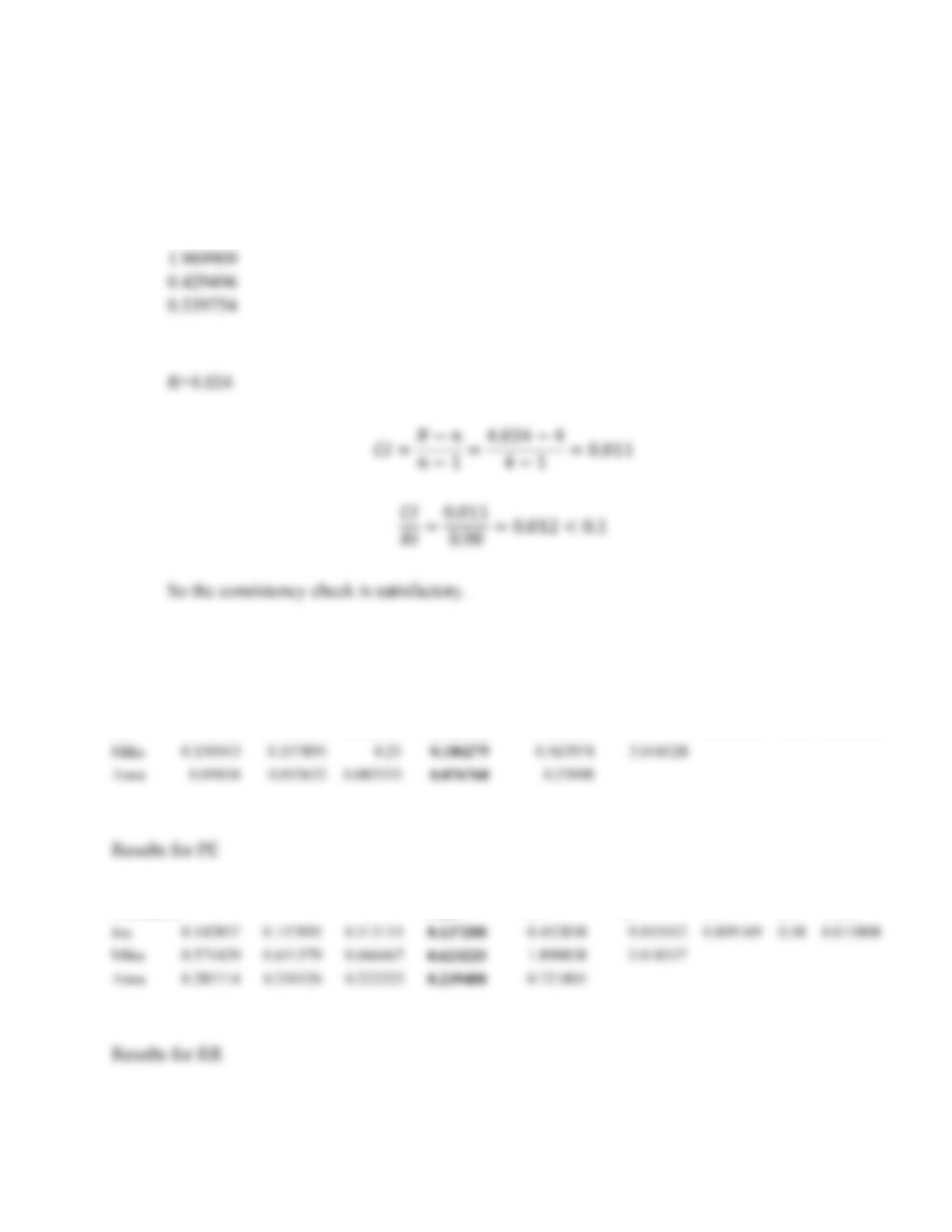
Consistency Check:
AW:
1.10563
Results for EB
Nomalized weight AW R CI RI CI/RI
Joe 0.754717 0.789474 0.666667 0.736952 2.282495 0.022264 0.58 0.038386
Nomalized weight AW R= CI RI CI/RI
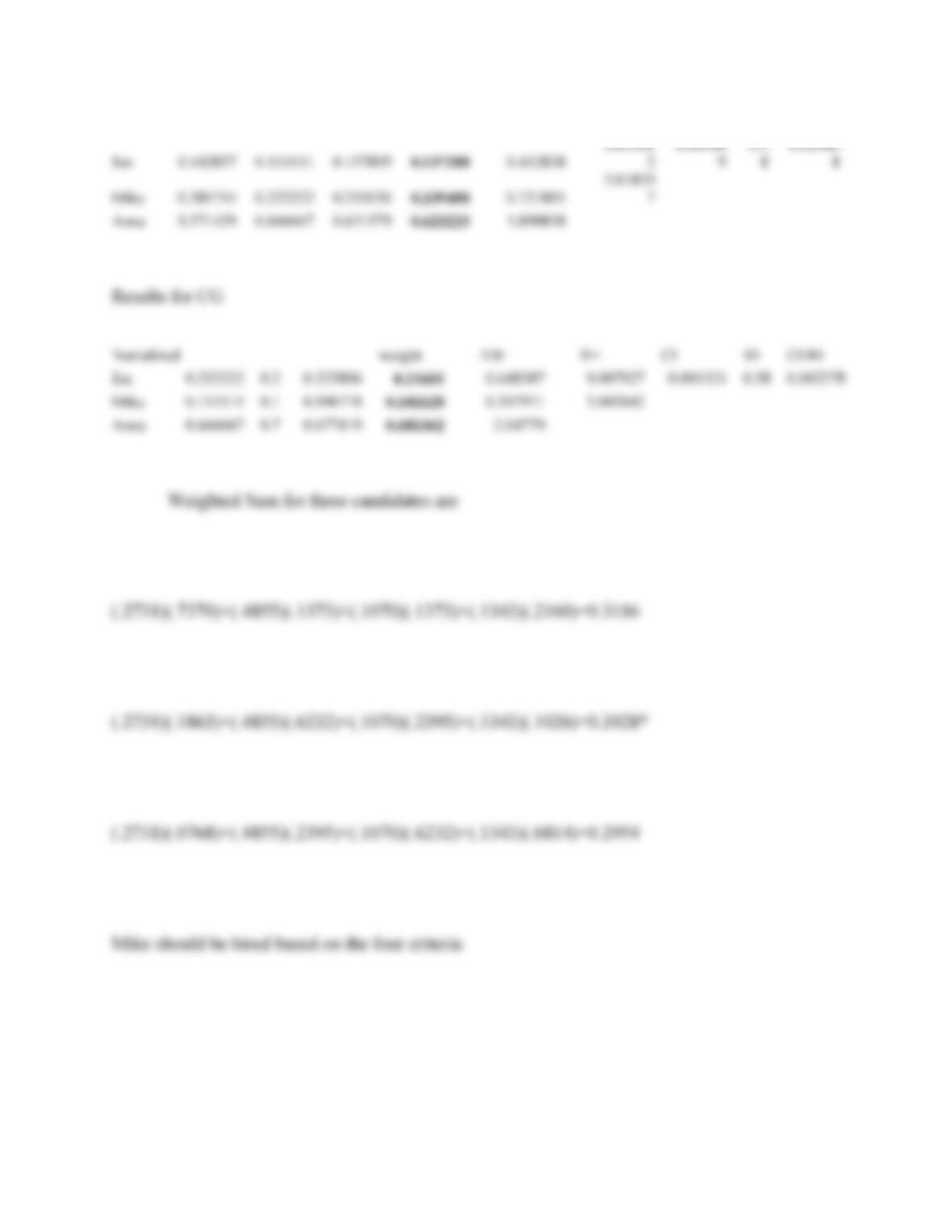
Nomalized weight AW R= CI RI CI/RI
Joe
Mike
Anne