CHAPTER 4
INTRODUCTION TO CONTROL LOOPS
LEARNING OBJECTIVES
• Identify the five elements of a control loop.
• Draw a level control loop.
• Draw a pressure control loop.
• Draw a flow control loop.
• Draw a temperature control loop.
• Draw an analytical control loop.
• Describe the various controller modes; rate reset, proportional and how each
compliments the other.
• Describe manual, automatic, and cascade control features.
REVIEW QUESTIONS
1. List the instruments found in the processing industry.
There are hundreds of instruments used by the chemical processing industry.
These are primarily used to illuminate the following variables; pressure,
temperature, flow, level, and analytical variables. The basic instruments in a
control loop include:
a. primary elements or sensors
b. transmitter
A differential pressure cell is classified as an instrument called a transmitter.
3. What is a rotameter used for?
4. List the basic elements of a control loop.
The basic elements of a control loop include:
5. How does a process technician operate a control loop?
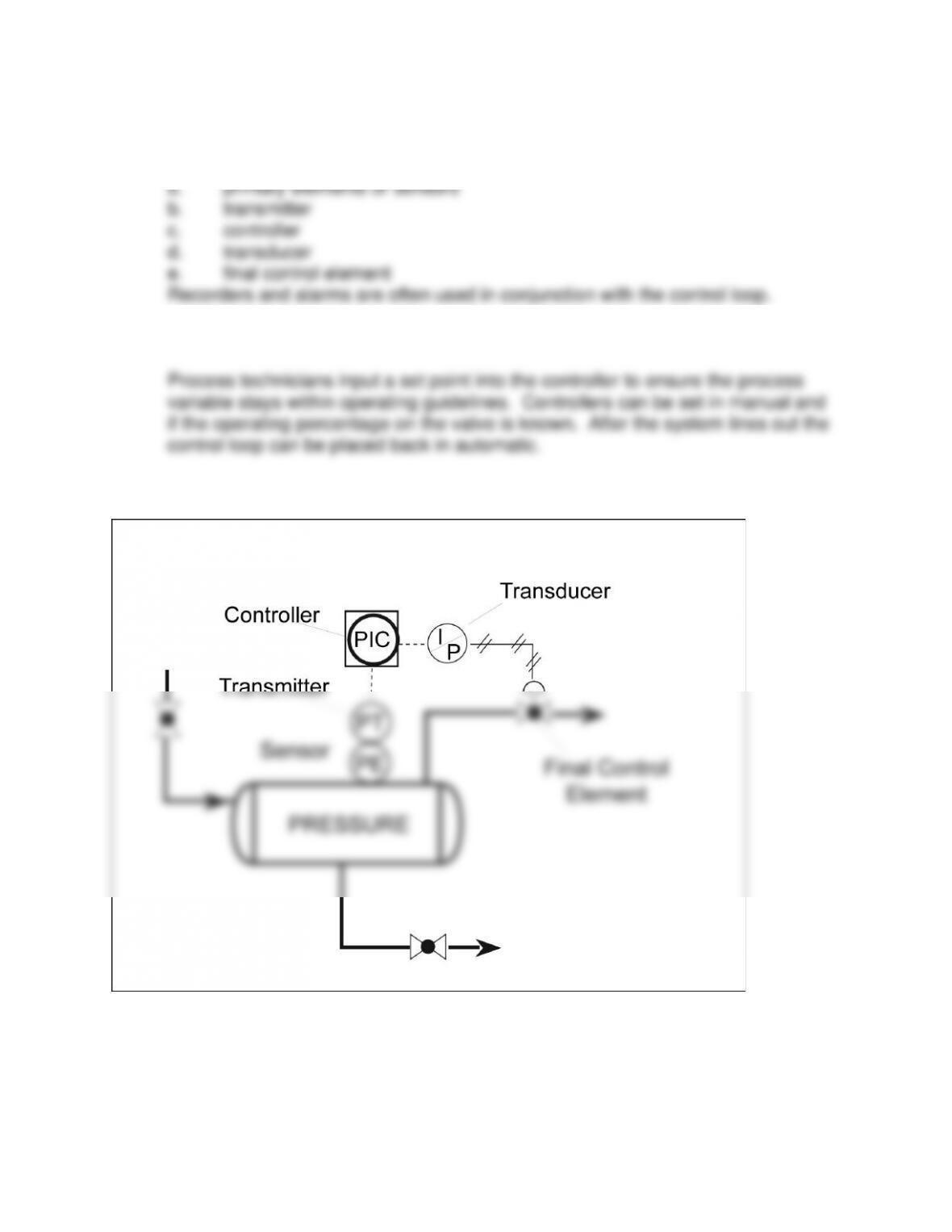
6. Draw a pressure control loop.
Pressure control loop
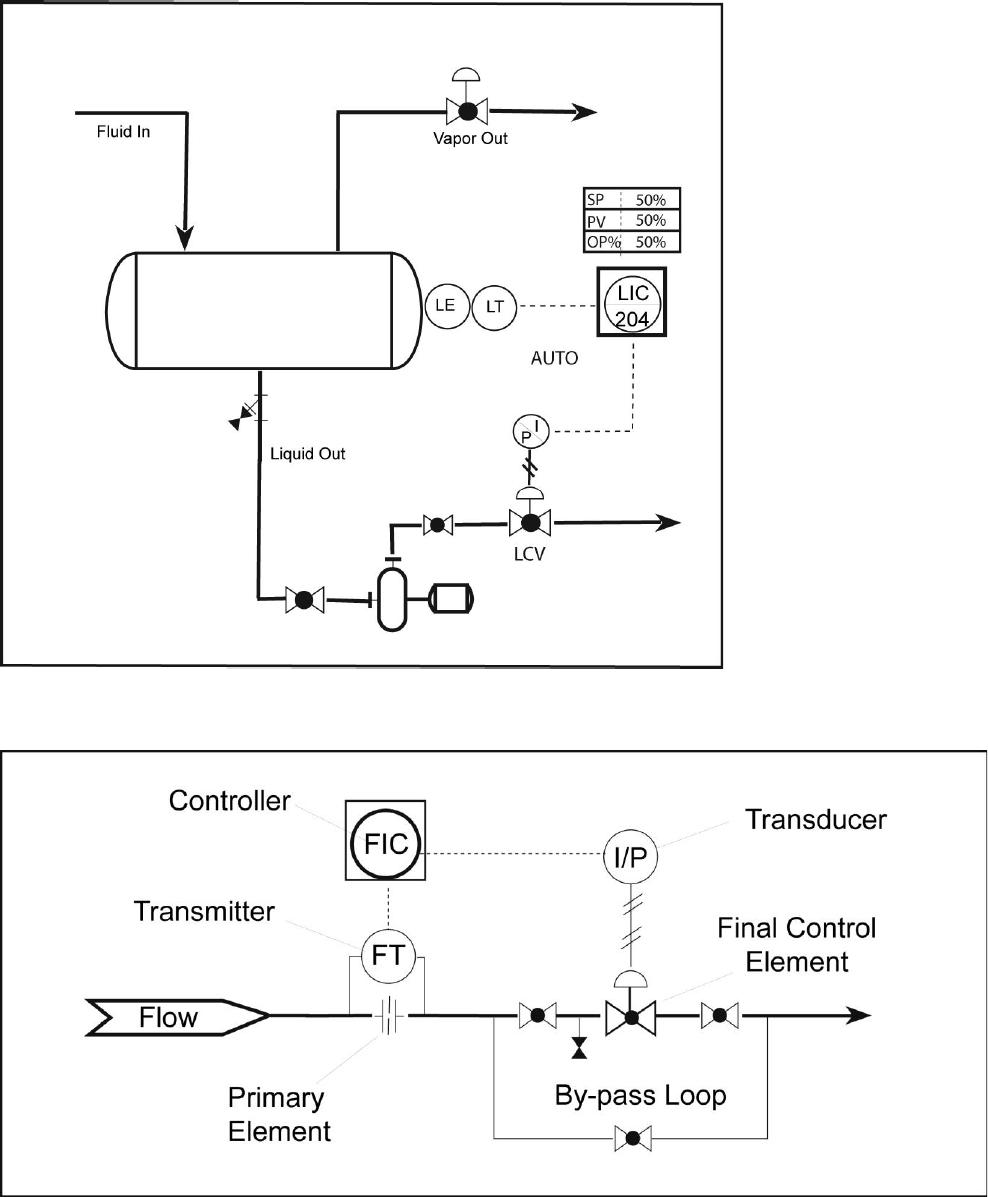
7. Draw a level control loop.
Level control loop
8. Draw a flow control loop.
Flow control loop
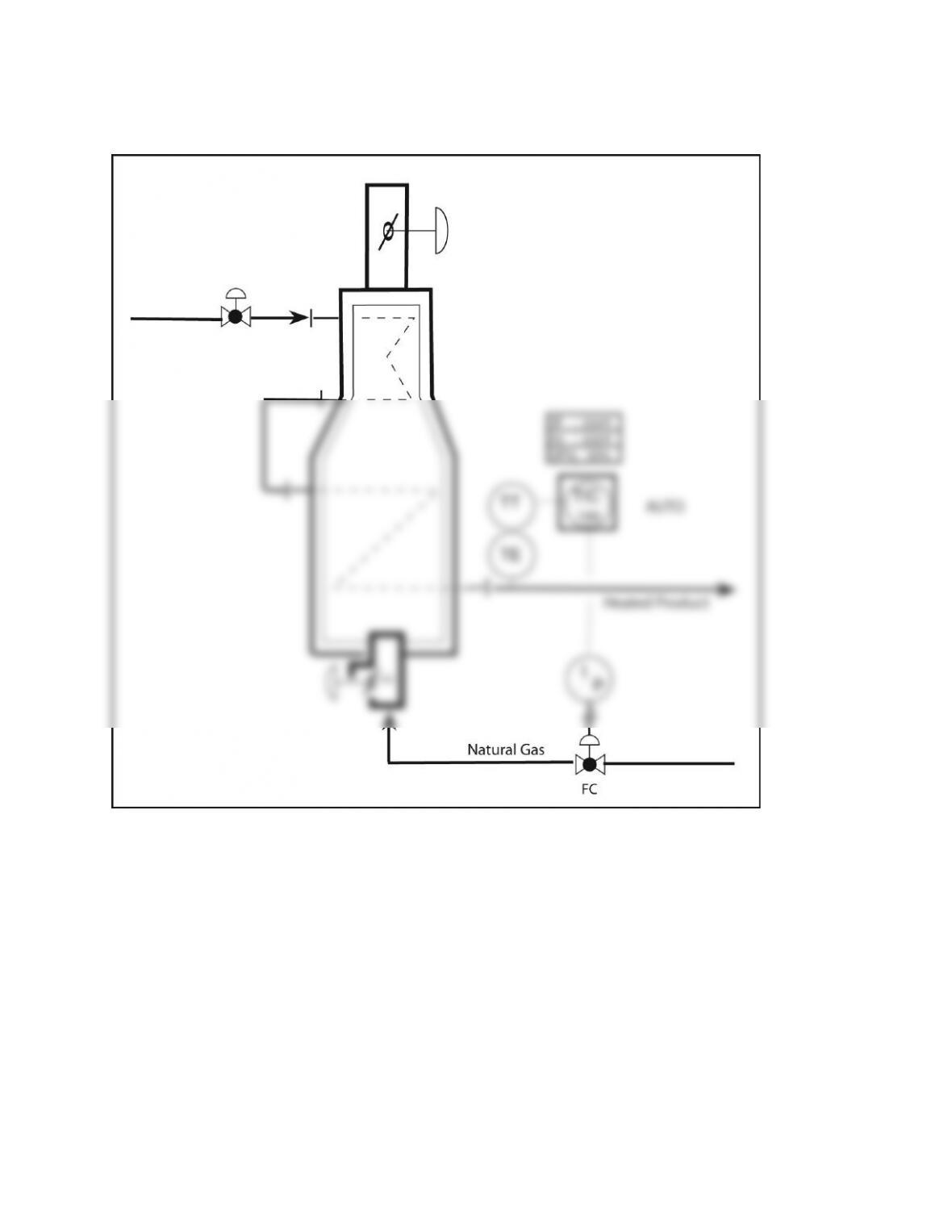
9. Draw a temperature control loop.
Temperature control loop
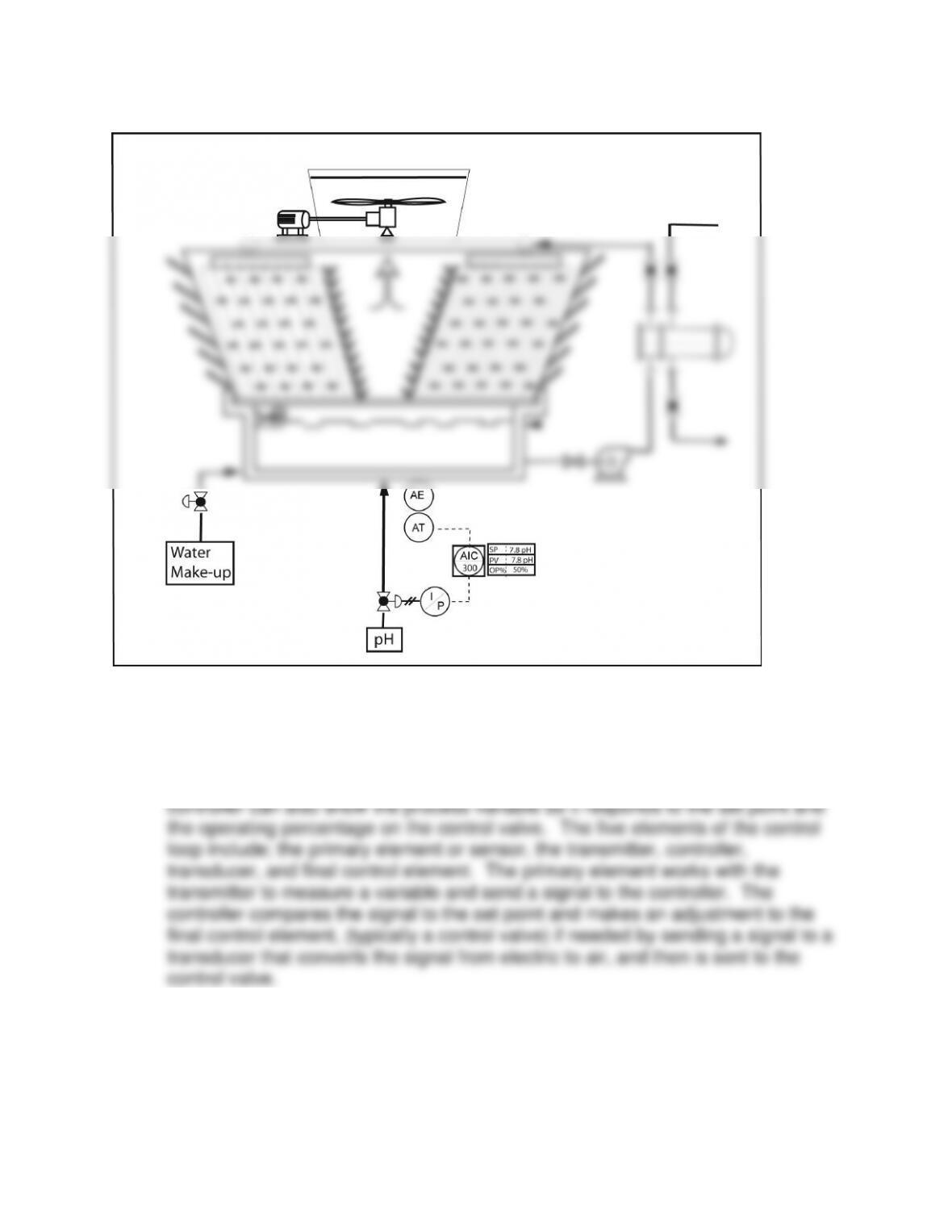
10. Draw an analytical control loop.
Analytical control loop
11. How do the basic elements of a control loop work together.
There are five different parts of a control loop. The heart of the control loop is the
controller. A controller has a set point that is set by a process technician. The
12. Describe controllers and control modes.
Controllers and Control Modes
The primary purpose of a controller is to receive a signal from a transmitter,
Controller modes– include proportional P, proportional plus integral PI,
proportional plus derivative PR, and proportional-integral-derivative PID.
13. List the primary elements and sensors used with temperature and pressure.
The primary elements and sensors associated with temperature are:
• thermocouple
The primary elements and sensors associated with pressure are:
• Manometers
• C-shaped bourdon tube
• Spiral bourdon tube
14. List the primary elements and sensors used with level and flow.
The primary elements and sensors associated with flow include:
• Orific plate
– Concentric
– Eccentric bore off center orifice plate
• Mass flow meters
• Differential pressure transmitters
• Integral orifice flow meter
• Venturi tubes
• Vortex flow meters
15. How are analyzers used to control product composition?
16. What is the difference between J and K type thermocouples.
Thermocouples are temperature-measuring devices that are composed of two
different types of metal. A thermocouple is designed to convert heat into
17. Describe the following terms, pressure indicator, flow indicator, level indicator,
temperature indicators.
A pressure indicator is typically a gauge that is used to indicate pressure. These
gauges have a variety of designs including; bourdon tube, helical, spiral, and bellows.
Flow control primary instruments include; orifice plates, flow nozzles, pitot tubes,
annubar pitot, magmeters, turbine meters, mass flow meters, nutating disks, oval
gear, venturi tubes, vortex meters, target flow meters, and integral orifice flow
18. Describe computer-based control and control loops.
Today modern process has virtually no lag time and can operate facilities from a
19. Define the term DCS.
Distributive control systems combine some of the most innovative technologies
20. Define the term PLC.
A programmable logic controller is a modern control system that combines
microprocessor features with software configurable controllers. The basic

NAME:____________________________ TEST A
DATE:____________________________
CHAPTER FOUR
TEST INTRODUCTION TO CONTROL LOOPS
1. Draw a level control loop.
2. Draw a flow control loop.
3. Draw a pressure control loop.
4. Draw a temperature control loop.
5. Draw an analytical control loop.
6. Cascade control is best described as:
a. a collection of instruments that work together to automatically control a
process
b. enhances controller output by increasing the output in relationship to the
changing process variable.
c. describes the scaling factor used to take a controller from 0% to 100%
output.
d. a term used to describe how one control loop controls or overrides the
instructions of another control loop in order to achieve a desired set point.
7. The proportional band on a controller:
a. is designed to reduce the difference between the set point and process
variable by adjusting the controllers output continuously until the offset is
eliminated.
b. describes the scaling factor used to take a controller from 0% to 100%
output.
c. is the difference ∆ between the upper and lower range limits.
d. is defined as the portion of the process controlled.
8. Range is defined as:
a. the portion of the process controlled by the controller.
b. the difference ∆ between the upper and lower range limits.
c. is designed to reduce the difference between the set point and process
variable by adjusting the controllers output continuously until the offset is
eliminated
d. enhances controller output by increasing the output in relationship to the
changing process variable.
9. Span is defined as:
a. enhances controller output by increasing the output in relationship to the
changing process variable.
b. the difference ∆ between the upper and lower range limits.
c. is designed to reduce the difference between the set point and process
variable by adjusting the controllers output continuously until the offset is
eliminated
d. the portion of the process controlled by the controller.
10. The rate or derivative mode:
a. is designed to reduce the difference between the set point and process
variable by adjusting the controllers output continuously until the offset is
eliminated
b. the amount of material that passes by the internal elements.
c. enhances controller output by increasing the output in relationship to the
changing process variable.
d. the difference ∆ between the upper and lower range limits.
11. List the five parts of a control loop.
a.
b.
c.
d.
e.
12. List he various controller modes described in this chapter.
a.
b.
c.
d.
13. When a process technician first starts up a unit, he/she will typically set the
controller in:
a. AUTO
b. MANUAL
c. CASCADE
14. When a process technician wants a control loop to keep the process near the
actual set point, he/she will set the controller in:
a. AUTO
b. MANUAL
c. CASCADE
15. When a primary controller takes over a secondary controller it is referred to
as a _____________________ .