CHAPTER 3
UNDERSTANDING PROCESS EQUIPMENT
LEARNING OBJECTIVES
• Identify and describe the valves used in industry.
• Describe the various types of storage and piping used in the chemical
processing industry.
• Identify the operation and primary components of a centrifugal pump.
• Explain the operation and types of positive displacement pumps.
• Describe dynamic and positive displacement compressors.
• Describe how a steam turbine works.
• Describe the purpose of seals, bearings and lubrication.
• Describe the major components and operation of the various types of heat
exchangers.
REVIEW QUESTIONS
1. Describe the purpose of valves in industrial applications.
2. Describe the basic operation and components of a centrifugal pump.
Centrifugal pumps move liquids trough centrifugal force. The primary
3. Describe how a steam turbine works.
4. Describe the basic operation and components of an electric motor.
5. List the basic tank and storage designs.
6. List the components for a simple shell and tube heat exchanger and explain it’s
primary operation.
7. List the components for a cooling tower and explain it’s primary operation.
The primary purpose of a cooling tower is to cool water. The basic
8. List the basic components of a boiler and explain it’s primary purpose.
The primary purpose of a boiler is to produce steam. The basic
9. List the basic components of a furnace and explain it’s primary purpose.
A furnace is designed to heat up large quantities of hydrocarbons. The
10. Describe how a typical distillation column works.

11. What are the basic components of a stirred reactor and explain how it
works.
A stirred reactor is designed to enhance molecular contact to make, break,
NAME:____________________________
DATE:____________________________
CHAPTER THREE
TEST UNDERSTANDING PROCESS EQUIPMENT
1. Name the primary difference between a pump and a compressor.
a. Compressors use steam turbines vs. electric motors
b. Pumps transfer fluids, compressors transfer gases.
c. Pumps are smaller than compressors.
d. Compressors transfer gases, pumps transfer liquids.
2. The primary purpose of a valve is.
a. Direct the flow of fluid.
b. Block in and isolate equipment.
c. Stop the flow of fluid.
d. Start the flow of fluid.
3. Explain how a centrifugal pump operates.
a. Positively displaces fluid with a reciprocating motion.
b. Spins liquid from the suction eye into a volute.
c. Positively displaces liquid with a rotary motion.
d. Dynamically spins liquid axially into discharge.
4. What is the purpose of a steam turbine?
a. Produce high pressure steam.
b. Produce low pressure steam.
c. Provide rotational energy to a pump, compressor, or generator.
d. Convert high pressure steam into condensate.
5. The basic principles that allow an electric motor to operate include all of the
following except:
a. electric current creates a magnetic field.
b. magnetic poles attract and repel each other.
c. electric current closes the magnetic field.
d. current direction determines the magnetic poles.
6. What is the purpose of a fired heater?
a. Heat large quantities of hydrocarbons for commercial use.
b. Steam generation for commercial use.
c. Provide heat during winter months for control rooms.
d. Burn excess hydrocarbons safely and efficiently.
7. Explain the operation of a positive displacement pump.
a. accelerates a specific volume of liquid through centrifugal force.
b. uses a combination of displacement and centrifugal force to move
liquid.
c. displaces a specific volume of liquid on every stroke or rotation of the
transfer element.
d. axial movement that displaces a specific volume of liquid.
8. What is the primary purpose of a stirred reactor?
a. blend chemicals into a homogenous mixture using a catalyst.
b. provide stirring action to create molecular friction.
c. to heat or cool a chemical mixture.
d. to mix two or more chemicals under specific conditions to make or
break chemical bonds.
9. What is the primary purpose of a boiler?
a. Heat large quantities of hydrocarbons for commercial use.
b. Steam generation for commercial use.
c. Provide heat during winter months for control rooms.
d. Burn excess hydrocarbons safely and efficiently.
10. What is the purpose of a cooling tower?
a. Cool hydrocarbons and excess vapors
b. Emergency quench cooling for reactors
c. Provide cooling during summer months for control rooms.
d. Cool water for industrial applications.
11. What is the definition of a distillation column?
a. a cylindrical tower that uses trays or packing to provide a contact
point between vapors and liquid to separate the components in a
mixture by boiling point.
b. a mechanical device designed to accelerate or compress gases.
c. a cylindrical tower filled with a porous medium to separate
components in a mixture.
d. an energy transfer device designed to transfer heat energy between
the components in a mixture.
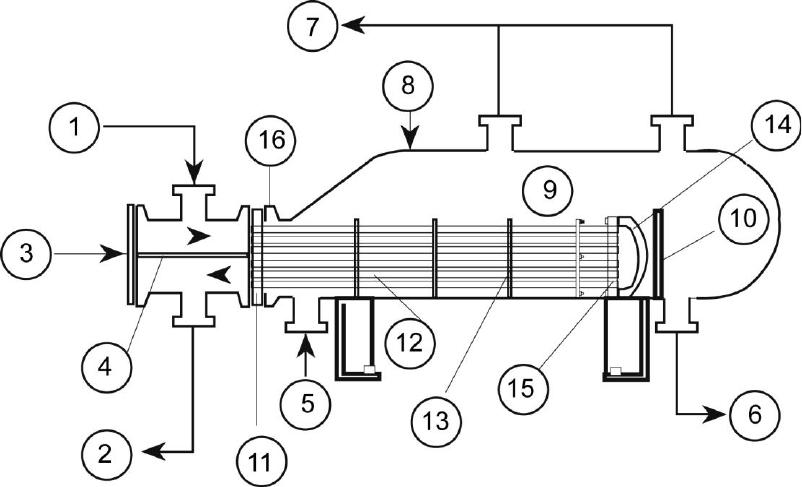
12. Identify the major components of a kettle reboiler.
Kettle reboiler components
12-1__________ 12-2__________ 12-3__________ 12-4__________
12-5__________ 12-6__________ 12-7__________ 12-8__________
12-9__________ 12-10__________ 12-11__________ 12-12__________
12-13_________ 12-14__________ 12-15__________ 12-16__________
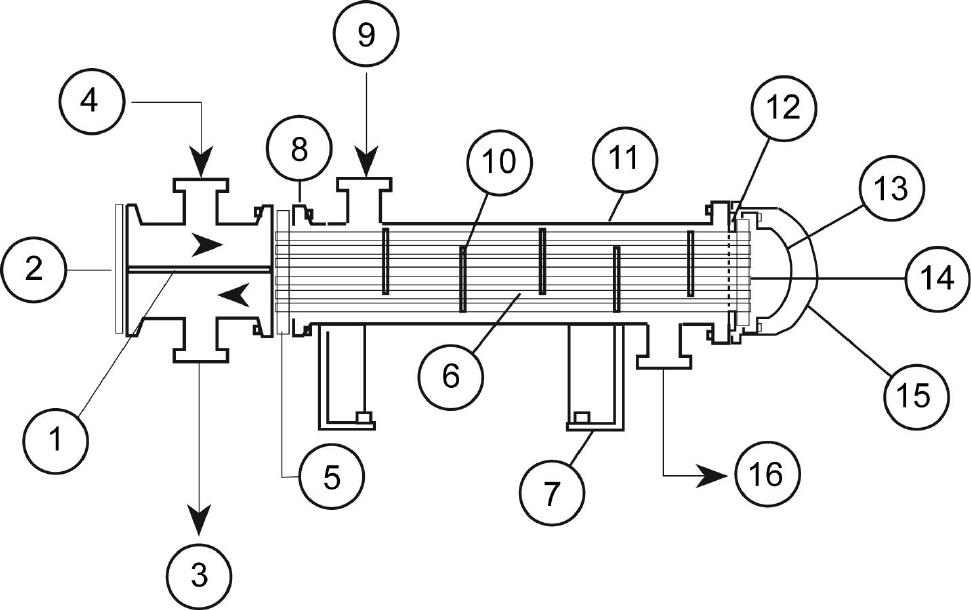
13. List the parts of a floating head heat exchanger.
Floating head heat exchanger components
13-1__________ 13-2__________ 13-3__________ 13-4__________
13-5__________ 13-6__________ 13-7__________ 13-8__________
13-9__________ 13-10__________ 13-11__________ 13-12__________
13-13__________ 13-14__________ 13-15__________ 13-16__________
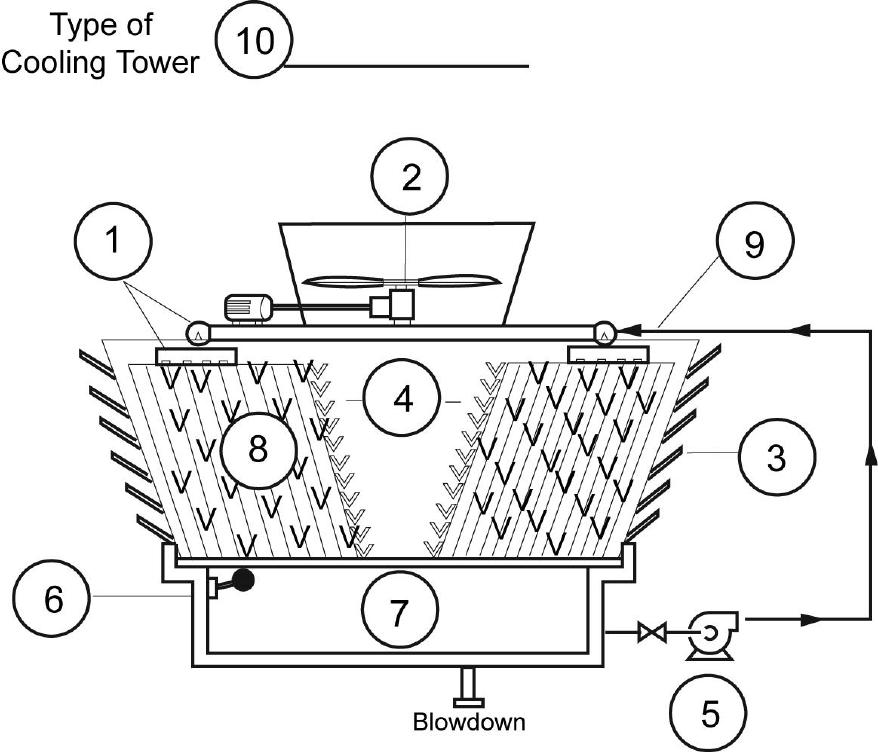
14. Identify the following components:
Cooling tower components
14-1_______________ 14-2________________ 14-3______________
14-4_______________ 14-5________________ 14-6______________
14-7_______________ 14-8________________ 14-9______________
14-10______________
15. On a boiler the inlet line to the lower (drum)header is called the.
a. downcomer
b. riser
c. steam generating tube
d. desuperheated tube
16. As steam flows from the boiler to the plant it begins to cool. When steam
cools it forms _______________ .
17. A section of the boiler utilized to preheat feed water before it enters the
main boiler system.
a. convection section
b. economizer section
c. radiant tube section
d. shockbank
18. Tubes located above the shock bank:
a. conduction tubes
b. radiant tubes
c. convection tubes
d. bridgewall tubes
19. The sum of the products entering the column equals the sum leaving:
a. energy balance
b. fractional balance
c. material balance
d. total balance
20. The upper section of the tower is referred to as:
a. feed section
b. rectifying section
c. enriching section
d. stripping section
e. b & c
21. The tray located below the inlet feed line is called the:
a. mid section tray
b. pumping section tray
c. feed tray
d. valve tray
22. Condensed tower product that is pumped back into a tower to increase
product purity and control temperature:
a. overlap
b. reflux
c. side-stream
d. accumulation
23. Reaction rates are impacted by:
a. heat and surface area
b. concentration
c. pressure & flow rates
d. all the above
24. How does heat and pressure effect a chemical reaction?
a. enhances
b. slows down
c. no effect
d. a & b
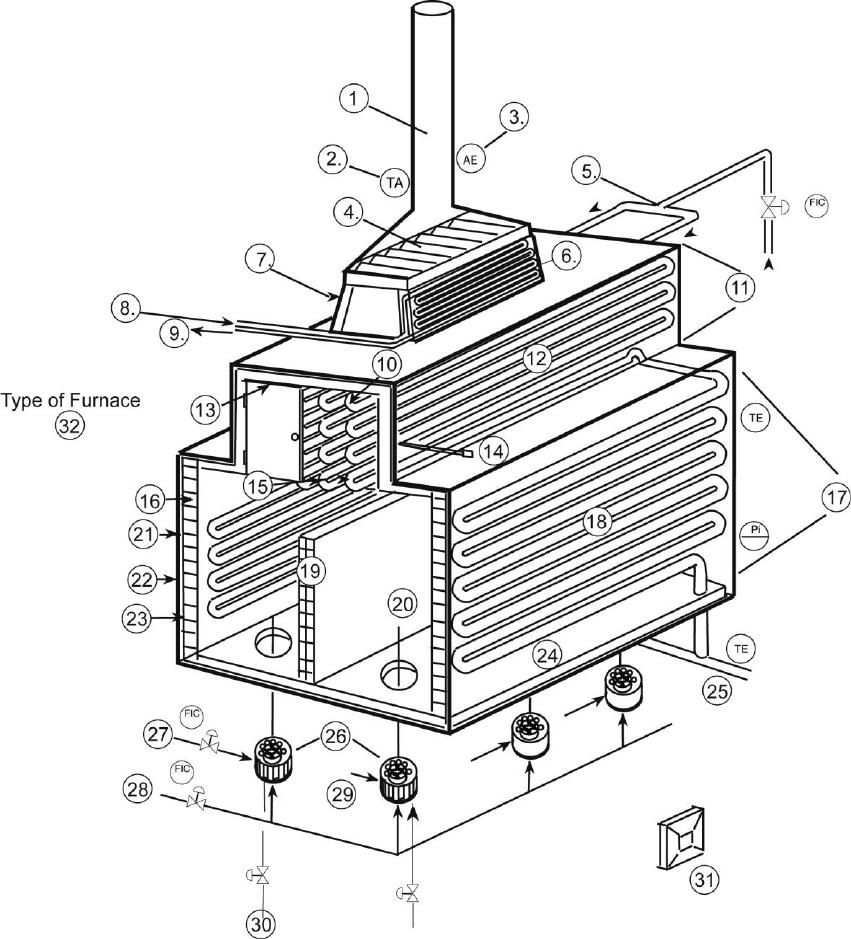
25. Label the following furnace.
Furnace components
25-1 ______________ 25-6 ______________ 25–11 ______________
25-2 ______________ 25-7 ______________ 25–12 ______________
25-3 ______________ 25-8 ______________ 25–13 ______________
25-4 ______________ 25-9 ______________ 25–14 ______________
25-5 ______________ 25–10 ______________ 25–15 ______________
25–16 ______________ 25-22 ______________ 25–28 ______________
25–17 ______________ 25–23 ______________ 25–29 ______________
25–18 ______________ 25–24 ______________ 25–30 ______________
25–19 ______________ 25–25 ______________ 25–31 ______________
25–20 ______________ 25–26 ______________ 25–32 ______________
25–21 ______________ 25–27 ______________
Answer Key CHAPTER 3 UNDERSTANDING PROCESS EQUIPMENT
13–15 shell cover 13–16 shell nozzle outlet
14-8 Fill

20. E
22. B
19 Bridgewall