Applied Statistics and Probability for Engineers, 7th edition 2017
3-1
CHAPTER 3
Section 3-1
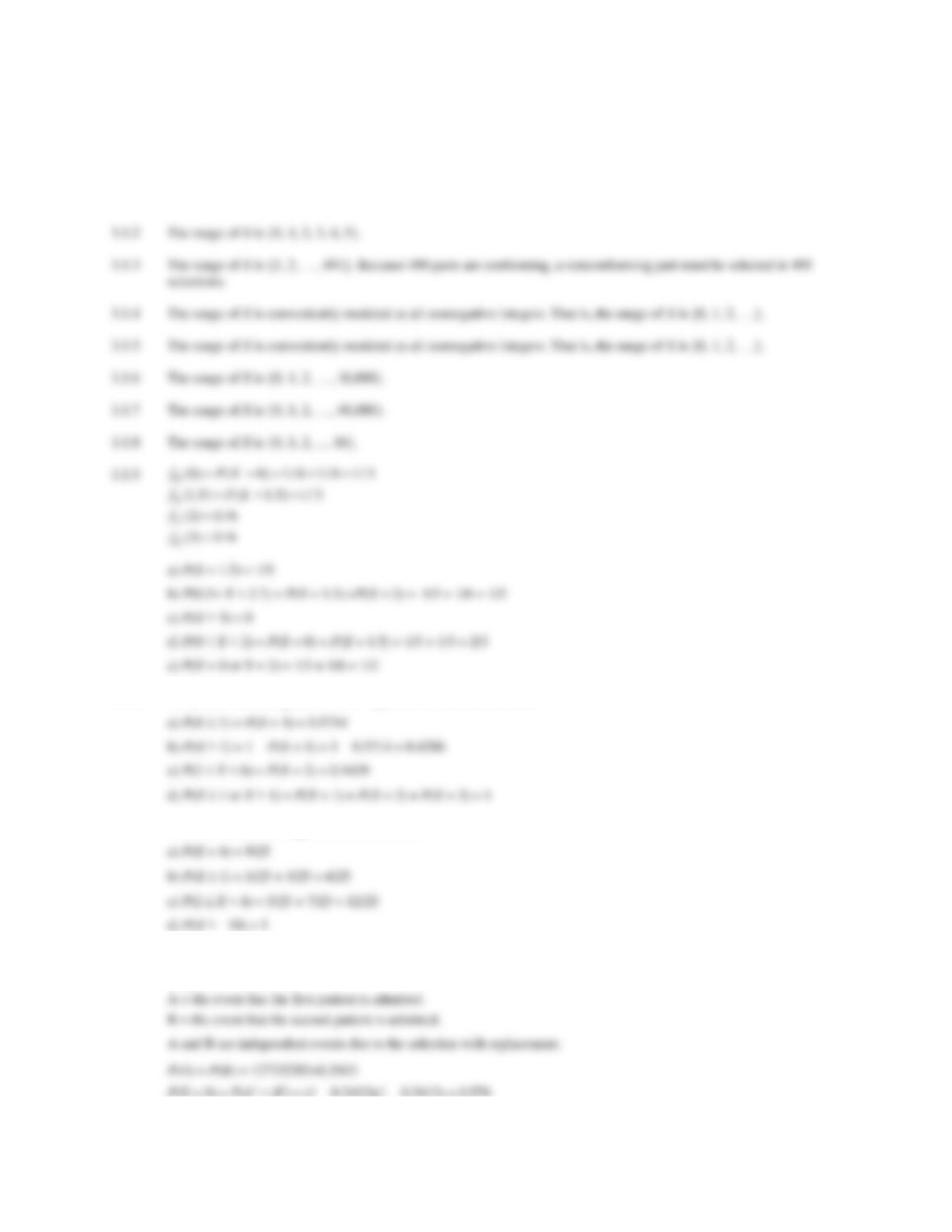
3.1.1 The range of X is {0, 1, 2, …, 1000}.
3.1.10 All probabilities are greater than or equal to zero and sum to one.
3.1.11 Probabilities are nonnegative and sum to one.
3.1.12 X = the number of patients in the sample who are admitted.
Range of X = {0, 1, 2}.
Applied Statistics and Probability for Engineers, 7th edition 2017
3-2
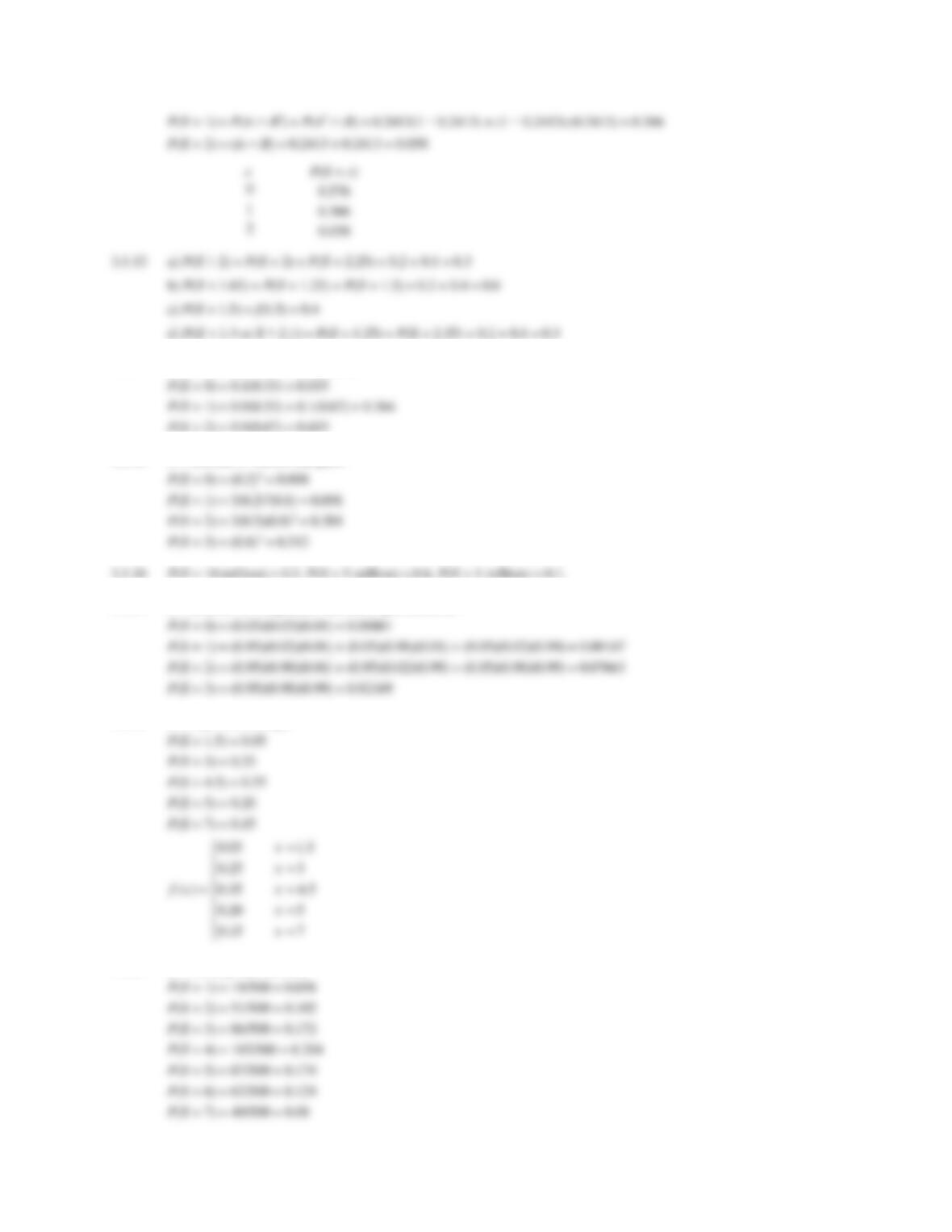
3.1.14 X = number of successful surgeries.
3.1.15 X = number of wafers that pass.
3.1.17 X = number of components that meet specifications.
3.1.18 X = days until change.
3.1.19 X = waiting time (hours).
Applied Statistics and Probability for Engineers, 7th edition 2017
3-3
Section 3-2
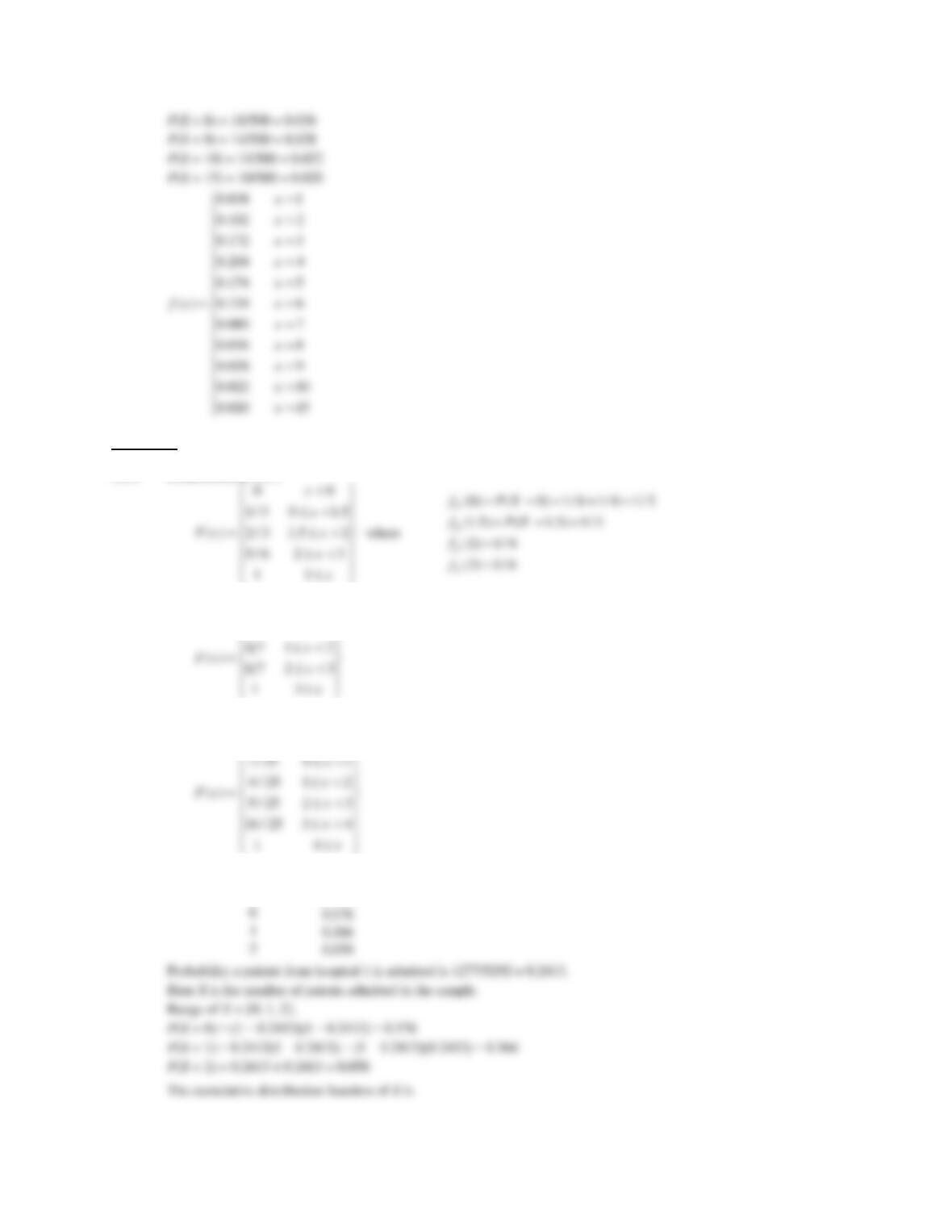
3.2.1 From Exercise 3.1.9
3.2.2 From Exercise 3.1.10
01
x
3.2.3 From Exercise 3.1.11
00
x
3.2.4 From Exercise 3.1.12
x
P(X = x)
Applied Statistics and Probability for Engineers, 7th edition 2017
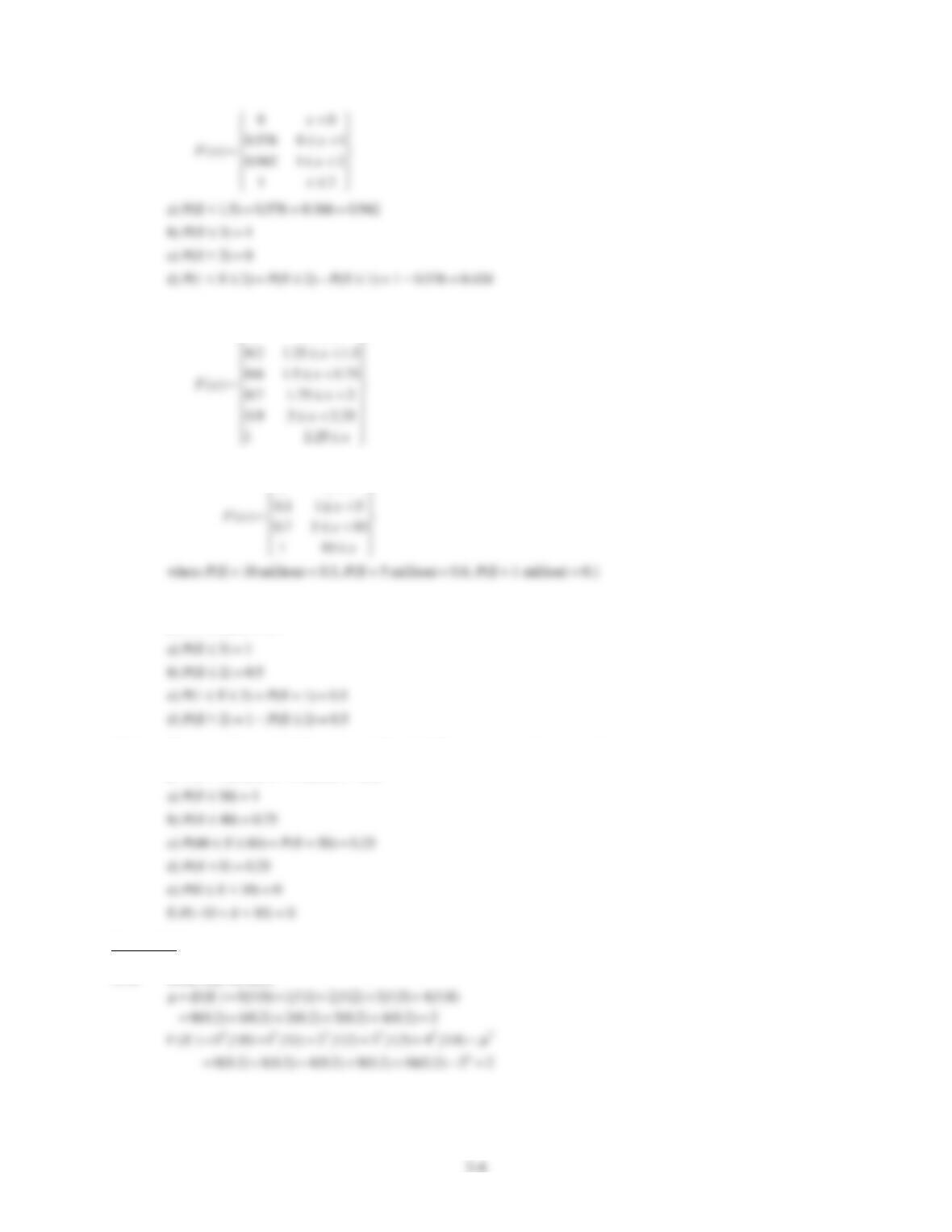
3.2.5 From Exercise 3.1.13
0 1.25
x
3.2.6
01
x
3.2.7 The sum of the probabilities is 1 and all probabilities are greater than or equal to zero.
f(1) = 0.5, f(3) = 0.5
3.2.8 The sum of the probabilities is 1 and all probabilities are greater than or equal to zero.
f(−10) = 0.25, f(30) = 0.5, f(50) = 0.25
Section 3-3
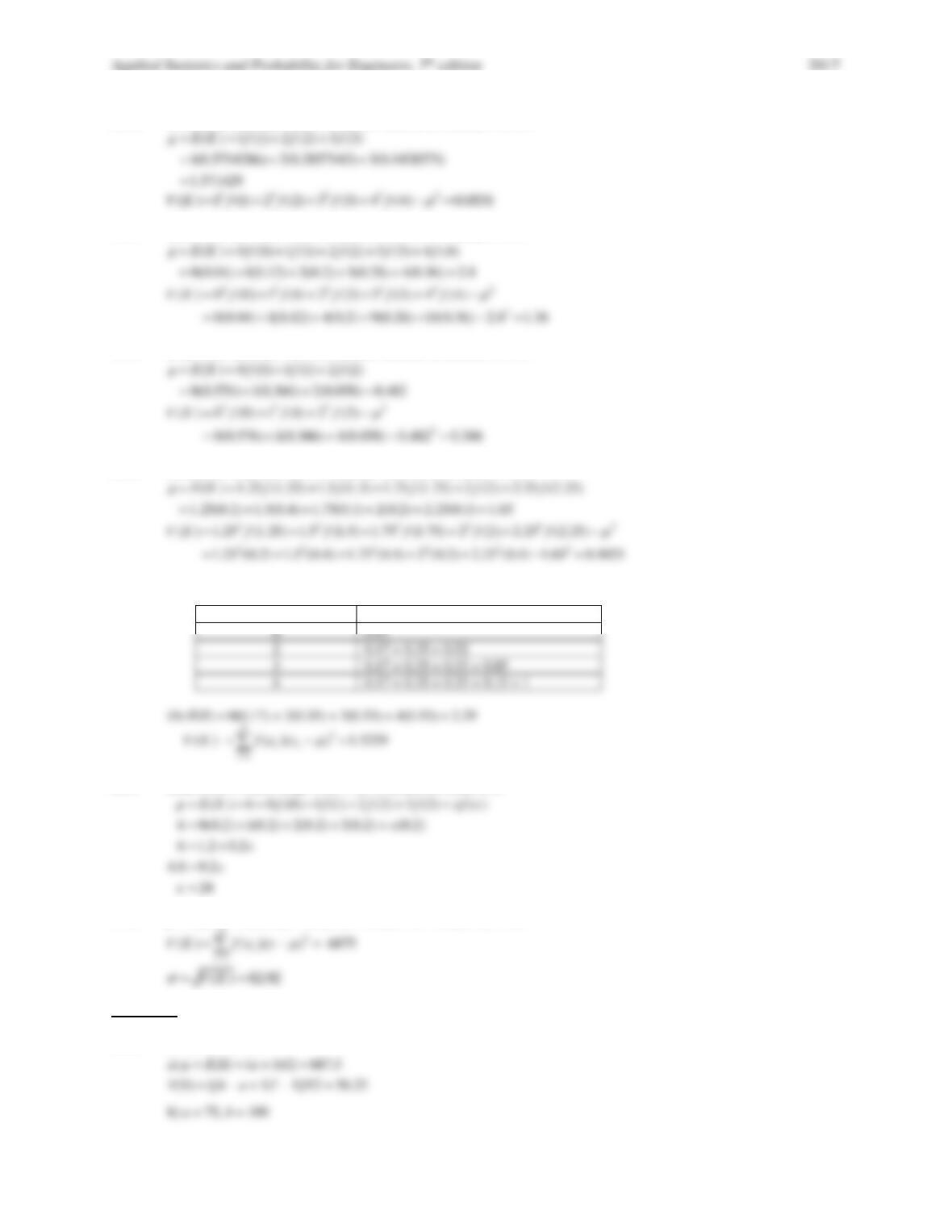
3.3.1 Mean and variance
3-5
3.3.2 Determine E(X) and V(X) for random variable in exercise 3.1.10.
3.3.3 Determine E(X) and V(X) for random variable in exercise 3.1.11.
3.3.4 Determine E(X) and V(X) for random variable in exercise 3.1.12.
3.3.5 Determine E(X) and V(X) for random variable in exercise 3.1.13.
3.3.6 (a) F(0) = 0.17
Nickel charge: X
CDF
0.17
3.3.7 Determine x where range is [0, 1, 2, 3, x] and the mean is 6.
3.3.8 µ = E(X) = 350(0.06) + 450(0.1) + 550(0.47) + 650(0.37) = 565
Section 3-4
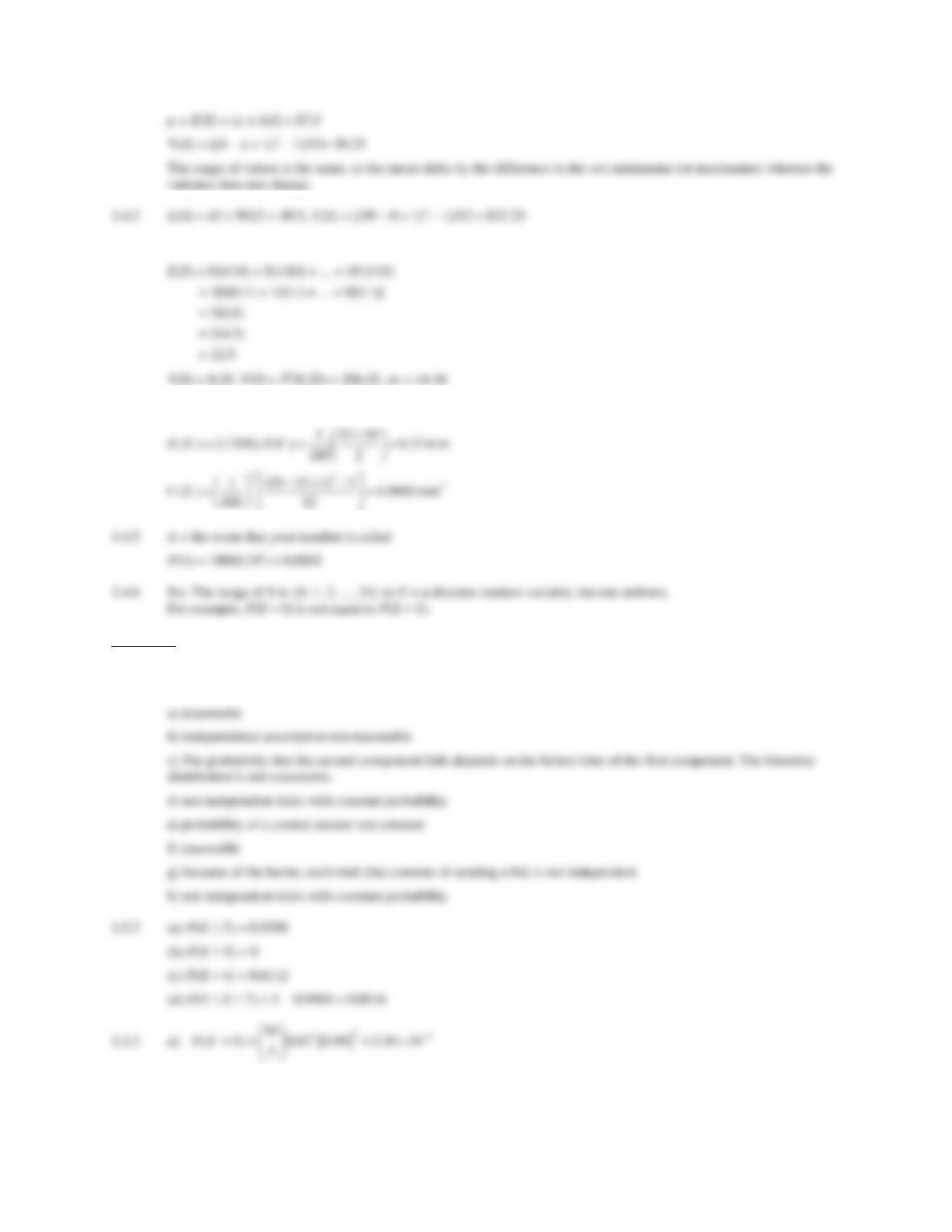
3.4.1 a = 675, b = 700
Applied Statistics and Probability for Engineers, 7th edition 2017
3-6
3.4.3 The range of Y is 0, 5, 10, …, 45, E(X) = (0 + 9)/2 = 4.5
3.4.4 X = (1/100)Y, Y = 15, 16, 17, 18, 19.
Section 3.5
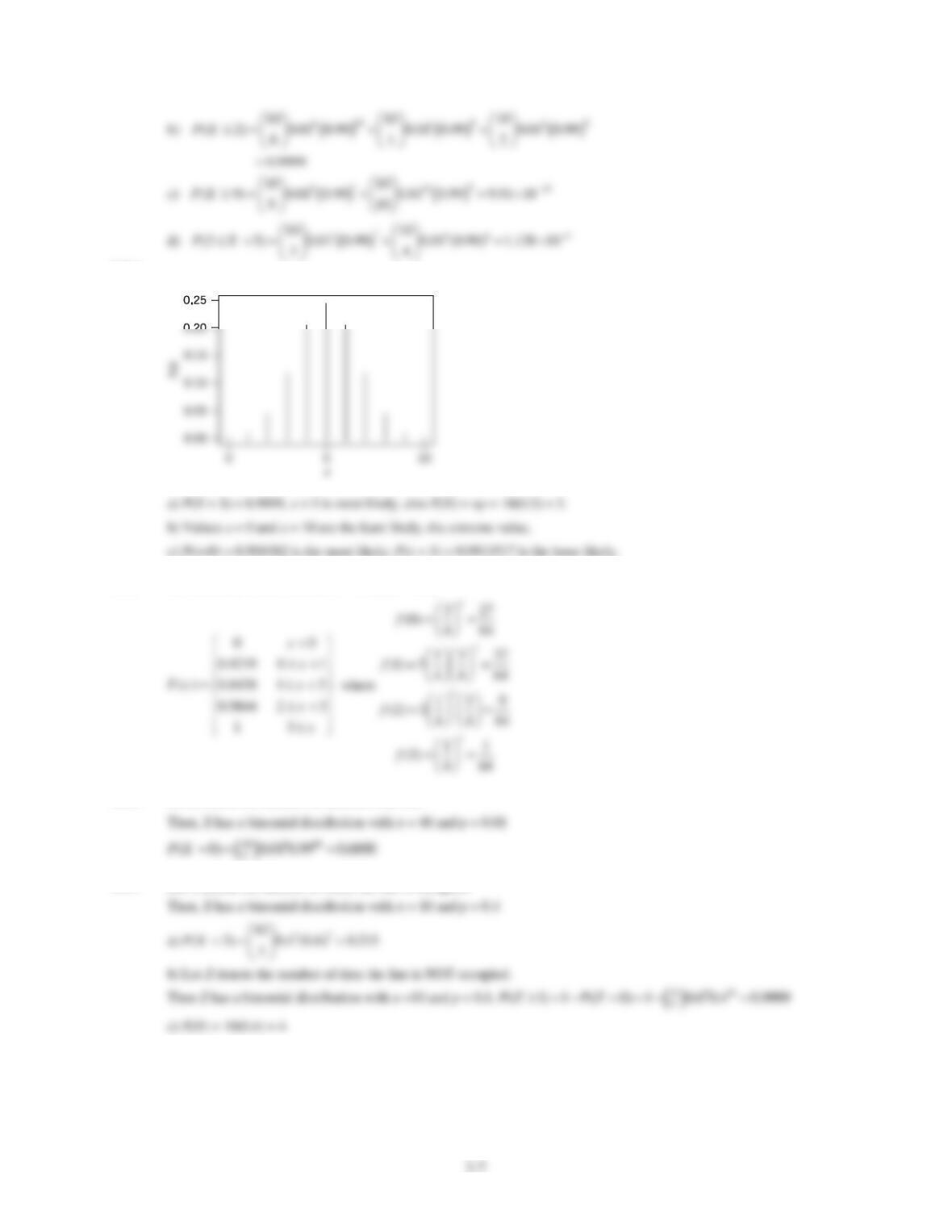
3.5.1 A binomial distribution is based on independent trials with two outcomes and a constant probability of success on each
trial.
Applied Statistics and Probability for Engineers, 7th edition 2017
3.5.4
3.5.5 The binomial distribution has n = 3 and p = 0.25.
3.5.6 Let X denote the number of defective circuits.
3.5.7 Let X denote the number of times the line is occupied.
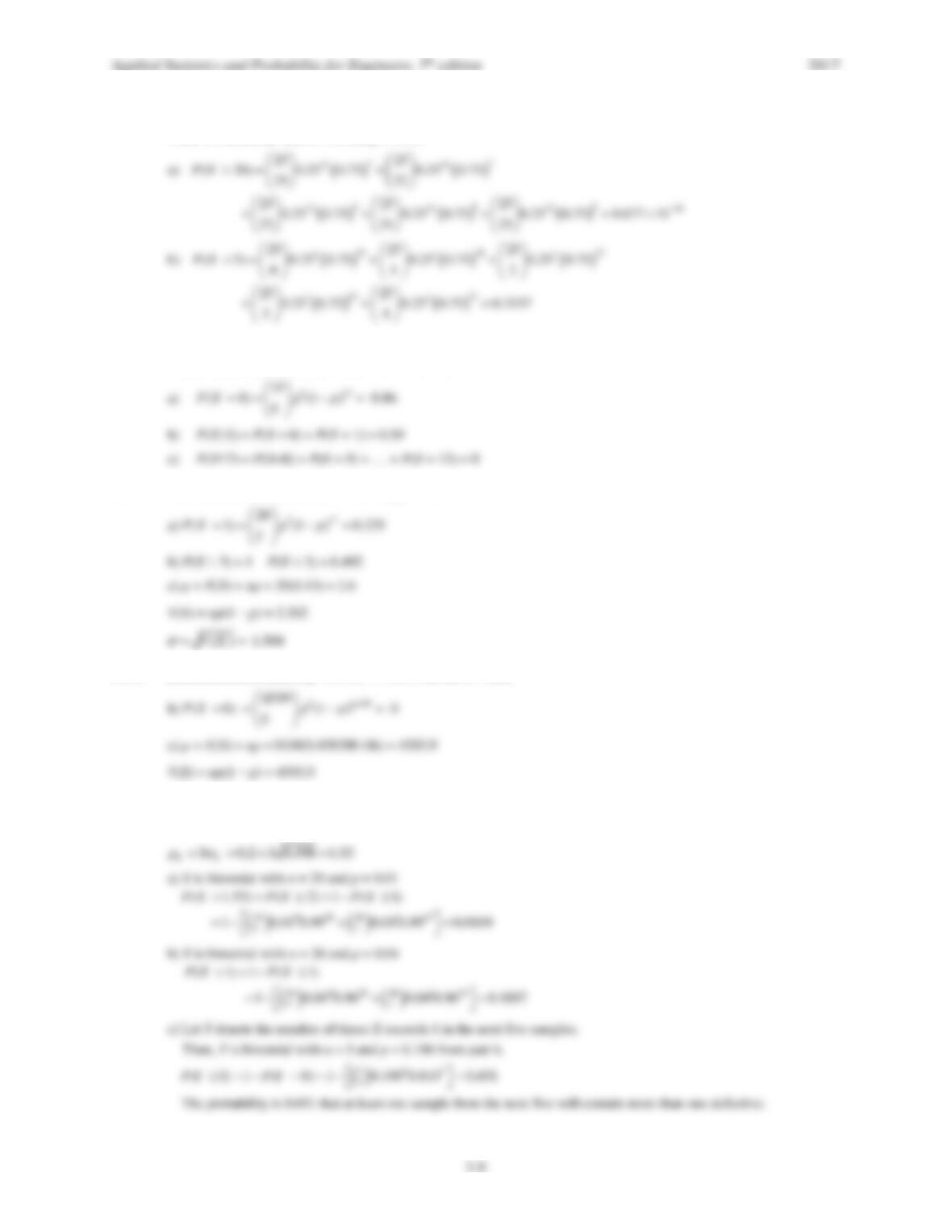
3.5.8 Let X denote the number of questions answered correctly.
Then, X is binomial with n = 25 and p = 0.25.
3.5.9 X = number of samples mutated
X has a binomial distribution with p = 0.01, n = 15
3.5.10 The binomial distribution has n = 20 and p = 0.13
3.5.11 a) Binomial distribution, p =104/369 = 4.59394E-06, n = 1E09
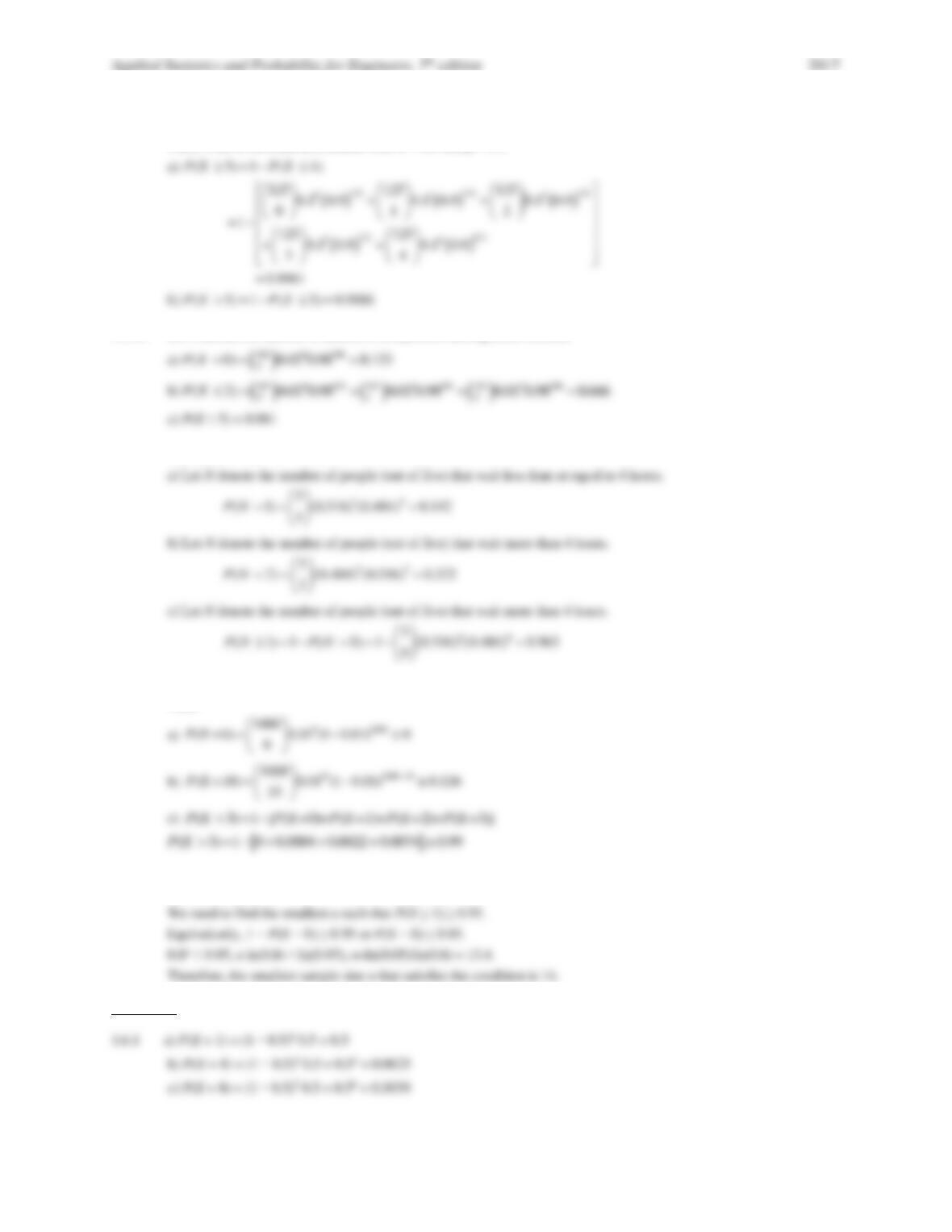
3.5.12 E(X) = 20(0.01) = 0.2
V(X) = 20(0.01) (0.99) = 0.198
3-9
3.5.13 Let X denote the passengers with tickets that do not show up for the flight.
Then, X has a binomial distribution with n = 125 and p = 0.1
3.5.14 Let X denote the number of defective components among those stocked.
3.5.15 P (length of stay ≤4) = 0.516
3.5.16 Let X = the number of visitors that provide contact data. Then X is a binomial random variable with p = 0.01 and n =
1000.
3.5.17 Let X = the number of cameras failing. Then X is a binomial random variable with probability of failing p = 0.2 and n is
to be determined.
Section 3-6
Applied Statistics and Probability for Engineers, 7th edition 2017
3-10
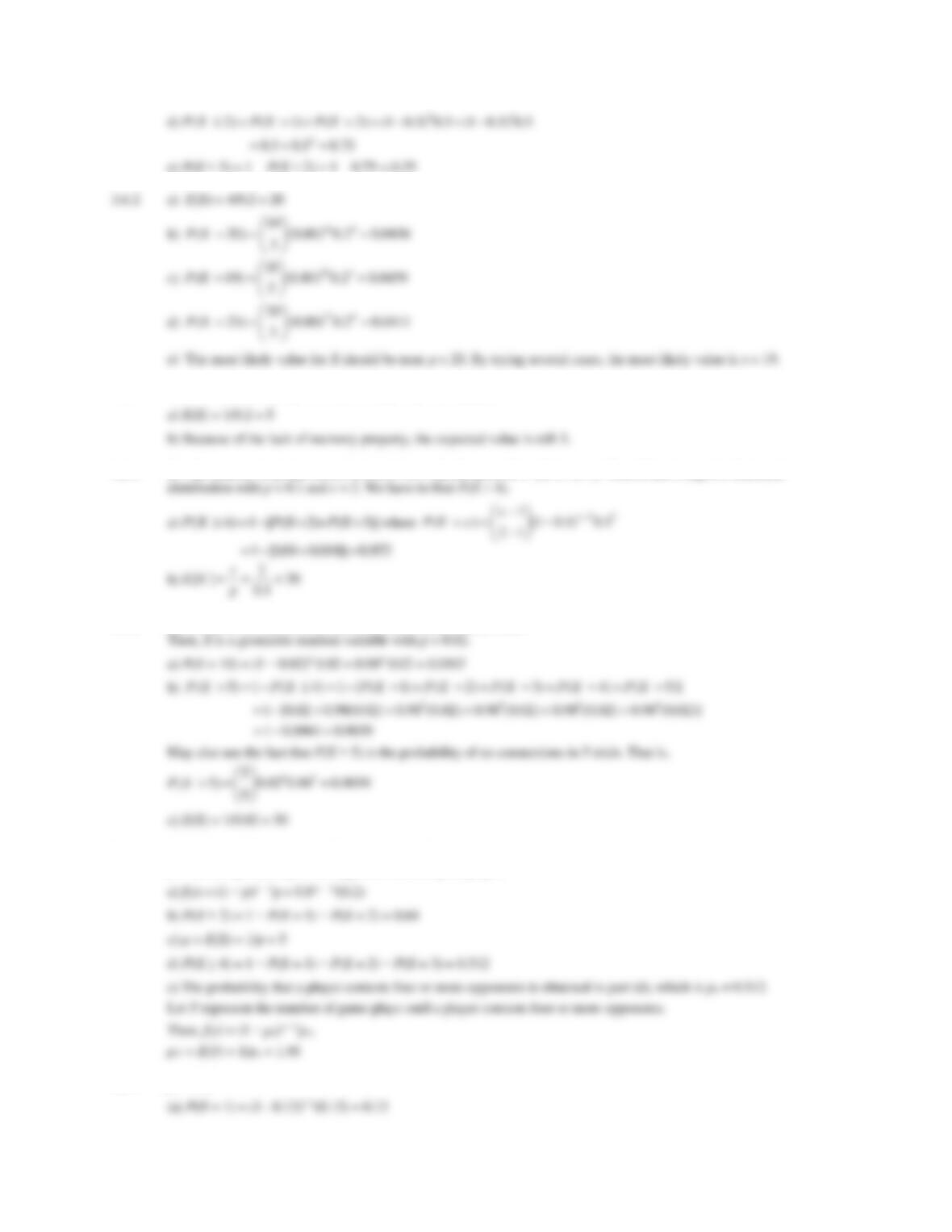
3.6.3 Let X denote the number of trials to obtain the first success.
3.6.4 X = the number of people tested to detect two with the gene, X {2, 3, 4, …}. Then X has a negative binomial
3.6.5 Let X denote the number of calls needed to obtain a connection.
3.6.6. X = number of opponents until the player is defeated.
p = 0.8, the probability of the opponent defeating the player.
3.6.7 p = 0.13
Applied Statistics and Probability for Engineers, 7th edition 2017
3-11
3.6.8 Let Y denote the number of samples needed to exceed 1 in Exercise 3-66.
Then Y has a geometric distribution with p = 0.0169.
3.6.9 p = 0.005 and r = 8
3.6.11 a) Probability that color printer will be discounted = 1/10 = 0.01
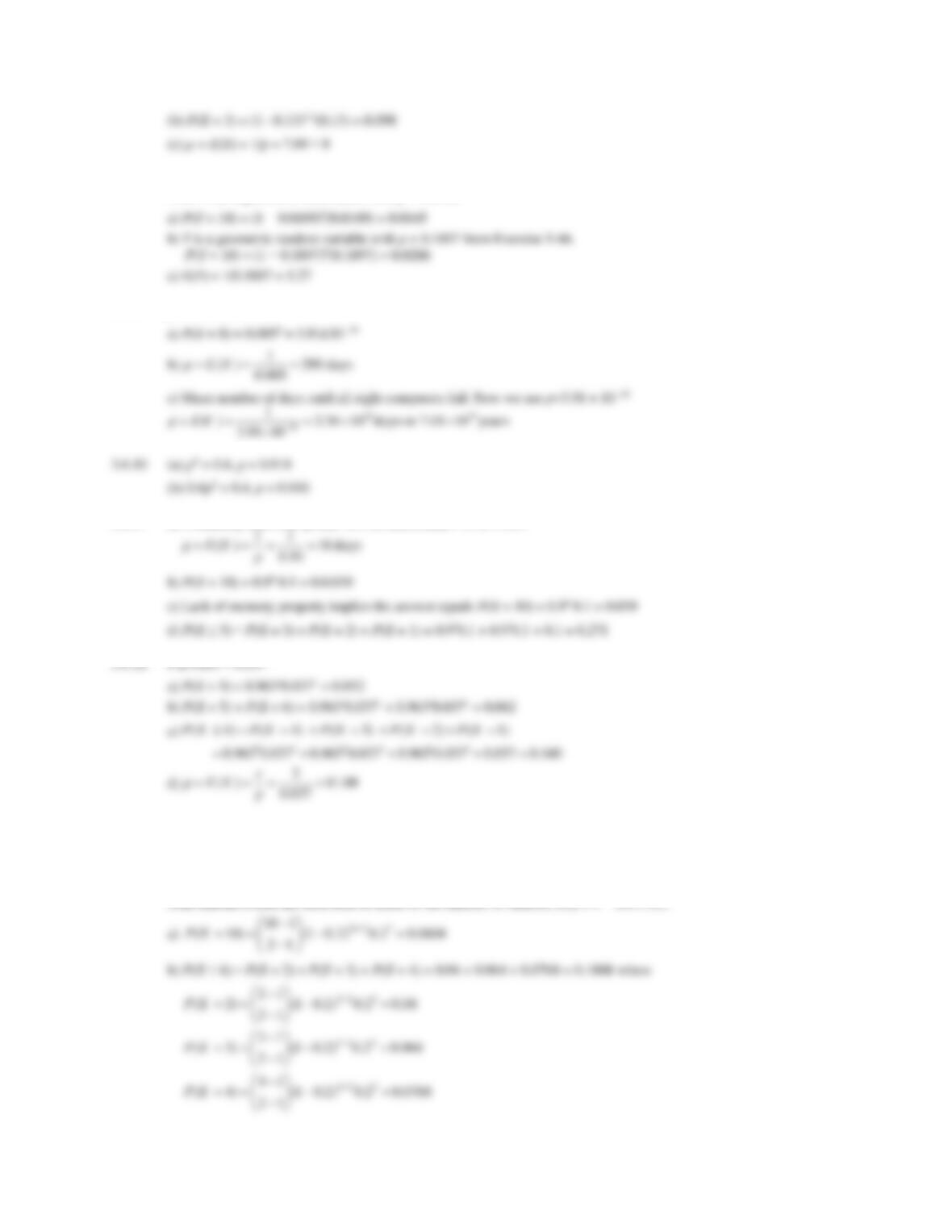
3.6.13 X = the number of cameras tested to detect two failures, X ϵ {2, 3, 4, …}. Then, X has a negative binomial distribution
with p = 0.2 and r = 2.
Y = the number of cameras tested to detect three failures, Y ϵ {3, 4, 5, …}. Then Y has a negative binomial distribution
with p = 0.2 and r = 3.
Note that the events are described in terms of the number of failures, so p = 1 − 0.8 = 0.2.