INSTRUCTOR PROBLEMS
Problem 2.55
Describe a process for evaluating if a bicycle is “ergonomic.”
Problem 2.56
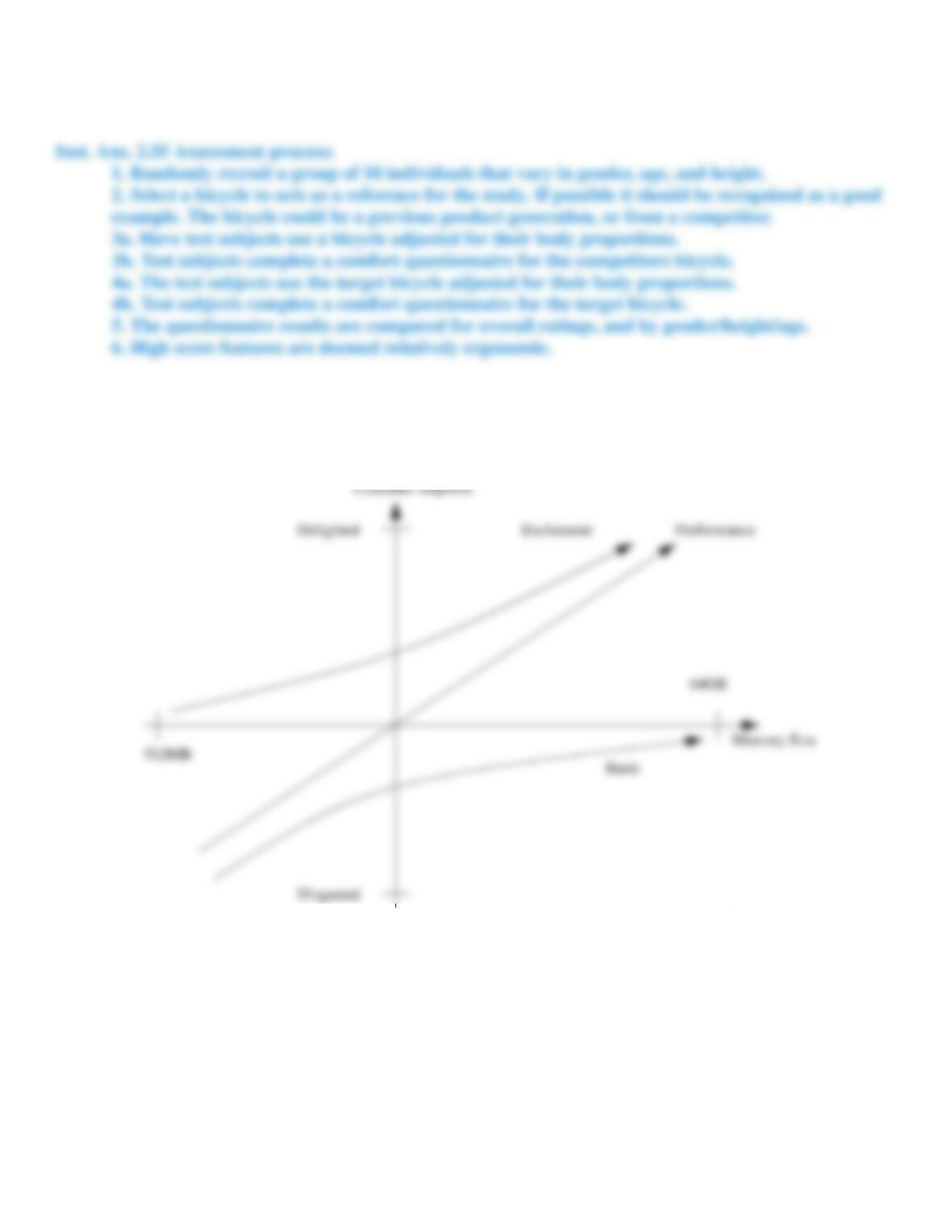
Select a laptop computer manufacturer. Use the memory size in its current product lines to construct a Kano
curve.
Inst. Ans. 2.56
64GB
Excitement
Disgusted
Performance
Customer response
512MB
Delighted
Basic
Memory Size
Problem 2.57
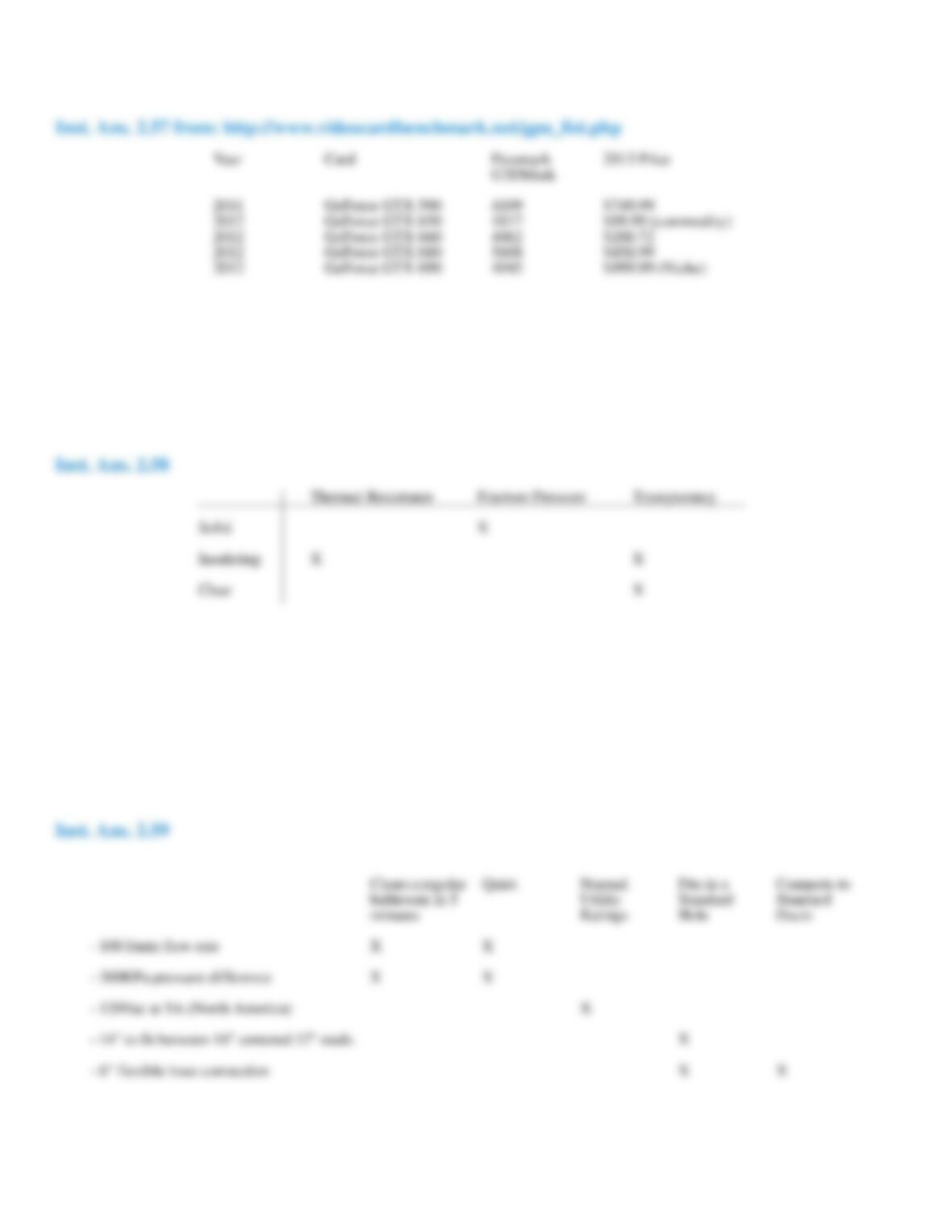
Select a company that manufactures computer graphics cards. Develop a table that shows product age, one
graphics benchmark, and the product cost. Identify the commodity and niche products in the table.
Problem 2.58
Consider standard window glass. You need to describe it using two perspectives: the customer needs and
engineering specifications. The customer needs should be put in general terms such as solid, insulating, and clear. The
specifications should be related to physical properties such as thermal resistance, fracture pressure, and transparency.
Use a matrix to relate each of the specifications to the needs.
Problem 2.59
A bathroom fan design has the following requirements. Develop a list of specifications that address all of these
and use a matrix to verify the coverage.
(a) Clears a regular bathroom in 5 minutes
(b) Quiet
(c) Normal utility ratings
(d) Fits in a standard hole
(e) Connects to standard ducts
Card
GeForce GTX 590
GeForce GTX 650
GeForce GTX 660
GeForce GTX 680
GeForce GTX 690
Passmark
G3DMark
4109
1817
4062
5608
4945
2013 Price
$749.99
$99.99 (commodity)
$200.72
$458.99
$999.99 (Niche)
Year
2011
2012
2012
2012
2012
Thermal Resistance
X
Fracture Pressure
X
Transparency
X
X
Solid
Insulating
Clear

Problem 2.60
Develop a set of questions for a customer. The customer currently uses 4 m high step ladders.
Problem 2.61
How are the QFD customer requirements and values obtained?
Problem 2.62
Consider a specification for a car that reads “hold five passengers.” Give five examples of the different
interpretations that may be used in design and testing. For example, is the driver a passenger?
Problem 2.63
What are the advantages and disadvantages of numerical specifications?
Problem 2.64
Why is testing important for numerical specifications?

Problem 2.65
The following vague specifications were provided for a laptop. Rewrite these to be specific and testable.
(a) Laptop will work 10 hours
(b) Screen is viewable in daylight
(c) Cost will be low
(d) It will be reliable
(e) High quality
(f) Can be upgraded
(g) Aesthetically pleasing
Problem 2.66
Consumer devices must be appealing and it is tempting to add aesthetics to the specifications. Explain how
aesthetics could be in the specifications.
Problem 2.67
Office chairs have a maximum design weight. Find the specifications that define these.
Problem 2.68
Briefly describe why each of the following attributes is important when developing specifications:
(a) Detailed
(b) Testable
(c) Clear
(d) Understandable
(e) Unique and not open to interpretation

Problem 2.69
The reliability of research resources can vary. Use a search engine, such as Google, to find information about
programmable logic controllers. Sort the first 50 information sources into academic, corporate, irrelevant, anecdotal,
and unknown.
Problem 2.70
What is the difference between searching for information and searching for answers?
Problem 2.71
Find the following items for a battery.
(a) Specifications from a manufacturer’s website that include time–voltage curves
(b) A commercial site that compares batteries from various manufacturers
(c) A research paper that discusses new materials for increasing battery life
(d) An application or selector guide that indicates how to select various battery sizes, based on life, space, power, temperature,
and more
Problem 2.72
How does learning to research new technologies support lifelong learning?
Problem 2.73
Find examples of:
(a) Databases of books and standards
(b) Retail catalogs with parametric selection tools
(c) Industry product guides

Problem 2.74
Use Internet auction or sales sites to find new and used prices for a laser cutting machine that can cut stainless
steel circuit board mask materials at least 500 mm by 500 mm by 0.3 mm thick.
Problem 2.75
Mini-case: Project initiation
The military deals with entrepreneurial project approaches using the Defense Advanced Research Projects Agency (DARPA).
The website lists a number of priority technologies as well as requests for general proposals. (www.darpa.mil/) See “Opportu-
nities” on the main web page and look for the submission processes for different companies and agencies. An example of a
DARPA project could be a new system for non-lethal weaponry. A proposer would complete a proposal for outlining the proj-
ect details and projected budget and deliverables. DARPA would receive and review the form. If the proposal meets the needs
and policies it might be approved and the designer would be expected to deliver as outlined.
The arts community generates many creative ideas but has issues reaching a larger customer base. In response, the Kickstarter
website was created to present project proposals.
(www.kickstarter.com)
Site visitors can view the projects and make bids on them.
Each bidder contributes a small amount of the minimum needed for the project. If the minimum for a project is met or
exceeded it moves forward. The outcomes of the projects vary widely. A common approach is to have different donation lev-
els, and the level of donation is tied to a number of items and additional features. The niche for the website has expanded to
include many engineering and technology projects. An example Kickstarter project might be a new type of computer mouse.
The project sponsor would post a description of the planned project. Visitors would review the project details and might donate
$75 for one mouse at the end of the project, or $200 for three mice. The proposer might require $150,000 before moving for-
ward.
What are the common elements in the DARPA and Kickstarter proposal processes?

Problem 2.76
Mini-case: Specification drift
Gaming took a massive leap forward in the 1990s as computers became fast enough to expand graphics from two dimensions
(2D) to three (3D). 2D games normally had characters that moved on a surface that scrolled as the game progressed. 3D games
allowed a player to move in three dimensions using a perspective view. A few landmark 3D games included Doom (1993),
Duke Nukem (1996), and Quake (1996). Customers enjoyed the new generations of 3D games and wanted more like them.
The companies that developed Doom and Quake produced sequels that were all commercial successes. Duke Nukem, devel-
oped by 3D Realms, was also the subject of a design project called Duke Nukem Forever. The game was announced in 1997
for delivery in 1998.
Between 1997 and 1998 game developers shifted from an on older graphics processing software library (engine) to a newer
graphics engine developed for Quake II. The new graphics library was essential to provide a contemporary appearance. The
team developed graphics, wrote software, and modified the library. In 1998 the Unreal engine was released and the team
decided to move to it, discarding the work done with the Quake II engine. The next decade was filled with similar technical
changes, the addition of new game features, business changes, and missed deadlines. The product has become synonymous
with vaporware —promised software that never materializes.
When the game was eventually released in 2011 it was projected to sell 3 million copies but only sold 1.6 million. Compare
this to Doom 3 (2004) which sold 3 million copies and Call of Duty: Modern Warfare 3 (2011) which sold 28 million copies.
In hindsight the specifications for the project were repeatedly “improved” after substantial design work was complete. Each
change resulted in lost time and effort. Ironically the developers’ desire to adapt, to produce a cutting-edge game, resulted in a
game that was 13 years late and was criticized for being outdated. It is possible to argue that they should have released the
game in 1998 with the out-of-date features and then moved on to a newer version. Investigate the development of Duke
Nukem Forever and find 10 events where the team effectively changed the specifications and embodiments.