CHAPTER 15
REACTOR MODEL
OBJECTIVES
• Draw the reactor system, show all flows, and instruments.
• Draw each of the control loops on the reactor.
• Explain the primary purpose of each control loop.
• Describe the basic principles of reaction as applied to Rx-202
• Operate the reactor system.
• Identify the common problems associated with the reactor system.
• Solve various troubleshooting scenarios associated with the reactor system.
REVIEW QUESTIONS
1. Explain the primary purpose of stirred reactor 202.
3. Identify the instruments associated with Rx-202.
Temperature
TIC-210 Temperature Indicating Controller- located on the cooling water jacket
to Rx-202. The temperature is controlled at 120ºF. Temperature on the reactor is
measured at the bottom of the reactor.
Pressure
PIC-210 Pressure Indicating Controller- located on the reactor to flare line at the
Pi-210B Pressure indicator- located on the discharge side of pump 210.
Pressure typically runs at 130 psig.
Flow
FIC-210 Flow Indicating Controller- located on the reactor feed inlet line. Flow
FIC-211 Flow Indicating Controller- located on the solvent feed inlet line. Flow
Fi-210 Flow indicator- located on the pressure control line to the flare. Flow
to the flare after start-up is 2.5 cubic feet per minute.
Level
LIC-210 Level Indicating Controller- located on the lower reactor outlet. The
Analytical
AT-4 Analyzer transmitter- located on the feed line to the reactor. AT-4 is
AIC-210 Analyzer Indicating Controller- measures the concentration of
4. List the basic components in the two feed stocks.
5. List the safety features found on Rx-202.
Stirred reactors are equipped with a number of safety features: pressure relief
systems, quench systems, process variable alarms, and automatic shutdown controls.
Quench systems are designed to stop the reaction process. Pressure relief systems
are sized to handle and contain any release from the reactor. The relief system
may be designed for liquid, vapor, or a liquid-vapor combination. Safety relief
systems allow process releases to go to the plant flare system. Sometimes a
chemical scrubber system is used before a product is sent to the flare system.
6. Explain how the reaction is controlled in the Rx-202 system.
The reaction is controlled by mixing two different feed stocks at controlled flow
7. Draw each of the control loops associated with the stirred reactor system. See
Figure 15-1 Typical stirred reactor.
FIC-210, 36.5 GPM, FIC-211, 68 GPM, PIC-210, 85 PSIG, LIC-210, 75%, TIC-
210, 120ºF, AIC-210, 21%.
9. List the primary reactor variables in effect on Rx-202.
10. Explain how to safely start-up the stirred reactor system.
Action Notes
1. Ensure C-202 is operating properly and at operational specification.
3. Set LIC-210 to 75% and put in AUTO.
5. Set TIC-210 to 120ºF and put controller in AUTO.
7. Set FIC-211 to 68 GPM and put in AUTO.
9. Open V-203, V-204, V-205.
11. Start P-210 and circulate to Rx-202. Monitor pressures and level.
13. Compare AT-4 to lab sample and to AIC-210
15. Set FIC-211 to CASCADE
11. List the various operational problems reactor technicians encounter on a stirred
reactor.
Problems associated with the operation of Rx-202 include:
• feed composition changes
• concentration increase- increase reaction factors
• agitation problems- will reduce reaction
NAME:____________________________ TEST A
DATE:____________________________
CHAPTER FIFTEEN
TEST REACTOR MODEL
1. What is the primary purpose of a reactor?
a. to combine chemicals and make new products
b. to make, break, or make and break chemical bonds
c. produce heat and pressure
d. a & b
2. What is the flow rate from the column to the reactor?
a. 36.5 GPM
b. 50 GPM
c. 68 GPM
d. 200 GPM
3. What is the solvent flow rate to the reactor?
a. 36.5 GPM
b. 50 GPM
c. 68 GPM
d. 200 GPM
4. What is the typical speed of the mixing motor?
a. 100 RPM
b. 175 RPM
c. 250 RPM
d. 325 RPM
5. What is the target Butane set point exiting the reactor?
a. 61 %
b. 21 %
c. 38 %
d. 17%
6. The temperature on the stirred reactor is controlled at?
a. 50ºF
b. 100ºF
c. 221ºF
d. 120ºF
7. The inlet Butane analyzer to the reactor should read?
a. 61%
b. 21%
c. 38%
d. 17%
8. The level on the stirred reactor is controlled at?
a. 30%
b. 50%
c. 75%
d. 100%
9. Which of the following is not a chemical reaction:
a. replacement
b. neutralization
c. combustion
d. distillation
10. Given the chemical equation: H3PO4 + 3 NaOH —-»Na3PO4 + 3H2O
If you are told to add 355 pounds of phosphoric acid H3PO4 to the above
equation how many pounds will you need to add to the sodium hydroxide NaOH
in order to keep the equation balanced?
a. 394.8 tons
b. 3.29 pounds
c. 394.8 pounds
d. 3948 pounds
11. _______________________ adds raw materials incrementally to the reactor.
Finished products flow out while raw materials flow in and are exposed to
catalysts, pressure, liquids, or heat.
a. batch operation
b. continuous reactor operation
12. 2Na2O + 2HOCl —» 2NaOCl + H2O. Is this chemical equation balanced? List
reactant elements. List the product elements.
a. balanced
b. not balanced
Na X 4 Na X 2
O X 4 O X 3
H X 2 H X 2
Cl X 2 Cl X 2
13. 2H3PO4 —» H2O + H4P2O7. Is this chemical equation balanced?
a. balanced
b. not balanced
14. The two most common forms of chemical bonding are:
a. covalent and ionic
b. covalent and numeric
c. ionic and electromagnetic
d. covalent and memonic

15. The major difference between the two most common forms of chemical bonding
are:
a. neutral vs electrically charged
b. endothermic vs. exothermic
c. reactive vs. equilibrium
d. all of the above
16. N2 + 3H2 ————» 2NH3
120 lbs 39 lbs 159 lbs
? lbs ? lbs 556 lbs
What are the new settings for nitrogen and hydrogen?
a. 420 nitrogen, 136 hydrogen
b. 410 nitrogen, 146 hydrogen
c. 395 nitrogen, 161 hydrogen
d. 465 nitrogen, 91 hydrogen
17. How does heat and pressure effect a chemical reaction?
a. enhances
b. slows down
c. no effect
d. a & b
18. An exothermic reaction:
a. requires heat
b. requires energy
c. gives off heat
d. destroys matter
19. All of the following are active catalysts except:
a. intermediate type
b. adsorption
c. inhibitor
d. poisoned
20. CH4 + 2O2 —————-—–» CO2 + 2H2 O
1600 lbs ? ? ?
a. 7400, 5400, 4600
b. 6600, 4600, 3800
c. 5400, 3400, 2600
d. 6400, 4400, 3600
21. Given the chemical equation: H3PO4 (18 tons) + 3 NaOH (10 tons) —-
»Na3PO4 + 3H2O (products total 28 tons)
Change H3PO4 to 4900 tons. What does the (3 NaOH) weight need to be in
order to balance the equation?
a. 2722 tons
b. 272.22 tons
c. 1600 tons
d. 3200.32 tons
22. Reaction rates are impacted by:
a. heat and surface area
b. concentration
c. pressure & flow rates
d. all the above
23. A 3500 pound barrel has a 37% catalyst solution. What is the weight of the
catalyst?
a. 129.5 lbs
b. 1295 lbs
c. 2205 lbs
d. 1400 lbs
24. In a ________________ raw materials are carefully weighed and added to a
reactor. The raw materials are mixed and allowed to react. After a pre-
determined amount of time the batch is dumped and a new batch mixed.
a. continuous batch operation
b. batch operation
25. What type of reaction is occurring in the stirred reactor?
a. exothermic
b. endothermic
c. combustion
d. replacement
e. neutralization
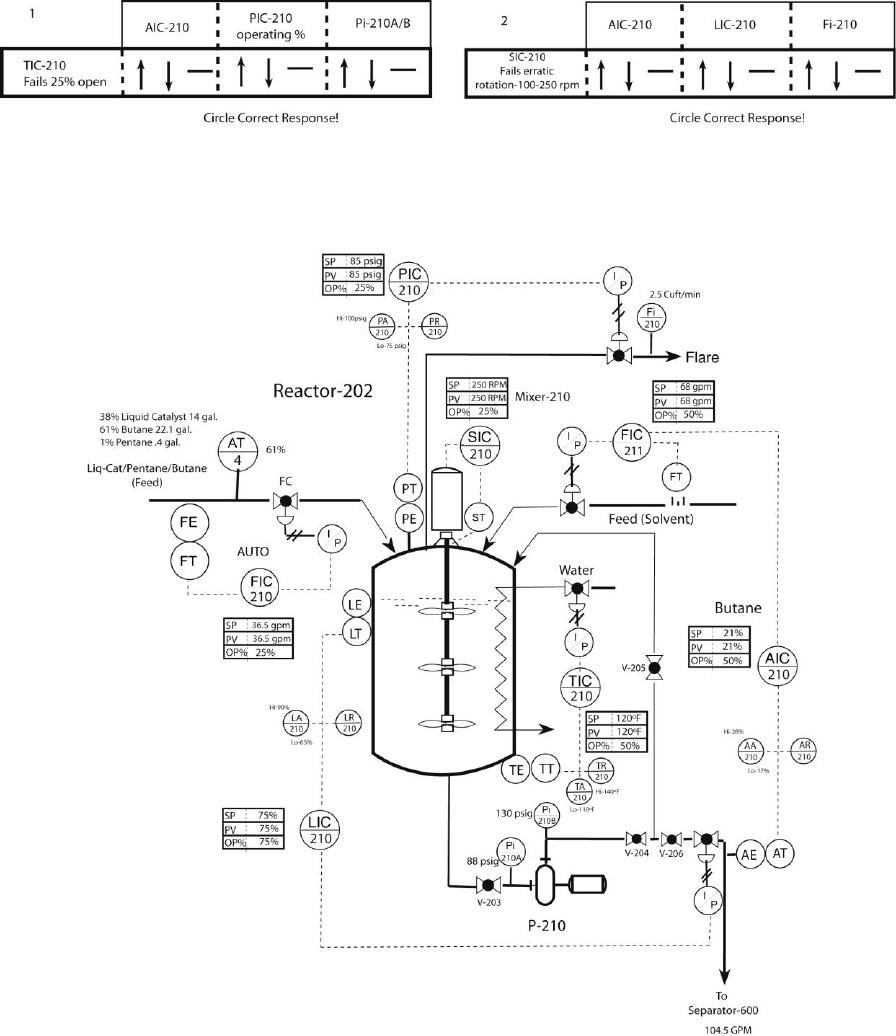
26.
1
2
3
4
5
6

27.
1
2
3
4
5
6
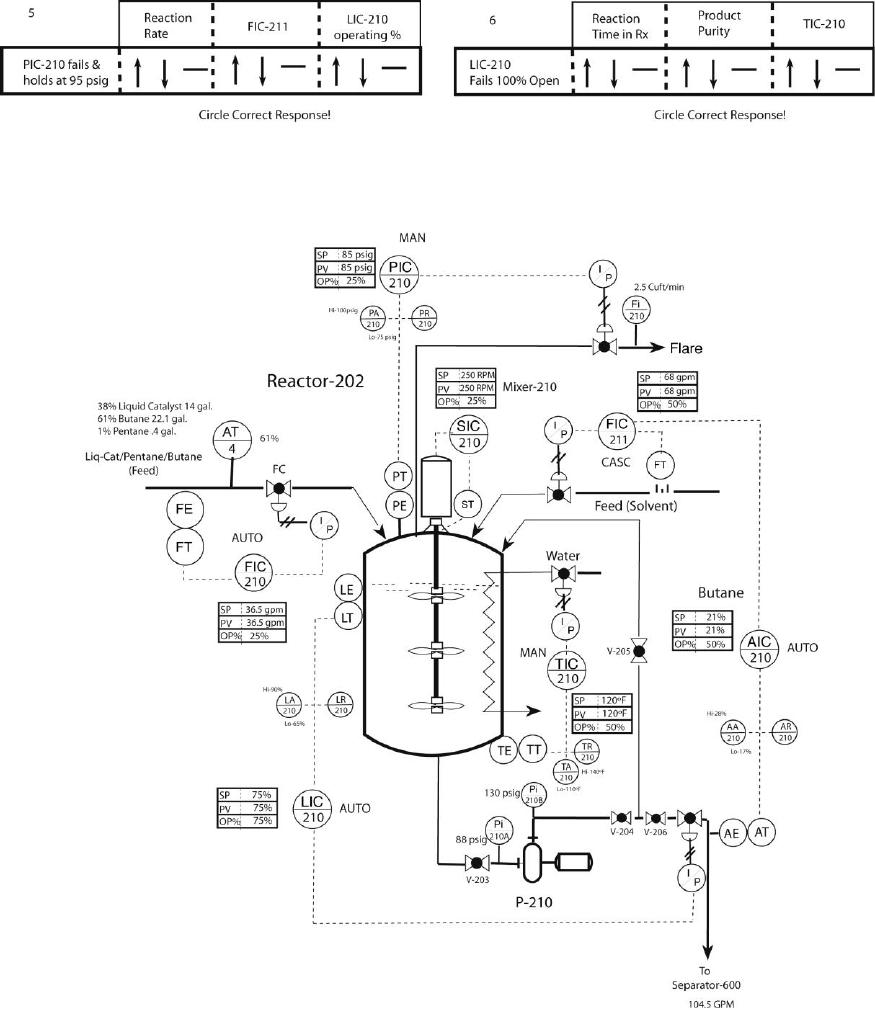
28.
1
2
3
4
5
6
Answer Key CHAPTER 15 TEST A
REACTOR MODEL