CHAPTER 14
DISTILLATION MODEL
OBJECTIVES
• Apply the principles of distillation.
• Analyze the relationship between the boiling point of a hydrocarbon and pressure,
temperature, flow, and level.
• Analyze the various concepts associated with pressure in a distillation system:
vapor pressure, partial pressure, relative volatility, compressibility, liquid pressure,
and vacuum.
• Identify the different equipment systems used to make up a distillation system.
• Analyze how the methods of heat transfer apply to the distillation process.
• Explain the basic components of a plate column.
• Operate and troubleshoot the equipment systems associated with a distillation feed
system.
• Operate and troubleshoot the equipment systems associated with a distillation
preheat system.
• Describe and operate the equipment systems associated with the bottom section
of a distillation column.
• Operate and troubleshoot the equipment systems at the top of a distillation column.
• Compare and contrast preheaters and condensers.
• Describe the basic principles associated with column design.
• Troubleshoot various troubleshooting scenarios on the distillation system.
REVIEW QUESTIONS
1. Draw and label the feed system. Show all instruments. List start-up procedure.
See Figures 14-2 Feed System.
The operating procedures associated with the distillation preheat system include:
Action Notes
1-1. Verify pump recirculation to Tk-202. This includes looking at pump suction and
discharge pressures and level in Tk-202.
1-3. Open V-202C and V-202D. This will admit flow into the lower tube-side of Ex-
1-4. Set FIC-202 to 75 GPM and set in AUTO. Ensure C-202 has been prepared prior
to this step.
1-6. Set FIC-202 to 225 GPM.
1-8. Open V-202J.
1-10. Open V-202K and V-202L. Close V-202J. This will admit flow into the tube-side
of Ex-203.
1-11. Monitor and ensure both control systems are operating properly. This includes
the flow and temperature recorder.
1-12. Place the system on-spec when operating temperatures approach set-point.
2. Draw and label the preheat system. Show all instruments. List start-up
procedure.
See Figure 14-5 Preheat system. Refer to the above procedure.
3. Draw and label the bottom section of the distillation system. Show all
instruments. List start-up procedure.
See Figure 14-6 Bottom System.
The operating procedures associated with the distillation bottom system
includes:
Action Notes
3-1. Set LIC-205 to 50% and set in AUTO.
V-205B.
3-4. Ensure level in Ex-205 is at 25% and rising.
3-6. Set TIC 205 to 221.7ºF and put in AUTO
3-8. Monitor temperature profile on bottom of column.
3-10. Monitor AT-3 and switch to Tk-205A when analyzer reads below 2.5%. Open V-
205A and close V-205B.
3-12. Cascade FIC-205 to TIC-205.
4. Draw and label the upper section of the column. Show all instruments. List
start-up procedure.
See Figure 14-7 Overhead system.
The operating procedures associated with the distillation overhead
system include:
Action Notes
4-1. Set FIC-300 to 525 GPM and put in AUTO.
4-3. Set LIC-204 to 50% and put in AUTO.
4-5. Set TIC-203 to 158.7ºF and set in AUTO.
4-7. Line-up P-204A to reflux and to Tk-204B Off-Spec. Open V-204H, open V-204J,
open V-204M, open V-204P, and V-204Q.
4-8. Start P-204 when level reaches 50% in D-204 and ensure all pressures are
correct and Tk-204B is filling.
4-9. Line-up and start P-204D when level reaches 50%.
4-11. Monitor AT-2 and switch to Tk-204A Prime Butane when analyzer reaches
4-12. Shutdown P-204D and line-up and start P-204C when level in tank reaches 50%.
4-13. Cascade FIC-203 to TIC-203.
4-14. Cross-Check process variables with SPEC sheet.
5. List the various components in the feed mixture.
6. List the required specification of components on tray three.
8. Draw and label the pentane storage system.
See Figure 14-8 Pentane 205 A/B.
9. Describe the function of each of the four butane analyzers and identify where
each is located in the system.
AT-1 38% Butane- feed line
AT-3 1.5% Butane- bottom line
10. Explain how the following variables relate to each other; pressure and boiling
point, temperature, flow rate, level, time, feed composition.
As has been mentioned earlier, pressure has a direct relationship to boiling point.
Higher pressures will result in a shift upward of the boiling point. Lower
pressures will result in a shift downward of the boiling point. Temperature is one
NAME:____________________________ TEST A
DATE:____________________________
CHAPTER FOURTEEN TEST
DISTILLATION MODEL
1. Two basic tower designs include:
a. packed and tray
b. plate and packed
c. bubblecap and sieve
d. valve and packed
e. a & b
2. Overlap can be minimized by:
a. refluxing
b. increasing pressure
c. reboiling
d. a & c
3. High bottoms temperature in a distillation tower are controlled by :
a. increase over head flow and decrease bottoms flow
b. decrease overhead flow and increase bottoms flow
c. stop feed flow and cut bottom temperature
d. open side-streams
4. Feed composition changes have very little impact on the energy balance but
significant impact on the material balance.
a. true
b. false
5. Calculate the total vapor pressure exerted by the mixture: 25% hexane 20.6
psia @ 175F, 25% heptane 8.8 psia @ 175F, and 50% benzene 14.7 psia @ 176
F. Give answer in psia.
a. 14.7 psia
b. 44.1 psia
c. 22.05 psia
d. 34.7 psig
6. Puking is most closely related to:
a. reduced partial pressure
b. excessive vapor pressure
c. low temperature
d. high temperature
7. The process of vaporizing liquids at lower temperatures by reducing pressure:
a. azeotropic distillation
b. fractional distillation
c. vacuum distillation
d. adsorption distillation
8. Tube shaped funnels that allow fluid transfer between plates in a tower:
a. riser
b. bubble-cap
c. downcomer
d. sieve
9. The temperature at which the heaviest component begins to boil:
a. IBP- initial boiling point
b. FBP- final boiling point
c. ABP– average boiling point
d. Dew point
10. Excessive liquid flowing down a tower that blocks vapor flow up the tower:
a. puking
b. flooding
c. surging
d. reflux
11. A binary mixture contains:
a. lighter hydrocarbons
b. is heavier than a ternary mixture
c. two or more components
d. three compounds in a mixture
12. Boil-up rate is defined as:
a. the temperature at which a liquid turns to vapor
b. the vapor-liquid balance returned to tower from the reboiler
c. the vapor-liquid reflux balance returned to tower from overhead
accumulator.
d. the total amount of vapor moving up the column.
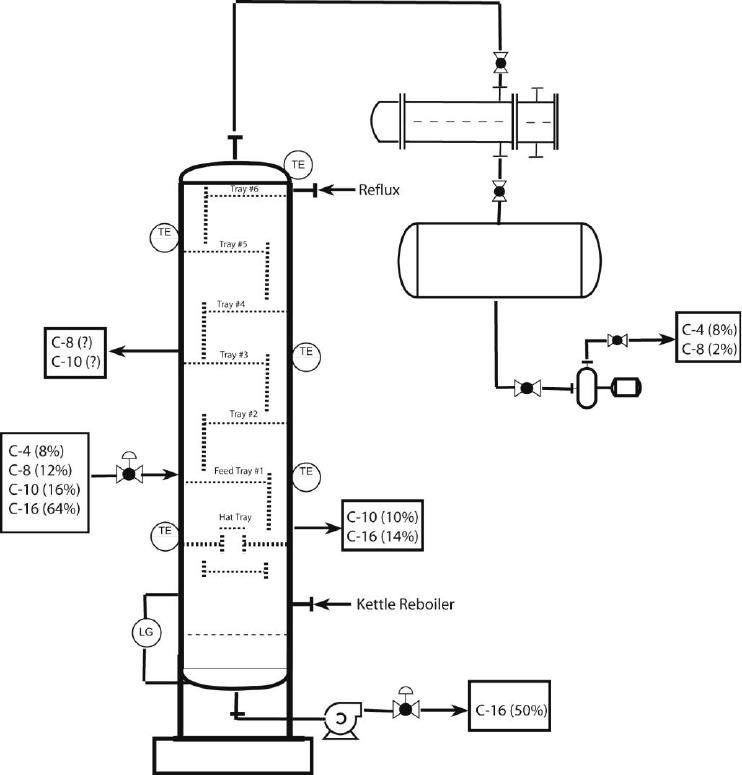
13. What is the composition of side stream #2?
Material Balance
14. The sum of the products entering the column equals the sum leaving:
a. energy balance
b. fractional balance
c. material balance
d. total balance
15. Packed towers use specially designed packing materials to reduce surface area
during the distillation process:
a. true
b. false

16. Distillation columns have two major types of separation grids: plate and
packing. Plate towers have the following tray types:
a.
b.
c.
17. Packed towers have the following types of packing:
a.
b.
c.
18. Liquid distillate returned to the tower is called:
a. boil-up
b. reflux
c. total reflux
d. incomplete separation
Analyze the following process variables and decide if they are related to energy (E) or
material (M) balance.
19. steam loop on feed pre-heater. ____
20. feed flow rate. ____
21. overhead condenser. ____
22. reflux rate. ____
23. boil-up rate. ____
24. reboiler. ____
25. side stream flow. ____
26. bottoms flow. ____
27. overhead flow. ____
28. The temperature at which a liquid mixture turns to vapor:
a. boil-up rate
b. IBP
c. FBP
d. boiling point
e. dew point
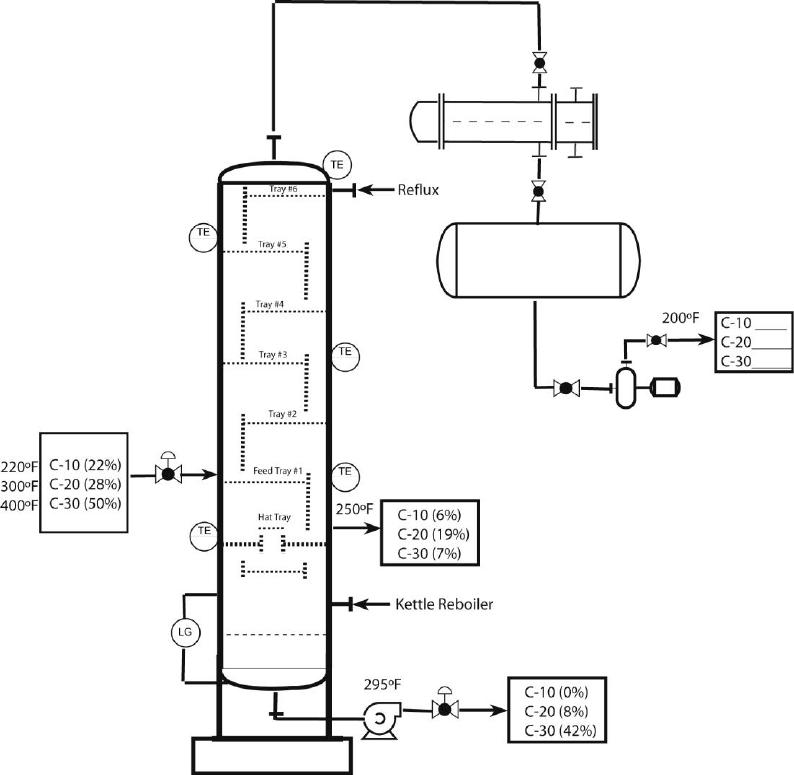
29. What is the overhead composition?
Material Balance #2
30. The upper section of the tower is referred to as:
a. feed section
b. rectifying section
c. enriching section
d. stripping section
e. b & c
31. Condensed tower product that is pumped back into a tower to increase
product purity and control temperature:
a. overlap
b. reflux
c. side-stream
d. accumulation
32. The condensed gas taken from a distillation tower is called:
a. residuum
b. distillate
c. condensate
d. distillation
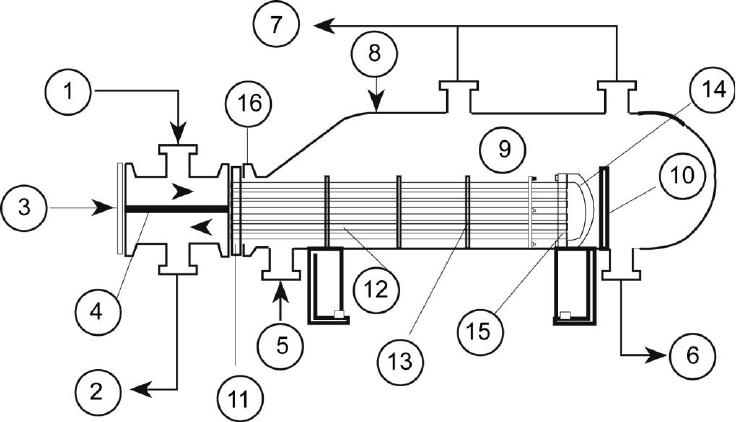
33. Identify the major components of a kettle reboiler.
Kettle Reboiler Components
33-1__________ 33-2__________ 33-3__________ 33-4__________
33-5__________ 33-6__________ 33–7__________ 33-8__________
33-9__________ 33-10__________ 33-11__________ 33-12__________
33-13_________ 33-14__________ 33-15__________ 33-16__________
34. Distillation is best defined by the following statement:
a. the separation of components in a mixture by tower segregation
b. the fractional separation of a binary mixture by tray filtration
c. the azeotropic process designed to separate hydrocarbons by fractional
boiling points.
d. the separation of components in a mixture by boiling point
35. The lower section of the tower is referred to as:
a. feed section
b. rectifying section
c. enriching section
d. stripping section
e. b & c

36. The tray located below the inlet feed line is called the:
a. mid section tray
b. pumping section tray
c. feed tray
d. valve tray
37. Each tray in a distillation column has a different molecular structure.
a. true
b. false
38. The varying temperatures across the tower:
a. temperature gradient
b. temperature profile
c. temperature overlap
d. temperature delta
39. List three process variables that can be used to break a flood:
a.
b.
c.
40. A ternary mixture:
a. lighter hydrocarbons
b. is heavier than a ternary mixture
c. two or more components
d. three compounds in a mixture
41. When a heat exchanger is used to convert all of the overhead vapors to liquid, it
is called:
a. normal overhead condenser
b. total reflux
c. total condenser
d. partial condenser
42 All of the following are principles of distillation except:
a. heat increases vapor pressure
b. pressure increases boiling point
c. vacuum decreases boiling point
d. forms and breaks molecular bonds
43. The larger the difference between partial pressures the harder it is to separate
the fractions by boiling point.
a. true
b. false
44. Using information from question 6, calculate the % component in vapor of
hexane:
a. 20%
b. 25%
c. 30%
d. 35%
45. Vapor distillate returned to the tower is called:
a. boil-up rate
b. reflux rate
c. total reflux
d. incomplete separation
46. The vapor medium suspended above a boiling mixture is enriched with the
components that have the lowest boiling points.
a. true
b. false
47. Heat that can not be sensed or measured:
a. latent
b. sensible
c. kinetic
d. potential energy
48. Incomplete separation of components in a mixture:
a. overlap
b. puking
c. temperature gradient
d. overloading
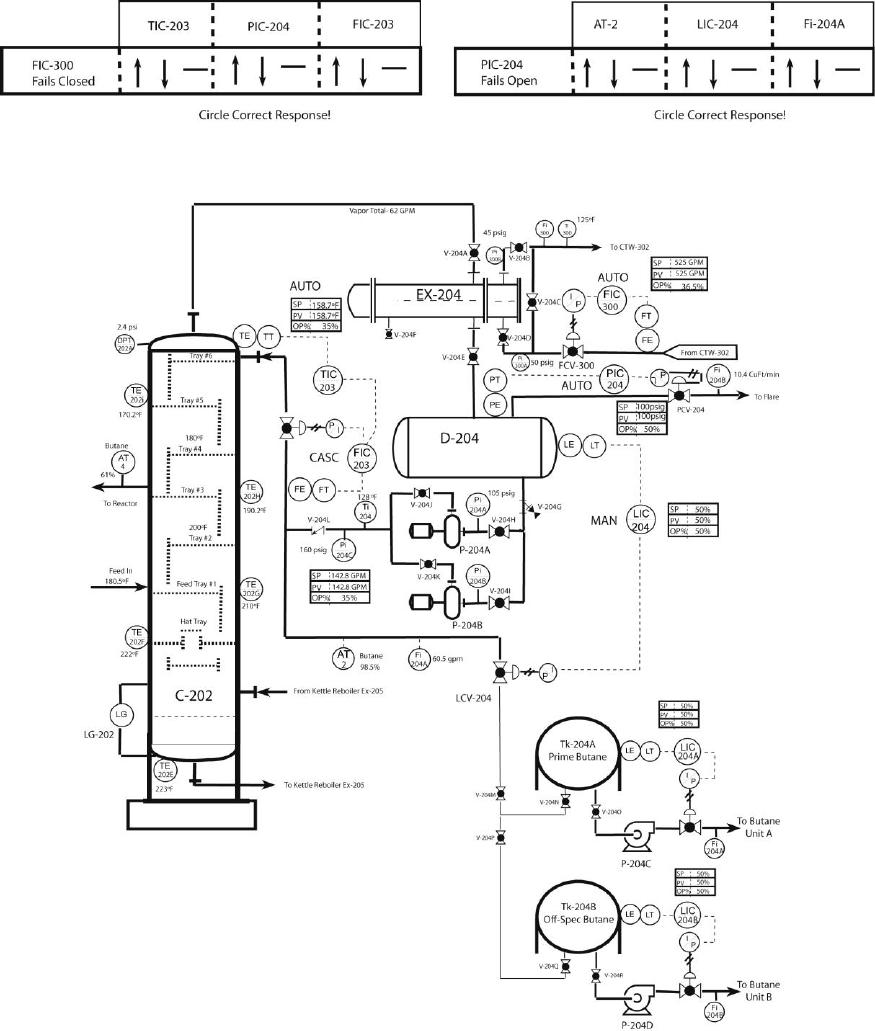
49.
1
2
3
4
5
6
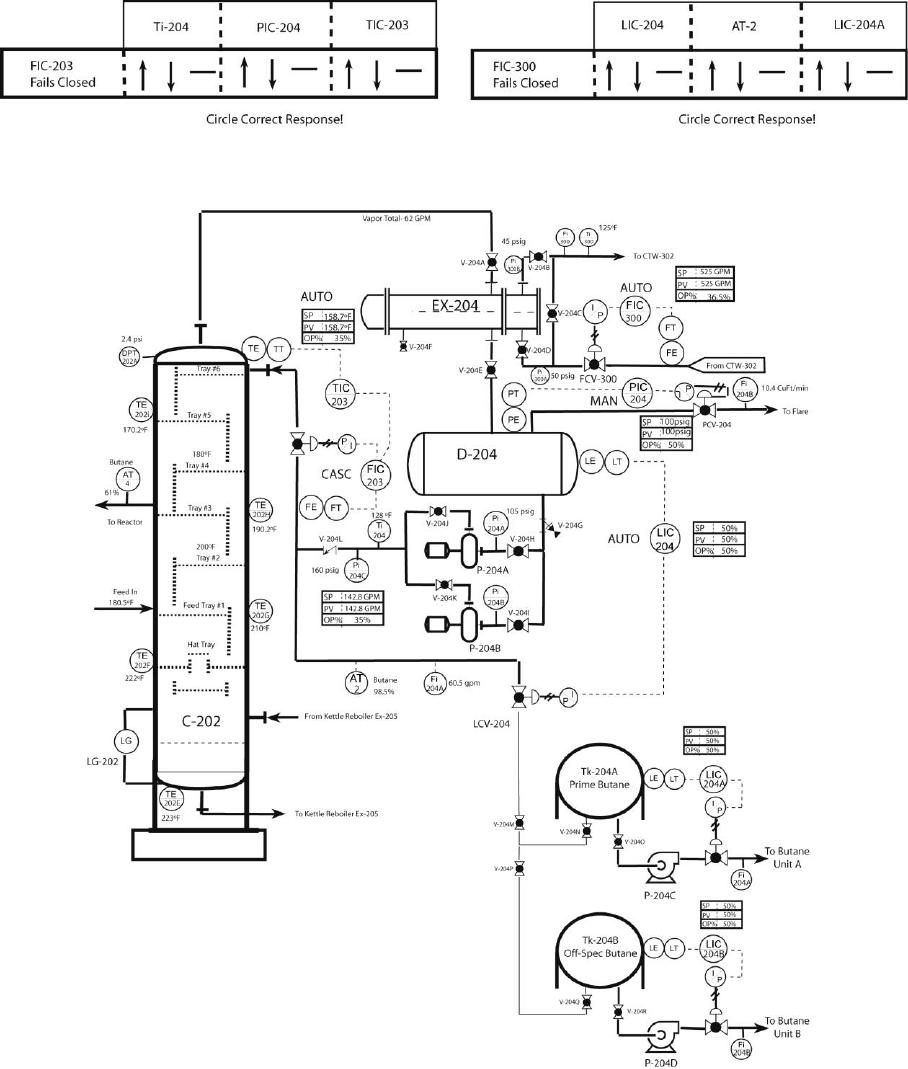
50.
1
2
3
4
5
6
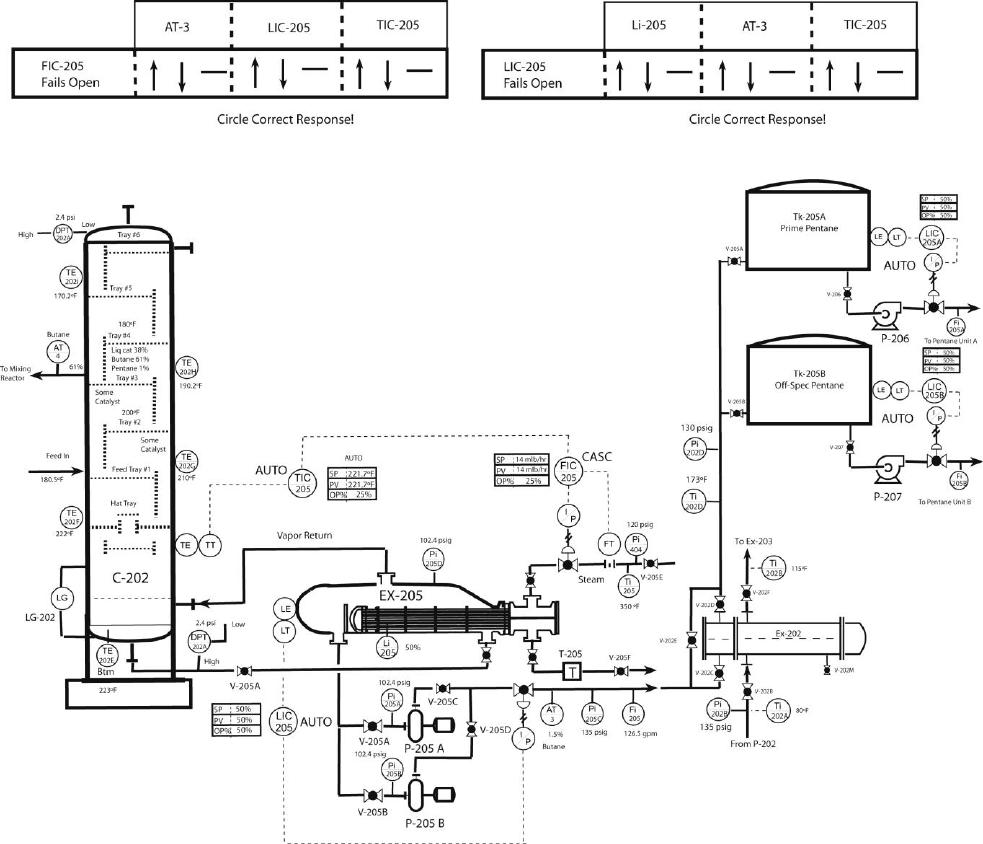
51.
1
2
3
4
5
6
Answer Key CHAPTER 14 TEST A
DISTILLATION MODEL