1
© 2020 Pearson Education, Inc., Hoboken, NJ. All rights reserved. This material is protected under all copyright laws as they currently exist.
No portion of this material may be reproduced, in any form or by any means, without permission in writing from the publisher.
Chapter 11
Planning Production Activity
DISCUSSION QUESTIONS
11-1. Q: Why is a vigorous production capability so important to the United States in the “post–
industrial society”?
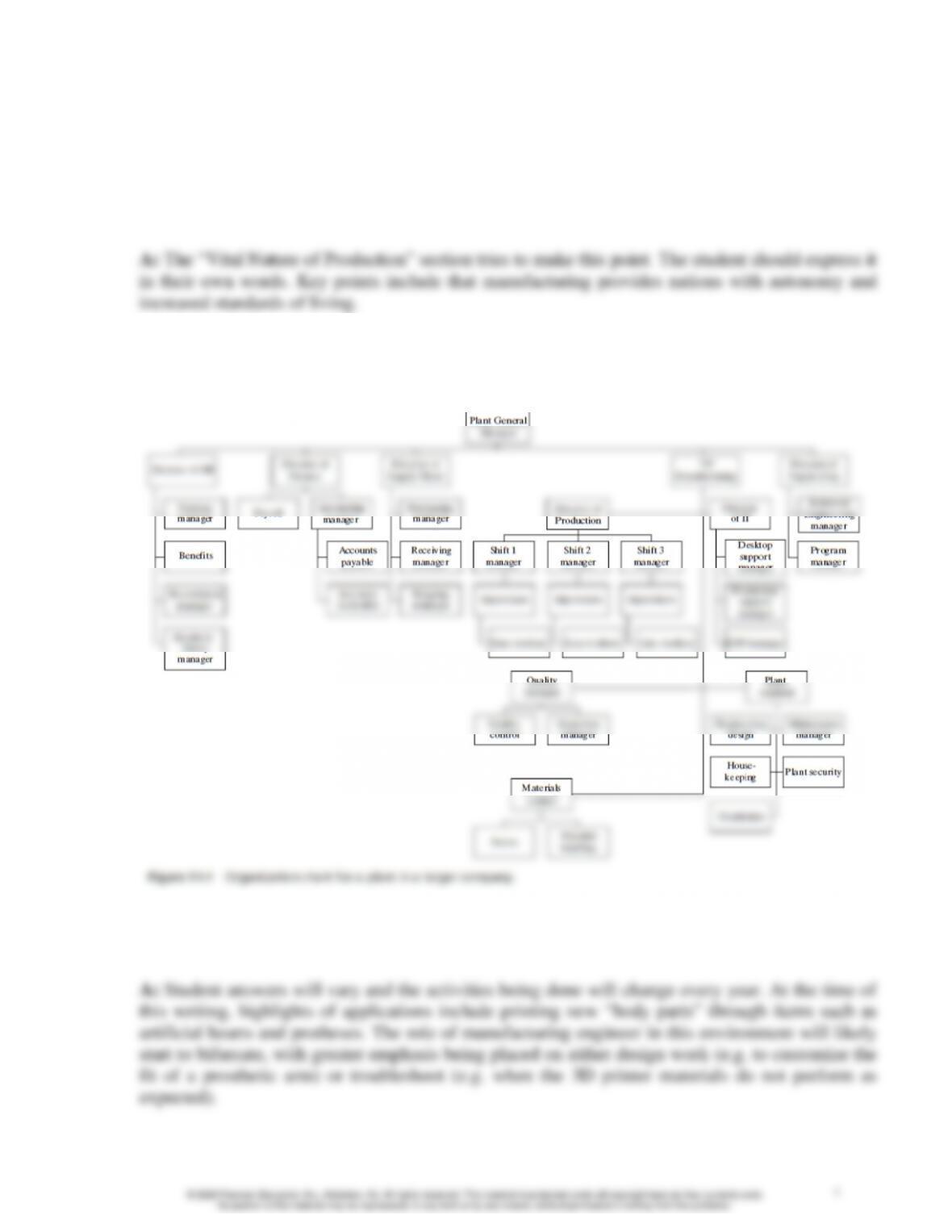
11-2. Q: What are some of the positions that engineers fill in a large manufacturing plant?
A: Fig. 11-1 (displayed below) and the text description of it provide a starting point for an answer.
11-3. Q: Research how manufacturing firms are using additive manufacturing (3D printing). How does
this change the needed skills of a manufacturing engineer?
2
© 2020 Pearson Education, Inc., Hoboken, NJ. All rights reserved. This material is protected under all copyright laws as they currently exist.
No portion of this material may be reproduced, in any form or by any means, without permission in writing from the publisher.
11-4. Q: Discuss some of the factors that would be most important in selecting a site for (a) a cement
plant, (b) a research “think tank,” (c) a software company and (d) a furniture manufacturer.
A: The text identifies some of the factors generally important in locating a plant. (a) cement has
relatively low value per unit weight, so it should be sited near raw materials (limestone and clay)
11-5. Q: Distinguish between (a) product layout, (b) process layout, and (c) group technology.
11-6. Q: List some of the characteristics that make the Dunn and Savastano Orthodontics business
compete with other practices.
11-7. Q: Distinguish between MRP and MRP II.
11-8. Q: Describe how the kanban is used in the just-in-time production system.
11-9. Q: Outline how lean manufacturing has been applied to other industries. What other approaches
discussed in this chapter have moved beyond manufacturing? Why have others not made the
transition?
3
© 2020 Pearson Education, Inc., Hoboken, NJ. All rights reserved. This material is protected under all copyright laws as they currently exist.
No portion of this material may be reproduced, in any form or by any means, without permission in writing from the publisher.
11-10. Q: What is the relationship between FMS (flexible manufacturing systems) and the group
technology concept introduced earlier in the chapter?
11-11. Q: Discuss how the management functions of planning, organizing, leading, and controlling relate
to the production planning process.
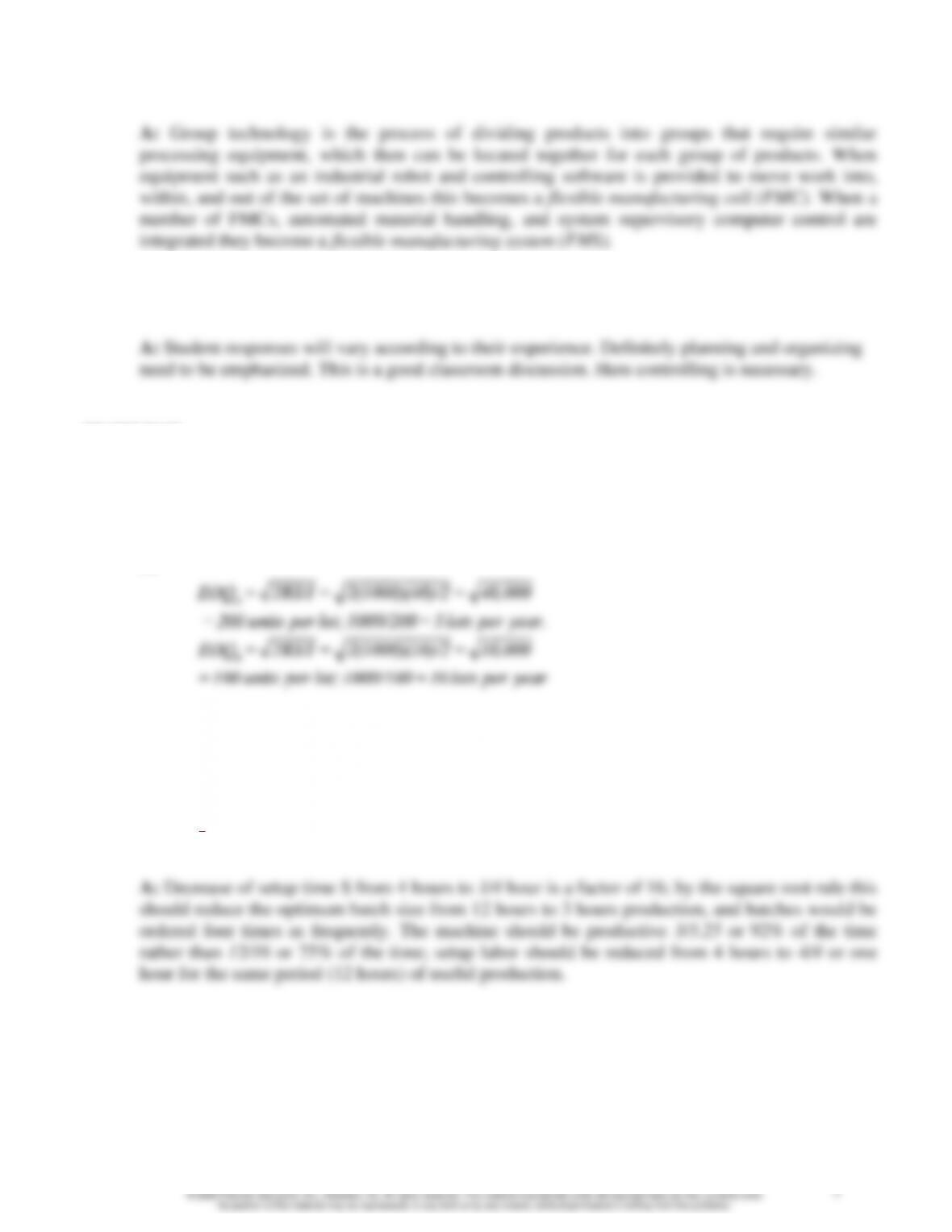
11-1. Q: (a) If it costs $2 per unit to store an item for one year, $40 setup cost every time you produce
a lot, and you use 1000 units per year, how many lots of what size should be manufactured each
year? (b) How would your answer change if the setup cost becomes $10?
A:
11-2. Q: Setup for a stamping operation required a time-consuming fixture installation and testing that
took four hours each time a different part was to be produced; typically twelve hours production
was made for inventory of a given stamping before the machine was stopped to permit setup for
a new part. After careful process analysis, fixtures and transfer methods were revised to permit
setup in fifteen minutes. Discuss the implications for this change on (a) optimum batch size, (b)
order frequency, and (c) machine and labor productivity.
4
© 2020 Pearson Education, Inc., Hoboken, NJ. All rights reserved. This material is protected under all copyright laws as they currently exist.
No portion of this material may be reproduced, in any form or by any means, without permission in writing from the publisher.
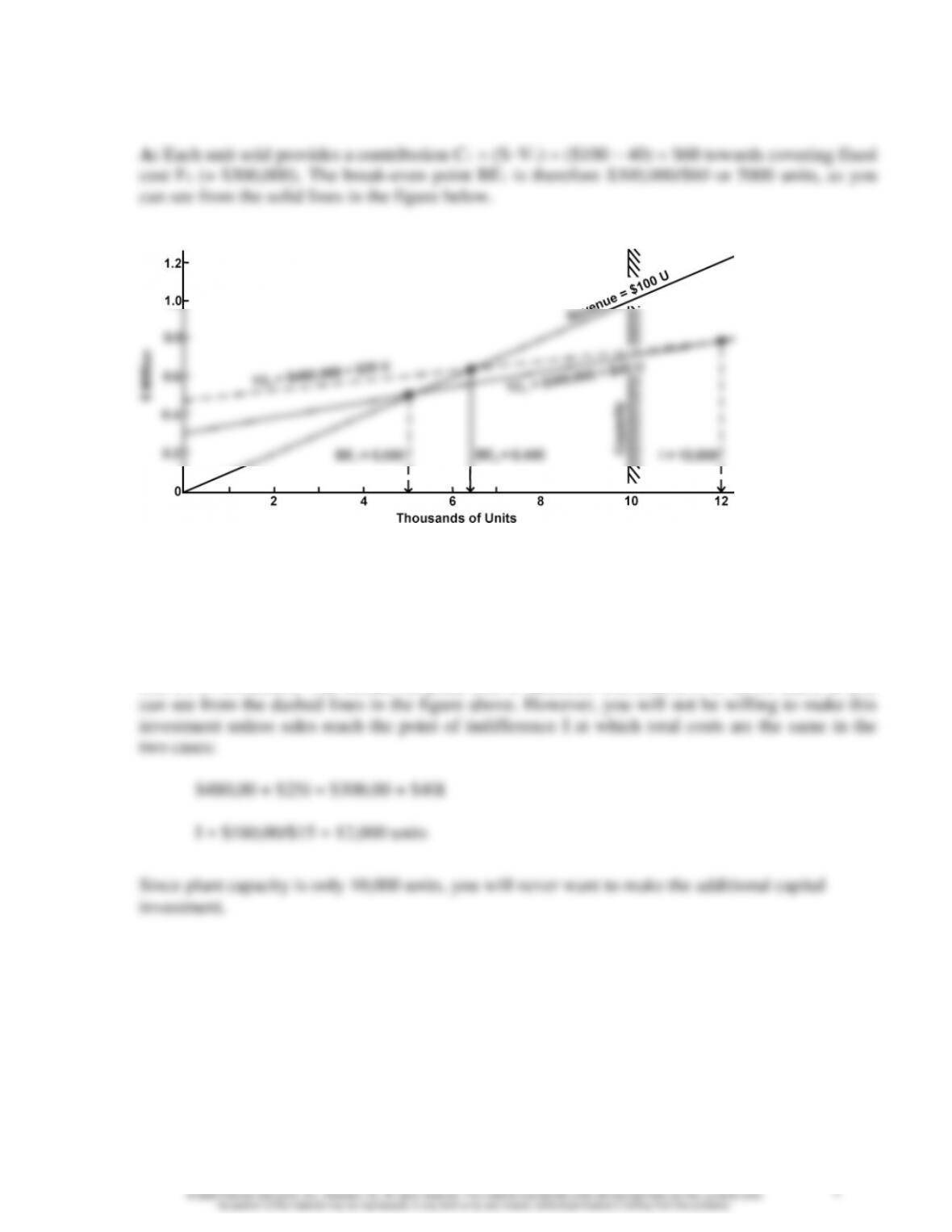
11-3. Q: A production plant with fixed costs of $300,000 produces a product with variable costs of $40
per unit and sells them at $100 each. What is the break-even cost? Illustrate with a break-even
chart.
A: Each unit sold provides a contribution C1 = (S–V1) = ($100 – 40) = $60 towards covering fixed
11-4. Q: A machine tool salesperson offers the plant of question 11-8 equipment that would increase
their fixed cost by $180,000 but reduce their variable cost from $40 to $25. Should the plant
accept this suggestion if they can sell their entire plant capacity of 10,000 units per year at $100
each? Illustrate by modifying the break-even chart of question
A: Each unit sold provides a contribution C2 = (S–V2) = ($100 – 25) = $75 towards covering fixed
cost F2 (= $480,000). The breakeven point BE2 is therefore $480,000/$75 or 6,400 units, as you
5
© 2020 Pearson Education, Inc., Hoboken, NJ. All rights reserved. This material is protected under all copyright laws as they currently exist.
No portion of this material may be reproduced, in any form or by any means, without permission in writing from the publisher.
11-5. Q: A plant is beginning production of a light-alloy product and finds that it takes 400 hours to
produce the first item. How many hours should it take to produce each of the following: (a) the
second item; (b) the eighth item; (c) the thirty-seventh item? (Hint: Refer to Table 11-1)
A: (a,b) According to that table, the learning rate for a light alloy product can be taken as 80%. If
11-6. Q: The first two units of a product cost a total of $9,000 to produce. If you believe an 80%
learning curve applies, how much would you expect the fourth unit to cost?