CHAPTER 11
COOLING TOWER MODEL
OBJECTIVES
• Describe the various components of the cooling tower system
• Describe the principles of heat transfer in the cooling tower system
• Describe the relationship between heat exchangers and cooling towers.
• Draw a simple block flow diagram of the cooling tower model
• List the safety aspects associated with the cooling tower system
• Describe the cooling tower instrumentation systems
• List the operational specifications for the cooling tower system
• Solve various troubleshooting scenarios associated with cooling tower systems.
• Identify common problems associated with cooling tower operation
• Operate the cooling tower system
REVIEW QUESTIONS
1. Describe the purpose of LIC-300, and how it works.
LIC-300 is designed to control the water level in the cooling water basin. The
2. Describe the purpose of AIC-300 pH control and how it works.
AIC-300 is designed to measure and control the pH concentration in the basin.
3. Describe the purpose of AIC-301 blow down system.
AIC-301 has a set point of 30 PPM. This variable is carefully controlled. As
the cooling water flows from the tower to the operating units and back to the
cooling tower it picks up suspended materials. The blow down system
4. Describe the purpose and operation of AIC-302 water treatment control
system.
5. Describe the purpose and operation of TIC-301.
TIC-301 is designed to control the temperature of the hot water returning to
6. Explain how SIC-300 regulates the temperature in the cooling tower cell.
SIC-300 is cascaded to the temperature control system TIC-301. The speed of
7. Explain what the approach to the tower is and how it is calculated.
One of the most important variables controlled on the cooling tower is a term
8. Evaporative cooling accounts for what percentage of the cooling effect in CTW–
302.
9. Define the term “plenum.”
10. Define the term “psychrometry.”
11. List the various ways that CTW-302 is classified.
12. Describe how the temperature in the water basin is controlled so ice formation is
reduced.
13. List the various components of CTW-302.
fan and shroud, basin, plenum, water distribution system, louvers, fill or splash
14. Describe the term, “concentration cycles” and how does it apply to CTW– 302.
Concentration cycles in CTW-302 typically can range from 3 to 7. The
cooling tower is typically set at 6 concentration cycles before it blows down
NAME:____________________________ TEST A
DATE:____________________________
CHAPTER ELEVEN TEST
“A” COOLING TOWER MODEL
1. Evaporative cooling accounts for ___________ to __________ of the cooling
effect in a tower.
a. 10% to 20%
b. 40% to 70%
c. 80% to 90%
d. 90% to 100%
2. The approach to tower is the:
a. Relative humidity minus the dry bulb
b. Wet-bulb minus the dry-bulb
c. temperature delta ∆ that exists between the relative humidity and the wet–
bulb temperature of the air leaving the tower.
d. temperature delta ∆ that exists between the water leaving the tower and
the wet bulb temperature of the air entering the tower.
3. The measurement of how much water the air has absorbed at a given
temperature.
a. relative humidity
b. standard humidity
c. wet bulb
d. approach to the tower
4. Heat that can be measured or sensed is referred to as:
a. latent heat of vaporization
b. latent heat of condensation
c. sensible heat
d. latent heat of fusion
5. A device used in a cooling tower to break up and redirect the flow of falling water.
a. louvers
b. drift eliminators
c. columns
d. splash bars
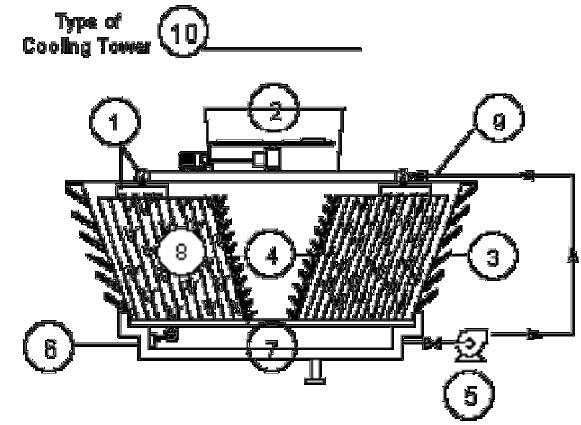
6. Identify the following components:
Cooling Tower Components
6-1_______________ 6-2________________ 6-3______________
6-4_______________ 6-5________________ 6-6______________
6-7_______________ 6-8________________ 6-9______________
6-10______________
7. Devices used in a cooling tower to keep water from blowing out.
a. louvers
b. drift eliminators
c. columns
d. splash bars
8. The objective of cooling water treatment is to reduce or minimize all of the
following except:
a. Scale formation- suspended solids form deposits
b. Corrosion- electrochemical reactions with metal surfaces
c. Fouling- silt, debris, algae plug exchanger tubes
d. Wood decay- fungi
e. pH increase or decrease
f. water deionization
9. The wet bulb temperature is the:
a. the air temperature as measured by a bulb thermometer covered by a
water saturated wick. Takes into account the relative humidity.
b. combination of dry and wet-bulb temperature
c. air temperature as measured by a dry-bulb thermometer
d. wet-bulb temperature minus the relative humidity
10. A cooling tower is classified by:
a. How it produces air flow; mechanical or natural.
b. How the air flows in relation to the downward flow of water; cross or
counter current.
c. How the water flows in relation to the downward flow of air, cross or
counter.
d. a & b
11. Vents located on the side of a cooling tower.
a. louvers
b. drift eliminators
c. columns
d. splash bars
12. The measure of how much water the air has absorbed at a given temperature.
a. humidity
b. wet bulb
c. relative humidity
d. dry bulb
13. A pipe that evenly disperses hot water over the fill of a cooling tower.
a. water distribution header
b. tower water discharge line
c. hot water inlet to cooling tower
d. a & c
14. The framework of a cooling tower most closely resembles.
a. steel and metal frame
b. white pine column
c. plastic screw seams and plates
d. treated post and beam
15. The temperature delta that exists between the water leaving the tower and the
wet bulb temperature of the air entering the tower.
a. wet bulb ÷ dry bulb
b. relative humidity ÷ dry bulb
c. approach to tower
d. temperature delta
16. A common term used to describe the internal buildup on the surface area of a
heat exchanger that results in restricted flow .
a. corrosion
b. plugging
c. fouling
d. scale
17. Sensible heat transfer accounts for __________ to ___________ of the cooling
effect in a cooling tower.
a. 10% to 20%
b. 40% to 70%
c. 80% to 90%
d. 90% to 100%
18. Hot water has all of the following characteristics except:
a. Hot water dissolves a little bit of everything it comes in contact with. By
the time the hot water returns to the tower it is full of suspended solids.
b. Hot water also has a tendency to become corrosive and deposit forming.
c. When hot water enters the cooling tower laced with suspended solids it
undergoes evaporation. This process removes water and leaves the
solids. The remaining fluid concentrates in the basin. Over time this
concentration will build up to levels that must be controlled.
d. Increases oxygen level in the water raising pH levels.
19. A term applied to fluid flow that is equally distributed to multiple pieces of
equipment. Example heat exchanger
a. parallel flow
b. series flow
c. cross flow
d. counter-current flow
20. The open area located directly under the fan is referred to as:
a. the water distribution system
b. the plenum
c. louvers
d. upper drift elimination section
21. The typical speed on the fan is:
a. variable
b. 1000 RPM
c. 1250 RPM
d. 1850 RPM
22. TIC-301 has an operating set point of:
a. 125ºF
b. 135ºF
c. 150ºF
d. 212ºF
23. The condenser is:
a. Ex–202
b. Ex–203
c. Ex–204
d. Ex–305
24. The cooling tower is labeled as:
a. CTW-202
b. CTW-203
c. CTW-302
d. CTW-405
25. FIC-300 operates at:
a. 525 GPH
b. 225 GPM
c. 325 GPH
d. 525 GPM
26. How many analyzers are located on the cooling tower?
a. 1
b. 2
c. 3
d. 4
27. LIC-300 operates at:
a. 30%
b. 40%
c. 50∞
d. 75%
28. The pH on the cooling tower is operated at:
a. 6.8 pH
b. 7.0 pH
c. 7.2 pH
d. 7.8 pH
29. PPM in the water basin is controlled at:
a. 30 PPM
b. 60 PPM
c. 100 PPM
d. 800 PPM
30. The cooling basin temperature is:
a. 60ºF
b. 75ºF
c. 85ºF
d. 100ºF
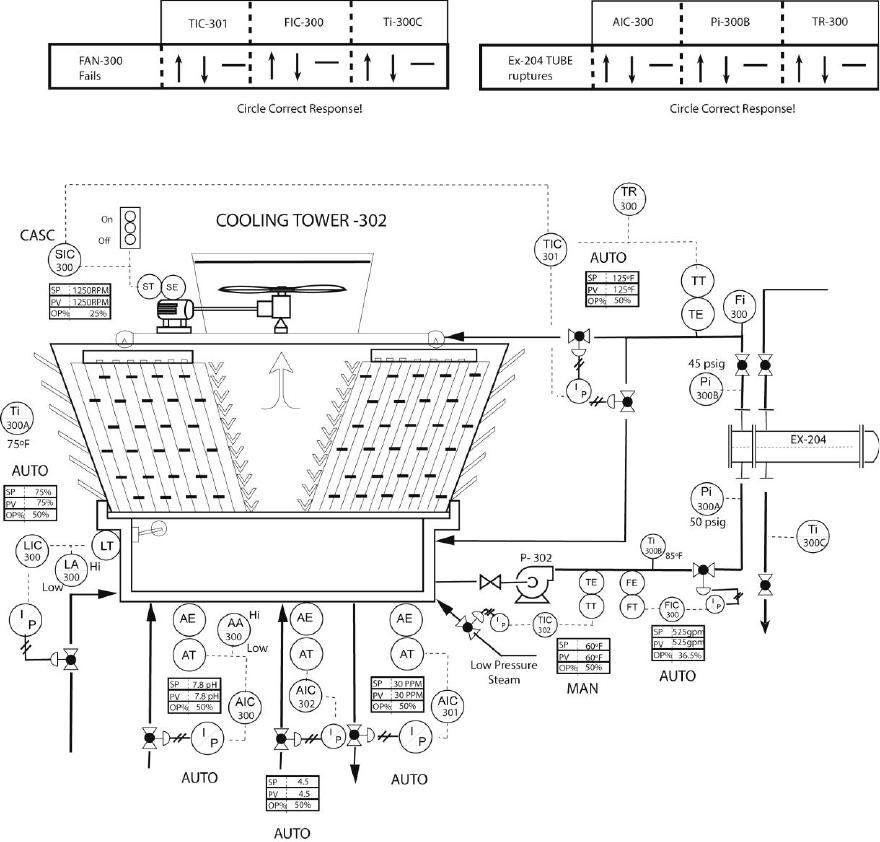
31. Cooling Tower
1
2
3
4
5
6
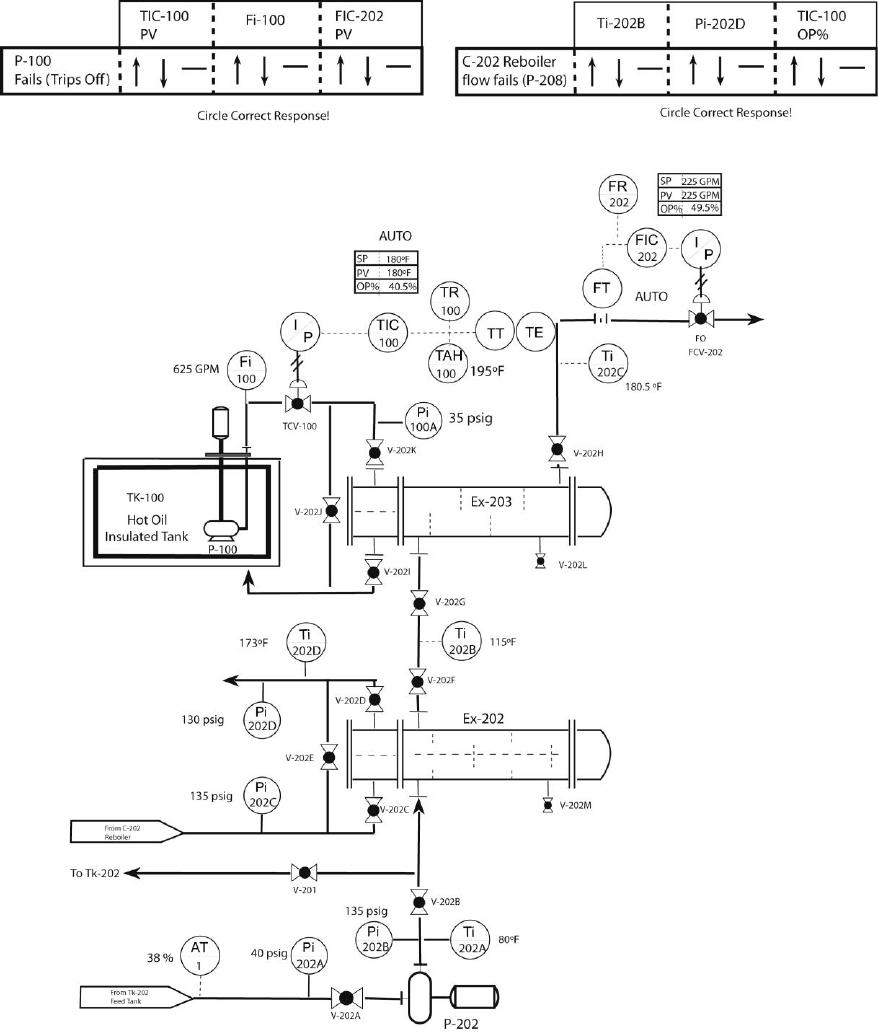
32. Cooling Tower
1
2
3
4
5
6
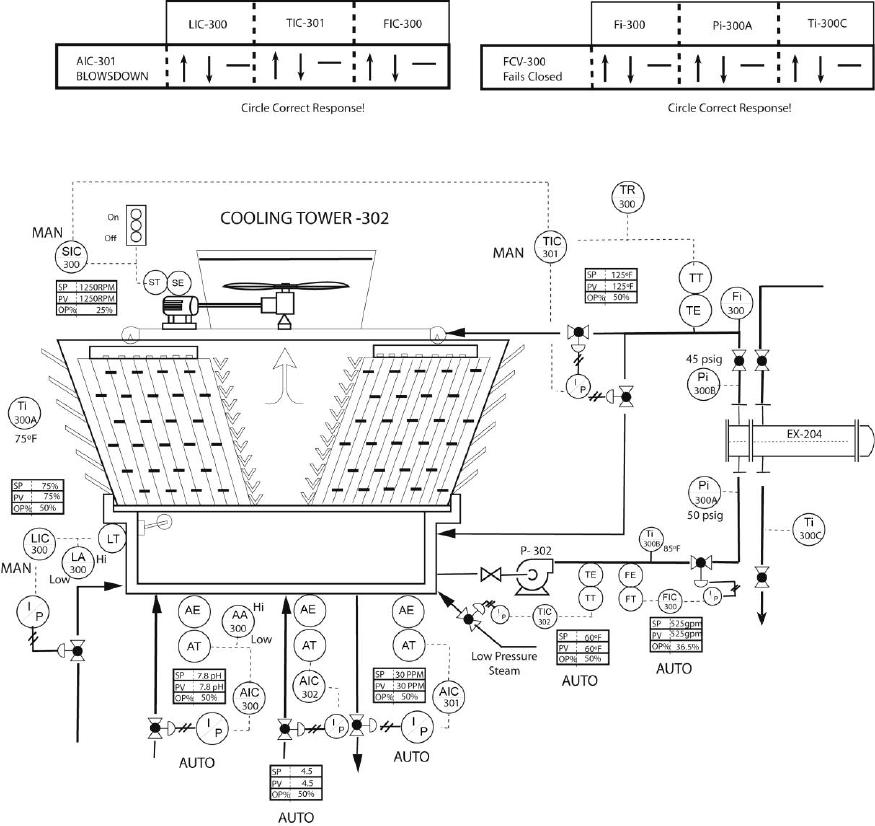
33. Cooling Tower
1
2
3
4
5
6
Answer Key CHAPTER 11 TEST A
COOLING TOWER MODEL