1
© 2020 Pearson Education, Inc., Hoboken, NJ. All rights reserved. This material is protected under all copyright laws as they currently exist.
No portion of this material may be reproduced, in any form or by any means, without permission in writing from the publisher.
Chapter 10
Managing Engineering Design
DISCUSSION QUESTIONS
10-1. Q: Outline how the design approaches outlined in this chapter might have led to the failures
experienced by Toyota and Takata.
10-2. Q: How does the design work done in the technical feasibility stage of new product
development differ from that done in the later design stages?
10-3. Q: Are there products that should not consider human factors in their design? Why or why not?
10-4. Q: For an engineering design or project management system you are familiar with, describe the
drawing release and design review processes.
A: Each answer must be evaluated separately; one hopes the systems described will achieve the
10-5. Q: Summarize the history of gradually increasing liability of industry for damage caused by
their products.
2
© 2020 Pearson Education, Inc., Hoboken, NJ. All rights reserved. This material is protected under all copyright laws as they currently exist.
No portion of this material may be reproduced, in any form or by any means, without permission in writing from the publisher.
10-6. Q: Research the results of two recent product liability cases. Based on these examples, are
companies being held accountable for their actions? Why or why not?
10-7. Q: Select a product line in a specific industry and list actions that can be taken to reduce
product liability.
A: While each answer will be different, a few student responses may serve as examples: (1)
10-8. Q: Identify a company and product (aside from television or automobiles) and tell how good or
poor reliability has significantly affected company success.
10-9. Q: Describe some mechanisms a designer can use to improve maintainability.
A: Increasing reliability increases the MTBF, and designing to minimize the need for
10-10. Q: Give an example of a consumer product with which you are familiar that, through recent
redesign, seems to be a greater value (a better ratio of utility to apparent cost).
A: Most electronics are examples of products that have undergone a substantial increase in
3
© 2020 Pearson Education, Inc., Hoboken, NJ. All rights reserved. This material is protected under all copyright laws as they currently exist.
No portion of this material may be reproduced, in any form or by any means, without permission in writing from the publisher.
10-11. Q: Discuss how the management functions of planning, organizing, leading, and controlling
relate to the engineering design process.
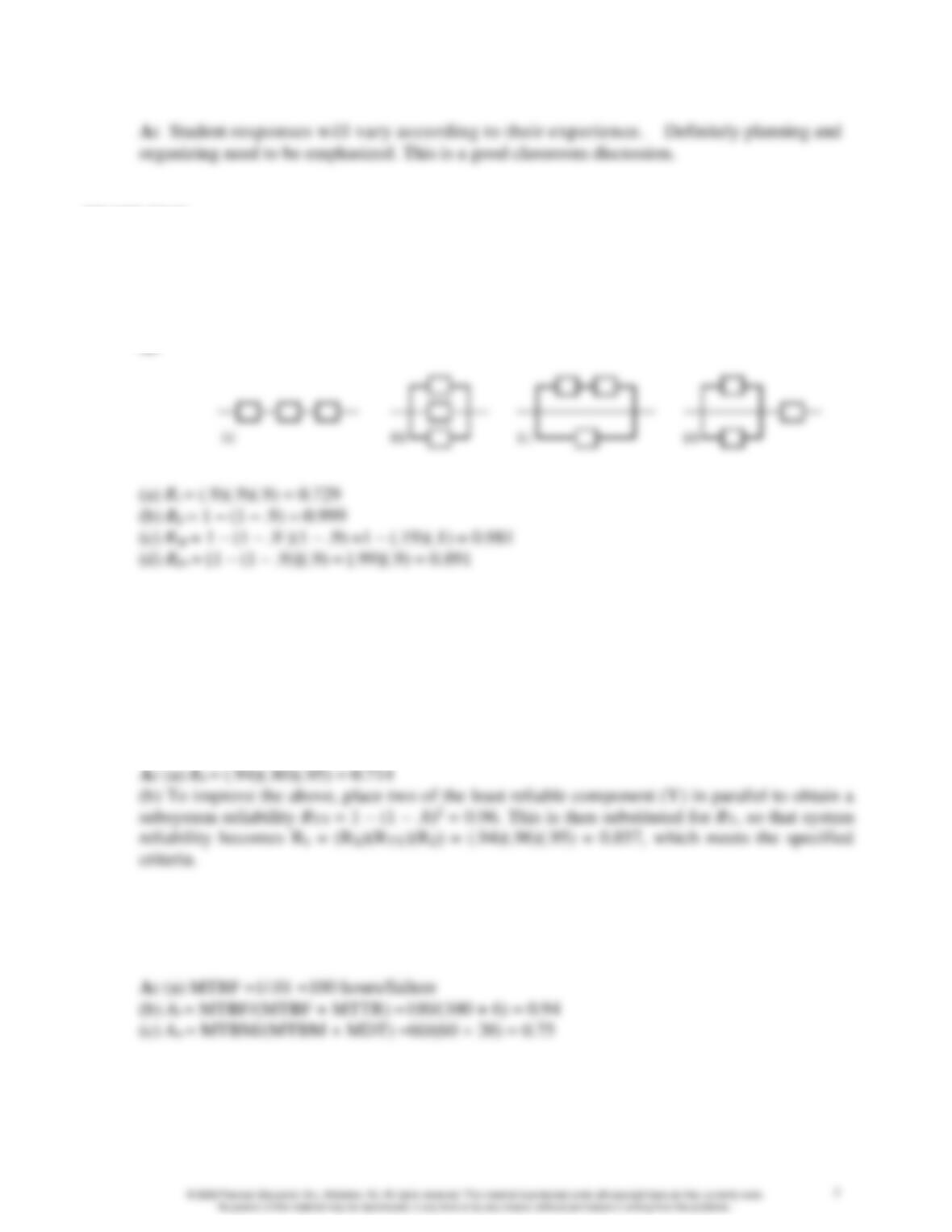
10-1. Q: Given three components, each with a reliability of 0.9, calculate the reliability of a total
system in which the three are arranged (a) three in series, (b) three in parallel, and (c, d) in two
different series/parallel designs each using a total of three components.
A:
10-2. Q: An engineered system consists of one each of three components X, Y, and Z with
reliabilities RX, RY, and RZ of 0.94, 0.80, and 0.95 respectively (underlined data omitted in first
printing of the 2nd edition).
(a)
What is the system reliability assuming one component of each type must work?
(b)
If required system reliability is 0.85, show how you can meet this goal by replacing one of
these components with two of that same component in parallel.
A: (a) Ra = (.94)(.80)(.95) = 0.714
10-3. Q: An engineered system has a hazard rate of 0.01 failure per hour.
(a) What is its MTBF? If the same system has a MTBM of 60 hours, a MDT of 20 hours, and a
MTTR of 6 hours, what is its (b) inherent availability and (c) operational availability?