CHAPTER 1
INTRODUCTION TO PROCESS INSTRUMENTATION & TROUBLESHOOTING
OBJECTIVES
• Describe the basic instruments used in the process industry.
• Describe key terms associated with process control and troubleshooting
• List the various types of control loops.
• Explain how symbols and diagrams are used by process technicians in the
chemical processing industry.
• Describe the various troubleshooting models.
• Describe the methods used in troubleshooting process problems.
REVIEW QUESTIONS
1. Describe the two different types of analyzers and explain how each is designed
to work.
Analyzers can calculate both quantitative and qualitative variables. Quantitative
variables are most closely associated with the amount or percentage present in a
process. Qualitative analyzers simply determine whether a substance is present
or not. Examples of this are analyzers that are designed to detect the presence
of methane gas.
2. List the primary elements and sensors associated with flow.
3. List the primary elements and sensors associated with temperature.
4. List the primary elements and sensors associated with pressure.
Pressure Elements, shows several examples of these instruments.
Examples of process instruments include:
• Pressure elements—sense changes in pressure and convert to
5. List the primary elements and sensors associated with level.
Examples of level elements and instruments include:
• Displacer— buoyancy devices
• Sight glass—transparent tube mounted on the side of a tank.
• Float and tape—float rests on the surface of the fluid. Tape moves up and
6. Explain why the skills required to be a jet fighter pilot are similar to those skills
required to be a process technician.
7. How do increases and decreases in pressure inside an enclosed vessel impact
the boiling point of a substance?
8. Why is it so difficult to develop for educators a pure “process
instrumentation” textbook?
When the curriculum for the process technology program was originally
designed, it was decided that an introductory course in “process”
instrumentation should be included in the required core classes. The design
of this course would be different from any that was presently being offered at
community colleges or universities. During this time period instrumentation courses
The transition to the development of a “process” instrumentation course has
been difficult since old habits are hard to let go of. A number of texts have been
developed, unfortunately, each still reads like required course work for an
instrumentation program. The needs of a process technician are drastically
Process technology and modern process instrumentation for process
technicians should merge around the concepts of the control loop, equipment
systems and the control room. Course work needs to resemble real time process
simulations. It is important to point out that process technicians are uniquely different
from other occupations. A process technician operates the equipment and
processes using modern instrumentation and electronics. Maintenance technicians
9. What is temperature defined as?
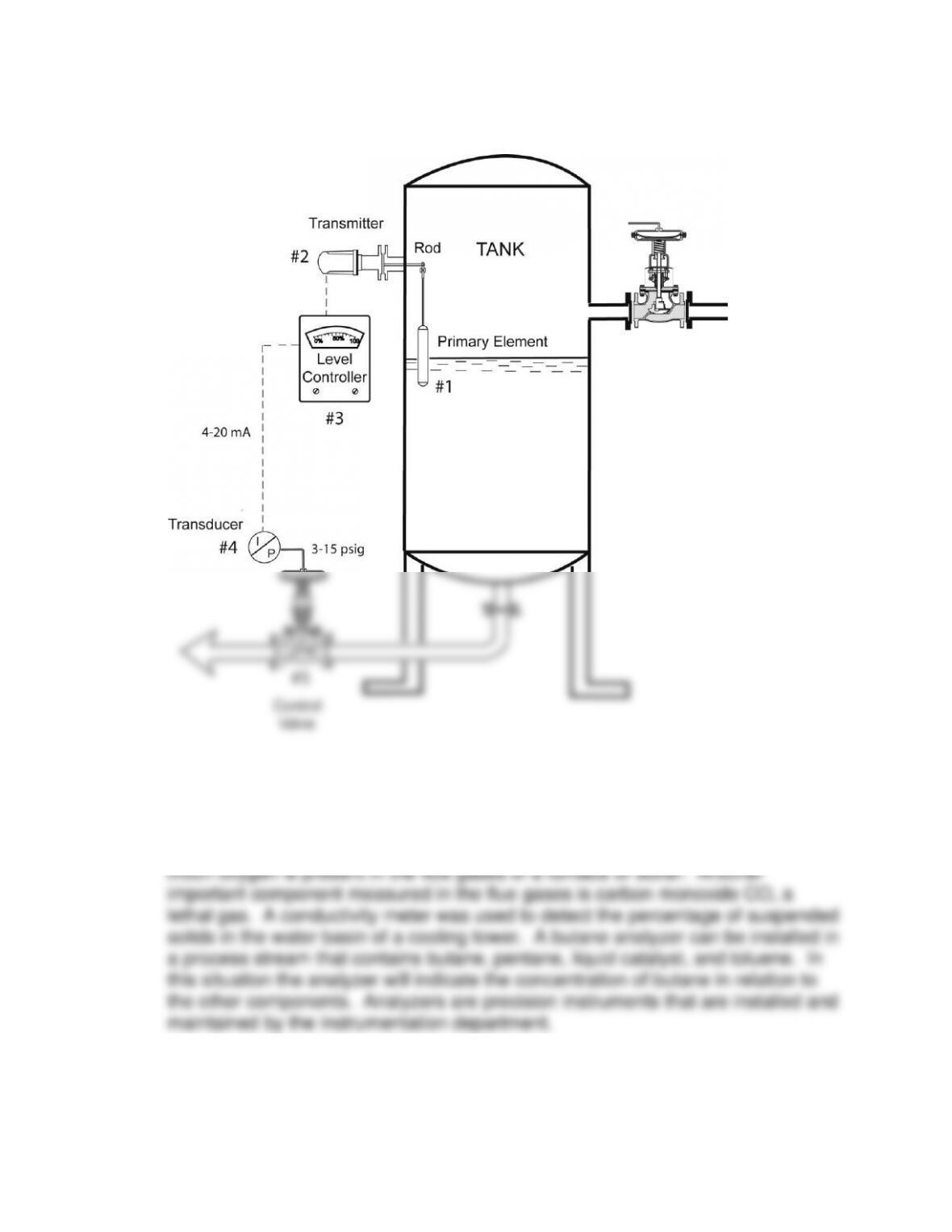
10. Draw a simple control loop. Explain the purpose of each device.
11. Explain how analyzers are used on fired heaters, cooling towers, boilers, and a
stirred reactor.
Analyzers are devices that are designed to detect the concentration of a specific
component or element. For example an O2 analyzer is designed to detect how
12. Explain the importance of memorizing the process instrumentation symbols and
diagram file. The importance of learning these symbols and diagrams is also
13. List the nine common equipment troubleshooting models presently being studied
at most community colleges and universities.
2. Compressor Model
4. Cooling Tower Model
6. Furnace Model
8. Reactor Model
14. List the four different troubleshooting methods and explain the special features of
each.
1. Method One: Educational (Completed in College Program)
• Basic knowledge of the equipment and technology
2. Method Two: Instrumental (Completed in College Program)
• Basic understanding of process control instrumentation
3. Method Three: Experiential (Completed on-the-job)
• Experience operating specific equipment and system
4. Method Four: Scientific (Requires engineering technology, process
technology, experience, and high aptitude)
• Grounded in principles of mathematics, physics, and chemistry
15. Identify the most difficult to achieve troubleshooting method and explain why?
Method Three: Experiential (Completed on-the-job)
• Experience operating specific equipment and system
Method Four: Scientific (Requires engineering technology, process technology,
experience, and high aptitude)
• Grounded in principles of mathematics, physics, and chemistry
• Theory-based operations
The most difficult method to achieve is four because it requires a combination
of experience, aptitude, engineering, and typical process technology methodology.
NAME:____________________________ TEST A
DATE:____________________________
CHAPTER ONE
TEST INTRODUCTION TO PROCESS INSTRUMENTATION & TROUBLESHOOTING
1. An analytical variable is:
a. a device used to measure physical and chemical compositions of
materials.
b. transmitted continuously as air pressure, electric current, or voltage.
c. process variables associated with the chemical or physical composition of
a material.
d. used to measure temperature changes by changes in electrical resistance.
2. A RTD is used to measure:
a. pressure
b. flow
c. level
d. temperature
3. A control loop is:
a. a single instrument designed to control process variables.
b. a computer system connected to a network of process variables.
c. a term used to describe a process operating team.
d. a collection of instruments that work together to automatically control
process variables.
4. Process technology and modern process instrumentation for process
technicians should merge around the concepts of:
a. the control loop
b. equipment systems
c. the control room
d. all the above
5. List five different types of control loops.
a.
b.
c.
d.
e.
6. List the nine troubleshooting models discussed in this chapter.
a.
b.
c.
d.
e.
f.
g.
h.
i.
7. List the four troubleshooting methods discussed in this chapter.
a.
b.
c.
d.
8. Each of the following are examples of flow elements except:
a. turbine flow meter
b. vortex flow meter
c. orifice plates
d. conductivity probe
9. A French scientist named Blaise Pascal is associated with:
a. temperature in fluids
b. pressure in fluids
c. gas volume changes
d. practical applications in pump design
10. An Irish scientist named Robert Boyle developed laws that describe:
a. how pressure in fluids is transmitted equally to all distances and in all
directions.
b. how the volume of a gas changes when the pressure changes
c. gas volume changes
d. variations in pump compression ratios
11. Flow rates are controlled through a relationship between ____________ and
__________________.
a. centrifugal pumps, flow control loops
b. positive displacement pumps, control loops
c. centrifugal pumps, level control loops
d. a & c
12. Flow elements are described as:
a. devices designed to transmit a signal
b. devices designed to compare a signal and regulate a final control element.
c. devices designed to simulate a situation that can be measured.
d. devices designed to regulate flow.
13. All of the following are examples of flow elements except:
a. orifice plates
b. vortex meters
c. helical
d. turbine meter
14. A flow control loop includes the following parts:
a.
b.
c.
d.
e.
15. Pressure is defined as: ____________________________ .
16. Atmospheric pressure is defined as: ___________________ .
17. Examples of pressure control elements include all of the following except:
a. C-type bourdon
b. bellows bourdon
c. helical bourdon
d. spiral bourdon
e. diaphragm bourdon
18. Pressure gauges include all of the following except:
a. psim- manometer
b. psia- absolute
c. psid- differential
d. psig- gauge
e. psiv- vacuum
19. Level elements include all of the following except:
a. displacer
b. sight glass
c. convective probes
d. D/P cell
e. capacitance probe
20. Temperature is defined as? _______________________________ .
21. What is the boiling point of water in:
ºF ________
ºC________
22. List three temperature measuring elements:
a.
b.
c.
23. Analyzers are devices designed to:
a. identify the presence of a substance
b. calculate particle concentration in a process stream
c. identify the concentration of a substance
d. a & c
24. Sketch a typical control loop.
Chapter 1
Introduction to Process Instrumentation and Troubleshooting
Answer Key
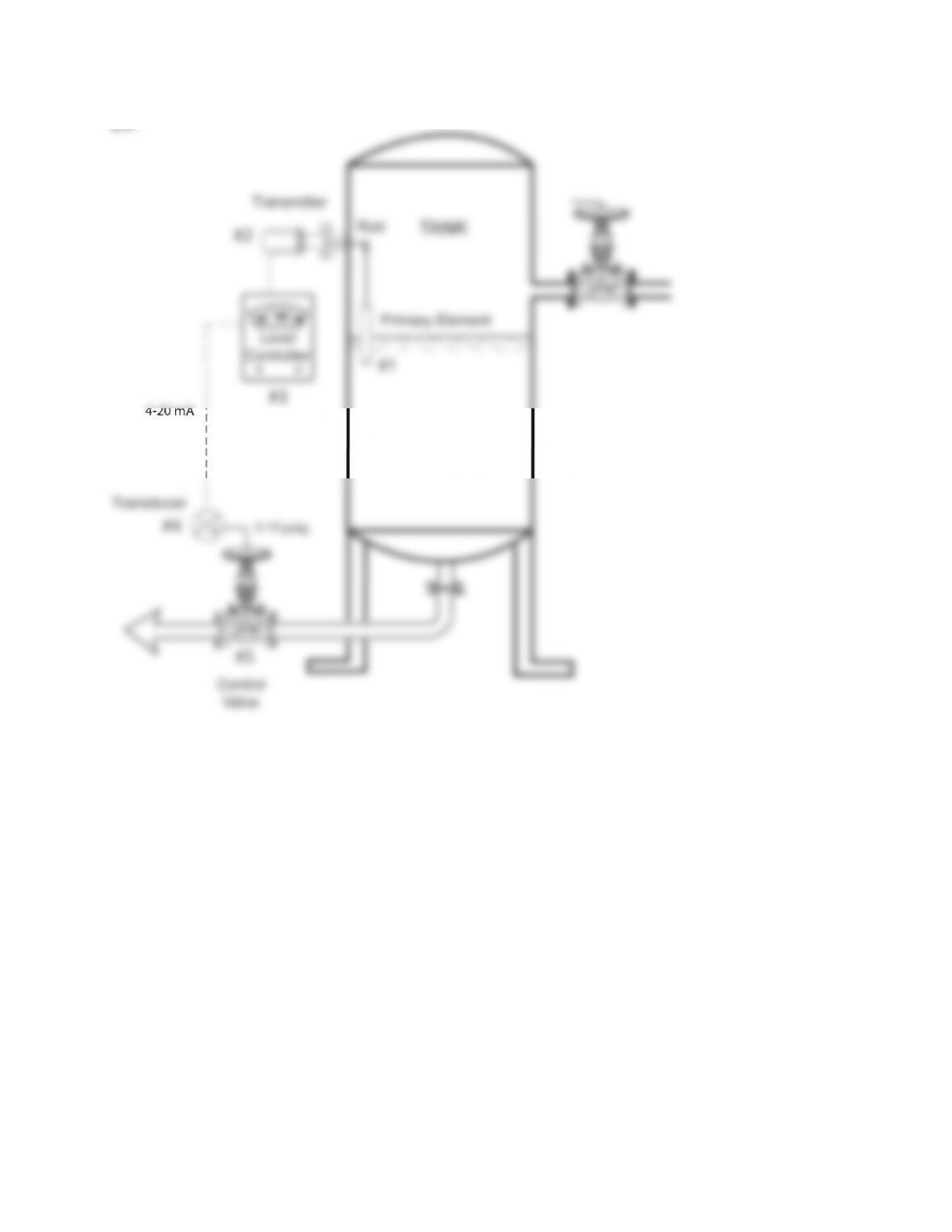
24.