
Preface Page
Copyright ©2014 Pearson Education Inc. publishing as Prentice Hall
i
Preface
Instructor’s Manual Overview
This instructor’s manual has been created as an easy–to-use guide for the classroom
instructor. The maximum amount of detail has been provided for each major teaching point
Components of the Instructor’s Manual
Each chapter of the instructor’s manual contains a detailed lecture outline, discussion
questions and answers, and individual and team exercises.
Lecture Outline
The lecture outline follows the textbook and provides relevant details for each teaching
Discussion Questions
The discussion questions are taken from the chapter objectives. One question is provided
Exercises
The number of exercises provided for each chapter varies, but at a minimum, each of the
following areas will be covered for every chapter.
Self-Analysis. As a means for allowing students to internalize the lessons of the course, each
Web Crawling. To appeal to the digital-friendly nature of most students, each chapter is
provided with a web search exercise. Most of these will involve searching for outside
references on concepts given in the textbook and writing analyses of the similarities and
differences between the textbook and any discovered Internet-based information. In some
cases, students will be directed to take free web-based versions of some OB tools for self-
reflection and analysis.
Teamwork. While the emphasis on the use of teams in the classroom varies from institution
to institution, it is important that students studying OB learn, through experience, some of
Preface Page
ii
Analyzing Your Organization (Cumulative Project). As another means of helping students
internalize the major concepts of the course, they are encouraged to apply them directly to
while still allowing sufficient time for classroom exercises and activities.
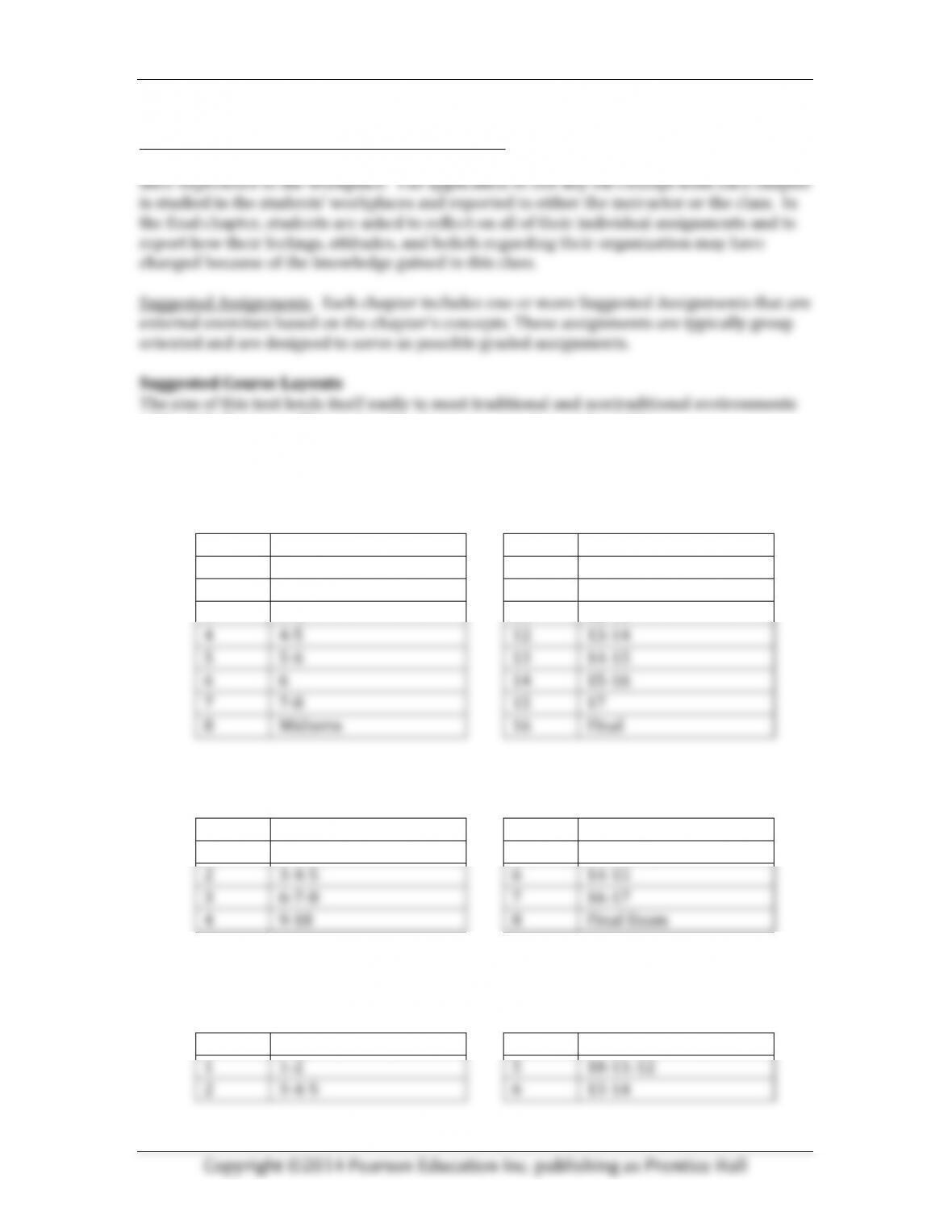
Traditional Semester/Quarter Systems
The traditional semester system of 16 weeks allows ample time for the use of many of the
exercises provided in this manual. The 13-week quarter systems may require slight
compression of the material, which could limit the amount of time available for classroom
exercises.
Week
Chapter/Activity
Week
Chapter/Activity
1
1
9
9-10
2
2
10
11-12
3
3-4
11
12–13
4
4-5
12
13–14
5
5-6
13
14–15
6
6
14
15–16
7
7-8
15
17
8
Midterm
16
Final
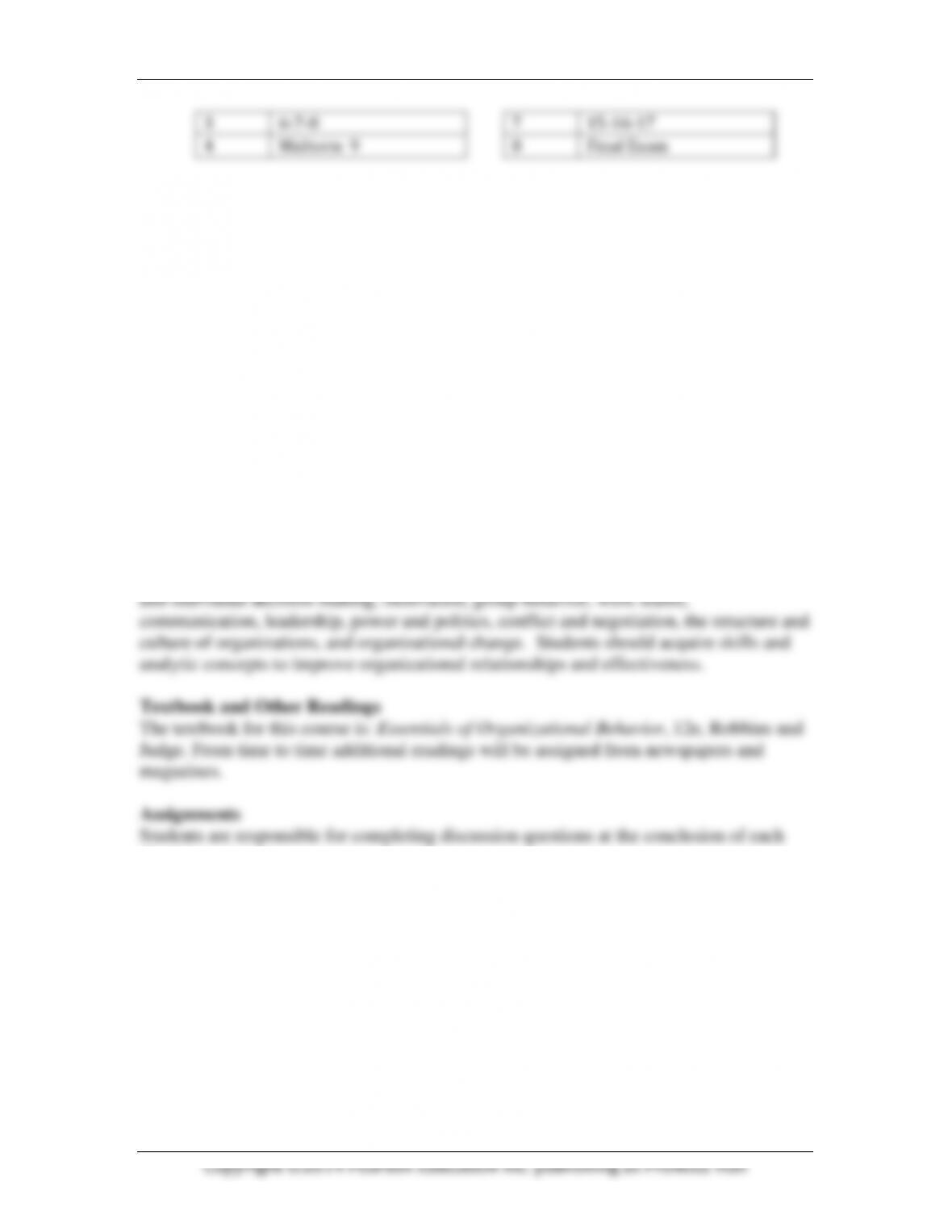
Traditional Summer/Intensive Course Eight-Week Systems
It is strongly recommended that intense courses such as these maximize the use of in-class
and team-based activities to create a more dynamic classroom experience.
Week
Chapter/Activity
Week
Chapter/Activity
1
1-2
5
11–12–13
2
3-4-5
6
14–15
3
6-7-8
7
16–17
4
9-10
8
Final Exam
Non-Traditional (Four to Five Week) Systems
Non-traditional classrooms have the greatest need for compression of material and may
have few alternatives regarding the use of class exercises. Still, instructors are strongly
encouraged to include at least one exercise for every two chapters.
Session
Chapter/Activity
Session
Chapter/Activity
1
1-2
5
10–11–12
2
3-4-5
6
13–14
Preface Page
iii
3
6-7-8
7
15–16–17
4
Midterm 9
8
Final Exam
SAMPLE SYLLABUS
Introduction to Organizational Behavior
Spring 2014
Joan Smith
Office: HH 235; ext. 6789
Email: Smithjj@uaa.edu
Office Hours: T and TH 10am – noon
Course Description and Objectives
This course provides a one-term introduction to, and survey of, basic organizational
behavior concepts and their application in contemporary organizations. The field of
organizational behavior focuses on issues related to human behavior and interpersonal
relations within an organization. The course will include conceptual frameworks, case
discussions, and skill oriented activities. Topics include diversity in organizations,
attitudes and job satisfaction, emotions and moods, personality and values, perception
chapter.
Students will also complete a Self-Analysis exercise and Web Crawling exercise for each
chapter. Each of these assignments is worth 10 points for a total of 340 points. These
exercises will be discussed in class.
A cumulative project will be due the last week of the course. Details of the assignment
will be given during lecture each week. The cumulative project is worth 150 points.
Preface Page
iv
Examination Policy
In this course, there will be two examinations, a midterm and a comprehensive final
examination. The midterm is worth 150 points and the final examination that is worth
300 points.
You must take exams with your class at the assigned period. Make-up examinations are
given only for rare and unusual circumstances.
Grading Policy
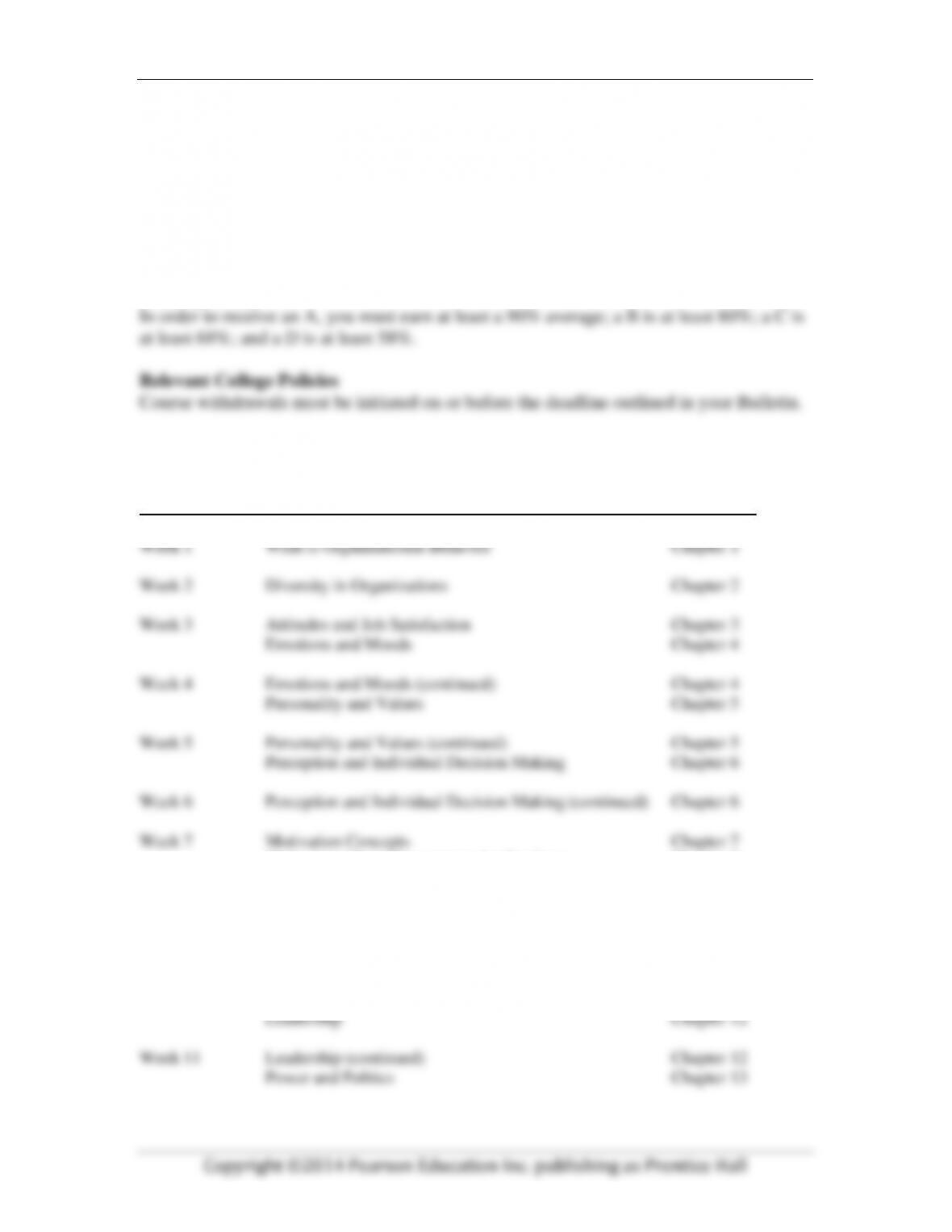
TOPICS AND ASSIGNMENTS
Week Topic Assignment
Motivation: From Concepts to Applications Chapter 8
Week 8 MIDTERM EXAMINATION
Week 9 Foundations of Group Behavior Chapter 9
Understanding Work Teams Chapter 10
Week 10 Communication Chapter 11

Preface Page
v
Week 12 Power and Politics (continued) Chapter 13
Conflict and Negotiation Chapter 14