120
PART III
NOTES FOR THE EXERCISE BOOK
121
INTRODUCTION TO THE INSTRUCTOR’S MANUAL
FOR THE EXERCISE BOOK
Each chapter in the text presents either a major concept, a basic tool or process, or a fundamental
force (i.e., labor markets, government, etc.) that has an impact on every compensation system. The
Exercise Book provides a set of easy-to-understand, analytical exercises that guide students through the
design and development of a compensation program in which they play the role of a compensation
specialist. The Exercise Book is accompanied by software which can be used with eight exercises.
Through the use of the text and its accompanying exercise book, including the software, theory
flows into direct application. This flow of information and the relationship between theory and
application enable the students to visualize and, through personal involvement, relate the many and varied
elements of a basic compensation system. Practical applications, in addition to standard reading
assignments, enhance the learning opportunities and serve as a first step for anyone interested in
becoming a specialist in this area of management. These assignments and exercises will also assist
managers who, although not directly involved as specialists in compensation management, need to be
better equipped to handle the varied and frequently unstructured roles they face daily in performing their
jobs. The exercises provide them with an understanding of the basic components of the compensation
system within the employer-employee exchange process. As a place to begin, the Introduction to
Olympia, Inc. in the Exercise Book provides information about how a compensation department might be
structured, summary descriptions of compensation-related jobs, and pay data for compensation positions.
For those instructors who wish to minimize the number of exercises in the course, the
following is a list of what can be considered the CORE exercises:
122
TERM PROJECT
DESIGNING A COMPENSATION POLICY AND ADMINISTRATION MANUAL
This Term Project in the Exercise Book can be used as a term project or possibly a take-home
final examination. It can be done as either an individual exercise or a group project. The authors have
used it as a group project to be completed over the term. The project serves as a capstone and a review of
everything covered in the course. In order for a student to appreciate the scope of the project, some time
should be spent explaining how, ideally, such a manual is developed.
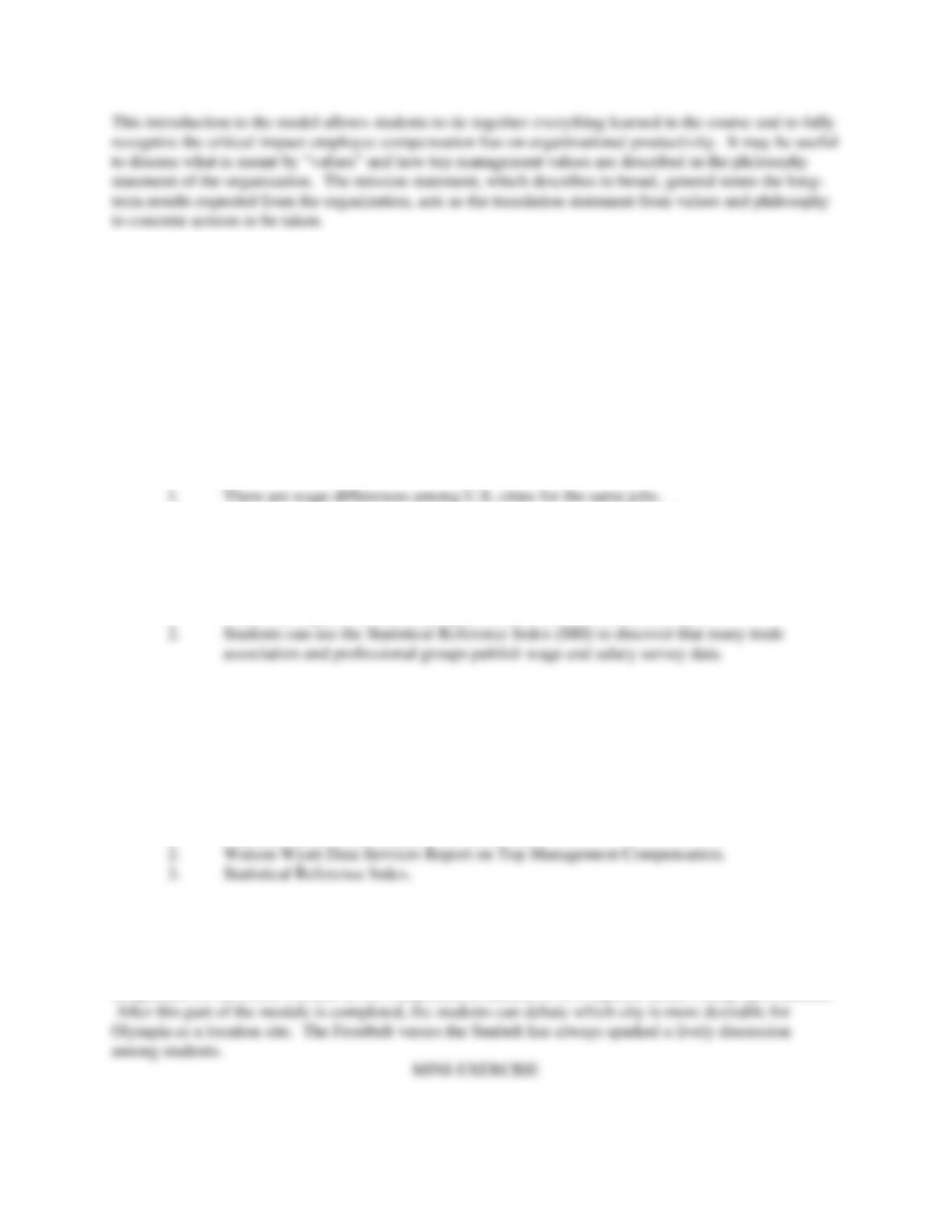
A starting point for discussing the term project may be to use the model following this paragraph
to explain how top management’s and the board of directors’ (owners’) values impact the reward
structure of the organization, which in turn directly influences employee motivation, employee workplace
behavior, and, finally, organizational productivity.
123
The rubber finally meets the road when jobs are identified and defined, incumbents are selected to
perform these activities, and rewards are given relative to employee contributions. If the compensation
rewards can be linked both to employee performance and to employee lifestyle demands, the possibility
that compensation will act as a motivator of positive workplace behavior increases dramatically.
Teaching Note A
As part of the compensation policy and administration manual the instructor may wish to assign
different U.S. cities included in the Bureau of Labor Statistics Occupational or Area Wage Surveys. This
allows two additional teaching points to be made.
2. Area C.P.I. figures can be examined to help explain area wage differences.
Another useful teaching aid is to assign different industries to the student groups. There are two
teaching points for this:
1. There are wage differences among different industries for the same job.
Teaching Note B
The instructor can use different industries to demonstrate how to survey executive compensation.
The authors have required students to survey the executive compensation of the CEO/Presidents of their
assigned industry. The students are instructed to use the following sources.
1. Annual Report/10-K (available on the internet)
Teaching Note C
The assignment of different cities allows the instructor to include the following Mini-Module
assignment for inclusion whether in the compensation manual or as a separate homework/project module.
124
Instructor’s note: This mini-exercise will expose students to various sources of compensation-related
data.
After reviewing the recent Alexander Grant and Company Business Climates Study, Olympia’s
Pat developed the following checklist to guide her in her analysis:
2. Age distribution
4. Employment
—Unemployment rate
—Average hours and earnings
5. Inflation/Cost of living
6. Local and state employment and labor laws
11. Climate
12. Commuting/Transportation
13. Housing costs
15. City, county, and state taxes (property, income, and sales)
ASSIGNMENT
Gather the information that Pat needs to help Olympia’s board to decide if they should relocate the
plastics company.
SOURCES OF INFORMATION
Local Chamber of Commerce
Local Multiple Listing Service
State Employment Commission—State Laws

125
Commerce Clearing House, Employment Practices Guide
Vernon’s Civil Statutes of the State of ________ Annotated Labor
(Worker’s Compensation Law)
Local labor union contracts
For the instructors who want an assignment that will replace the development of a compensation
126
TERM PROJECT II
The assignment on the next page may be used instead of the Term Project in the Exercise Book. It
requires the student to use previously acquired education, experience, and skills to respond to the attached
Request for Proposal (RFP) from your instructor as a representative of OMEGA Organization.
127
TERM PROJECT II—Continued
Assignment:
• Review the RFP and relate RFP information and requirements to Planning Model.
• Review previously completed Exercises and research performed on the assignments to develop
response(s) to the RFP.
The RFP provided for Term Project II is a standard device used by organizations in both public
and private sectors for establishing criteria applicable to organizational improvement projects to be
performed by internal or external consultants.
The instructor may modify the RFP by adding specific information and data that will give the
organization unique qualities. For example, the instructor might provide specific organizational
dimensions to OMEGA, i.e., total number of employees, number of exempt employees, number of
nonexempt employees, number of levels of management, number of managers at each level, number of
professionals, paraprofessionals, and/or technicians. The instructor could also include the development
and use of teams and an appropriate team-based compensation program.
128
OMEGA ORGANIZATION
REQUEST FOR PROPOSAL
Contents of Request for Proposal
This Request for Proposal (RFP) consists of the following:
Part I. Statement of Work
A. Background Information
Part II. Evaluation Criteria

PART I
STATEMENT OF WORK
The Department of Human Resources of OMEGA has been authorized to perform a Human
Resources Management Improvement Study that focuses on developing a workable compensation system
that will have a positive impact on organizational productivity and employee performance.
A. Background Information
Within these functional units, membership consists of such major occupational groups as
executive, managerial, professional, technical, and operative personnel. Employees in three of the output
groups (product and service providing employees) are members of recognized collective bargaining units
(unions).
The benefits package provided to each OMEGA employee also varies according to the
employee’s particular pay structure. The current pay plan also allows for merit increases to those
employees whose performance meets or exceeds certain preset standards.
B. Issues and Problems
Over the past five years, a number of issues and problems have been identified that relate directly
to current pay policies, procedures, methods, and/or instruments. A fundamental reason for this proposal
is to eliminate, or at least minimize, the ill- and unwanted- effects on the organization caused by these key
problem areas:
1. There is an underlying sympathy among non-union management as well as non-
management personnel for the union representation to gain as many improvements in terms and
2. Non-union clerical groups have expressed deep dissatisfaction with the career ladders

3. There has been widespread dissatisfaction with the current performance appraisal system.
4. Over the past five years, many jobs have had a substantial change in their responsibilities
5. Supervisory abilities at the lower level of management appear to be diminishing. At the
6. Because of the faulty classification and inaccurate job descriptions, the hiring and
selection procedures are not providing new hires with the background necessary for performing jobs as
they are currently defined.
7. Negotiations with three different unions that are working under contracts of various
8. A feeling prevails among many members of OMEGA that the current pay plan is unjust,
9. Senior management recognizes that few members of OMEGA understand the relationship
between their duties, the associated knowledge requirements, and their pay and the total compensation
costs OMEGA incurs in having an individual perform a specific job.
10. Human Resources has a difficult time at best in administering the compensation program
in a workable and equitable manner. They realize that, over the past five years, such fundamental
11. The executives of OMEGA realize that OMEGA cannot continue to function as an
efficient and effective organization if it doesn’t change some of the traditional methods and processes by
which it operates. Declining rates of productivity are unacceptable and improvements must be made.
131
C. Objectives
1. A compensation plan that enhances the development of a motivating environment within
OMEGA.
3. A plan that provides a pay structure with minimal compression of pay between the top
levels of the operative pay structure and the lower levels of the management pay structure.
5. A benefits packages that provides for the present and future security of the employee,
6. A compensation plan that is flexible enough to adjust to and satisfy changing
requirements without the need for drastic overhaul or revision.
7. A compensation plan that satisfied all requirements established by the various
government regulatory bodies that have an influence on pay policies and programs of OMEGA.
D. Specifications
The study must include the following:
1. A job analysis plan that identifies the major duties and knowledge requirements of each
job.
5. Procedures for satisfying existing laws and ordinances, including FLSA, EPA, and ADA
regulations.
9. A pay plan that assists in eliminating any existing artificial barriers to employment or
promotion.
13. Identification of the factors used for evaluating and categorizing jobs into grades, classes,
or other occupational groupings.
14. A pay plan that assists in developing a “career ladders” program.
It is possible for a consultant to address each specification independently, resulting in a wide
variety of compensation plans. At some point, however, the specifications must be viewed as a totality
133
PART II
EVALUATION CRITERIA
OMEGA will use the following criteria to establish the reasonableness and worth of the
consultant’s response:
A. Scope and Thoroughness of the Work Plan
1. The detail and applicability of each major component of the study.
B. Utilization of Internal Advisory Committee*
1. Key areas for review identified.
C. Implementation Plan
1. Identification of approaches, procedures, and methods to be used for implementing
programs.
2. Steps used in moving from the existing system to the new compensation plan.
3. Methods of communicating results to all concerned and involved parties throughout the
study and at its conclusion.
_______________________________
* The Internal Advisory Committee which is composed of senior managers from the