
i
Fundamentals of Human Resource Management
Instructor Manual
5th Edition
TABLE OF CONTENTS
INTRODUCTION ii.
SAMPLE SYLLABUS iii.
CHAPTER 1: Managing Human Resources Today 1
CHAPTER 2: Managing Equal Opportunity and Diversity 14
CHAPTER 3: Human Resource Strategy and Analysis 32
CHAPTER 4: Job Analysis and Talent Management 45
CHAPTER 5: Personnel Planning and Recruiting 58
CHAPTER 6: Selecting Employees 71
CHAPTER 7: Training and Developing Employees 86
CHAPTER 8: Performance Management and Appraisal 100
CHAPTER 9: Managing Careers 111
CHAPTER 10: Developing Compensation Plans 123
CHAPTER 11: Pay for Performance and Employee Benefits 138
CHAPTER 12: Maintaining Positive Employee Relations 155
CHAPTER 13: Labor Relations and Collective Bargaining 166
CHAPTER 14: Improving Occupational Safety, Health, and Risk Management 181
ii
Introduction
This Instructor’s Manual is provided to assist you in teaching your Human Resource
Management course. Included in this manual you will find the following elements:
Lecture Outline: This section provides an outline of all of the sections within the
chapter.
In Brief and Interesting Issues: Includes a one-paragraph summary of the chapter
and highlights an interesting related issue to the chapter content which can be used to
introduce the chapter.
Annotated Outline: The outline can serve as a lecture outline. It provides an outline of
the chapter and notes to summarize each section.
Key Terms: Includes the key terms and definitions from the chapter.
Discussion Questions: Responses to the Discussion Questions at the end of the
chapter are provided. Some of the questions can be assigned in MyLab Management.
Individual and Group Activities: Sample responses to the activities provided at the
end of the chapter are provided. Some of the activities may have a variety of possible
responses.
iii
Fundamentals of Human Resource Management
Sample Syllabus
Professor: Professor Name Prerequisite: If Applicable
Telephone: Professor Telephone Credit Hours: 3 hours
Email: Professor@univesity.edu Term: Semester
Course Description:
This course is an introduction to the human resource management (HRM) function and
related elements and activities to examine the role of the human resource professional
as a strategic partner in managing today’s organizations. Key functions such as
Learning Objectives:
Upon satisfactory completion of this course, students will be able to:
1. Define the roles and activities of a company’s human resource management
function.
2. Discuss how to strategically plan for the human resources needed to meet
organizational goals and objectives.
3. Define the process of job analysis and discuss its importance as a foundation for
human resource management practice.
4. Compare and contrast methods used for selection and placement of human
resources.
Instructional Materials:
Dessler, G., (2019). Fundamentals of Human Resource Management. (Fifth Edition)
Upper Saddle River, NJ: Pearson Education, Inc.
Methodology:
The method of study for this course will include any combination of lecture and discussion,
problem-solving, small groups, case studies, outside research, role-playing, and
video/audio presentations as well as assignments from MyLab Management.
iv
Assessment Criteria:
The following criteria are applied in determining grades for assignments:
A (90-100%): Superior achievement—exemplary work that shows exceptionally high
quality and careful attention to the objectives and expectations of the assignment.
B (80-89%): Commendable achievement—work that demonstrates a clear
understanding to the objectives and expectations of the assignment. Though not superior
in quality, the weaknesses of the achievement do not seriously impair the otherwise high
quality of the work.
Attendance Policy:
Student learning is improved by regular attendance and participation in all classes. As
part of their preparation for a career, students are expected to maintain good
attendance. In a professional environment, employees are expected to be regular and
punctual in attendance and to report to their employer if they will be absent.
Make-Up Policy:
The eligibility of a student to make up class work, assignments, and tests missed due to
absences is at the discretion of the instructor. Students are expected to understand each
instructor’s policy on make–up work as this is presented in the instructor’s syllabus. Some
Academic Integrity:
As an institution which values learning through academic inquiry, and must ensure that
its students clearly understand the value, process, and use of research, as well as the
consequences of misconduct in presenting or otherwise employing the results of
research.
v
Students must accurately represent and attribute ideas and expressions belonging to
others, and completely and accurately document all resources in which those ideas or
expressions are found. Whether quoted, paraphrased, summarized, or otherwise
represented, every idea or expression beyond the realm of common knowledge or the
student’s own invention must be appropriately attributed and its source carefully
documented.
Method for Evaluating Students:
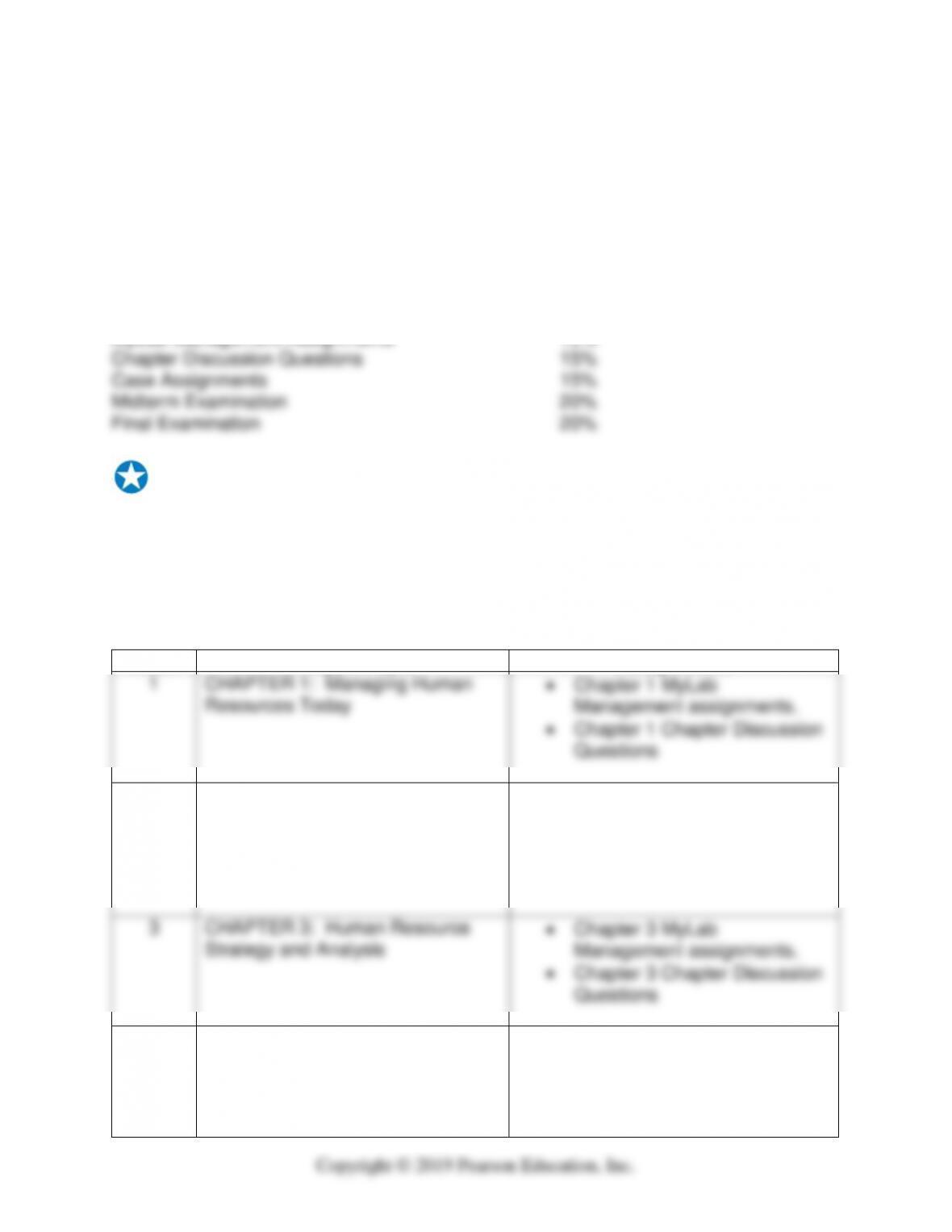
Weekly Quizzes 15%
MyLab Management Assignments 15%
For MyLab Management: go to www.pearson.com/mylab/management to complete
the problems marked with this icon in the book.
Course Outline:
Week
Chapter/Topic
Assignments
1
CHAPTER 1: Managing Human
Resources Today
Chapter 1 MyLab
Management assignments.
Chapter 1 Chapter Discussion
Questions
2
CHAPTER 2: Managing Equal
Opportunity and Diversity
Chapter 2 MyLab
Management assignments.
Chapter 2 Chapter Discussion
Questions
Case: Bandag Automotive
3
CHAPTER 3: Human Resource
Strategy and Analysis
Chapter 3 MyLab
Management assignments.
Chapter 3 Chapter Discussion
Questions
4
CHAPTER 4: Job Analysis and
Talent Management
Chapter 4 MyLab
Management assignments.
Chapter 4 Chapter Discussion
Questions
vi
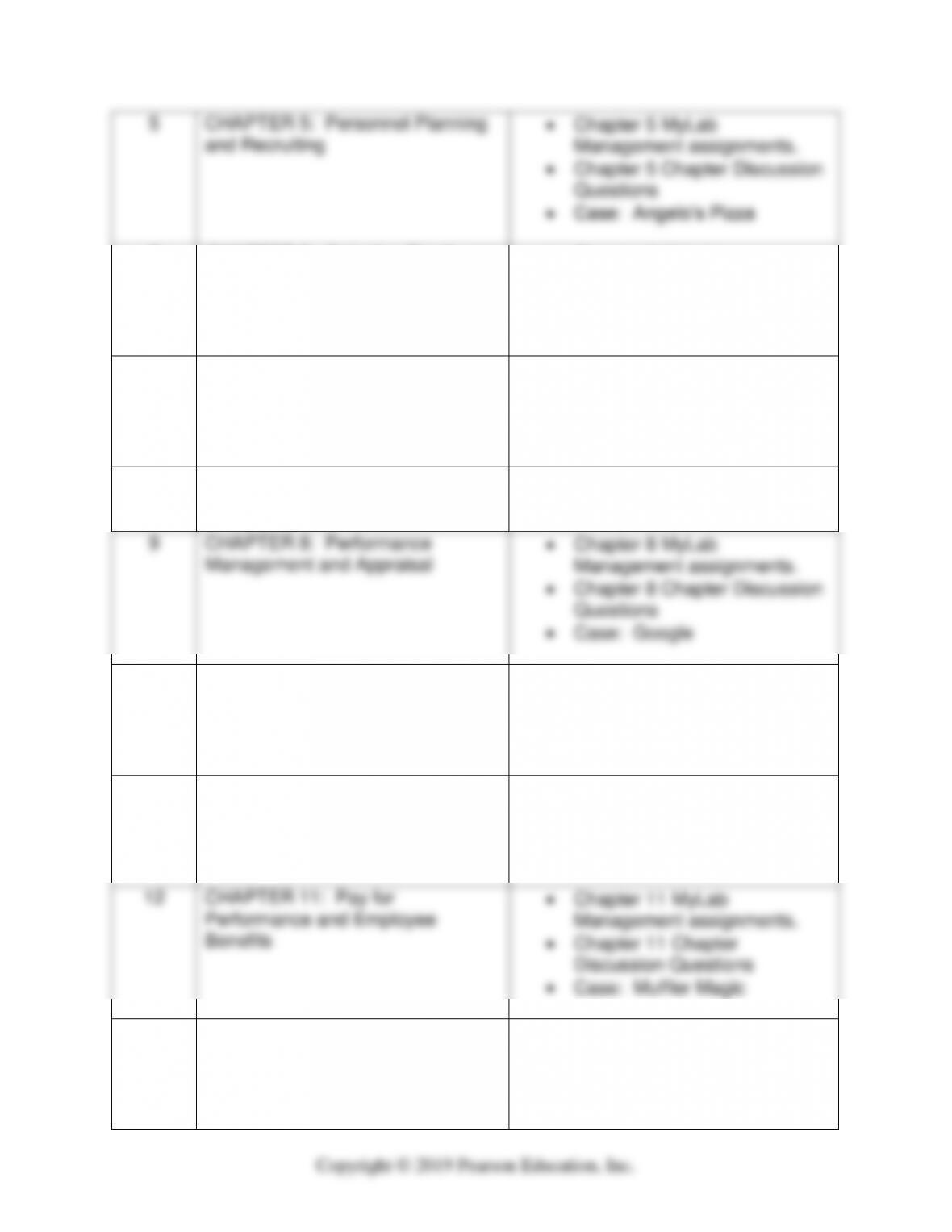
5
CHAPTER 5: Personnel Planning
and Recruiting
Chapter 5 MyLab
Management assignments.
Chapter 5 Chapter Discussion
Questions
Case: Angelo’s Pizza
6
CHAPTER 6: Selecting Employees
Chapter 6 MyLab
Management assignments.
Chapter 6 Chapter Discussion
Questions
7
CHAPTER 7: Training and
Developing Employees
Chapter 7 MyLab
Management assignments.
Chapter 7 Chapter Discussion
Questions
8
Mid-term Exam
9
CHAPTER 8: Performance
Management and Appraisal
Chapter 8 MyLab
Management assignments.
Chapter 8 Chapter Discussion
Questions
Case: Google
10
CHAPTER 9: Managing Careers
Chapter 9 MyLab
Management assignments.
Chapter 9 Chapter Discussion
Questions
11
CHAPTER 10: Developing
Compensation Plans
Chapter 10 MyLab
Management assignments.
Chapter 10 Chapter
Discussion Questions
12
CHAPTER 11: Pay for
Performance and Employee
Benefits
Chapter 11 MyLab
Management assignments.
Chapter 11 Chapter
Discussion Questions
Case: Muffler Magic
13
CHAPTER 12: Maintaining
Positive Employee Relations
Chapter 12 MyLab
Management assignments.
Chapter 12 Chapter
Discussion Questions
vii
14
CHAPTER 13: Labor Relations
and Collective Bargaining
Chapter 13 MyLab
Management assignments.
Chapter 13 Chapter
Discussion Questions
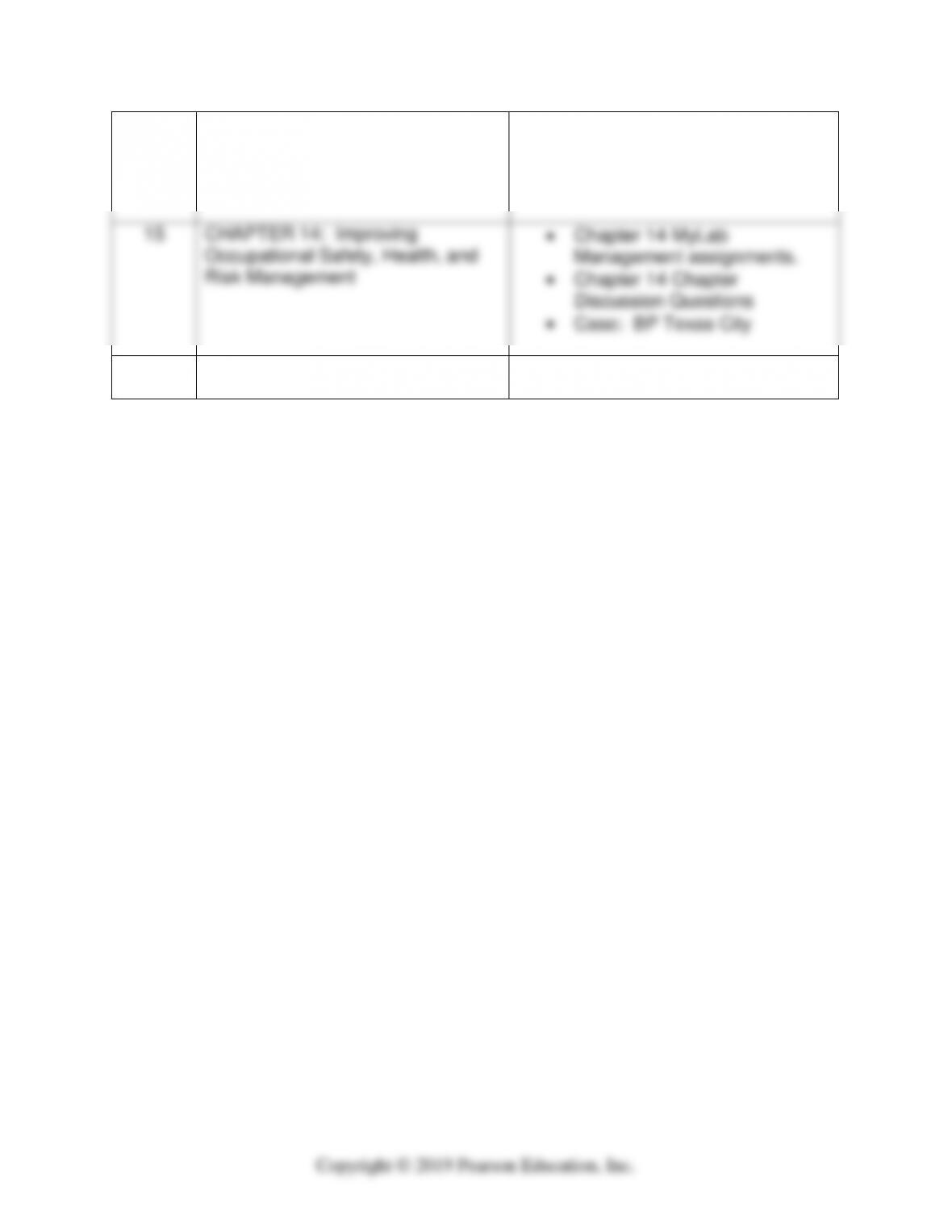
15
CHAPTER 14: Improving
Occupational Safety, Health, and
Risk Management
Chapter 14 MyLab
Management assignments.
Chapter 14 Chapter
Discussion Questions
Case: BP Texas City
Finals
Week
Exam Chapters 8-14