Lecture Notes
Lussier, Human Resource Management, Third Edition
SAGE Publishing, 2018
Lecture Notes
Chapter 8: Performance Management and Appraisal
Learning Objectives
After studying this chapter, you should be able to do the following:
8-2 List and briefly discuss the purposes of performance appraisals.
8-4 Briefly discuss the commonly used performance measurement methods and forms.
8-5 Identify and briefly discuss available options for the rater/evaluator.
Annotated Chapter Outline
I. Performance Management Versus Performance Appraisal
a. Performance management
i. Identifying, measuring, managing, and developing HR performance. Serves
as systematic measurement of performance.
Lecture Notes
Lussier, Human Resource Management, Third Edition
SAGE Publishing, 2018
II. The Performance Appraisal Process
III. Accurate Performance Measures
a. Must be:
i. Valid and reliable
ii. Acceptable and feasible
iii. Specific and pertinent to the job itself
iv. Based on the mission and objectives
IV. Why Conduct Performance Appraisals?
a. To communicate employee’s strengths and needs and to motivate performance.
V. Two Factors of an Effective Appraisal
a. Evaluate
i. Avoid problems by coaching employees between performance evaluations.
b. Motivate
Lecture Notes
Lussier, Human Resource Management, Third Edition
SAGE Publishing, 2018
c. Positive communication should prevent any surprises.
Without appearing passive/aggressive, always try to praise before criticizing.
For any area of improvement you should as the manager praised the employee 10 times.
VI. Behavioral Appraisals
a. Evaluated employees should have recourse to question outcome of their appraisals.
Managers should provide examples and transition to a coaching mode.
VII. What Can Be Assessed?
a. Traits
b. Behaviors and actions
c. Results and outcomes
d. Direct relationship to job functions
e. Accurate, reliable, and valid measures
Traits, behaviors and outcomes being evaluated should have a direct relationship to the
essential job functions and be accurate (reliable and valid) measures.
What are traits and behaviors?
Lecture Notes
Lussier, Human Resource Management, Third Edition
SAGE Publishing, 2018
If all members of a department or business unit are evaluated as “Exceptional” or “Outstanding”
but the results indicate “Underperforming” then there is a serious DISCONNECT which can be
detrimental to the organization.
VIII. What Are Traits and Behaviors?
a. Traits
a. Such as honesty, patience, independence, persistence, humility, optimism,
and so on.
b. Behaviors
VIX. Appraising for Results and Outcomes
a. Traits are not easily measured, but behaviors and results are easily quantified.
b. Results represent a tangible confirmation of acceptable actions.
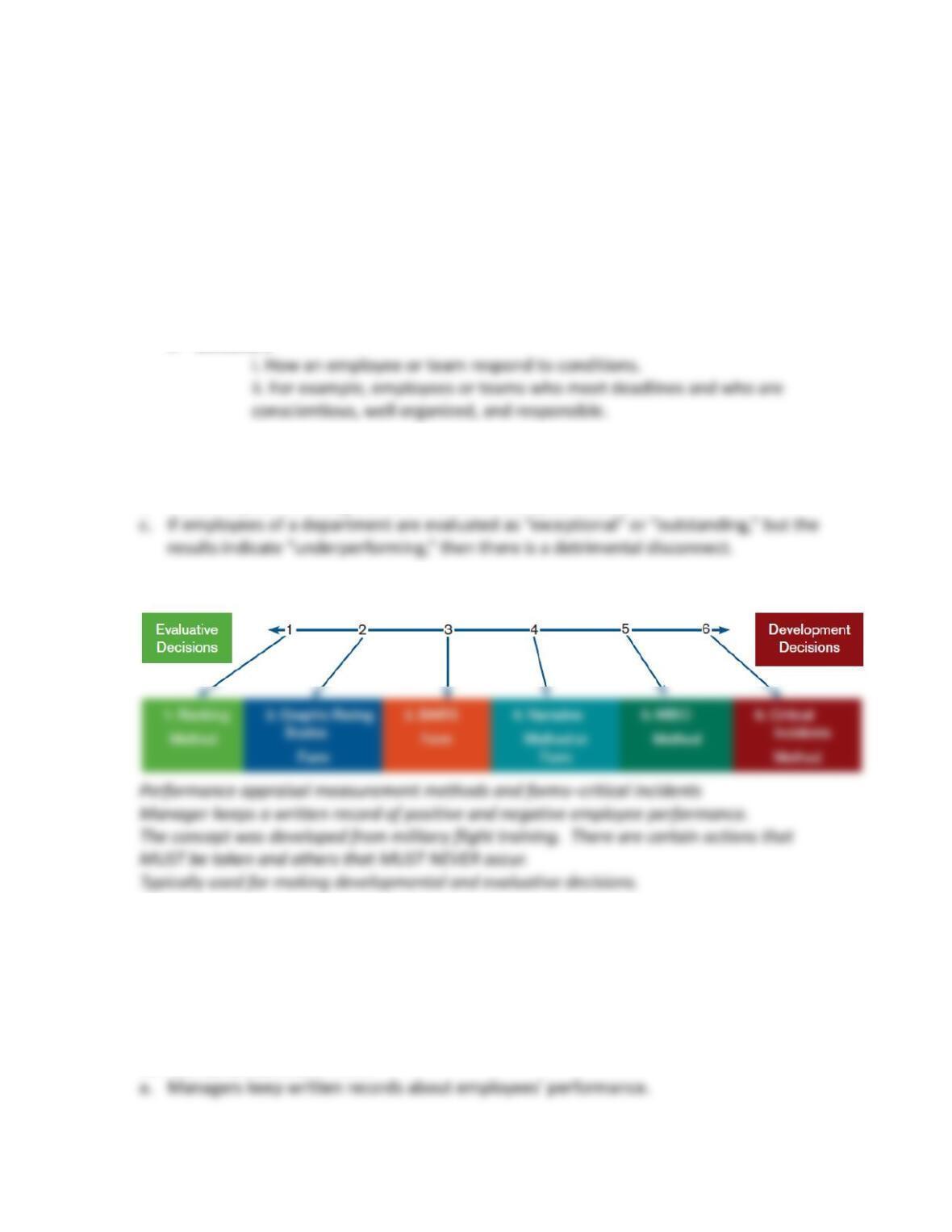
X. Performance Appraisal Measurement Methods and Forms
XI. Management by Objectives (MBO)
a. Managers and employees jointly set employee objectives.
b. Managers give feedback, evaluate performance, and reward as merited.
c. Not unusual to see misappropriation of resources used to fulfill MBOs. Misuse of
MBOs can foster a “me first” mentality.
XII. Narrative Method or Form
Lecture Notes
Lussier, Human Resource Management, Third Edition
SAGE Publishing, 2018
b. Used for ongoing feedback and employee development planning.
c. Narratives capture employees’ values and contributions.
XIII. Graphic Rating Scale Forms
a. Managers use appraisal checklists to rate employee performance, often expressed as a
numerical scale.
b. Typically used for evaluative decisions, but should also steer development decisions.
XIV. Behaviorally Anchored Rating Scales (BARS)
a. Managers use behaviorally based continuum to rate employee performance, often
expressed as a numerical scale.
XV. Ranking
a. Managers rank employees by comparing best to worst.
b. Forced distribution ranking of best to worst is the most used measure when
XVI. Who Should Assess Performance?
a. While managers typically evaluate employees’ performance, they may invite peers,
subordinates, customers, and/or employees themselves to evaluate performance.
XVII. How to Choose Who We Select to Conduct an Evaluation
a. Conduct a cost-benefit analysis.
i. Do the benefits of increasing performance feedback outweigh cost to give the
organization a return on its investment?
Lecture Notes
Lussier, Human Resource Management, Third Edition
SAGE Publishing, 2018
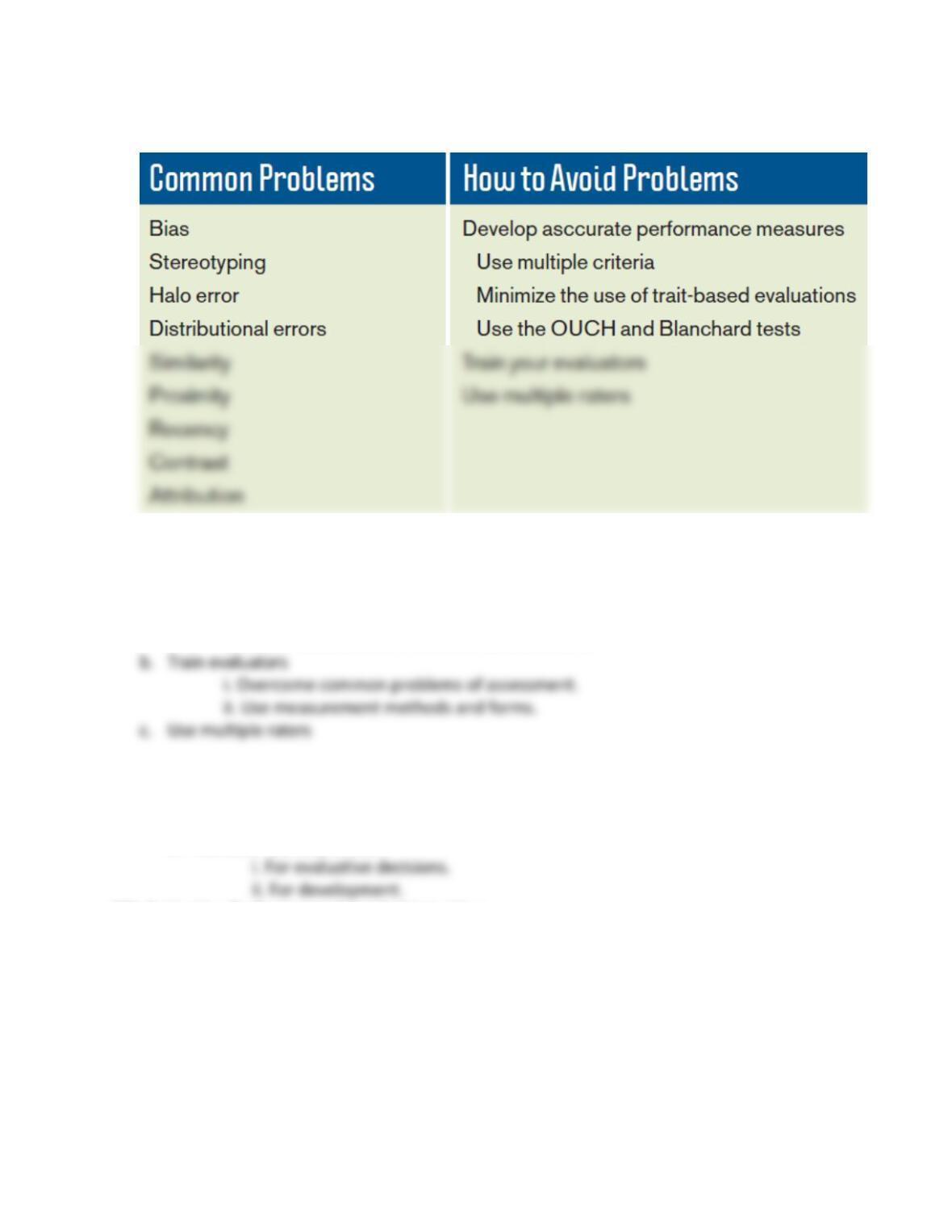
XVIII. Performance Appraisal Problems and Avoiding Them
XIX. How to Avoid Appraisal Process Problems
a. Develop accurate performance measures
i. Use multiple criteria.
ii. Minimize use of trait-based evaluations.
iii. Give measures the OUCH and Blanchard tests.
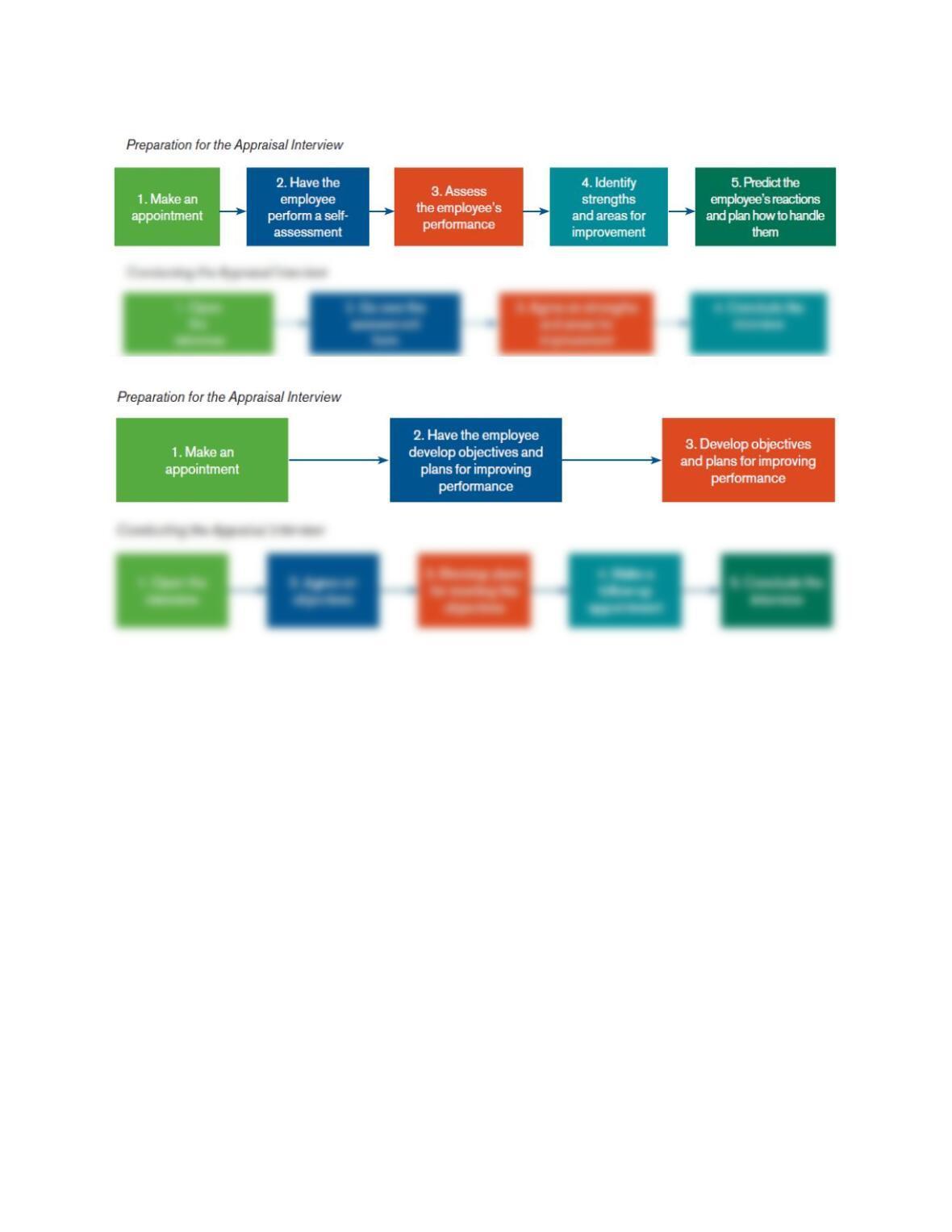
XX. Debriefing the Appraisal
a. Managers prepare for and communicate analysis of each employee’s performance
with the employee.
b. Conduct two interviews:
XXI. Evaluative Performance Appraisal Interview
Lecture Notes
Lussier, Human Resource Management, Third Edition
SAGE Publishing, 2018
XXII. Developmental Performance Appraisal Interview