Chapter Eight: Designing Pay Levels, Mix, and Pay Structures 8 – 20
o Thus, all FastCat engineer 1s are supposed to receive a salary higher than
$43,917 but lower than $65,875.
What Size Should the Range Be?
• The size of the range is based on judgment about how the ranges support
career paths, promotions, and other organization systems.
o Top-level management positions commonly have ranges of 30 to 60%
above and below the midpoint; entry to midlevel professional and
• Some compensation managers use the actual survey rates, particularly the 75th
and 25th percentiles, as maximums and minimums.
• Others establish the minimum and maximum separately, with the amount
D. Overlap
• Exhibit 8.20 shows two extremes in overlap between adjacent grades.
o The high degree of overlap and low midpoint differentials in Exhibit
8.20(a) indicate small differences in the value of jobs in adjoining grades.
Promotion Increases Matter
• The size of differentials between grades should support career movement
through the structure.
o A managerial job would typically be at least one grade higher than the jobs
it supervises.
▪ Although a 15% differential between manager and employee has been
• Optimal overlap between grades ought to be large enough to induce employees
8 – 21 Compensation – Thirteenth Edition Gerhart │Newman │Milkovich
to seek promotion into a higher grade.
• Not all employers use grades and ranges.
o Skill-based plans establish single flat rates for each skill level regardless of
IX. From Policy to Practice: Broad Banding
• Exhibit 8.21 collapses salary grades into only a few broad bands, each with a sizable
range.
o This technique, known as broad banding, consolidates as many as four or five
traditional grades into a single band with one minimum and one maximum.
• Contrasts between ranges and broad bands are highlighted in Exhibit 8.22.
• Supporters of broad bands list several advantages over traditional approaches.
o Broad bands provide flexibility to define job responsibilities more broadly.
o They support redesigned, downsized, or boundaryless organizations that have
eliminated layers of managerial jobs.
o They foster cross-functional growth and development in these new organizations.
▪ Employees can move laterally across functions within a band in order to gain
• Broad bands are often combined with more traditional salary administration practices
by using midpoints, “zones,” or other control points within bands.
• Perhaps the most important difference between the grades-and-ranges and broad-
banding approaches is the location of the controls.
o The grade-and-range approach has guidelines and controls designed into the pay
system.
Chapter Eight: Designing Pay Levels, Mix, and Pay Structures 8 – 22
Copyright © McGraw-Hill Education. All rights reserved. No reproduction or distribution without the prior written consent of McGraw-Hill
Education.
increasingly designed into them.
• Bands may add flexibility—less time will be spent judging fine distinctions among
jobs.
o But perhaps the time avoided judging jobs will now be spent judging individuals, a
prospect managers already try to avoid.
• Banding takes two steps.
o Set the number of bands.
▪ Usually bands are established at the major “breaks,” or differences, in work or
▪ As the pop-out in Exhibit 8.23 depicts, the three job families (purchasing,
finance, and engineering) in the professional band have different reference
rates, drawn from survey data.
A. Flexibility-Control
• Broad banding encourages employees to seek growth and development by
moving cross-functionally.
o The assumption is that this cross-fertilization of ideas will benefit the
organization.
X. Balancing Internal and External Pressures: Adjusting the Pay Structure
• Up until now, the text made a distinction between the job structure and the pay
structure.
8 – 23 Compensation – Thirteenth Edition Gerhart │Newman │Milkovich
Copyright © McGraw-Hill Education. All rights reserved. No reproduction or distribution without the prior written consent of McGraw-Hill
Education.
o A job structure orders jobs on the basis of internal factors (reflected in job
evaluation or skill certification).
o The pay structure, on the other hand, is anchored by the organization’s external
competitive position and reflected in its pay-policy line.
A. Reconciling Differences
• The problem with using two standards (internal and external) to create a
structure is that they are likely to result in two different structures.
• The order in which jobs are ranked on internal versus external factors may not
agree.
• Differences between market structures and rates and job evaluation rankings
warrant a review of the basic decisions in evaluating and pricing a particular
job.
o This may entail a review of the job analysis, the evaluation of the job, or
the market data for the job in question.
• Sometimes, differences arise because a shortage of a particular skill has driven
up the market rate.
o But reclassifying such a job into a higher salary grade, where it will remain
XI. Market Pricing
• Some organizations adopt pay strategies that emphasize external competitiveness and
deemphasize internal alignment.
• Called market pricing, this approach sets pay structures almost exclusively on external
market rates.
o Market pricers match a large percentage of their jobs with market data and collect
• The objective of market pricing is to base most, if not all, of the internal pay structure
on external rates, breaking down the boundaries between the internal organization and
the external market forces.
• Some companies even match all forms of pay for each job to its competitors in the
A. Business Strategy (More Than “Follow the Leader”)
• Pure market pricing carried to this extreme ignores internal alignment
completely.
o Gone is any attempt to align internal pay structures with the business
strategy and the work performed.
o Rather, the internal pay structure is aligned with competitors’ decisions as
reflected in the market.
o In a very real sense, the decisions of its competitors determine an
organization’s pay.
• If a competitor’s pay decisions is the sole or even primary determinant of
another company’s pay structure, then how much or what mix of forms a
company pays is no longer a potential source of competitive advantage.
o It is not unique, nor is it difficult to imitate.
• Fairness is presumed to be reflected by market rates; employee behavior is
presumed to be reinforced by totally market-priced structures, which are the
very same as those of competitors.
• In contrast, an organization may choose to differentiate its pay strategy from
that of its competitors to better execute its own strategy.
• In sum, the process of balancing internal and external pressures is a matter of
judgment, made with an eye on the pay system.
o De-emphasizing internal alignment may lead to unfair treatment among
employees and inconsistency with the strategy and fundamental culture of

8 – 25 Compensation – Thirteenth Edition Gerhart │Newman │Milkovich
Copyright © McGraw-Hill Education. All rights reserved. No reproduction or distribution without the prior written consent of McGraw-Hill
Education.
ability to compete in the product/service market.
XII. Review
• The end of Part Two of the textbook is a logical spot for a midterm exam. Exhibit 8.24
has been designed to help you review.
XIII. Your Turn: Google’s (now Alphabet’s) Evolving Pay Strategy
Summary of Case
Students are provided with an example of the pay strategy applied by Google. When
Google went public in 1994, its stock price was around $100/share and then rose rapidly,
peaking at $747 in November 2007. (During 2018 [now as Alphabet], the stock price was
over $1,000). As a result, Google is now subjected to comments such as “Google isn’t the
Learning Objective
Understand how startups struggle when they graduate from startup status into a higher
status. Discover solutions to overcome the issues.
Teaching Guidelines
Use this case to help students analyze the struggles faced by startups and suggest ways to
overcome these problems.
Discussion of Case Questions
1. What is Google’s pay level? How do you define and measure its pay level? How
well is it captured by salary alone?
Google’s pay level currently ranges from $90,000 to $105,000. Google could have
defined and measured its pay level only after:
Copyright © McGraw-Hill Education. All rights reserved. No reproduction or distribution without the prior written consent of McGraw-Hill
Education.
2. Does your answer to the above question depend on what point in time it is
answered? For example, what was Google’s pay level the day before it repriced
employee stock options? What was Google’s pay level the day after it repriced
employee stock options? And now?
Yes, the answer to the above question depends on what point in time it is answered.
Most organizations make adjustments to employees’ pay on a regular basis. Such
3. Why did Google reprice its stock options and also give a 10 percent salary
increase (in an era when 2 to 3 percent annual salary increase budgets are the
norm)? Is it because its business strategy and/or product life cycle changed? Is it
because it was concerned that employees’ perceived value of compensation did
not match what Google was spending?
Microsoft had changed its pay strategy to rely less on stock options, more on stock
grants, and then to rely less on stock grants and more on cash as its product cycle
4. Do you think Google has made the right choices in changing its compensation
strategy? How much do these changes cost? How do these costs compare to
Google’s total costs and operating income? Are these increased compensation
costs likely to be a good investment? In other words, will they pay for themselves
(and more)? Explain.
Copyright © McGraw-Hill Education. All rights reserved. No reproduction or distribution without the prior written consent of McGraw-Hill
Education.
5. Will Google’s pay strategy work “forever”? Consider the evolution of
Microsoft’s pay strategy as its growth slackened. Should Google prepare for a
similar future? If so, when and what sort of actions should they take to prepare?
XIV. Still Your Turn: Word-of-Mouse: Dot-Com Comparisons
Summary of Case
Compensation data for numerous jobs are more available due to the existence of various
Learning Objective
Understand and apply several of the concepts of internal alignment and external
competitiveness in analyzing actual pay data of specific jobs.
Teaching Guideline
Student responses to the following questions will vary depending on the jobs a student
selects for analysis. To gain the maximum benefit from discussing the case questions, you
may wish to assign students one of the following options:
Discussion of Case Questions
1. Which jobs are paid more or less? Is this what you would have expected? Why or
why not? What factors could explain the differences in the salaries?
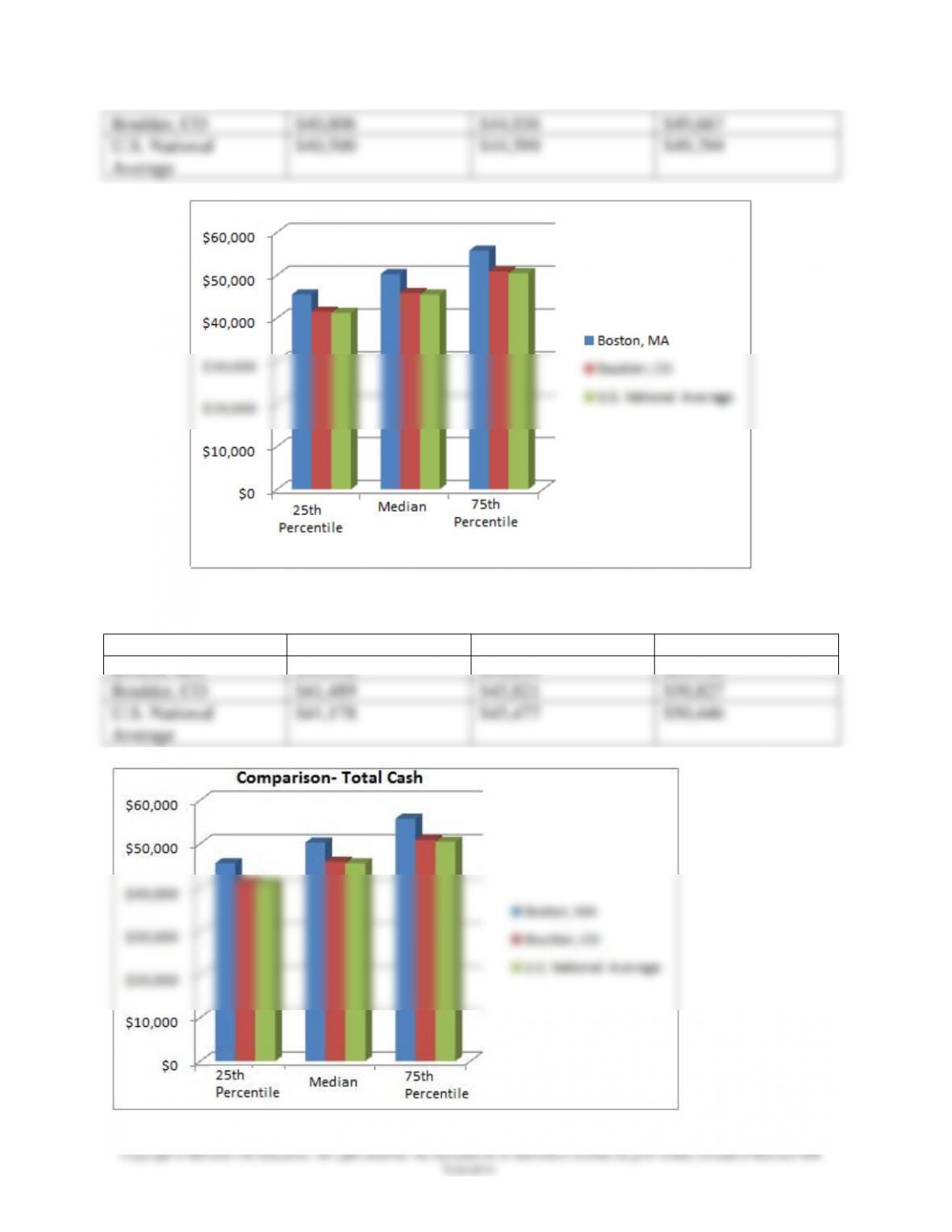
Salaries for an Accountant I position for two cities and the U.S. national average are
provided below.
Accountant I
Base Salary
Location
25th percentile
Median
75th percentile
Boston, MA
$44,742
$49,270
$54,458
Chapter Eight: Designing Pay Levels, Mix, and Pay Structures 8 – 28
Boulder, CO
$40,806
$44,936
$49,667
U.S. National
Average
$40,500
$44,599
$49,294
Accountant I
Total Cash (Base + Bonus)
Location
25th percentile
Median
75th percentile
Boston, MA
$45,492
$50,241
$55,730
Boulder, CO
$41,489
$45,821
$50,827
U.S. National
Average
$41,178
$45,477
$50,446
8 – 29 Compensation – Thirteenth Edition Gerhart │Newman │Milkovich
Accountant I
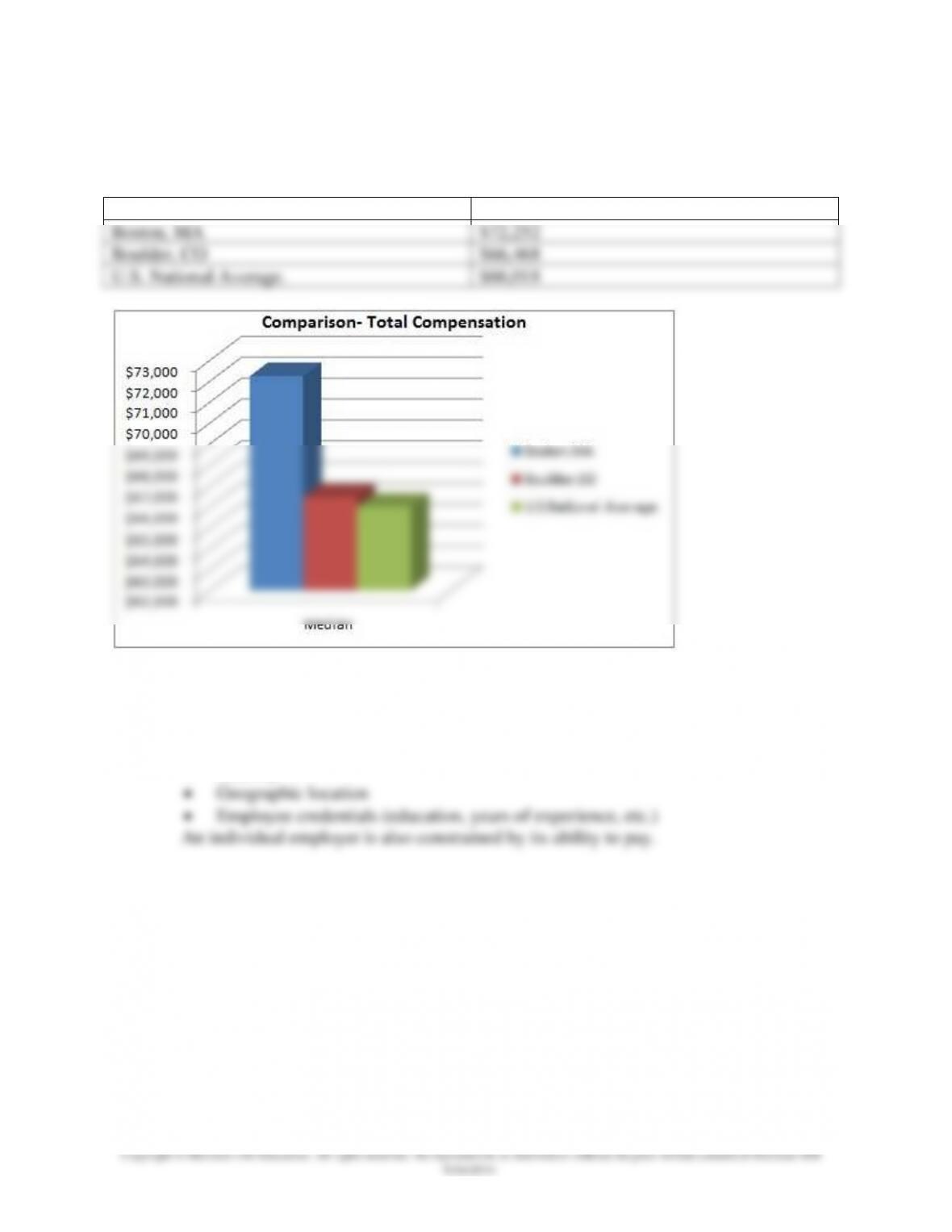
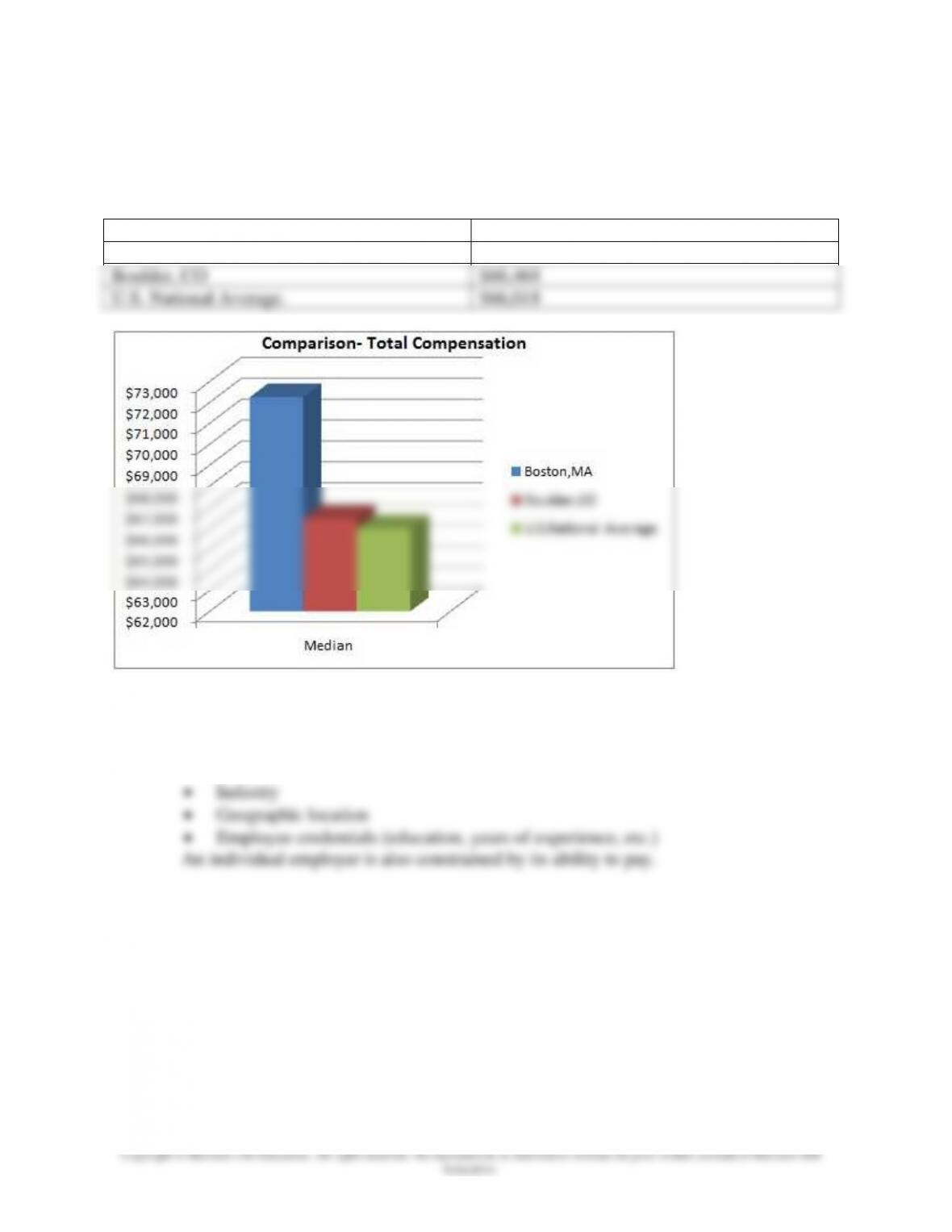
Total Compensation (Total cash+ Benefits)
Location
Median
Boston, MA
$72,252
Boulder, CO
$66,468
U.S. National Average.
$66,018
Accountant I jobs in Boston are paid more due to the higher cost of living when
compared to Boulder and the U.S. national average. Several factors affect the
differences in salary rates:
• Employer size
• Industry
Chapter Eight: Designing Pay Levels, Mix, and Pay Structures 8 – 30
Accountant I
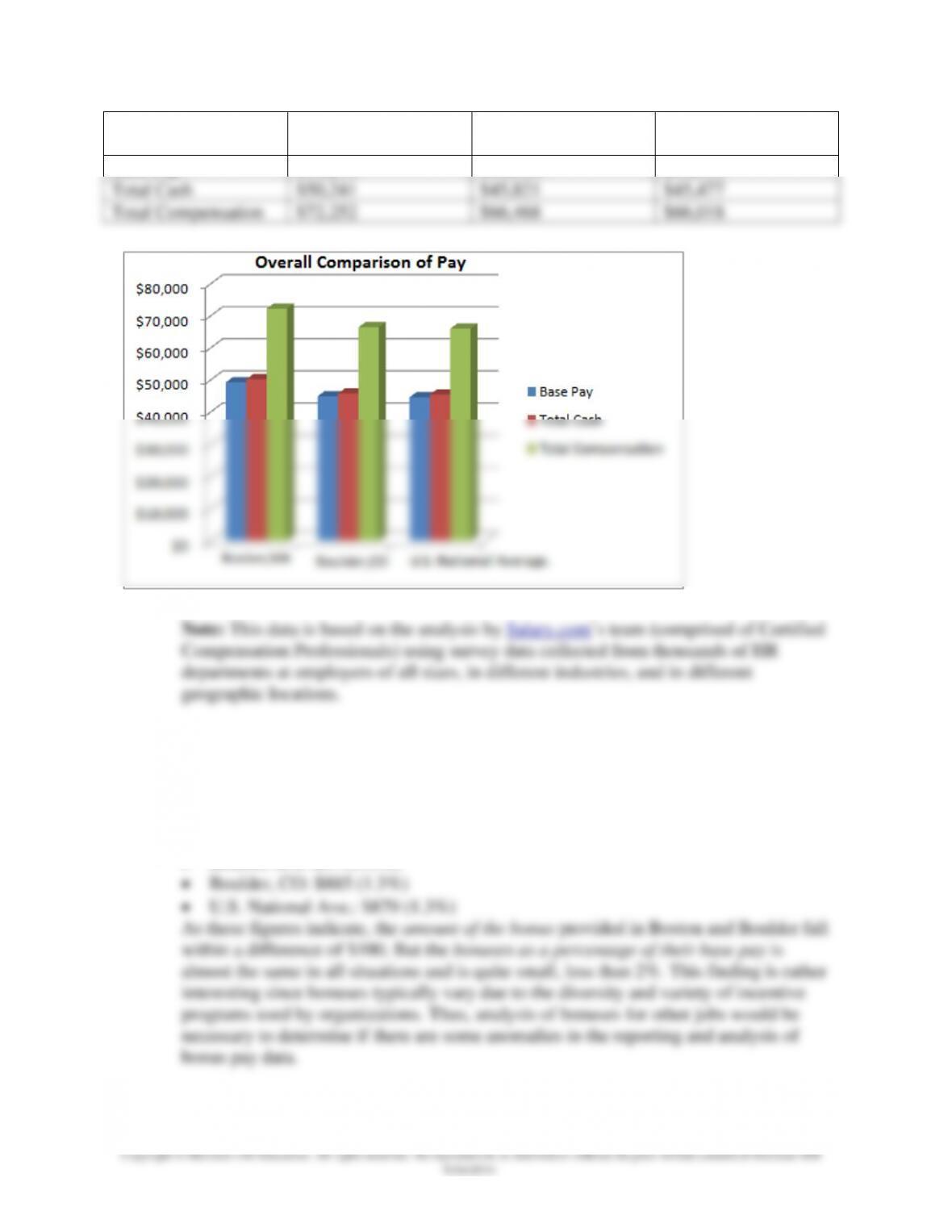
Total Compensation (Total cash+ Benefits)
Location
Median
Boston, MA
$72,252
Boulder, CO
$66,468
U.S. National Average.
$66,018
Accountant I jobs in Boston are paid more due to the higher cost of living when
compared to Boulder and the U.S. national average. Several factors affect the
differences in salary rates:
• Employer size
8 – 31 Compensation – Thirteenth Edition Gerhart │Newman │Milkovich
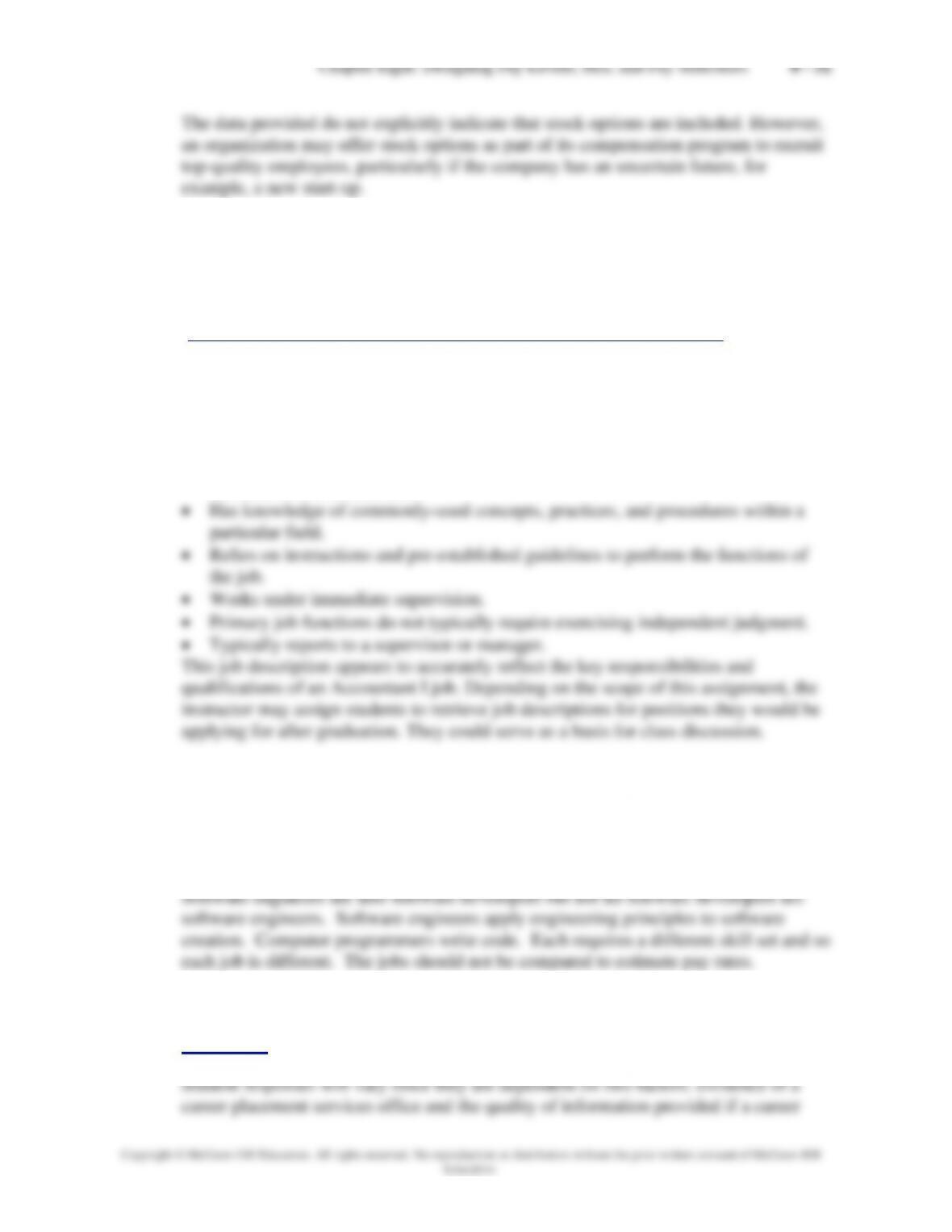
Location
Boston, MA
Boulder, CO
U.S. National
Average
Base Pay
$49,270
$44,936
$44,599
Total Cash
$50,241
$45,821
$45,477
Total Compensation
$72,252
$66,468
$66,018
2. Do the jobs have different bonuses as a percentage of their base salaries? What
could explain these differences?
Salary data for an Accountant I position for two cities and the U.S. national average
are provided in question 1. The amount of the bonus as a percentage of the base salary
are as follows:
• Boston, MA: $971(1.3%)
3. Do the data include the value of stock options? What are the implications of this?
Copyright © McGraw-Hill Education. All rights reserved. No reproduction or distribution without the prior written consent of McGraw-Hill
Education.
4. Read the job descriptions. Are they accurate descriptions for jobs that you would
be applying for? Why or why not? Are there jobs for which you cannot find an
appropriate match? Why do you think this is the case?
An Accountant I job description from the website is provided below
(http://swz.salary.com/SalaryWizard/Accountant-I-Job-Description.aspx):
• Prepares balance sheets, profit and loss statements, and other financial reports.
• Responsibilities also include analyzing trends, costs, revenues, financial
commitments, and obligations incurred to predict future revenues and expenses.
• Reports organization’s finances to management, and offers suggestions about
resource utilization, tax strategies, and assumptions underlying budget forecasts.
• May require a bachelor’s degree in area of specialty and 0–2 years of experience in
the field or in a related area.
5. If you are majoring in computer science, you may find that some surveys include
data on software developers, but not software engineers (and vice versa). How
similar are these jobs and can you use data on one of these job titles to estimate
pay rates for the other title? Also, where does the job of computer programmer
fit in?
6. Check out pay levels for these types of jobs in your school’s career office. How
does the pay for jobs advertised in your career office differ from the pay levels on
salary.com? Why do you think these differences exist?
Copyright © McGraw-Hill Education. All rights reserved. No reproduction or distribution without the prior written consent of McGraw-Hill
Education.
7. How could you use this information while negotiating your salary in your job
after graduation? What data would you provide to support your “asking price”?
What factors will influence whether or not you get what you ask for?
The ability of a student to negotiate a salary will first depend on an organization’s pay
policy and pay structure. Most organizations have policies regarding salary offers.
8. What is the relevant labor market for these jobs? How big are the differences
between salaries in different locations?
The relevant labor for the Accountant I job would likely be regional. However, there
are several factors that affect an employer’s relevant labor market: size of
9. For each job, compare the median salary to the low and high averages. How
much variation exists? What factors might explain this variation in pay rates for
the same job?
The national average data for the Accountant I job (see question #1) is used for
illustrative purposes. The data provided does not include minimum and maximum pay
10. Look for a description of how these salary data are developed. Do you think it
provides enough information? Why or why not? Discuss some of the factors that
might impair the accuracy of these data. What are the implications of using
inaccurate salary data for individuals or companies?
According to the website, Salary.com’s team of compensation consultants review
Chapter Eight: Designing Pay Levels, Mix, and Pay Structures 8 – 34
available, applicable market pay data to determine the true market for each job in the
11. With this information available for free, why would you bother with consultants’
surveys?
While the quality of much salary data provided on the Internet is suspect, the data
provided by Salary.com appears to be quite credible. While some salary data is
Copyright © McGraw-Hill Education. All rights reserved. No reproduction or distribution without the prior written consent of McGraw-Hill
Education.
12. If you were a manager, how would you justify paying one of your employees
either higher or lower than the results shown on this website?
An organization must provide information and training to its managers regarding its
compensation program—pay strategy, approach used to develop the pay structure, and
pay policies and procedures. As a manager, you could justify the pay difference by
stating that differences do exist between employees’ pay and survey results. Some
Answers to Review Questions
1. Which competitive pay policy would you recommend to an employer? Why?
Does it depend on circumstances faced by the employer? Which ones?
The most common pay policy for an employer is to match rates paid by competitors.
Failure to do so may negatively affect their employees’ level of satisfaction with pay.
Copyright © McGraw-Hill Education. All rights reserved. No reproduction or distribution without the prior written consent of McGraw-Hill
Education.
2. How would you design a survey for setting pay for welders? How would you
design a survey for setting pay for financial managers? Do the issues differ? Will
the techniques used and the data collected differ? Why or why not?
The questions involved in survey design are the same for both jobs:
• Who should be involved in the survey design?
• How many employers to include?
• What information to collect?
3. What factors determine the relevant market for a survey? Why is the definition
of the relevant market so important?
Factors that determine the relevant market include:
• The purpose of the survey
4. What do surveys have to do with pay discrimination?
5. Contrast pay ranges and grades with bands. Why would you use either? Does
their use assist or hinder the achievement of internal alignment? External
competitiveness?
Pay ranges exist whenever two or more rates are paid to incumbents in a given job.
Copyright © McGraw-Hill Education. All rights reserved. No reproduction or distribution without the prior written consent of McGraw-Hill
Education.