7 – 19 Compensation – Thirteenth Edition Gerhart │Newman │Milkovich
▪ Consulting firm AMR Research found that, in the case of China, theft of
intellectual property and product quality were major concerns and higher
o Agency theory (discussed later) tells us that companies must devote
resources to systems that monitor worker effort or output.
▪ This, as well as coordination of efforts, can be more difficult and more
o Customers’ reactions must be considered.
▪ Delta Air Lines stopped using call centers in India to handle sales and
reservations, despite the savings in labor costs.
o If labor costs are the driving force behind placing jobs, ask the question:
How long will the lower labor cost advantage hold and whether sufficiently
qualified employees will continue to be available as other companies also
tap into this pool of labor.
▪ However, nothing is forever, and labor cost savings from offshoring
• A compelling example is Apple’s manufacturing strategy for its iPad and
iPhone.
o The labor cost savings Apple realizes by outsourcing assembly to Foxconn
is many billions of dollars.
o Exhibit 7.11 shows that under Scenario 1, assembly in the U.S. would
IX. Competitive Pay Policy Alternatives
• Compensation theories offer some help in understanding the variations in pay levels
Chapter Seven: Defining Competitiveness 7 – 20
observed among employers.
o They are less helpful in understanding differences in the mix of pay forms.
• Recall that pay level is the average of the array of rates inside an organization. There
are three conventional pay-level policies:
o to lead,
• Newer policies emphasize flexibility: among policies for different employee groups,
A. What Difference Does the Pay-Level Policy Make?
• The basic premise is that the competitiveness of pay will affect the
organization’s ability to achieve its compensation objectives, and this in turn
will affect its performance.
• The probable effects of alternative policies are shown in Exhibit 7.12.
• The problem with much pay-level research is that it focuses on base pay and
ignores bonuses, incentives, options, employment security, benefits, or other
forms of pay.
o Comparisons on base alone can mislead.
B. Pay with Competition (Match)
• Given the choice to match, lead, or lag, the most common policy is to match
rates paid by competitors.
• A pay-with-competition policy tries to ensure that an organization’s wage
costs are approximately equal to those of its product competitors and that its
C. Lead Pay-Level Policy
• A lead pay-level policy maximizes the ability to attract and retain quality
employees and minimizes employee dissatisfaction with pay.
o It may also offset less attractive features of the work, à la Adam Smith’s
7 – 21 Compensation – Thirteenth Edition Gerhart │Newman │Milkovich
“net advantage.”
• Sometimes an entire industry can pass high pay rates on to consumers if pay is a
relatively low proportion of total operating expenses or if the industry is highly
regulated.
• A number of researchers have linked high wages to ease of attraction, reduced
vacancy rates and training time, and better-quality employees.
o Research also suggests that high pay levels reduce turnover and
absenteeism.
o Exhibit 7.15 shows the relationship of pay satisfaction with turnover and
also determinants of pay satisfaction.
▪ In addition to pay level, and consistent with equity theory, we see that
o There is no simple relationship between pay-level and financial
performance.
▪ Several studies found that the use of variable pay (bonuses and long-
term incentives) is related to an organization’s improved financial
• A lead policy can also have negative effects.
o It may force the employer to increase wages of current employees too, to
avoid internal misalignment and murmuring.
D. Lag Pay-Level Policy
• A policy of paying below-market rates may hinder a firm’s ability to attract
potential employees.
o But if a lag pay-level policy is coupled with the promise of higher future
• How long this promise works, in the face of flat or declining stock markets, is
unknown.
Chapter Seven: Defining Competitiveness 7 – 22
o Unmet expectations probably have negative effects.
E. Different Policies for Different Employee Groups
• In practice, many employers go beyond a single choice among the three policy
options. They may:
o Vary the policy for different occupational families, as did the company in
Exhibit 7.3.
F. Not by Pay Level Alone: Pay-Mix Strategies
• Some obvious alternatives to pay-mix policies include performance driven,
market match, work/life balance, and security.
o Exhibit 7.16 illustrates these four alternatives.
▪ Compared to the other three, incentives and stock ownership make up a
• How managers position their organization’s pay against competitors is
changing.
• Such pay-mix policy alternatives exist among companies in other countries.
o Apache Footwear, located in Quingyuan, China, offers base plus bonus,
which matches local practice.
o In contrast, Top Form Undergarment Wear, located in the same region,
phased out employee housing.
Employer of Choice/Shared Choice
o Some companies compete based on their overall reputation as a place to
work, beyond pay level and mix.
▪ For example, IBM compares within the information technology
7 – 23 Compensation – Thirteenth Edition Gerhart │Newman │Milkovich
marketplace and positions its pay “among the best” in the industry.
▪ Further, it claims to “strongly differentiate based on business and
individual results.”
o In a sense, “employer of choice” corresponds to the brand or image a
company projects as an employer.
o Shared choice begins with the traditional alternatives of lead, meet, or lag.
▪ But it then adds a second part, which is to offer employees choices
(within limits) in the pay mix.
▪ This “employee–as–customer” perspective is not all that revolutionary, at
least in the United States.
▪ Does offering people choices matter?
o One risk is that employees will make “wrong” choices that will
jeopardize their financial well-being.
▪ Netflix gives employees a choice in pay mix.
o Each December, after November evaluations, each employee
chooses how much compensation to receive in cash and how much
to receive in stock options.
Pitfalls of Pies
o The pie charts in Exhibit 7.16 contrast various pay mix policies.
▪ However, thinking about the mix of pay forms as pieces in a pie chart
has limitations.
o These are particularly clear when the value of stock is volatile.
▪ The pie charts in Exhibit 7.17 show how a well-known software
company’s mix changed after a major stock market decline – stock
prices dropped 50% within a month.
Chapter Seven: Defining Competitiveness 7 – 24
Copyright © McGraw-Hill Education. All rights reserved. No reproduction or distribution without the prior written consent of McGraw-Hill
Education.
▪ Base pay went from 47 to 55% of total compensation, whereas the value
of stock options fell from 28 to 16%.
▪ The mix changed even though the company made no change to its pay
strategy.
o But wait, it can get worse.
▪ One technology company disclosed that three-quarters of all its stock
options were exercisable at prices higher than the market price.
o So the possible volatility in the value of different pay forms needs to be
anticipated.
o Some companies prefer to report the mix of pay forms using a “dashboard,”
as depicted in Exhibit 7.18.
▪ The dashboard changes the focus from emphasizing the relative
o Pies, dashboards – different focus, both recognize the importance of the mix
of pay forms.
o The mix employees receive differs at different levels in the internal job
structure.
▪ Exhibit 7.19 shows the different mix of base, cash incentives, and stock
programs Merrill Lynch pays at different organization levels.
o While the percentages vary among organizations, greater emphasis on
performance (through incentives and stock) at higher levels is common
practice.
X. Consequences of Pay-Level and Pay-Mix Decisions: Guidance from the Research
• Earlier we noted that external competitiveness has two major consequences. It affects:
1. Operating expenses and
2. Employee attitudes and work behaviors
• Exhibit 7.20 summarizes the above consequences.
7 – 25 Compensation – Thirteenth Edition Gerhart │Newman │Milkovich
A. Efficiency
• A variety of theories make assumptions about the effects of relative pay levels
on an organization’s efficiency.
Which Policy Achieves Competitive Advantage?
o Research on the effect of pay-level policies is difficult because companies’
stated policies often do not correspond to reality.
▪ For example, HR managers at 124 companies were asked to define their
firm’s target pay level.
▪ All 124 of them reported that their companies paid above the median.
o Beyond opinions, there is minimal evidence of the consequences of different
policy alternatives.
o It may be that an employer’s pay level will not gain any competitive
advantage; however, the wrong pay level may put the organization at a
serious disadvantage.
o The effects of the different pay-mix alternatives or the financial results of
shifting the responsibility for choosing the mix to employees are also not
known.
▪ Perhaps it is the message communicated by pay mix and levels that is
the key to achieving competitive advantage.
B. Fairness
Chapter Seven: Defining Competitiveness 7 – 26
• Satisfaction with pay is directly related to the pay level—more is better.
• But employees’ sense of fairness is also related to how others are paid.
• Employers have many choices about how and where to invest their resources.
C. Compliance
• Provisions of prevailing wage laws and equal rights legislation must also be
met.
• In addition to pay level, various pay forms are also regulated.
• No matter the competitive pay policy, it needs to be translated into practice.
XI. Your Turn: Two-Tier Wages
Summary of Case
U.S. automakers are counting on two-tier wage structure to control labor costs over the
next several years. The case talks about how this new pay strategy has helped the U.S.
automobile companies beat recession and bankruptcies and increase employment rates in
the industry. There are also some automobile plants that have employees of an outside
supplier as their workers, to whom they pay even lower wages, which has in turn helped
them reduce their cost per vehicle and as such increase their savings.
Learning Objective
Look at compensation strategies that help in controlling costs and increasing revenue and at
the same time attract and retain employees.
Teaching Guideline
Use this case to help students apply the concepts related to external competitiveness in a
real-life situation.
Discussion of Case Questions
1. To what extent is the renewed job growth in the automobile industry in the United
7 – 27 Compensation – Thirteenth Edition Gerhart │Newman │Milkovich
States due to the use of two-tier wages?
Answer: Anything that lowers the cost of product will, all else equal, lower the cost of the
2. To the degree job growth (and increased car sales that come from more competitive
labor costs) is based on two tier-wage structures; how sustainable is this approach?
Consider, for example, that Chrysler Fiat CEO Sergio Marchionne stated, “Long
term, (the system) is not a viable structure. It creates two classes of workers within
the plant. It doesn’t work in the same direction we are working . . . to get this
organization to work in unison.”70 Why would Mr. Marchionne make this
statement? What are the potential drawbacks of a two-tier structure? When would
we expect any such drawbacks to materialize?
Answer: Two tier wages have drawbacks, as noted by the former and late CEO Sergio
Marchionne. Ask students how they would feel and how it might affect their work and
3. What about the use of non-GM workers at the Chevy Sonic plant? What might Mr.
Marchionne think about that approach?
4. Will the two-tier wage structure go away in the near future? Summarize the
pressures to eliminate it as well as the pressures to keep it. Be sure to consider labor
costs and productivity of workers and plants at other companies and in other parts of
the world. Auto worker Gary Walkowicz, a member of the UAW bargaining
committee at Ford’s Dearborn truck assembly plant, estimates that Ford could

Chapter Seven: Defining Competitiveness 7 – 28
convert its 14,685 Tier 2 workers to Tier 1 wages for $335 million per year. The UAW
will likely point out that is a small fraction of the $6.9 billion North American profit
earned by Ford the previous year. Your thoughts?
Answer: The pros and cons of two-tier wages were the focus of the previous questions. Can
5. You may wish to do some research on the new Volkswagen plant in Chattanooga,
Tennessee, the last one built in the United States. Also, consider that Automotive
News estimates that the Ford Fiesta (a competitor to the Chevy Sonic) plant in
Cuautitlán, Mexico, may have labor costs as low as $150 per vehicle.71 Recall also
our earlier discussion of where automobile production plants in North America have
been built in recent years (as well as where they have not been built).
6. More recently, Fiat Chrysler CEO Sergio Marchionne referred to the two-tier wage
structure as “impossible” and described it as “almost offensive.”72 However, Mr.
Marchionne’s actual plan when it came to contract talks was not to eliminate the two–
tier structure. As we saw earlier in the chapter, it appears that base pay differences
will remain between the two tiers. However, consistent with suggestions made by Mr.
Marchionne leading up to contract negotiations, Tier 2 worker pay will move very
near to that of Tier 1 workers (after 8 years of employment) and the gap in
percentage terms will also narrow when the company’s profits are high through
larger profit sharing payments for both Tier 1 and Tier 2 workers. You may wish to
gather the key facts on the most recently negotiated contracts (in 2015) between the
Big Three and the UAW and evaluate how well the new contracts will serve the
interests of the companies and those of the workers (which are similar, yet
different).73
4. What pay level does the efficiency wage predict? Does the theory accurately
predict organization behavior? Why or why not?
Efficiency wage theory predicts that high wages may result in more productive
workers and actually lower labor costs in certain situations; thus, profits are
5. What is a relevant market? What difference does it make when
determining people’s pay?
The appropriate labor market is defined by three factors:
• Occupation (skill/knowledge required to do the job)
• Geography (willingness to relocate, commute, or work in a virtual
situation)
6. Can you think of any companies that follow a lag and/or lead policy? Why
do they believe it pays to pay differently? Can you think of any companies
that follow performance driven and/or work/life balance policies?
Students, collectively, may offer several examples. Discussion should then
7 – 31 Compensation – Thirteenth Edition Gerhart │Newman │Milkovich
center on the characteristics of each policy to determine which policy a
company follows. Exhibit 7.12 provides a good framework to facilitate the
discussion.
XII. (Still) Your Turn: Combining Pay Survey and Job Evaluation Data (Whole Foods)
Summary of Case
This asks students to return to the Whole Foods Your Turn in Chapter 5. Using the NAICS
from the U.S. Bureau of Labor Statistics, students should look at the occupations which
match positions at Whole Foods and answer the questions.
Learning Objective
Become familiar with NAICS codes and discover the information available through the
Bureau of Labor Statistics, and the inherent limitations.
Discussion Questions
1. What pay level (e.g., 50th or other) would you recommend be used for the Whole
Foods Jobs? Would you use the same pay level for all jobs? Explain.
Students should understand that market pay data (from product market and labor
market competitors) is important input in deciding how much to pay. If they wish to
pay more than the 50th percentile, they should have a convincing rationale for what the
Chapter Seven: Defining Competitiveness 7 – 32
Copyright © McGraw-Hill Education. All rights reserved. No reproduction or distribution without the prior written consent of McGraw-Hill
Education.
level target may vary according to job. Jobs that are more important for executing the
organization’s strategy could be pegged at a higher pay level than less critical jogs.
Finally, students should be aware that companies may have different percentile targets
for different forms of compensation. For example, a company may target the 50th
percentile for base salary and benefits, but target the 75th percentile for total cash
compensation (e.g., base salary + bonus) IF the employee and the company perform at a
high level. Such a strategy would control fixed labor costs, while providing incentives
for strong performance.
2. How strongly do relative job evaluation points and relative survey pay
correspond? For example, what is the ratio of job evaluation points you assigned
to Job B (Cashier) and Job F (Team Member, Stock and Display) in the Chapter 5
Your Turn? What is the ratio of survey pay from Occupational Employment
Statistics for 41-2011 Cashiers and 43-5081 Stock Clerks? Are the two ratios the
same? (In Chapter 8, we will discuss why these ratios, one based on internal
worth and the other based on external worth, may differ.) If these two ratios or
other ratios you compute using other Whole Foods/pay survey jobs differ, which
ratio (internal, based on job evaluation, or external, based on the pay survey)
would you recommend be emphasized or receive priority in setting actual pay?
3. What are the limitations of the Occupational Employment Statistics data?
The job descriptions in the OES (market pay survey data) are not detailed enough in
terms of job responsibilities/specification (required experience, education, skills,
abilities, and competencies) to make a good job match with the
7 – 33 Compensation – Thirteenth Edition Gerhart │Newman │Milkovich
components of pay.
XIII. Appendix 7-A: Utility Analysis
• One way to quantify and think about the effects of a compensation program is to use
utility analysis.
• We define utility as the dollar value created by increasing revenues and/or decreasing
costs by changing one or more human resource practices.
• Higher pay levels may increase an organization’s ability to hire and keep the best talent.
• Differences in pay mix may also have major effects.
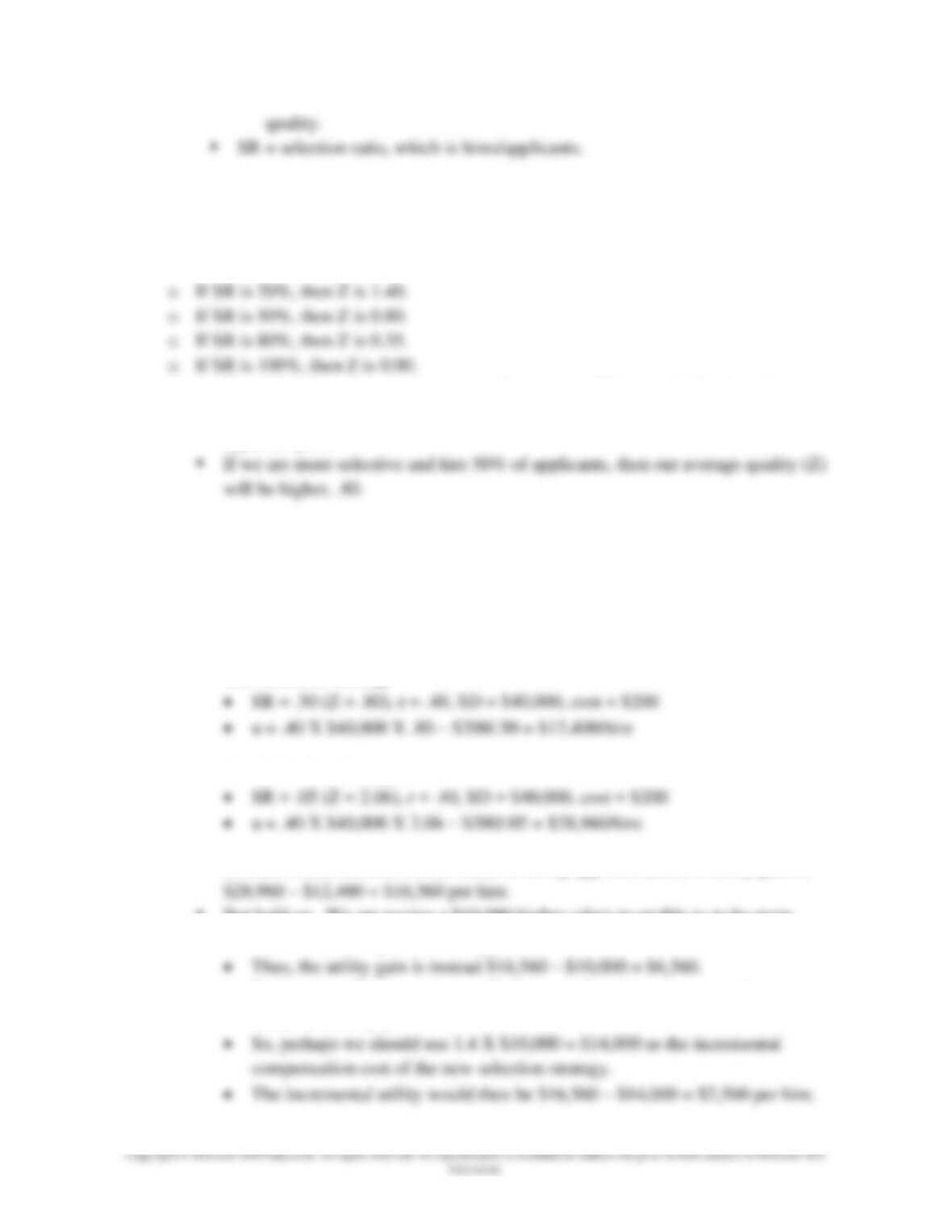
o Where:
▪ u = utility (revenue – cost) per hire per year.
▪ r = validity coefficient, the correlation between criterion, y, and one or more
pre-employment assessments used to make hiring decisions. It is the accuracy
of our predictions regarding which applicants will perform well as employees.
Chapter Seven: Defining Competitiveness 7 – 34
Copyright © McGraw-Hill Education. All rights reserved. No reproduction or distribution without the prior written consent of McGraw-Hill
Education.
quality.
▪ SR = selection ratio, which is hires/applicants.
• It is important to note how Z changes as we become more selective (lower SR) in our
hiring. Based on the standard normal distribution function:
o If SR is 5%, then Z is 2.06
o If SR is 10%, then Z is 1.75.
▪ If we hire all applicants, our average Z score would be zero, indicating the
average quality of our hires would be the same as the average quality of the
applicant pool.
• Assume we are filling a position that will cost us a salary of $100,000 under our new
selective hiring approach (versus $90,000 under the old system).
o If we are able to increase the quality of our hires to Z = 2.06 (from Z = .80) through
selective hiring, what would the impact be on utility?
o Assume the average cost per applicant is $200.
▪ Old Selection Strategy
▪ New Selection Strategy
▪ In other words, our new, more selective hiring approach yields a utility gain of
▪ But hold on. We are paying a $10,000 higher salary to enable us to be more
selective in our hiring in the new approach.
• Further, benefits, on average, add about another 40 cents on top of every
dollar of direct pay.

7 – 35 Compensation – Thirteenth Edition Gerhart │Newman │Milkovich
• Of course, our conclusion depends entirely on the estimates and assumptions we put into
the model.