Chapter 6 Perception and Individual Decision Making Page
65
Chapter 6
Perception and Individual
Decision Making
Chapter Overview
The old saw is that “perception is reality” and managers must learn
what “reality” their workers are reacting to in order to effectively
Chapter Objectives
After studying this chapter, the student should be able to:
1. Define perception and explain the factors that influence it.
3. Explain the link between perception and decision-making.
5. Contrast the three ethical decision criteria.
6. Define creativity and discuss the three-component model of creativity.
Suggested Lecture Outline
I. INTRODUCTION
A. This chapter examines perception and the influences on perception. It continues
with an exploration of how individuals make decisions and how perception can
influence those decisions.
II. WHAT IS PERCEPTION?
A. Perception is a process by which individuals organize and
interpret their sensory impressions in order to give meaning to
their environment.
1. However, what we perceive can be substantially different from objective reality.
2. For example, all employees in a firm may view it as a great place to work—
favorable working conditions, interesting job assignments, good pay, excellent
benefits, understanding and responsible management—but, as most of us know,
it’s very unusual to find such agreement.
3. The study of perception is important simply because people’s behavior is based
on their perceptions of what reality is, not on reality itself.
4. The world as it is perceived is the world that is behaviorally important.
B. FACTORS INFLUENCING PERCEPTION
1. Perceiver: When you look at a target and attempt to
interpret what you see, your interpretation is heavily
PPT 6.1
PPT 6.2
PPT 6.3
PPT 6.4
3) Consistency
d) An observer looks for consistency in a person’s actions.
(1) Coming in 10 minutes late for work is not perceived in the same
way for an employee who hasn’t been late for several months as
it is for an employee who is late two or three times a week.
(2) The more consistent the behaviors, the more we are inclined to
attribute it to internal causes.
e. Exhibit 6.1 summarizes the key elements in attribution
theory.
1) It tells us, for instance, that if an employee, Kim,
generally performs at about the same level on other
related tasks as she does on her current task (low
2) One of the most interesting findings from attribution theory research is
that errors or biases distort attributions.
a) When we make judgments about the behavior of
(1) This fundamental attribution error can explain why a sales
manager is prone to attribute the poor performance of her sales
(1) This is the self-serving bias.
(1) Individuals from Asian cultures tend to make group-based
stereotypes, whereas Westerners tend to focus on the individual.
3. Common Shortcuts in Judging Others.
a. We use a number of shortcuts when we judge others.
1) These techniques are frequently valuable: they
allow us to make accurate perceptions rapidly and provide valid data for
making predictions.
Exhibit 6.1
PPT 6.9
PPT 6.8
PPT 6.7
Chapter 6 Perception and Individual Decision Making Page
68
b) They can and do get us into trouble. Understanding these shortcuts
can help you recognize when they can result in significant
distortions.
b. Selective perception allows us to “speed–read” others, but not without the
risk of drawing an inaccurate picture.
1) Any characteristic that makes a person, an object, or an event stand out
will increase the probability that we will perceive it.
2) It is impossible for us to assimilate everything we see; we can take in
only certain stimuli.
3) Because we see what we want to see, we can draw unwarranted
conclusions from an ambiguous situation.
c. Halo Effect. Drawing an overall impression based on a single characteristic,
such as intelligence, sociability, or appearance.
2) This effect can also result in a negative impression.
d. Contrast Effect can distort perceptions.
2) Other persons we have recently encountered influence our reaction to a
person.
e. Stereotyping. Judging an individual based on the perception of a group to
which the target belongs.
1) We rely on generalizations every day because they help us make
2) The problem occurs, of course, when we generalize inaccurately or too
3) Stereotypes can be deeply ingrained and powerful enough to influence
life-and-death decisions.
4) One of the problems of stereotypes is that they are widespread and often
5) Thus, we constantly have to check ourselves to make sure we’re not
unfairly or inaccurately applying a stereotype in our evaluations and
Chapter 6 Perception and Individual Decision Making Page
69
Chapter 6 Perception and Individual Decision Making Page
70
a) Defining the problem. One of the most critical steps, incorrectly
defining the problem or identifying the wrong problem is a frequent
2) Assumptions of the Model: One of the reasons that
this model is rarely fully utilized in the real world is
because the assumptions are almost never all met.
2. Bounded Rationality
a. The limited information-processing capability of
human beings makes it impossible to assimilate and
understand all the information necessary to optimize.
1) So most people respond to a complex problem by reducing it to a level at
which they can readily understand it.
3) So people satisfice; that is, they seek solutions that are satisfactory and
sufficient.
b. Because the human mind cannot formulate and solve complex problems
with full rationality, we operate within the confines of bounded rationality.
2) We can then behave rationally within the limits of the simple model.
3) How does bounded rationality work for the typical
individual?
PPT 6.12
PPT 6.13
PPT 6.14
Chapter 6 Perception and Individual Decision Making Page
71
c) We identify a limited list of the most conspicuous choices, both easy
to find and highly visible, that usually represent familiar criteria and
tried-and-true solutions.
d) Next, we begin reviewing them, but our review will not be
comprehensive.
g) That ends our search.
h) So the solution represents a satisficing choice—the first acceptable
one we encounter—rather than an optimal one.
(1) This process of satisficing is not always a bad idea—using a
4) To use the rational model in the real world, you need to gather a great
deal of information about all the options, compute applicable weights,
and then calculate values across a huge number of criteria.
3. Intuition
a. Perhaps the least rational way of making decisions is to
rely on intuition.
1) Its defining qualities are that it occurs outside conscious thought; it
relies on holistic associations, or links between disparate pieces of
information;
a) it’s fast
b) it’s affectively charged
c) it usually engages the emotions
C. COMMON BIASES AND ERRORS IN DECISION-MAKING
judgments.
PPT 6.15
PPT 6.16
Chapter 6 Perception and Individual Decision Making Page
72
b. In many instances, these shortcuts are helpful. However, they can lead to
severe distortions of rationality.
c. Following are the most common biases in decision-making.
1) Overconfidence Bias.
2) Anchoring Bias.
a) The tendency to fixate on initial information and fail to adequately
3) Confirmation Bias.
a) This bias represents a specific case of selective perception.
4) Availability Bias.
a) The tendency for people to base their
judgments on information that is readily
available to them.
5) Escalation of Commitment.
a) This bias refers to staying with an initial decision through a series of
6) Randomness Error.
a) The tendency to believe we can predict the outcome of random
7) Risk Aversion.
a) Nearly everyone but committed gamblers would rather have the
PPT 6.17
(2) To offset the risks inherent in a commission-based wage,
(3) Risk-averse employees will stick with the established way of
(4) Sticking with a strategy that has worked in the past does
minimize risk, but in the long run it will lead to stagnation.
(5) Ambitious people with power that can be taken away (most
(6) CEOs at risk of being terminated are also exceptionally risk
8) Hindsight Bias.
a) The tendency to believe (falsely) once the outcome of an event is
actually known, that the results could have been accurately
predicted.
b) This bias reduces our ability to learn from the past and falsely
inflates our opinion of our ability to make accurate predictions.
V. ORGANIZATIONAL CONSTRAINTS ON DECISION-MAKING
A. Organizations can constrain decision-makers, creating
deviations from the rational model. These constraints can take
the form of:
1. Performance Evaluations. People are strongly influenced in their decision-
making by the criteria on which they are evaluated.
3. Formal Regulations. Rules and policies limit the decision-maker’s choice of
action.
4. Self-Imposed Time Constraints. Explicit deadlines create time pressures and
5. Historical Precedence. Commitments that have already been made constrain
current options. The historic context of a decision limits available alternatives.
VI. WHAT ABOUT ETHICS IN DECISION MAKING?
A. Three Ethical Decision Criteria:
1. The first ethical yardstick is utilitarianism, in which
decisions are made solely on the basis of their outcomes,
2. Another ethical criterion is to make decisions consistent with fundamental
liberties and privileges, as set forth in documents such as the Bill of Rights.
a. An emphasis on rights in decision making means respecting and protecting
PPT 6.18
PPT 6.19
Chapter 6 Perception and Individual Decision Making Page
75
can build up each of these three components, the more likely the employees will
1) A meta-analysis of 102 studies found positive moods increase creativity,
but it depends on what sort of positive mood was considered.
a) Moods such as happiness that encourage interaction with the world
are more conducive to creativity than passive moods such as calm.
(2) It would be better to get in an upbeat mood and then frame your
work as an opportunity to have fun and experiment.
(4) Passive negative moods such as sadness doesn’t seem to have
(5) Feeling threatened reduces your desire to try new activities; risk
aversion increases when you’re scared.
(6) Active negative moods, such as anger, however, do appear to
2) Being around creative others can make us more inspired, especially if
we’re creatively “stuck.”
3) Analogies allow decision makers to apply an idea from one context to
another.
a) Thinking in terms of analogies is a complex intellectual skill, which
helps explain why cognitive ability is related to creativity.
b) Demonstrating this effect, one study found children who got high
c. Intrinsic Task Motivation. The desire to work on something because it is
interesting, involving, exciting, satisfying or personally challenging.
1) This motivational component is what turns creative potential into actual
creative ideas.
2) Work environment significantly effects this creative motivation.
3) Environments that foster the open flow of ideas, fair and constructive
judgments of ideas, rewards and recognizes creative work, provides
sufficient resources, some freedom in the method to accomplish tasks,
Chapter 6 Perception and Individual Decision Making Page
76
and supportive supervisors tend to result in the highest levels of
employee creativity.
VII. INTERNATIONAL DIFFERENCES
A. In considering potential global differences in this chapter’s
B. Attributions
2. We noted earlier the tendency for Asians (Japanese) to be less susceptible to the
fundamental attribution error.
3. Another study found Korean managers less likely to use the self-serving bias—
4. On the other hand, Asian managers are more likely to lay blame on institutions
or whole organizations, whereas Western observers are more likely to believe
individual managers should be the focus of blame or praise.
5. Attribution theory was developed largely based on experiments with U.S. and
western European workers.
a. But these studies suggest caution in making attribution theory predictions in
C. Decision Making
2. A 2007 review of cross-cultural OB research covered 25 areas, but cultural
influence on decision-making was not among them.
3. Another 2007 review identified 15 topics, but the result was the same: no
research on culture and decision-making.
a. But Indonesians, for instance, don’t necessarily make decisions the same
4. Cultures differ in their time orientation, the importance of rationality, their
belief in the ability of people to solve problems, and their preference for
collective decision-making.
Chapter 6 Perception and Individual Decision Making Page
77
a. Differences in time orientation help us understand why managers in Egypt
b. Although rationality is valued in North America, that’s not true elsewhere in
the world.
1) A North American manager might make an important decision
intuitively but know it’s important to appear to proceed in a rational
5. Some cultures emphasize solving problems, whereas others focus on accepting
situations as they are.
6. Decision making by Japanese managers is much more group-oriented than in the
United States.
a. The Japanese value conformity and cooperation. So before Japanese CEOs
D. Ethics
2. Because bribery is commonplace in countries such as China, a Canadian working
in China might face a dilemma: Should I pay a bribe to secure business if it is an
accepted part of that country’s culture?
3. A manager of a large U.S. company operating in China caught an employee
stealing.
4. Although ethical standards may seem ambiguous in the West, criteria defining
5. Global organizations must establish ethical principles for decision makers in
countries such as India and China and modify them to reflect cultural norms if
they want to uphold high standards and consistent practices
VIII. Summary and Implications for Managers
A. Perception
2. Whether a manager successfully plans and organizes the work of employees and
PPT 6.23
3. Similarly, employees judge issues such as fair pay, performance appraisals, and
4. To influence productivity, we need to assess how workers perceive their jobs.
5. Dissatisfaction with working conditions and the belief that an organization lacks
6. The employee’s conclusion that a job is good or bad is an interpretation.
Managers must spend time understanding how each individual interprets reality
and, when there is a significant difference between what someone sees and what
exists, try to eliminate the distortions.
B. Individual Decision Making
1. Individuals think and reason before they act.
a. This is why an understanding of how people make decisions can be helpful
for explaining and predicting their behavior.
b. In some decision situations, people follow the rational decision-making
model.
C. What can managers do to improve their decision-making? We offer four suggestions.
1. First, analyze the situation. Adjust your decision-making approach to the
national culture you’re operating in and to the criteria your organization
evaluates and rewards.
2. Second, be aware of biases.
a. Then try to minimize their impact. Exhibit 5.3 offers some suggestions.
3. Third, combine rational analysis with intuition.
a. These are not conflicting approaches to decision making. By using both, you
4. Finally, try to enhance your creativity.
a. Actively look for novel solutions to problems, attempt to see problems in
IX. Keep in Mind
PPT 6.24
Chapter 6 Perception and Individual Decision Making Page
79
A. People have inherent biases in perception and decision making.
1. Understanding those biases allows for better prediction of behavior.
B. Biases can be helpful.
1. Managers must determine when the bias may be counterproductive.
C. Creativity aids in decision making.
D. Helps to appraise, understand, and identify problems.
X. Summary
Discussion Questions
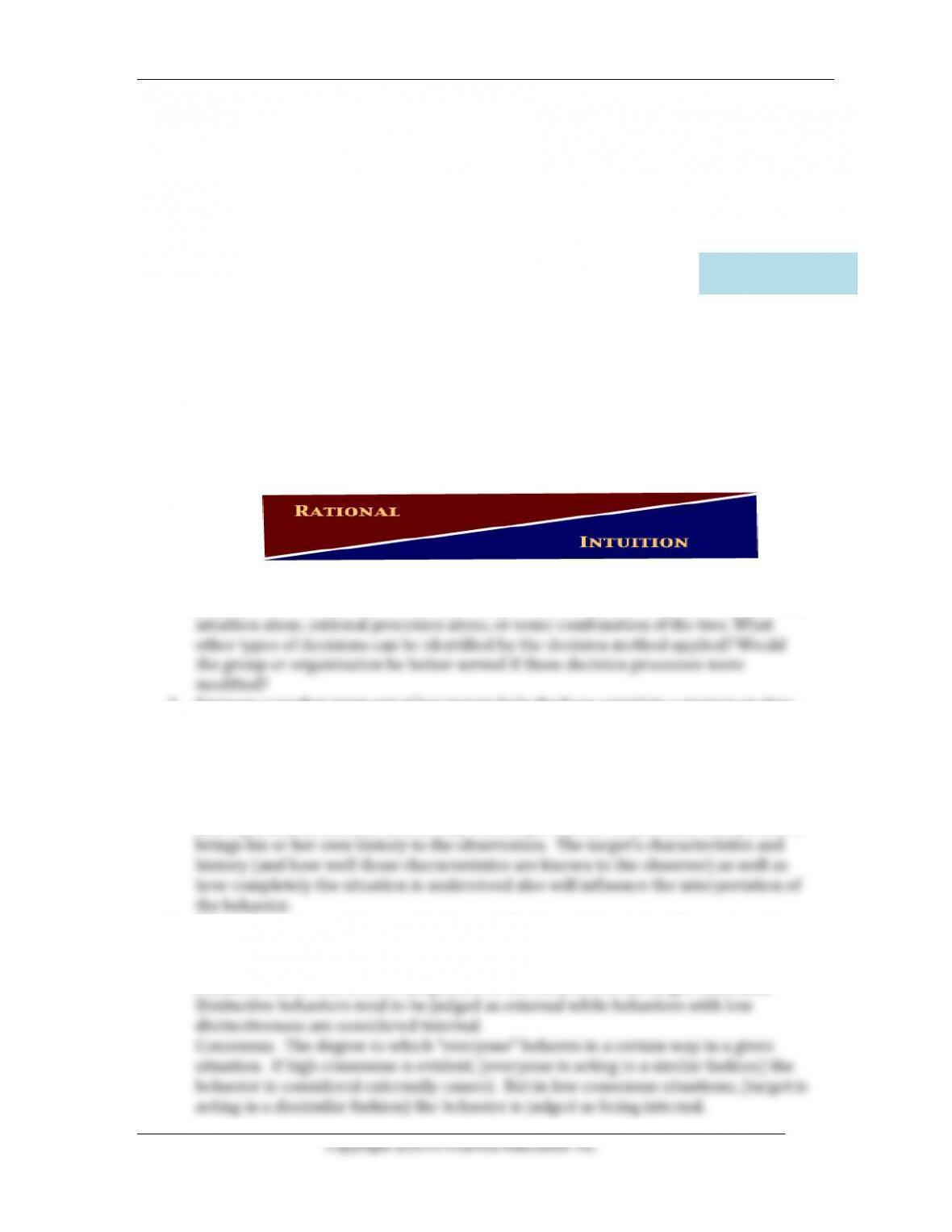
1. Ask the class members to think of places they have worked or organizations they
have been associated with. They should identify decisions that they observed being
made by people within the organization. Ask them to rate the decision on the
following scale:
Answer: Decisions about salary raises may be made by the decision maker based on
2. Suppose a worker went out of her way to help the boss complete a project on time.
Some of her co-workers saw that behavior and thought she was selfishly trying to
curry favor with the boss; others saw her as a great example of how employees
should act in a progressive company. Why do these two very different
interpretations come about?
Answer: The perceiver’s attitudes, personality, motives, interests, past experiences,
and expectations all filter and modify what is perceived. In this case, each perceiver
3. What criteria are used by people when attributing a behavior to either external or
internal causes? Describe these three criteria.
Answer: There are three criteria: distinctiveness, consensus, and consistency.
Distinctiveness. The level of uniqueness of the behavior of the target individual.
PPT 6.25
Chapter 6 Perception and Individual Decision Making Page
80
Chapter 6 Perception and Individual Decision Making Page
81
Answer: Bounded rationality deals with minimizing options and limiting scope to
make a problem’s solution more manageable. In this situation, the optimum
8. Choose one of the common decision-making biases that you have either personally
experienced or which you are “guilty” of and describe the following: (1) what error
was involved, (2) what were the circumstances, and (3) how did the bias affect the
outcome of the situation.
9. Which ethical viewpoint do you think is the best? Describe the viewpoint and
explain your choice.
10. Using the three-component model for creativity, which area do you believe would
be easiest for managers to affect? Why?
Answer: The answers will vary. One of the most logical components to use is
Exercises
1. Self-analysis. What biases, either perceptual or decision-making, do you find you
use most commonly? What actions can you take to reduce the effects of those
biases?
2. Web Crawling. Using your favorite search engine, enter the term “famous
perceptual experiments” and select three that look interesting to you. Describe
what impacts these studies have on organizational behavior.
3. Analyzing Your Organization (Cumulative Project). The job interview process is
where decision-making and perceptual biases can often come into play. Consider
your own interview when you took the job and describe:
• What may have been the influences of the length of the interview?
Chapter 6 Perception and Individual Decision Making Page
82
• What may have been the influence of the length of time it took for the
interviewer to make the hiring decision on both the perception of the firm
toward the individual and the individual toward the firm?
• What biases may have been involved in your own hire? Consider your own
biases regarding the firm as well as theirs toward you.
• What can the company do to reduce the negative effects of bias in the job
interview process?
Suggested Assignment
Divide the class into groups of three to five students each. Have each team review and
discuss the following court case. Answer the question that follows and be prepared to
present your findings. Each team will be given additional guidance by the instructor.
State vs. Scroggs
In the fall of 1875, Hiram Smith filed a claim on a very fertile piece of land in South
Dakota with the land office. Before he could put any improvements on the land, he
died. A young Swede, newly immigrated, filed a counterclaim to the land at once,
and by late spring of the following year had built a home and had begun to cultivate
the land.
A distant relative of Mrs. Smith, a minister named Scroggs lived in a small town
about two miles from the rival farms. He had been an advisor for the Swede on all
matters of religion and politics since the fellow had first taken up farming in Dakota.
He had often complimented the Swede on his land and had expressed his opinion at
the general store that it was the best land in the West.
Two more shots killed the horses at the plow. Scroggs galloped off and shouted that
he was going after the marshal. When the marshal and a posse arrived, they found
the Swede had killed the three women and had then committed suicide. Scroggs,
being the only relative of the dead woman, inherited both pieces of land.
Should Scroggs be held responsible for the killings?
Chapter 6 Perception and Individual Decision Making Page
83
process and see how different each strategy is in effort, process, and quality of
decision.
• Prior to passing out the case, divide the class into three large groups without
telling them how or why they are being divided. One group will use the
rational model, the second, bounded rationality, and the third intuition.
• Go to each group and quietly tell them the model they are to use to make
their decision. Refer students to the appropriate section of their text for
their process. Each large group should not know how the other groups are
making their decisions.
• Each group is to track how long it took them to come to their decision.
• During the next class, have students note on the board or orally present
what their decisions were. Simply tabulate their decisions, responsible or
not. Begin with those using the rational model, those using bounded
rationality, and end with the intuitive.
• As you debrief the class, note any pattern to the decisions. Did style lead to a
given conclusion? Ask the groups for the reasons for their decisions. How
long did it take to make the decision? Finally, ask the class if now that they
have heard more viewpoints, whether anyone wishes to change his or her
findings.