
Lecture Notes
Lussier, Human Resource Management, Third Edition
SAGE Publishing, 2018
Lecture Notes
Chapter 6: Selecting New Employees
Learning Objectives
After studying this chapter, you should be able to do the following:
6-2 Identify the three main types of “fit” in the selection process and why they are
important.
6-4 Briefly discuss the use of applications and resumes as selection tools.
6-5 Briefly discuss the testing and legal considerations in the selection process.
6-6 Discuss selection interviewing, including the three primary types of interviews and the
five steps in the model for conducting them.
Annotated Chapter Outline
I. Selection
a. The process of choosing the best qualified applicant for a job.
b. Focus on Fit
Lecture Notes
Lussier, Human Resource Management, Third Edition
SAGE Publishing, 2018
II. What Happens When Employees Are Placed in the Wrong Job?
a. Poor job fit makes it difficult for employees to perform successfully.
III. Effects of a Poor Selection Process
a. Wasted time and money
b. Reduced productivity
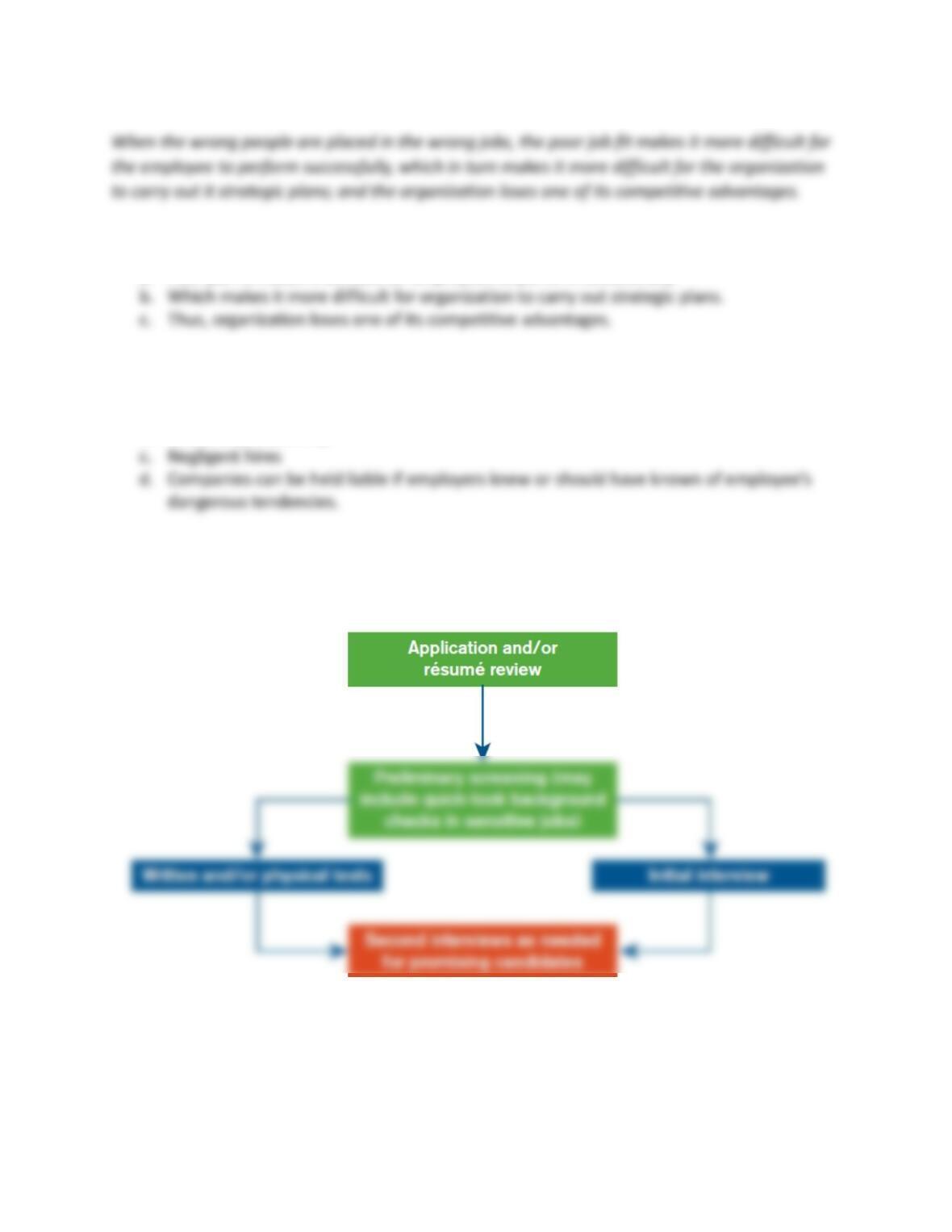
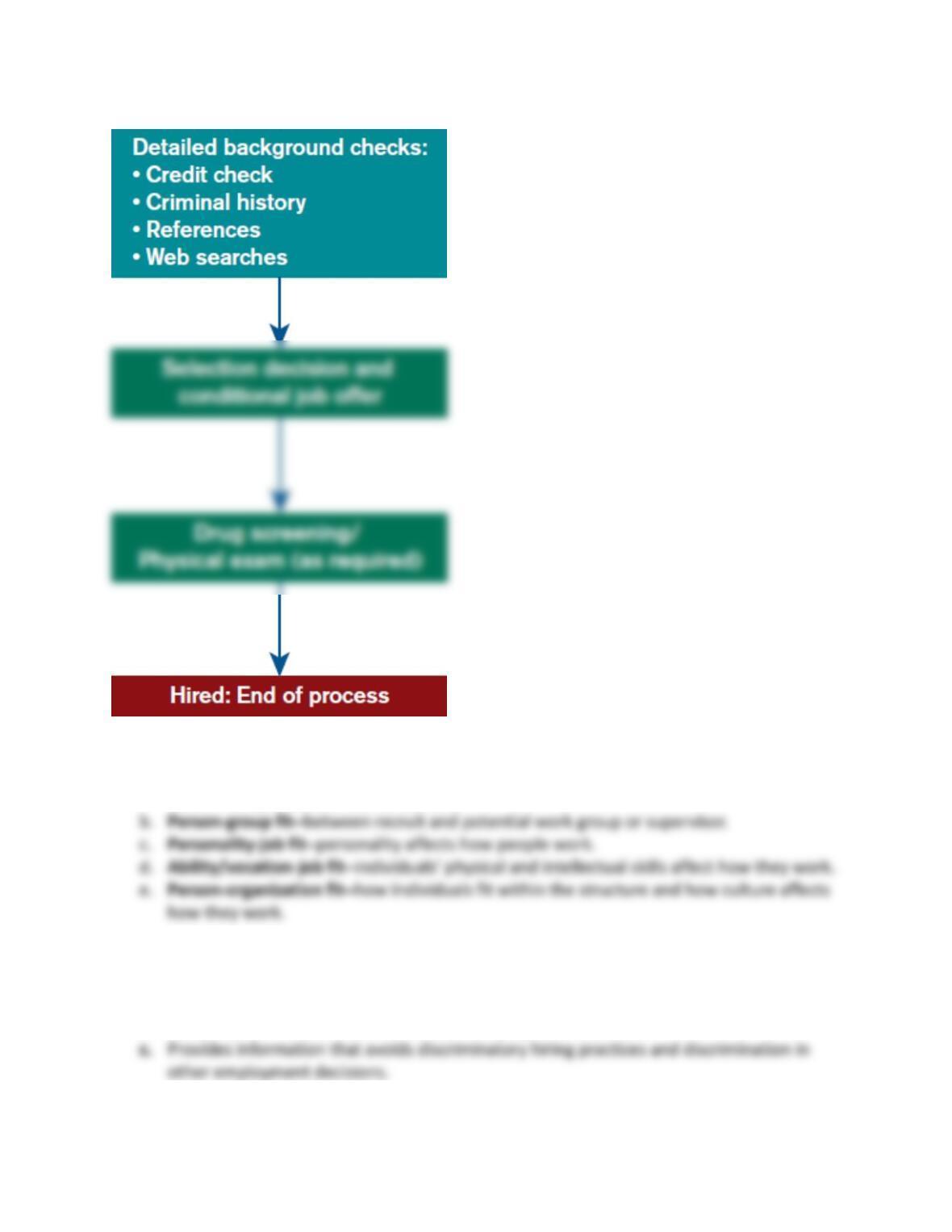
IV. Steps of the Selection Process
Depending on organizational circumstances, steps may not be followed sequentially or some
parts may not be included.
Steps of the Selection Process
Lecture Notes
Lussier, Human Resource Management, Third Edition
SAGE Publishing, 2018
V. Types of Fit
a. Person-job fit—between a person’s abilities and job demands or between a person’s
desires and job attributes and rewards.
VI. Legal Issues
a. Uniform Guidelines on Employee Selection Procedures (UGESP or “Uniform Guidelines”)
were developed by the government to guide employers.
b. Complies with federal laws that concern employment decisions.
Lecture Notes
Lussier, Human Resource Management, Third Edition
SAGE Publishing, 2018
VII. What Qualifies as an
“Employment Test”?
a. Any test or selection procedure that is used as a basis for employment decisions.
b. Employment decisions
i. Hiring and training
ii. Promotion and demotion
What qualifies as an “employment test”?
Any test or other selection procedure that is used as a basis for any employment decision.
Employment decisions include hiring, promotion, demotion, membership (for example, in a labor
organization), referral, retention, and licensing and certification, training, transfer, etc.
VII. Legal Issues: Uniform Guidelines
a. To be non-discriminatory, employment tests must be:
i. Valid—test should measure knowledge, skills, abilities, and so on, that it claims
to measure.
ii. Reliable—test scores should be consistent (similar) when taken by the same
VIII. Applications and Preliminary Screening
a. Applications and resumes.
b. Applicants’ information is compared to job specifications. This weeds out unqualified
applicants and finds the best applicants.
Applications and résumés—provide biographical data that aid in selecting the best person for the
job.
Lecture Notes
Lussier, Human Resource Management, Third Edition
SAGE Publishing, 2018
Applicants’ information is compared to job specifications to weed out unqualified applicants and
to narrow the pile down to the best applicants.
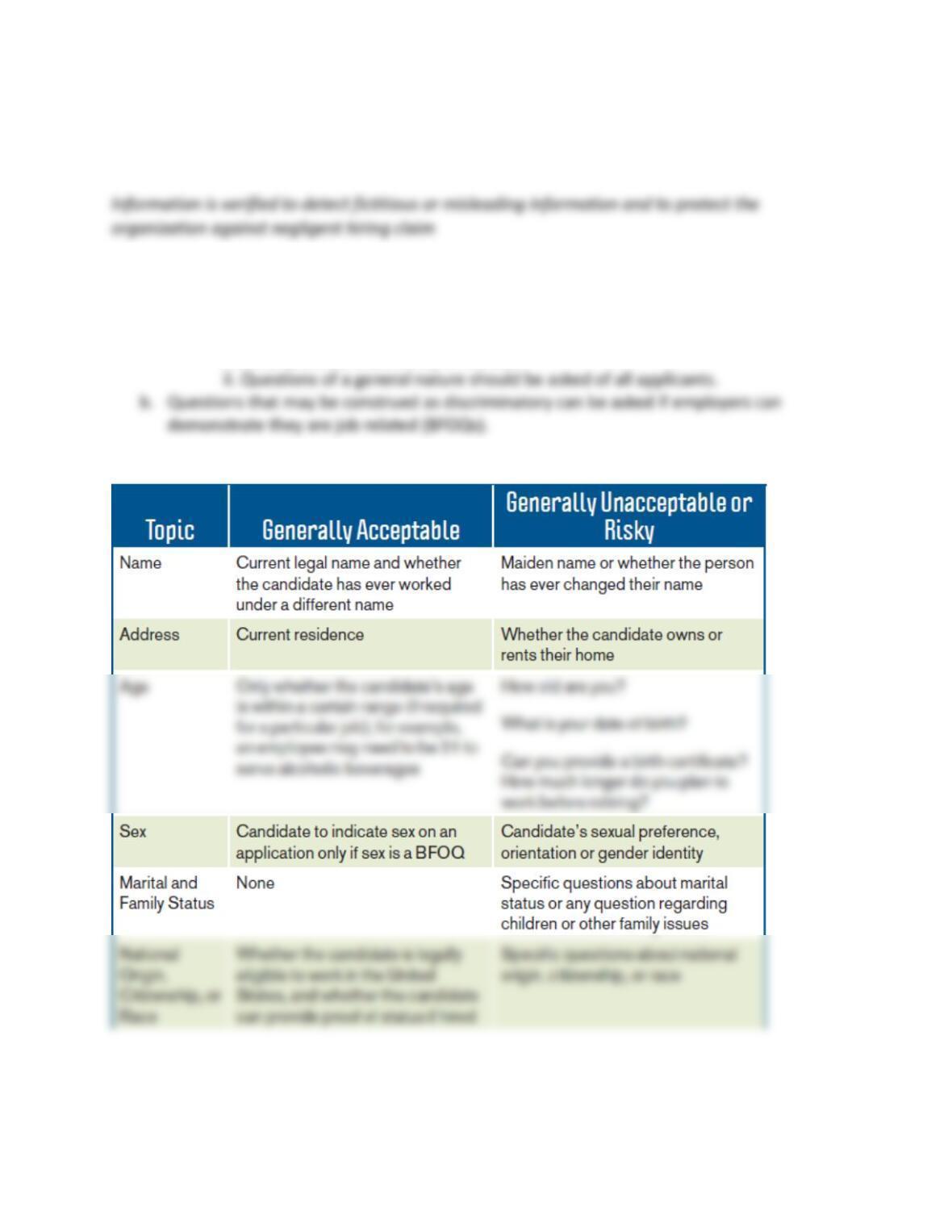
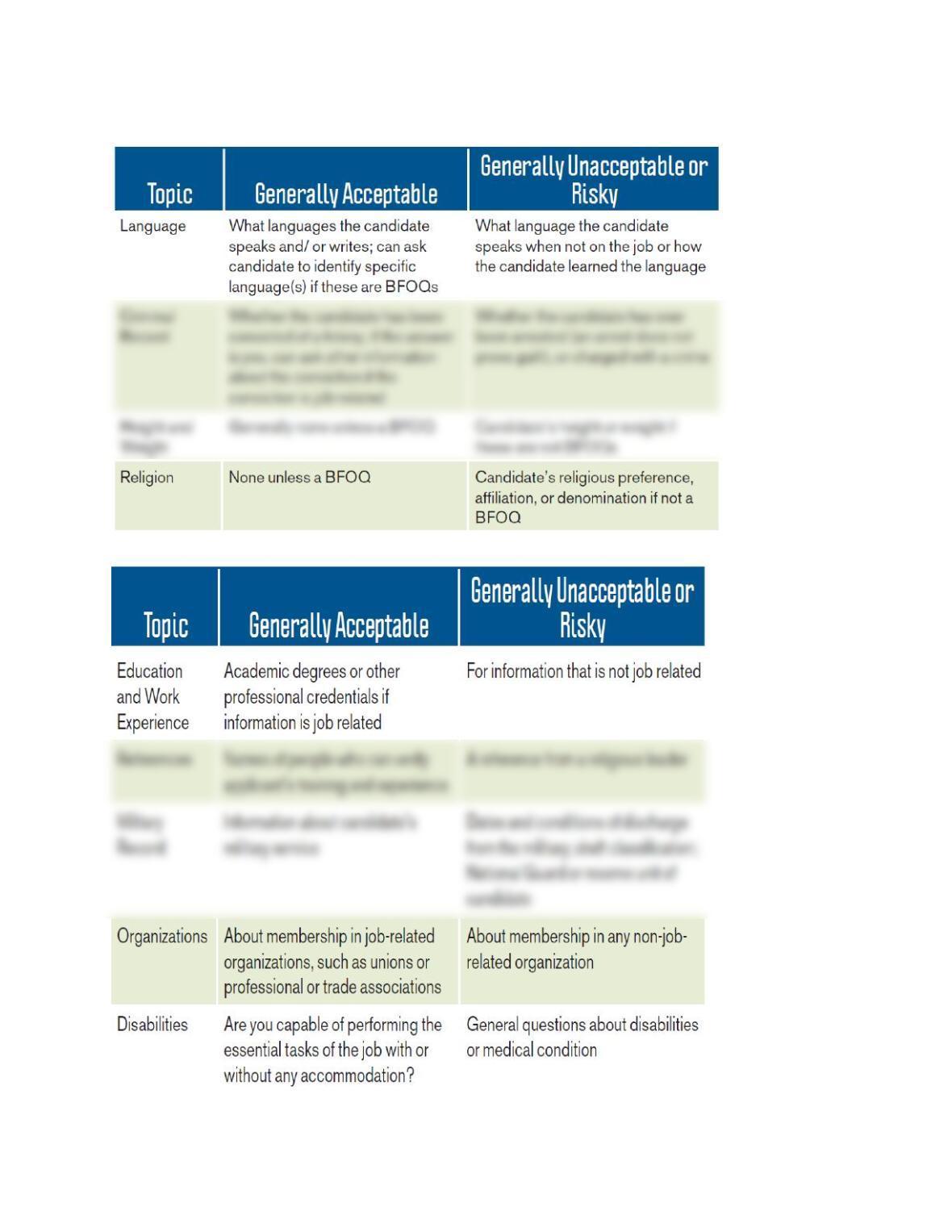
IX. Pre-Employment Inquiries
a. Pre-employment inquiries—information requested on job applications and during
interviews must be non-discriminatory.
i. Every question should be job related.
X. Interview Preparation Steps
Lecture Notes
Lussier, Human Resource Management, Third Edition
SAGE Publishing, 2018
Lecture Notes
Lussier, Human Resource Management, Third Edition
SAGE Publishing, 2018
XI. Employment Testing and Legal Issues
a. If the EEOC investigates a complaint about an employment test being discriminatory,
the company must prove the selection procedure is valid for that particular job.
XII. Types of Tests
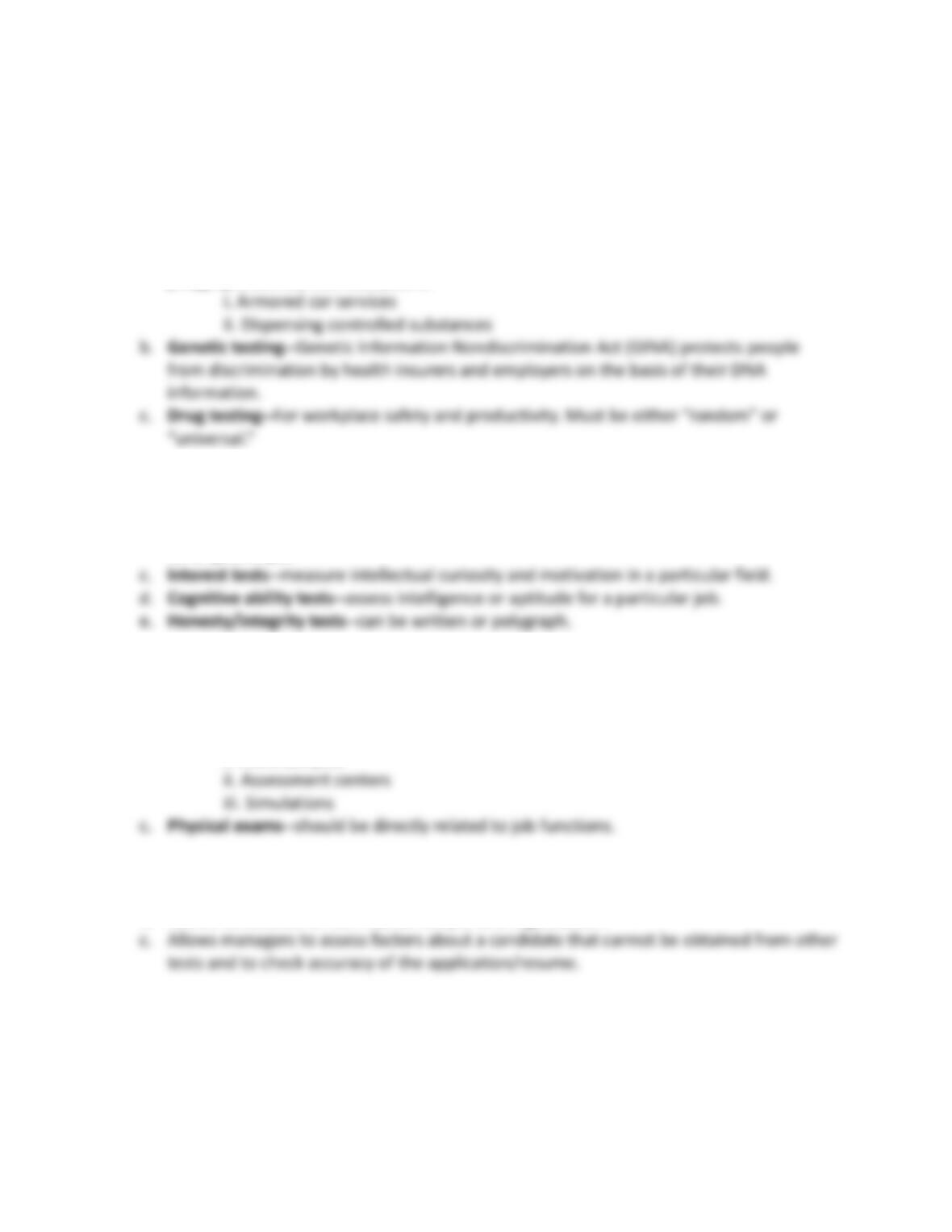
a. Polygraph tests—Employee Polygraph Protection Act (EPPA) makes it illegal to use a
polygraph, but has two exceptions.
XIII. Written Tests
a. Skills tests—measure ability to apply a particular knowledge set.
b. Personality tests—measure psychological traits or characteristics to determine suitability
for a specific job.
XIV. Physical Tests
a. To ensure applicants are capable of performing jobs as defined by job specifications and
descriptions.
b. Physical skills tests
i. Work samples
XV. Selection Interviews
a. Interviews are generally the most heavily weighted and one of the last steps.
b. Allows candidates to learn about the job and organization.
XVI. Types of Interviews
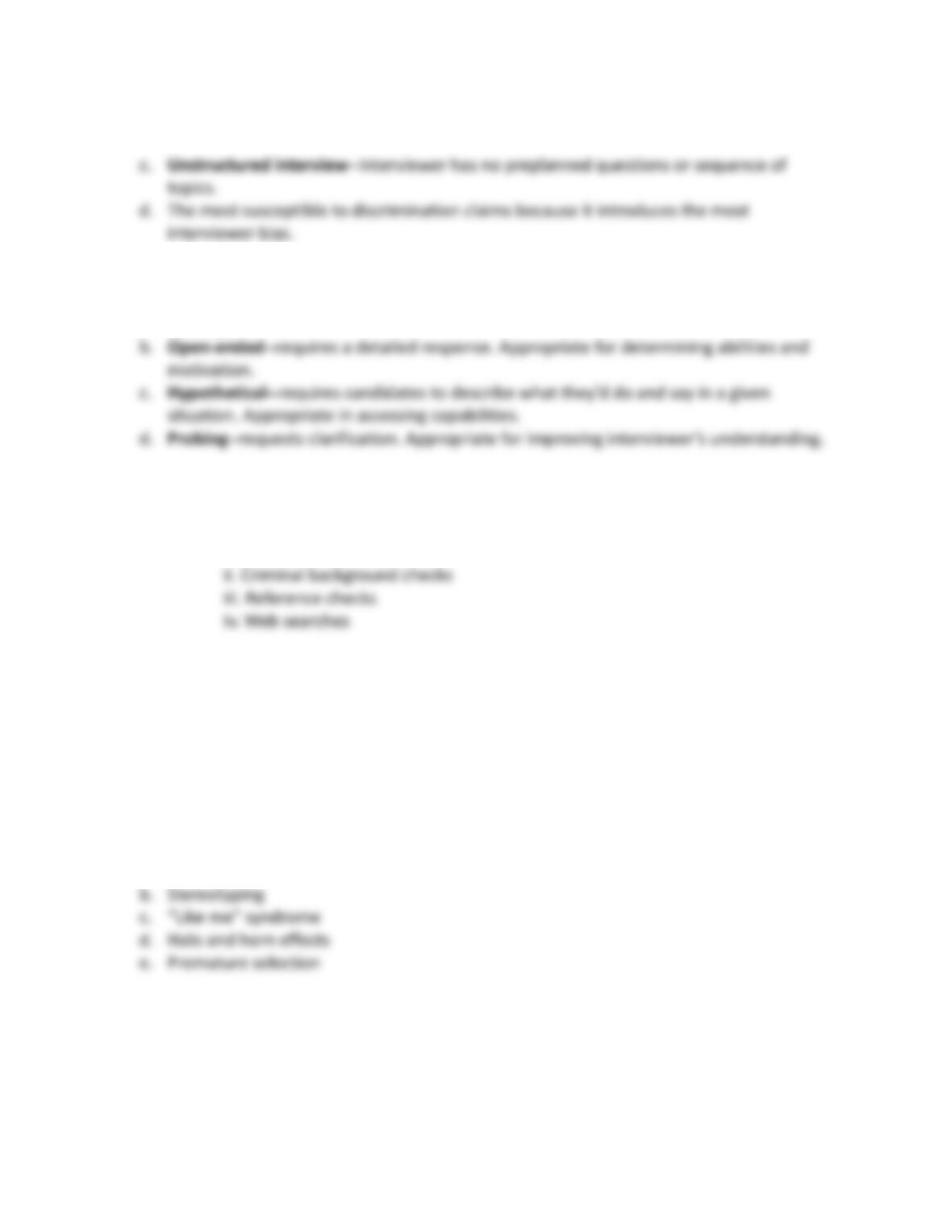
a. Structured interview—Candidates are asked the same questions.
b. Semi-structured interview—Interviewer follows list of questions, but also asks
unplanned questions.
Lecture Notes
Lussier, Human Resource Management, Third Edition
SAGE Publishing, 2018
XVII. Types of Questions
a. Closed-ended—requires a limited response (e.g., yes/no). Appropriate for fixed aspects
of the job.
XVIII. Background Checks
a. Prevents negligent hiring.
b. Types
i. Credit checks
XIX. Selecting the Candidate
a. Multiple-hurdle selection model
i. Requires applicants pass a selection test to go to the next test. Cost effective
because unqualified applicants stop taking further tests.
b. Compensatory selection model
i. Allows applicants to perform poorly on one test, but make up for that poor
score by doing well on other tests or interviews.
XX. Problems to Avoid During Selection Process
a. Rushing
XI. Hiring
a. Compares candidates’ qualifications and considers diversity.
b. Identifies if they truly desire the job and are honest.
c. Assesses person-organization fit via coworkers’ impressions.

Lecture Notes
Lussier, Human Resource Management, Third Edition
SAGE Publishing, 2018