5 – 13 Compensation – Thirteenth Edition Gerhart │Newman │Milkovich
the organization tends to use that factor for the entire work domain.
• Once a factor is part of the system, other workers are likely to say
their jobs have it, too.
▪ In one study, a 21-factor plan produced the same rank order of jobs that
could be generated using only seven of the factors.
Third – Scale the Factors
o Once the factors are determined, scales reflecting the different degrees
within each factor are developed.
o Most factor scales consist of four to eight degrees.
▪ For example, the difference between the first and second degrees in
Exhibit 5.13 should approximate the difference between the fourth and
fifth degrees, since the differences in points will be the same.
o The following criteria for scaling factors have been suggested:
1. Ensure that the number of degrees is necessary to distinguish among
jobs
Fourth – Weight the Factors According to Importance
o Factor weights reflect the relative importance of each factor to the overall
value of the job and to the organization.
Fifth – Select Criterion Pay Structure
o Contemporary job evaluation often supplements committee judgment for
determining weights with statistical analysis.
o The committee members recommend the criterion pay structure, that is, a
Chapter Five: Job-Based Structures and Job Evaluation 5 – 14
pay structure they wish to duplicate with the point plan.
o The criterion structure may be the current rates paid for benchmark jobs,
market rates for benchmark jobs, rates for jobs held predominantly by males
o Not only do the weights reflect the relative importance of each factor, but
research demonstrates that the weights influence the resulting pay structure.
▪ Selecting the appropriate pay rates to use as the criteria is critical.
▪ The job evaluation and its results are based on it.
Sixth – Communicate the Plan and Train Users
o A manual is prepared so others can apply the plan.
o The manual describes the method, defines the compensable factors, and
provides enough information to permit users to distinguish varying degrees
of each factor.
Seventh – Apply to Nonbenchmark Jobs
o The compensable factors and weights were derived using a sample of
benchmark jobs.
o The final step is to apply the plan to the remaining jobs.
o If the policy-capturing approach is used, then an equation can be used to
5 – 15 Compensation – Thirteenth Edition Gerhart │Newman │Milkovich
▪ They may also be part of panels that hear appeals from employees.
Eighth – Develop Online Software Support
o Online job evaluation is widely used in larger organizations.
V. Who Should Be Involved?
• If the internal structure’s purpose is to aid managers—and if ensuring high involvement
and commitment from employees is important—those managers and employees with a
stake in the results should be involved in the process of designing it.
A. The Design Process Matters
• Research suggests that attending to the fairness of the design process and the
approach chosen (job evaluation, skill/competency-based plan, and market
• Additional research is needed to ascertain whether the payoffs from increased
participation offset potential costs (time involved to reach consensus, potential
problems caused by disrupting current perceptions, etc.).
o Remember, no amount of participation overcomes low wages.
Appeals/Review Procedures
o No matter what the technique, no job evaluation plan anticipates all
situations.
o It is inevitable that some jobs will be incorrectly evaluated—or at least
Chapter Five: Job-Based Structures and Job Evaluation 5 – 16
o When the evaluations are completed, approval by higher levels of
management is usually required.
“I Know I Speak for All of Us When I Say I Speak for All of Us.”
o One study found that more powerful departments in a university were more
successful in using the appeals process to change the pay or the
classification of a job than were weaker departments.
VI. The Final Result: Structure
• The final result of the job analysis–job description–job evaluation process is a
structure, a hierarchy of work that translates the employer’s internal alignment policy
into practice – as shown in Exhibit 5.3 at the beginning of the chapter.
• Exhibit 5.15 shows four hypothetical job structures within a single organization. These
VII. Balancing Chaos and Control
• Job evaluation, with its specified procedures and documented results provided work-
related and business-related order and logic.
o However, over time, complex procedures and creeping bureaucracy can cause users
• At the same time, the world of work is changing.
o The work of many people now requires that they figure out what to do in a given

5 – 17 Compensation – Thirteenth Edition Gerhart │Newman │Milkovich
changing conditions.
• Some balance between chaos and control is required.
o History suggests that when flexibility without guidelines exists, chaotic and
VIII. Your Turn: Job Evaluation at Whole Foods
Summary of Case
Students are expected to design a job structure using information available through job analysis
and 10 job descriptions that have been completed already.
Learning Objective
Teaching Guideline
Use this case to help students understand the complexities in designing a job structure.
Discussion of Case Questions
1. Divide into teams of four to six each. Each team should evaluate the jobs and prepare a
job structure based on its evaluation. Assign titles to each job, and show your structure
by title and job letter. A broad hint: Recall from our discussion of Whole Foods’
business and pay strategy that teams play an important role.
This exercise is mainly directed at encouraging class participation. The instructor can divide
2. Your team should describe the process it went through to arrive at that job structure.
The job evaluation techniques and compensable factors used should be described, and
the reasons for selecting them should be stated.
This exercise is directed to improve any ambiguity in understanding the concept of job
structures and to encourage class discussions. Each team may put forth their analysis of the
Chapter Five: Job-Based Structures and Job Evaluation 5 – 18
process of having arrived at the particular job structure and explain the job evaluation
techniques and compensable factors used, and the reasons behind doing so. The
compensable factors that students choose should be based on the strategy and values of the
organization, and on the work performed. It should be acceptable to the stakeholders
affected by the resulting pay structure.
Students might choose some of the following compensation factors:
• Skills (analytical, communication, interpersonal)
• Responsibilities of the work
3. Each team should give each job a title and put its job structure on the board.
Comparisons can then be made among job structures of the various teams. Does the
job evaluation method used appear to affect the results? Do the compensable factors
chosen affect the results? Does the process affect the results?
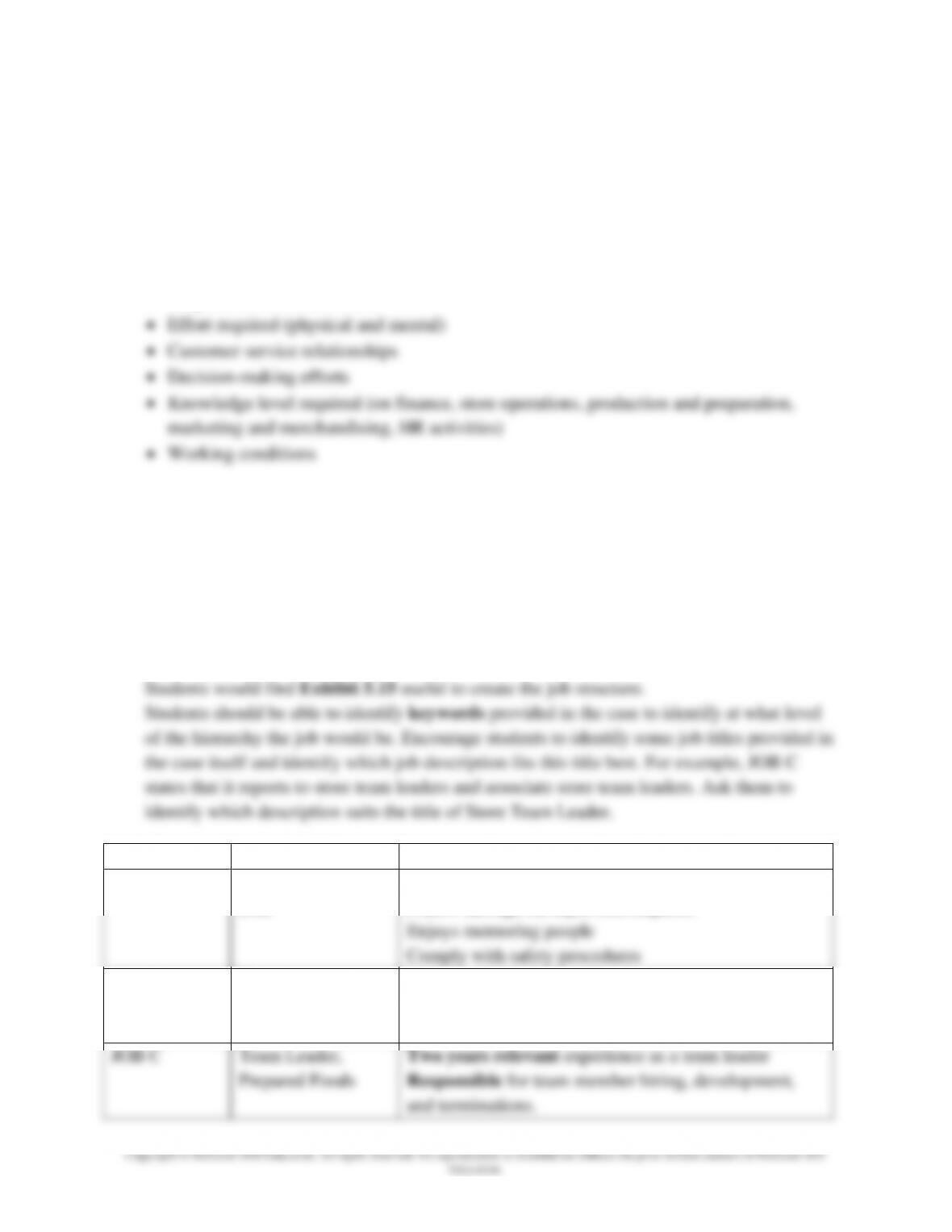
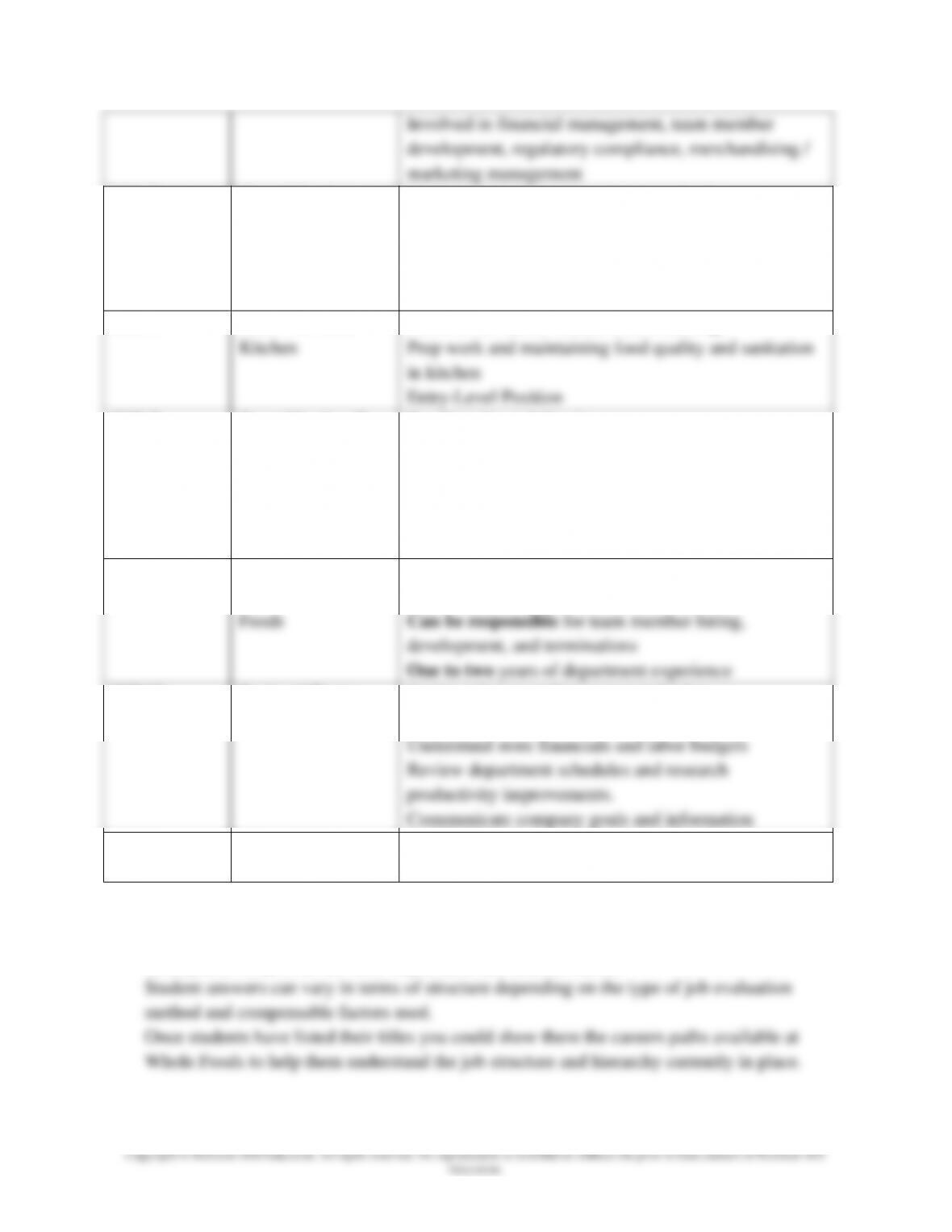
This exercise will encourage class discussions and student answers will vary. Students
should be able to analyze the descriptions and provide a suitable job title (similar titles to
what is provided in companies).
Job Number
Job Title
Keywords to identify the job title
JOB A
Team Member,
Deli
Prepares food items
Follow through on supervisor requests
Enjoys mentoring people
Comply with safety procedures
JOB B
Cashier
Assist and focus on customers
Perform cash register operations
Pass entry-level PLU code test
JOB C
Team Leader,
Prepared Foods
Two years relevant experience as a team leader
Responsible for team member hiring, development,
and terminations.
5 – 19 Compensation – Thirteenth Edition Gerhart │Newman │Milkovich
Involved in financial management, team member
development, regulatory compliance, merchandising /
marketing management
JOB D
Team Member,
Prepared Foods
Assist team leader or associate team leader
Mentor team members
Knowledge on operations of the store
Demonstrated decision-making ability, and leadership
skills
JOB E
Team Member,
Kitchen
Performs all duties related to dishwashing
Prep work and maintaining food quality and sanitation
in kitchen
Entry-Level Position
JOB F
Team Member II-
Stock and Display
Breaking down deliveries
Training entry-level grocery clerks
Performs all duties and responsibilities of grocery team
member.
Able to direct team members
One-year experience
JOB G
Associate Team
Leader, Prepared
Foods
Reports directly to Prepared Foods Team
Leader.
Can be responsible for team member hiring,
development, and terminations
One to two years of department experience
JOB H
Regional Team
Leader
Assist and support the store team leader
Operate the store
Understand store financials and labor budgets
Review department schedules and research
productivity improvements.
Communicate company goals and information
JOB I
Grocery Team
Member
Breaking down deliveries
Retail grocery or natural foods experience a plus
Encourage students to notice the similarity in description between JOB A and JOB G, JOB F
and JOB I. They should be able to analyze the differences and similarities between job
descriptions for jobs in the same department and similar classes.

Chapter Five: Job-Based Structures and Job Evaluation 5 – 20
Copyright © McGraw-Hill Education. All rights reserved. No reproduction or distribution without the prior written consent of McGraw-Hill
Education.
Students’ version of a job structure would be based as follows: team members under
operational group, associate and department team leaders under professional or
administrative group; associate store team leaders and store team leaders under managerial
group.
4. Evaluate the job descriptions. What parts of them were most useful? How could they
be improved?
This exercise will encourage class discussions and student answers will vary. Student
answers on which part of the description was most useful would be ‘the kind of work’ since
Answers to Review Questions
1. How does job evaluation translate internal alignment policies (loosely coupled versus
tight fitting) into practice? What does (a) organization strategy and objectives, (b) flow
of work, (c) fairness, and (d) motivating people’s behaviors toward organization
objectives have to do with job evaluation?
• Organization strategy and objectives—Job evaluation aligns with the organization’s
strategy by including what it is about work that adds value and contributes to pursuing
the organization’s strategy and achieving its objectives.

5 – 21 Compensation – Thirteenth Edition Gerhart │Newman │Milkovich
Copyright © McGraw-Hill Education. All rights reserved. No reproduction or distribution without the prior written consent of McGraw-Hill
Education.
chance, favoritism, and bias in setting pay.
• Motivate people’s behaviors toward organization objectives—Job evaluation calls out
to employees what it is about their work that the organization values, what supports the
organization’s strategy and its success. It can also help employees adapt to organization
changes by improving their understanding of what is valued and why that value may
have changed.
2. Why are there different approaches to job evaluation? Think of several employers in
your area (the college, hospital, retailer 7-Eleven, etc.). What approach would you
expect them to use? Why?
Different employers wish to emphasize different aspects of work; the different approaches
should support the organization’s strategy. Consequently, a wide variety of job evaluation
approaches exist. Some organizations desire to be more formalistic, legalistic, and thus use
3. What are the advantages and disadvantages of using more than one job evaluation
plan in any single organization?
The advantage of using multiple plans is it provides a higher likelihood of covering all
significant aspects of work content (due to the wide diversity of work among various job
families). For example, production jobs may vary in terms of manipulative skills, knowledge
of statistical quality control, and working conditions. But these tasks and skills may not be
4. Why bother with job evaluation? Why not simply market-price? How can job
Chapter Five: Job-Based Structures and Job Evaluation 5 – 22
evaluation link internal alignment and external market pressures?
With job evaluation, the systematic evaluation of jobs reflects the internal job structure
within a single organization. This structure and the underlying relationships among jobs are
the basis of internal alignment. As a process, job evaluation can help gain employee
acceptance of pay differences among jobs. The usefulness of job evaluation is that it
5. Consider your college or school. What are the compensable factors required for your
college to evaluate jobs? How would you go about identifying these factors? Should the
school’s educational mission be reflected in your factors? Or are the more generic
factors used in the Hay plan okay? Discuss.
Colleges need high-quality professors who can “package” the material based on the type of
students (admissions standards vary widely so the skill level of students will also differ).
Thus, faculty needs technical competence—knowledge/skills—in their chosen fields, plus
the ability to interact constructively with students. Since knowledge is so important, it will

5 – 23 Compensation – Thirteenth Edition Gerhart │Newman │Milkovich
Copyright © McGraw-Hill Education. All rights reserved. No reproduction or distribution without the prior written consent of McGraw-Hill
Education.
accountability), would not be applicable as such when evaluating faculty jobs. Of these
generic factors, know-how is the only applicable factor. The other factors would have to be
modified to apply to faculty positions.
6. You are the manager of 10 people in a large organization. All of them become very
suspicious and upset when they receive a memo from the HR department saying their
jobs are going to be evaluated. How do you try to reassure them?
First, find out from the HR department what forums are available for employee participation
and the anticipated uses of the job evaluation information. Ideally, one or more employees
should be provided an opportunity to be involved in the job analysis phase of the process.