EXPANDING THE TALENT POOL:
RECRUITMENT AND CAREERS
This chapter emphasizes the fact that increasingly firms compete on the basis of the talent of their
employees. Even though workers seemed to be in plentiful supply following the recession of
2001, the economy has recovered and many industries suffer serious shortages of qualified
workers. As the baby boomers begin retiring, the problem will worsen unless firms expand their
talent pools, that is, the number and kinds of people able to contribute to the success of the
organization, even if they are located globally.
This chapter encourages readers to recognize that procuring competent employees requires
CHAPTER LEARNING OUTCOMES
5
5
c
ch
ha
ap
pt
te
er
r
Describe how a firm’s strategy affects its recruiting efforts.
LEARNING OUTCOME 1
LECTURE OUTLINE
I. STRATEGIC ASPECTS OF RECRUITING
Decisions about talent—regardless of whether they pertain to recruiting, transferring,
promoting, developing, or deploying people—need to be considered within the context of
a business’s strategies and priorities.
A. WHO SHOULD DO THE RECRUITING?
The size of an organization often affects who performs the recruitment function. Most
B. SHOULD A FIRM RECRUIT INTERNALLY OR EXTERNALLY?
Most managers try to follow a policy of filling job vacancies above the entry-level
C. LABOR MARKETS
The condition of the labor can have a big effect on a firm’s recruiting plans. During
Explain the techniques organizations can use to improve their
recruiting efforts.
LEARNING OUTCOME 4
56 Part 3: Developing Effectiveness in Human Resources
1. Regional and Global Labor Markets
In addition to locating near their talent, to stay apace of their competitors and
expand their operations around the world, companies are also looking globally for
D. BRANDING
Branding refers to a company’s efforts to help existing and prospective workers
understand why it is a desirable place to work.
II. RECRUITING INTERNALLY
1. Internal Job Postings
Internal job postings are a quick way to find qualified employees interested in a
position.
• Ask students to describe the job posting and bidding system where they
work. Was it done electronically or manually? Were students able to track
2. Identifying Talent through Performance Appraisals
• Successful performers are often good candidates for a promotion. In contrast,
poor performing employees may benefit from a transfer or even a demotion.
Chapter 5: Expanding the Talent Pool: Recruitment and Careers 57
3. Skills Inventories and Replacement Charts
As we discussed in Chapter 2, firms use skills inventories to help track an
employee’s education, past work experience, vocational interests, specific
III. RECRUITING EXTERNALLY
Recruiting is the HR function concerned with locating and encouraging potential
applicants to apply for existing or future job openings. Point out to students that recruiting
can basically be done internally or externally (or in combination). However, it’s not a
question about whether or not candidates will be recruited from outside of the
organization. They definitely will be. The question is at what level they will be brought
in—entry level or higher-rank levels.
1. Advertisements
• There appears to be a correlation between how accurately job advertisements
2. Walk-Ins and Unsolicited Applications and Résumés
• Unsolicited applications can actually be a good source of applicants because
it’s believed that people who seek out their employers versus the other way
around actually make better employees. However, the Internet has made it so
3. The Internet, Social Networking, and Mobile Recruiting
• According to an SHRM study, the most common tactic used by job seekers is
to search the Internet. Moreover, nine out of ten recruiters use the Internet to
58 Part 3: Developing Effectiveness in Human Resources
4. Job Fairs
Job fairs can be a good way to cast a wide net for diverse applicants in a certain
5. Employee Referrals
• Employee referrals are the primary way most job positions are filled. Some
potential negative factors associated with employee referrals include
inbreeding and the violation of EEO regulations.
• Ask students what they think about employee referrals, including nepotism. Is
6. Rerecruiting
Rerecruiting is the process of keeping track of and maintaining relationships with
former employees to see if they would be willing to return to the firm.
Chapter 5: Expanding the Talent Pool: Recruitment and Careers 59
7. Executive Search Firms
• Headhunters generally charge 30 to 40 percent of an applicant’s annual salary
when the executives they recommend are chosen. Newer data suggests,
6. Educational Institutions
• About 30 percent of workers in the U.S. hold bachelor’s degrees. Given these
numbers, colleges are likely to remain a good recruiting source for employees.
7. Professional Associations
8. Labor Unions
• Labor unions are a good source of applicants, particularly for tradespeople.
9. Public Employment Agencies
• Each U.S. state maintains an employment agency that administers its
60 Part 3: Developing Effectiveness in Human Resources
10. Private Employment and Temporary Agencies
• Private employment agencies differ with regard to the clients they represent,
services they offer, and fees they charge, although 25-30 percent of the hired
11. Employee Leasing
• According to the National Association of Professional Employer
Organizations (NAPFO), 700 PEOs oversee two–to-three million American
workers.
IV. IMPROVING THE EFFECTIVENESS OF RECRUITING
The HR department can do several things to improve its chances of locating
promising talent. These include the use of yield ratios, organizational recruiters, and
realistic job previews.
A. Using Realistic Job Previews
One way organizations may be able to increase the effectiveness of their recruitment
efforts is to provide job applicants with a realistic job preview (RJP). An RJP informs
applicants about all aspects of the job, including both its desirable and undesirable facets.
B. Surveys
Another way to improve a company’s recruiting is to survey managers about how
satisfied they are with the process.
C. Recruiting Metrics
Chapter 5: Expanding the Talent Pool: Recruitment and Careers 61
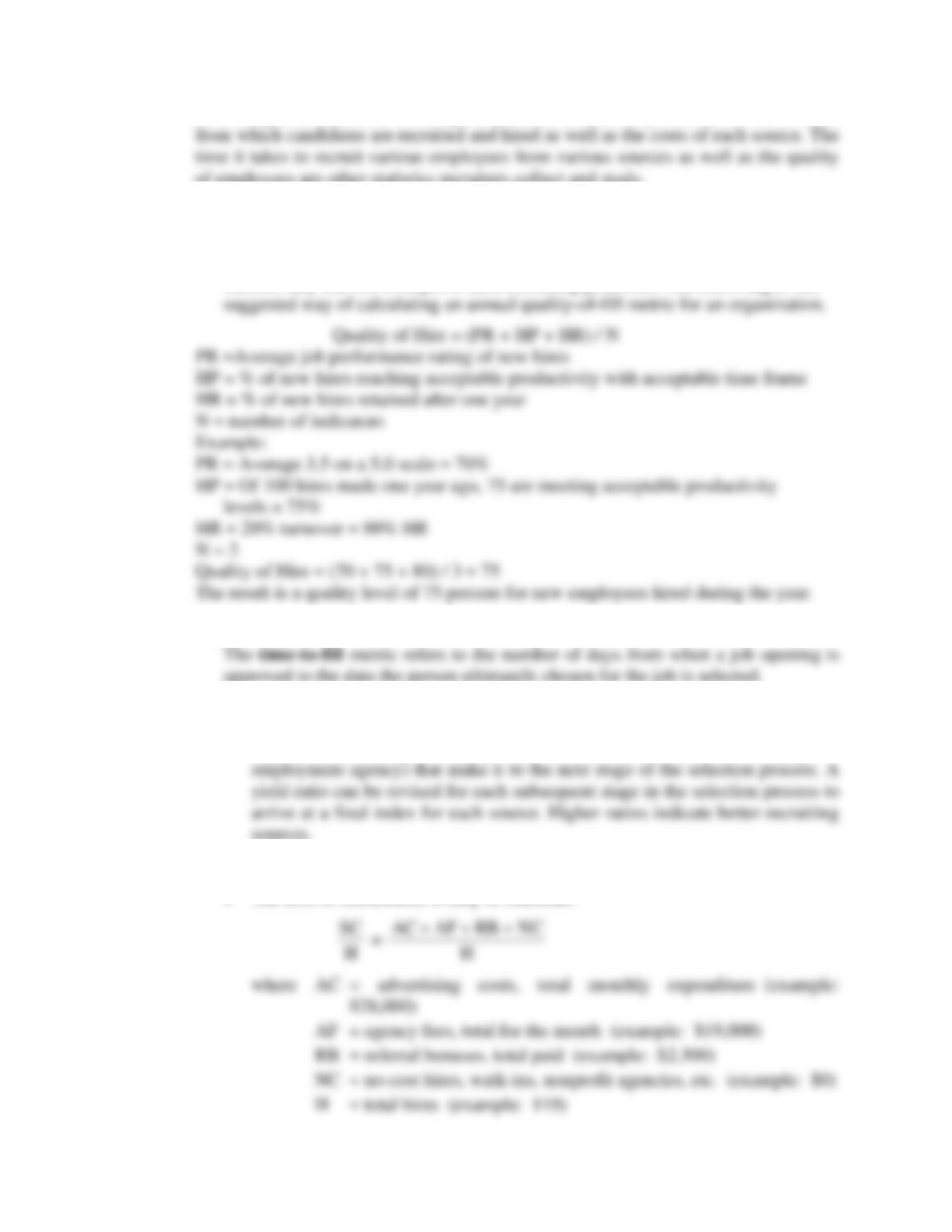
As we explained earlier in the chapter, recruiters should keep statistics on the sources
of employees are other statistics recruiters collect and study.
1. Quality of Fill Statistics
As we indicated in the appendix to Chapter 2, hiring quality employees is a
primary concern of recruiters. Firms have attempted to develop a quality-of-fill
statistic they can use to improve their recruiting processes. The following is one
2. Time to Fill
1. Yield Ratios
• A yield ratio is the percentage of applicants from a particular source (e.g., an
2. Costs of Recruitment
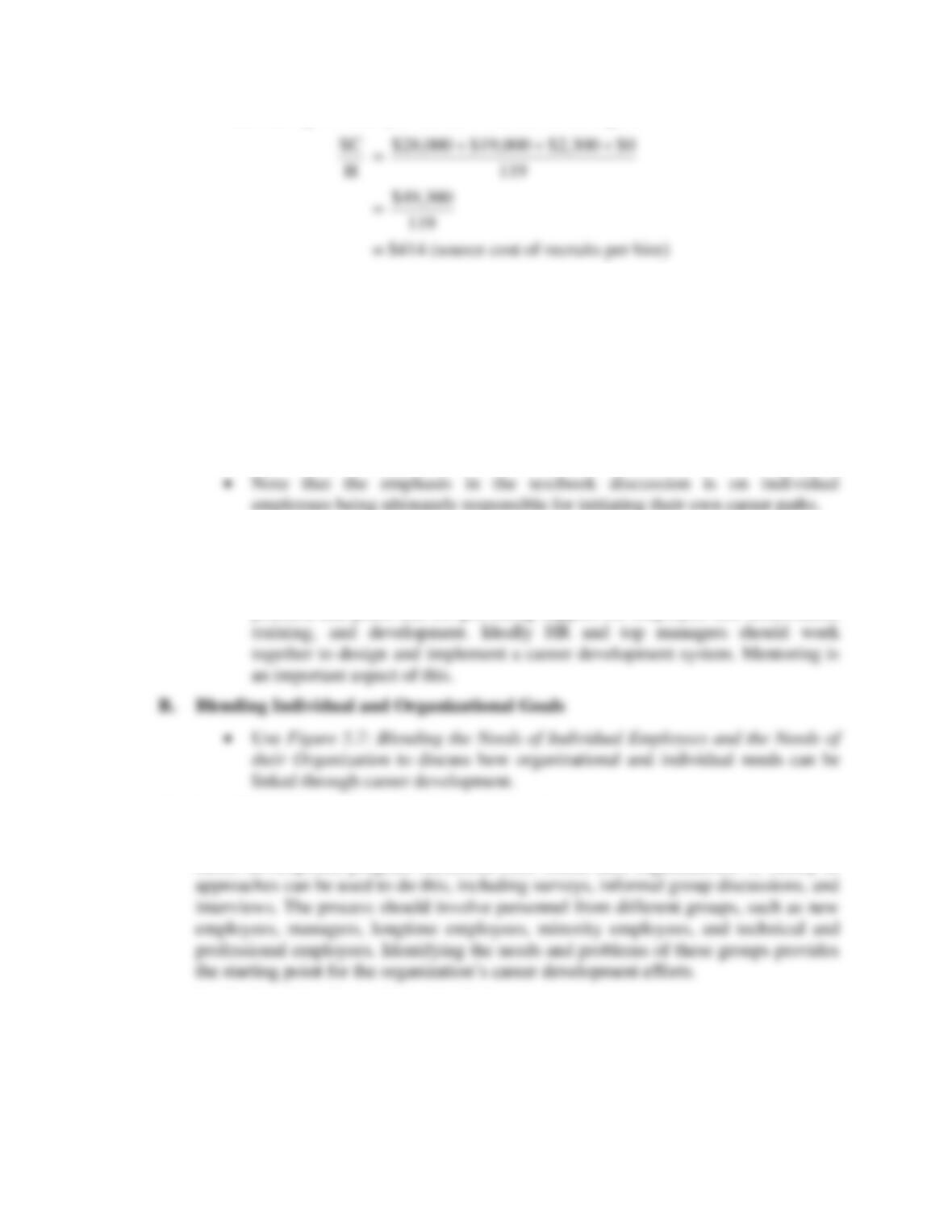
• The cost of recruitment is easy to calculate:
62 Part 3: Developing Effectiveness in Human Resources
Substituting the example numbers into the formula gives
V. CAREER MANAGEMENT: DEVELOPING TALENT OVER TIME
Career management places great emphasis on the individual’s career needs. Such programs
usually involve several specific activities, including counseling, career pathing, training,
computerized inventorying of background and skills, and job posting. Use Figure 5.6 for
an overview of the activities of a career development program.
A. The Goal: Matching Individual and Organizational Needs
1. The Employee’s Role
2. The Organization’s Role: Establishing a Favorable Career-Development
Climate
• The organization is responsible for providing information about its mission,
policies, and plans and for providing support for employee self–assessment,
C. Identifying Career Opportunities and Requirements
HR managers are responsible for making sure that the conditions that help make a
career development program successful exist within their organizations. A variety of
1. Begin with a Competency Analysis
• Jobs within an organization must be studied carefully to identify and assign
weights to the knowledge and skills that are required. Career development
paths may then be devised so that a move to a different job can be a growth–
requiring assignment.
Chapter 5: Expanding the Talent Pool: Recruitment and Careers 63
2. Identify Job Progressions and Career Paths
• Once the skill demands of jobs are identified and weighted, it is possible to
plan job progressions. Job progressions serve as a basis for career paths.
3. Track Career Stages
A person’s knowledge, skills, abilities, and attitudes as well as career aspirations
change with age and maturity. The challenges and frustrations people face at the
4. Recognize Different Career Paths
• Students often think that their best opportunities come from promotions, but a
quick conversation can reveal the fact that a person’s career advancement can
5. Consider Dual Career Paths
• Providing for progression in special areas, with compensation that is
6. Consider the Boundaryless Career
• The new boundaryless career model consists of continuously learning new
skills, developing new relationships, and capitalizing on existing skills and
7. Help Employees Progress beyond Career Plateau
64 Part 3: Developing Effectiveness in Human Resources
• The vast majority of people will experience a career plateau in their working
C. Career Development Initiatives
1. Career Planning Workbooks and Workshops
• Some companies have specially prepared workbooks for their career
advancement programs. The workbooks are useful in guiding employees
2. Career Counseling
• Career counseling may be provided by the HR staff, supervisors, specialized
staff counselors, or outside professionals. In addition, the Workforce
3. Mentoring
• Although mentoring is not a new phenomenon, it became more formalized in
the 1980s with the assignment of employees to mentors and the training of
individuals to be more effective at mentoring. One survey found that 77