Chapter 5 Personality and Values Page
51
Chapter 5
Personality and Values
Chapter Overview
Personality and values are major shapers of behavior. In order for managers to predict
Chapter Objectives
After studying this chapter, the student should be able to:
factors that determine an individual‘s personality.
3. Identify the key traits in the Big Five personality model and demonstrate how the
Big Five traits predict behavior at work.
5. Define values, demonstrate the importance of values, and contrast terminal
instrumental values.
6. Identify Hofstede’s five value dimensions of national culture.
Suggested Lecture Outline
I. PERSONALITY
A. What Is Personality?
1. Personality. When psychologists talk of personality, they
2. Defining Personality: The sum total of ways in which an individual reacts to, and
interacts with, others – described in terms of measurable traits.
3. Measuring Personality. The ability to measure personality
traits to help managers select appropriate employees and
1) Individuals evaluate themselves on a series of factors.
PPT 5.1
PPT 5.2
PPT 5.3
PPT 5.4
Chapter 5 Personality and Values Page
52
4. Personality Determinants. Personality appears to be development of both
hereditary and environmental factors. Of the two, heredity
1) These are factors determined at conception such as physical stature,
2) The heredity approach argues that personality is determined at the
chromosome level.
b. Twin studies.
1) Studies of identical twins that were separated at birth indicate that a
2) Genetics appears to be more influential on personality development than
parental environment.
c. Aging and personality.
2) However, this change is more in terms of level of ability than it is in
changes in the actual ranking of the behavioral traits themselves—which
are very stable over time.
d. Personality traits.
1) Traits are characteristics that describe an individual’s behavior that are
exhibited in a large number of situations.
2) Two of the dominant frameworks for describing relevant personality
traits are the MBTI and the Big Five Model.
B. The Myers-Briggs Type Indicator (MBTI).
1. This the most widely used instrument in the world.
1) Extraverted versus Introverted (E or I). People scoring higher on the
2) Sensing versus Intuitive (S or N). Sensing individuals are practical, enjoy
3) Thinking versus Feeling (T or F). This scale is important in decision-
4) Judging versus Perceiving (J or P). Judgers are control-oriented and
enjoy structure and order. Perceivers are more flexible and
spontaneous.
b. Sixteen Personality Types
1) These classifications together describe 16 personality types, with every
person identified with one of the items in each of the four pairs. Let’s
PPT 5.5
PPT 5.6
Chapter 5 Personality and Values Page
54
c. Conscientiousness. Measures reliability.
2) Low scorers are easily distracted, disorganized, and unreliable.
4) However, conscientious people also tend not to take risks and may find
organizational change difficult to handle.
d. Emotional Stability (or Neuroticism – its opposite). Measures ability to
handle stress.
1) The more stable a person, the better he (or she) can handle stress.
3) They often have higher life and job satisfaction. Low emotional stability
scorers tend to be nervous, anxious, depressed, and insecure.
4) Yet, surprisingly, low-scoring people make better and faster decisions
when in a bad mood than do stable people.
e. Openness to Experience. Measures the range of interests and fascination
with novelty, a proxy for creativity.
2) High scorers tend to be creative, curious, and artistically sensitive.
4. How do the Big Five traits predict behavior at work?
a. Research on the Big Five has found relationships
between these personality dimensions and job
performance.
1) As the authors of the most-cited review put it, “the
preponderance of evidence shows that individuals who are dependable,
2) In addition, employees who score higher in conscientiousness develop
3) Higher levels of job knowledge then contribute to higher levels of job
performance.
b. Conscientiousness is as important for managers as for front-line employees.
1) A study of the personality scores of 313 CEO candidates in private
equity companies (of whom 225 were hired, and their company’s
3) Although conscientiousness is the Big Five trait most consistently
related to job performance, the other traits are related to aspects of
Exhibit 5.1
PPT 5.8
Chapter 5 Personality and Values Page
55
Chapter 5 Personality and Values Page
57
g. In jobs that require bargaining skills (such as labor negotiation) or that offer
3. Narcissism.
a. The term is from the Greek myth of Narcissus, a man so vain and proud he
1) A study found that although narcissists thought they were better leaders
than their colleagues, their supervisors actually rated them as worse.
2) For example, an Oracle executive described that company’s CEO Larry
Ellison as follows: “The difference between God and Larry is that God
does not believe he is Larry.”
4. Self-Monitoring. Describes the ability of people to adjust their behaviors to fit
external, situational factors.
5. Risk Taking.
a. People differ in their willingness to take chances, a quality that affects how
much time and information managers need to make a decision.
2) High risk-taking managers made more rapid decisions and used less
information than did the low risk-taking managers. Interestingly,
decision accuracy was the same for both groups.
b. Although previous studies have shown managers in large organizations to
be more risk averse than growth-oriented entrepreneurs who actively
manage small businesses, recent findings suggest managers in large
organizations may actually be more willing to take risks than entrepreneurs.
c. The work population as a whole also differs in risk propensity.
d. It makes sense to recognize these differences and even consider aligning
them with specific job demands.
1) A high risk-taking propensity may lead to more effective performance
2) On the other hand, a willingness to take risks might prove a major
obstacle to an accountant who performs auditing activities.
6. Proactive Personality.
a. Individuals with this type of personality tend to
identify opportunities, show initiative, take action,
7. Other-Orientation.
a. A personality trait that reflects the extent to which decisions are affected by
social influences and concerns vs. our own well-being and outcomes.
II. VALUES
A. Values represent basic convictions that “a specific mode of
conduct or end-state of existence is personally or socially
preferable to an opposite or converse mode of conduct or end-
state of existence.”
2. Values have both content and intensity attributes.
a. The content attribute says a mode of conduct or end-
state of existence is important.
3. All of us have a hierarchy of values that forms our value system.
4. Values tend to be relatively stable and enduring.
a. A significant portion of the values we hold is established in our early years—
by parents, teachers, friends, and others.
PPT 5.10
PPT 5.11
PPT 5.12
5. If we question our values, of course, they may change, but more often it
reinforces them.
6. There is also evidence linking personality to values, implying our values may be
partly determined by our genetically transmitted traits.
B. The Importance of Values.
1. Values lay the foundation for understanding people’s attitudes, motivation, and
behavior.
3. Values can cloud objectivity and rationality.
C. Terminal versus Instrumental Values.
1. Values can be classified by instruments such as the
Rokeach Value Survey (RVS). See Exhibit 4.2.
2. This instrument consists of two sets of values each with
18 value items.
a. The sets are terminal and instrumental values.
states; goals a person would like to achieve.
2) Instrumental Values. Lists preferable modes of
behavior or means of achieving terminal values.
b. Several studies confirm that RVS values vary among
groups.
1) People in the same occupations or categories (corporate managers,
1) Although there was a good deal of overlap among them, there were also
significant differences.
2) The activists ranked “equality” as their most important terminal value;
executives and union members ranked this value 12 and 13,
respectively.
III. LINKING AN INDIVIDUAL’S PERSONALITY AND VALUES TO THE WORKPLACE
Managers have become concerned with matching both the personality and the values of
an employee with those of the organization. The hope is to identify workers who are
both flexible and committed to the organization.
A. Person-Job Fit
1. Holland’s Personality-Job Fit Theory.
a. Holland identified six personality types and proposed
PPT 5.16
Exhibit 5.2
Exhibit 5.3
PPT 5.13
PPT 5.14
PPT 5.15
Chapter 5 Personality and Values Page
60
c. Vocational Preference Inventory Questionnaire.
2) The six personality types (or fields in Holland’s
terminology) are laid out on a hexagon.
3) Fields that lie adjacent to each other are similar;
those diagonally opposite are highly dissimilar.
4) Appropriate jobs for that personality (that is, those jobs that are
congruent to the field) are listed either within the field’s segment of the
hexagon or in a separate document.
B. Person-Organization Fit.
1. The understanding that a person must be a good match to
the organization itself has become increasingly important
to managers.
2. This concept argues that employees are more likely to leave an organization
3. The alignment of an employee’s personality and values with an organization’s
4. By testing and selecting based on this concept, managers can increase
organizational outcomes.
5. Some general rules, using Big Five terminology are:
a. If the organization’s culture is aggressive and team-oriented, hire people
high in extraversion.
IV. INTERNATIONAL VALUES
A. Because values differ across cultures, an understanding of
the differences would be helpful in explaining and
predicting behavior of employees from different countries.
Two frameworks to assess culture are Hofstede’s Framework and the Globe
Framework.
a. Hofstede’s Framework. See Exhibit 5.5. Examines five value dimensions of
national culture. While there are many criticisms of
this framework, it is one of the most widely read and
accepted in OB.
1) Power Distance. The degree to which people accept
that power in institutions and organizations is
2) Individualism/Collectivism. The amount of emphasis placed on the
individual as opposed to the group.
Exhibit 5.4
PPT 5.17
PPT 5.18
Exhibit 5.5
PPT 5.19
Chapter 5 Personality and Values Page
61
a) Individualism is when people prefer to act as individuals rather than
as members of groups and believe in individual rights above all else.
b) Collectivism emphasizes a tight social framework in which people
expect group members to look after and protect them.
3) Masculinity/Femininity. The value a culture places on traditional
gender roles.
4) Uncertainty Avoidance. The degree to which people in a culture prefer
structured over unstructured situations.
5) Long-Term/Short–Term Orientation. Degree of long-term devotion to
traditional values.
6) There are both regional and national differences in culture as measured
by this framework.
7) Hofstede’s framework is not without its critics, but it is still highly
influential.
b. The GLOBE (Global Leadership and Organizational
Behavior Effectiveness) Framework.
1) A relatively recent and on-going program of
research, this framework uses nine dimensions of national culture.
3) Assertiveness. The extent to which people are encouraged to be tough,
confrontational, assertive, and competitive.
4) Future Orientation. The extent to which future-oriented behaviors are
5) Gender Differentiation. The extent to which society maximizes gender
differences. (Equivalent to Hofstede’s masculine/feminine.)
6) Uncertainty Avoidance. Reliance on social norms and procedures to
7) Power Distance. The degree to which unequal power is acceptable.
(Equivalent to Hofstede’s dimension of the same name.)
8) Individualism/Collectivism. The degree to which individuals are
9) In-Group Collectivism. Extent to which people take pride in membership
in small groups (family, friends, and work organizations).
PPT 5.20
10) Performance Orientation. The degree to which group members are
rewarded for performance improvement and excellence.
11) Humane Orientation. The degree individuals are rewarded for fair,
generous, and altruistic behaviors.
V. SUMMARY AND IMPLICATIONS FOR MANAGERS
A. Personality. Managers need to evaluate the job, the work
group, and the organization in order to determine what the
optimum Big Five personality type would be for a new
employee. The MBTI could be helpful in training and development.
VI. Keep in Mind
A. Personality
2. Easily measure
B. Big Five Personality Traits
2. May be very useful in predicting behavior
C. Values
1. Vary between and within cultures
VII. Summary
Discussion Questions
1. Describe the two most common methods of assessing a personality. Which is likely
to be the most accurate? Why?
2. Describe the Myers-Briggs Type Indicator personality framework. Based on the
framework, what would you think was your personality type? Why?
Answer: The MBTI is made up of four classification scales which are combined into
sixteen personality types denoted by the initials of the dominant side of each scale
(with N for intuitive). The scales are: 1) Extraverted/Introverted. People scoring
PPT 5.21
PPT 5.22
PPT 5.23
Chapter 5 Personality and Values Page
64
As team, find out which team members are currently in jobs (or if they are not
working now, were in jobs) that Holland’s assessment indicates they should enjoy
and which are in jobs that the assessment says they would not enjoy. Determine:
a. How accurately does the assessment match your own experiences?
3. Analyzing your Organization (Cumulative Project). Select a free web-based version
of the MBTI, Big Five, or Holland assessment tool. Take the assessment and ask five
of your co-workers and your supervisor to also take the assessment. Have them
share the results with you. Based on these results, consider the following questions:
a. How good a “match” are you with your co-workers and supervisor in terms
of personality?
Suggested Assignment
Divide the class into groups of three to five students. Ask them to go to
http://www.buzzle.com/articles/personality-types-a-b-c.html and read about this
resource’s definition of four different personality types. Ask the student groups to discuss
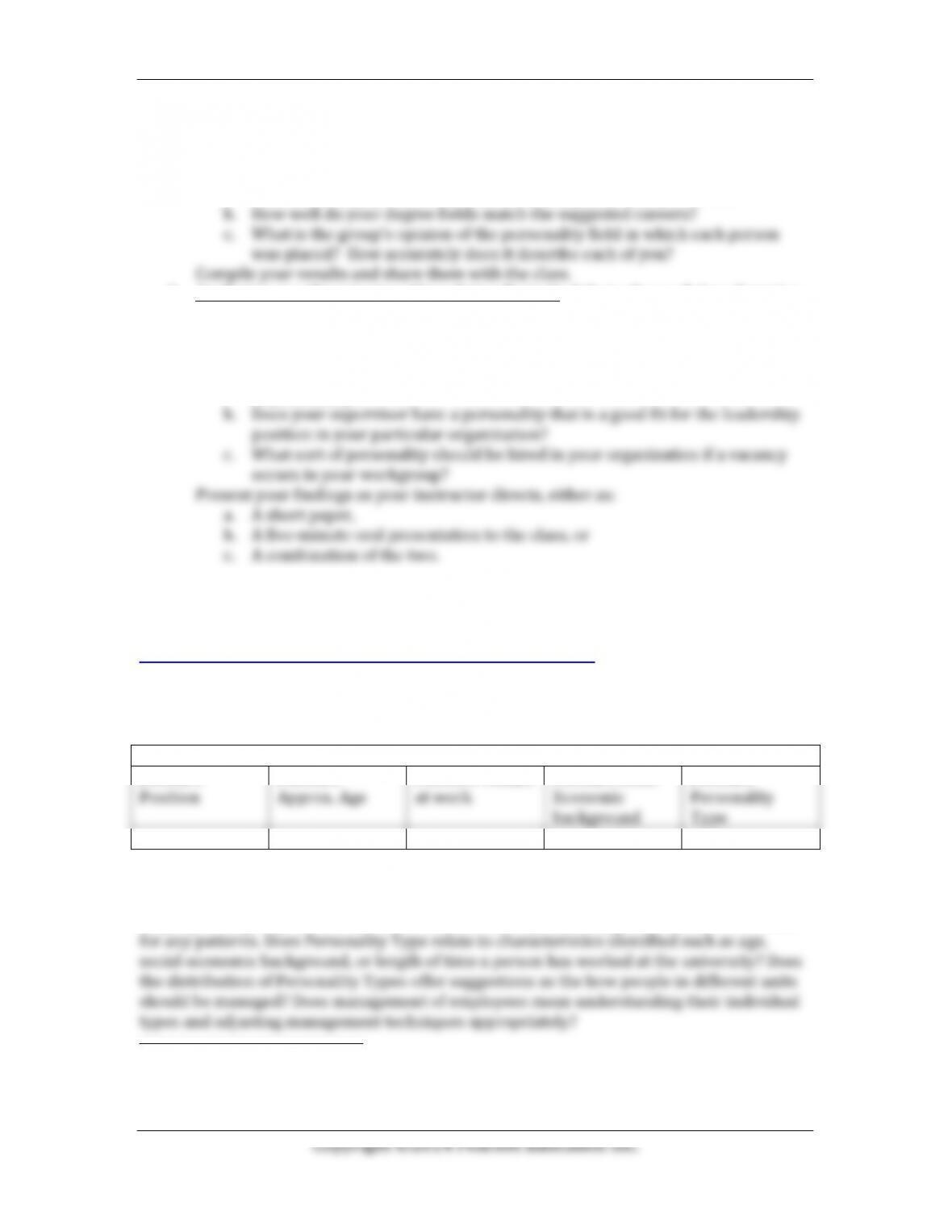
the four types as they relate to people who work at your university. Have them create a
table that shows the following:
University Employees
Person’s
Position
Person’s
Approx. Age
Person’s Tenure
at work
Person’s Socio–
Economic
background
Person’s
Personality
Type
Please do not place people’s names in the chart. But, attempt to estimate responses to
each of the categories for specific people the students know. Once this is completed for 15 to
20 people the group knows who work at the university, have the groups assess the entries