
Lecture Notes
Lussier, Human Resource Management, Third Edition
SAGE Publishing, 2018
Lecture Notes
Chapter 5: Recruiting Job Candidates
Learning Objectives
After studying this chapter, you should be able to do the following:
5-2 Briefly discuss the main items we need to consider before recruiting.
5-3 Discuss the major advantages and disadvantages of both internal and external recruiting.
Annotated Chapter Outline
I. Recruiting
a. Matches employees with jobs and creates a reasonable pool of qualified candidates
for a job opening.
Lecture Notes
Lussier, Human Resource Management, Third Edition
SAGE Publishing, 2018
The process should be as efficient as possible because costs associated with recruiting, selecting,
and training a new employee is often more than 100% of the
a. II. External Forces That Affect Recruiting
Labor market
III. Forecasting a Firm’s Labor Demand
a. Labor market—external pool of candidates to draw recruits.
b. Seasonal forecasts—some business demands are seasonal and predictable.
The labor market is the term for the external pool of candidates from which to draw recruits.
Seasonal forecasts—some business demands are seasonal and predictable.
Interest rate forecasts—higher interest rates discourage capital investment. When interest rates
fall product demand rises.
Lecture Notes
Lussier, Human Resource Management, Third Edition
SAGE Publishing, 2018
IV. Recruiting Considerations
a. Under what conditions will the organization recruit new people?
b. What are the organization’s alternatives and when will it use them?
V. Internal Recruiting
a. Filling job openings with current employees or individuals known by current employees.
b. Sources
VI. Types of Recruiting
a. Open recruiting
i. Advertising position openly within the organization.
Lecture Notes
Lussier, Human Resource Management, Third Edition
SAGE Publishing, 2018
VII. Internal Recruiting Strategies
a. Promotability ratings
b. Managerial sponsorship
i. Type of mentoring. Managers must provide sponsorship for individual
employees before they can be considered for a promotion.
VIII. Internal Recruiting: Advantages
a. Promotions and requested lateral moves increase organizational commitment and
job satisfaction.
IX. Internal Recruiting: Disadvantages
a. Applicant pool is significantly smaller.
b. Hiring from within opens another position to fill.
Lecture Notes
Lussier, Human Resource Management, Third Edition
SAGE Publishing, 2018
e. Internal employees may feel entitled to the job.
X. External Recruiting
a. Engaging individuals from labor market outside the firm to apply for a job.
XI. Sources of External Recruiting
a. Walk–ins
b. Educational institutions
i. Temporary agencies
XII. Major Recruiting Sources
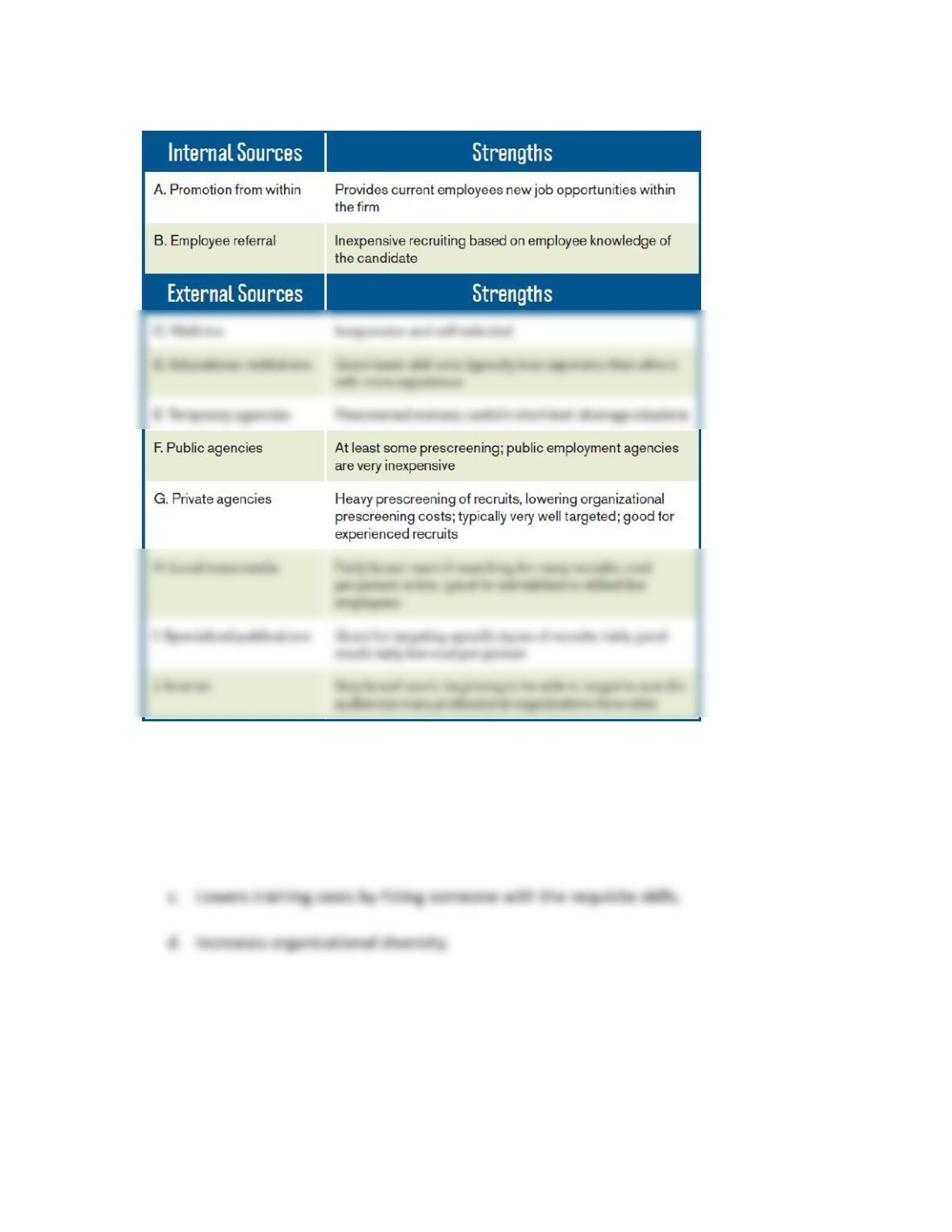
Lecture Notes
Lussier, Human Resource Management, Third Edition
SAGE Publishing, 2018
XIII. External Recruiting: Advantages
a. Avoids creating or perpetuating resistance to change.
b. Finds individuals with complex skill sets who are not available internally.
XIV. External Recruiting: Disadvantages
a. Disruption of introducing different ways of operating.
b. Takes more time and training costs.

Lecture Notes
Lussier, Human Resource Management, Third Edition
SAGE Publishing, 2018
XV. Challenges and Constraints of Recruiting
a. Budgetary constraints
XVI. Recruiting Yield Analysis
a. Applicant flow—how many and what type of applicants come from each recruiting
source.
b. Selection ratio—number of individuals hired divided by number of applicants.
XVII. Recruiting Evaluation Methods

Lecture Notes
Lussier, Human Resource Management, Third Edition
SAGE Publishing, 2018