CHAPTER 3
The Global Environment
Learning Objectives
After studying this chapter, the student should be able to:
1. Describe the growth of international business.
2. Identify and discuss global issues in international human resource management.
Chapter Outline
Opening Case: Thinking Globally, Hiring Locally
When international businesses first began to aggressively move into China and India, they
generally transferred expatriate managers from their home company to run these new operations.
In China, for instance, many locals sharpened their English language skills, developed more
Introduction
International business is an ever-growing component of the global economy. Almost every large
firm located anywhere in the world remains on the alert for new business opportunities anywhere
2
Chapter 3: The Global Environment
I. The Growth of International Business
International business is not a new phenomenon. Indeed, its origins can be traced back literally
thousands of years to merchants developing their trade routes linking southern Europe, northern
Africa, the Middle East, and Asia. The forces that shape today’s international business
Eventually, U.S. firms decided that they had little choice but to start over as well, so many of
them practically rebuilt themselves in the late 1980s and early 1990s. By the mid-1990s, global
competitiveness seemed to have become the norm rather than exception. The United States,
Japan, and Germany remained the three leading industrial powers in the world. However, other
western European countries such as France, England, the Netherlands, Spain, and Belgium were
also becoming increasingly important. In Asia, Taiwan, Singapore, and Malaysia were also
emerging as global economic powers. Of course, China and India are clearly emerging as global
powers. Figure 3.1 illustrates the regions of the world that are especially significant in today’s
global economy.
3
Chapter 3: The Global Environment
II. Global Issues in International Human Resource Management
As shown in Figure 3.2, one issue is the development of an international HRM strategy.
A. International Human Resource Management Strategy
Some firms adopt what is called an ethnocentric staffing model. Firms that use this model
primarily use parent-country nationals to staff higher-level foreign positions. This is based on
the assumption that home-office perspectives and issues should take precedence over local
4
Chapter 3: The Global Environment
B. Understanding the Cultural Environment
A country’s culture can be defined as the set of values, symbols, beliefs, and languages that
guide the behavior of people within that culture. Cultural beliefs and values are often
unspoken and may be taken for granted by those in a particular country. When cultures are
similar, relatively few problems or difficulties may be encountered.
Language is another important cultural dimension that affects international HRM practices.
Unfortunately, U.S. managers who are fluent in different languages still tend to be relatively
rare. On the other hand, it is fairly common for Asian managers to learn English in school, and
most European managers are multilingual. As it turn out, those decisions may result in some
competitive disadvantage for managers educated in the United States.
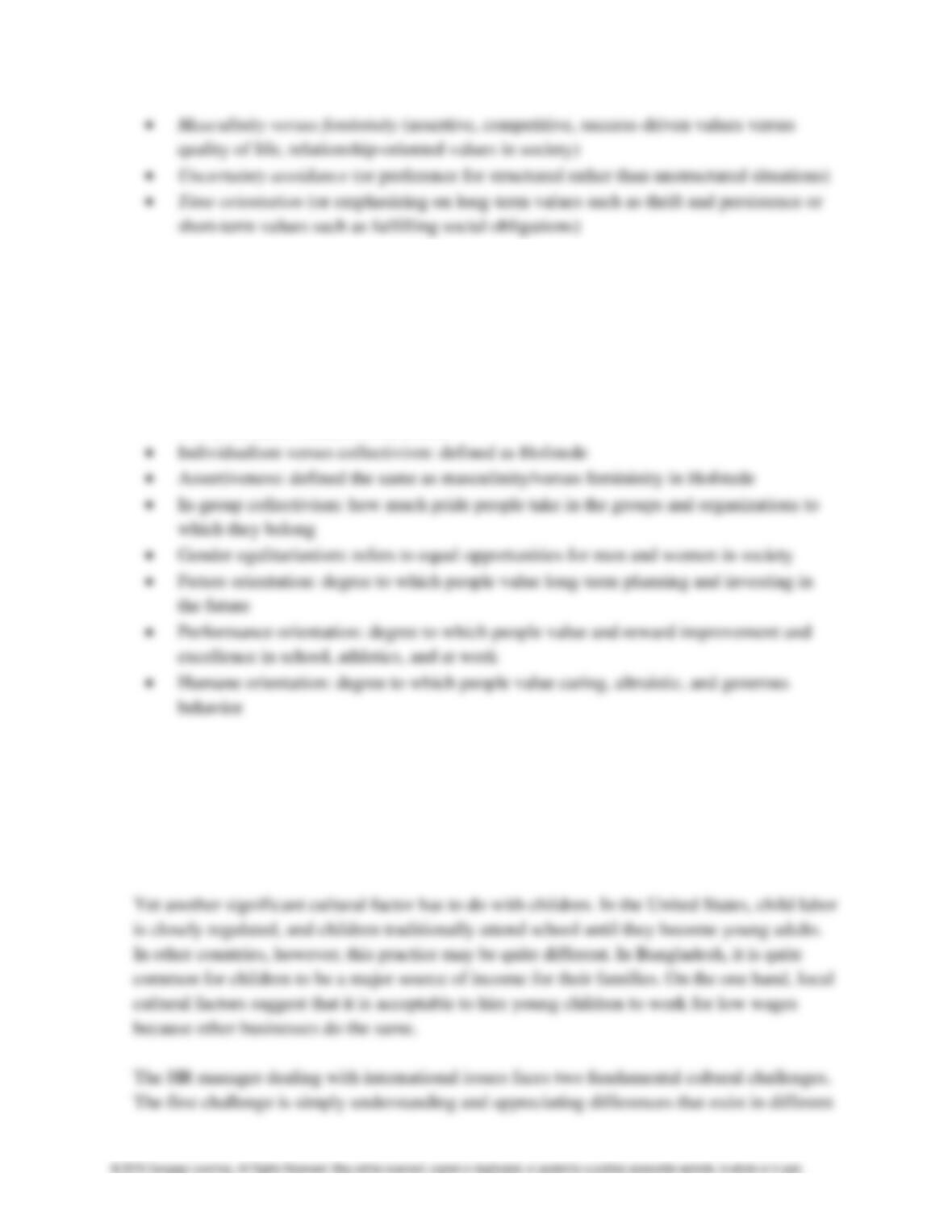
There have been at least two major studies of national values and how they influence behavior
at work. The first of these, conducted by Dutch scholar Geert Hofstede, involved managers
from fifty-three different countries. He identified five dimensions of national culture:
5
Chapter 3: The Global Environment
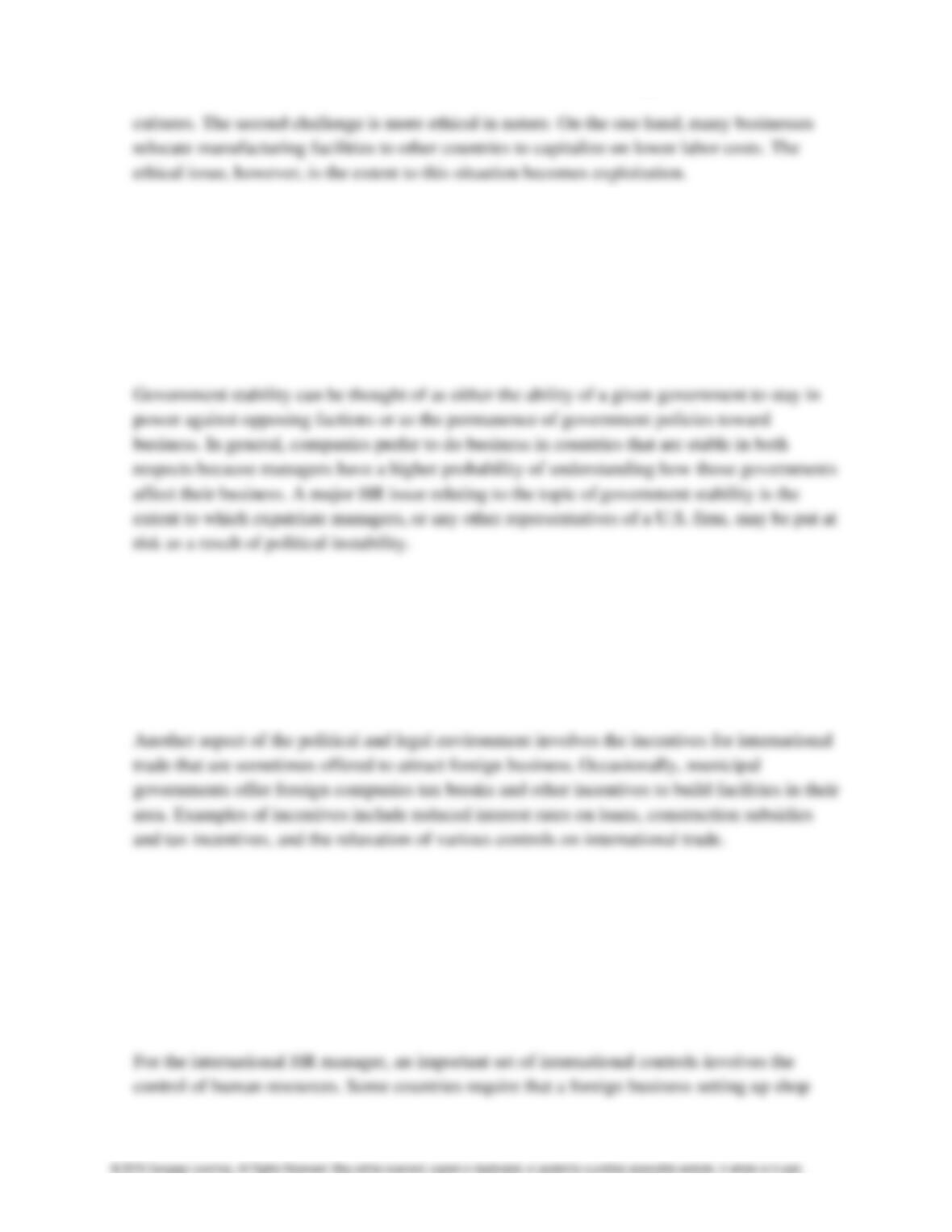
More recently, a group of scholars led by Robert House conducted a study of 62 different
national cultures. Their GLOBE project (Global Leadership and Organizational Behavior
Effectiveness) was built upon the work of earlier scholars and proposed a rather
comprehensive nine-dimension framework to explain cultural similarities and differences.
Their nine cultural values are:
• Uncertainty avoidance: defined as Hofstede
• Power distance: defined as Hofstede
Although Hofstede’s work has been applied more widely and is generally better known, there
are limitations to his work. Although the initial sample was quite large (100,000), it was
drawn from a single organization (IBM). Thus, it is not always possible to know if the effects
found in the study were due to country cultures or aspects of the corporate culture that all
employees shared.
6
Chapter 3: The Global Environment
C. Understanding the Political and Legal Environment
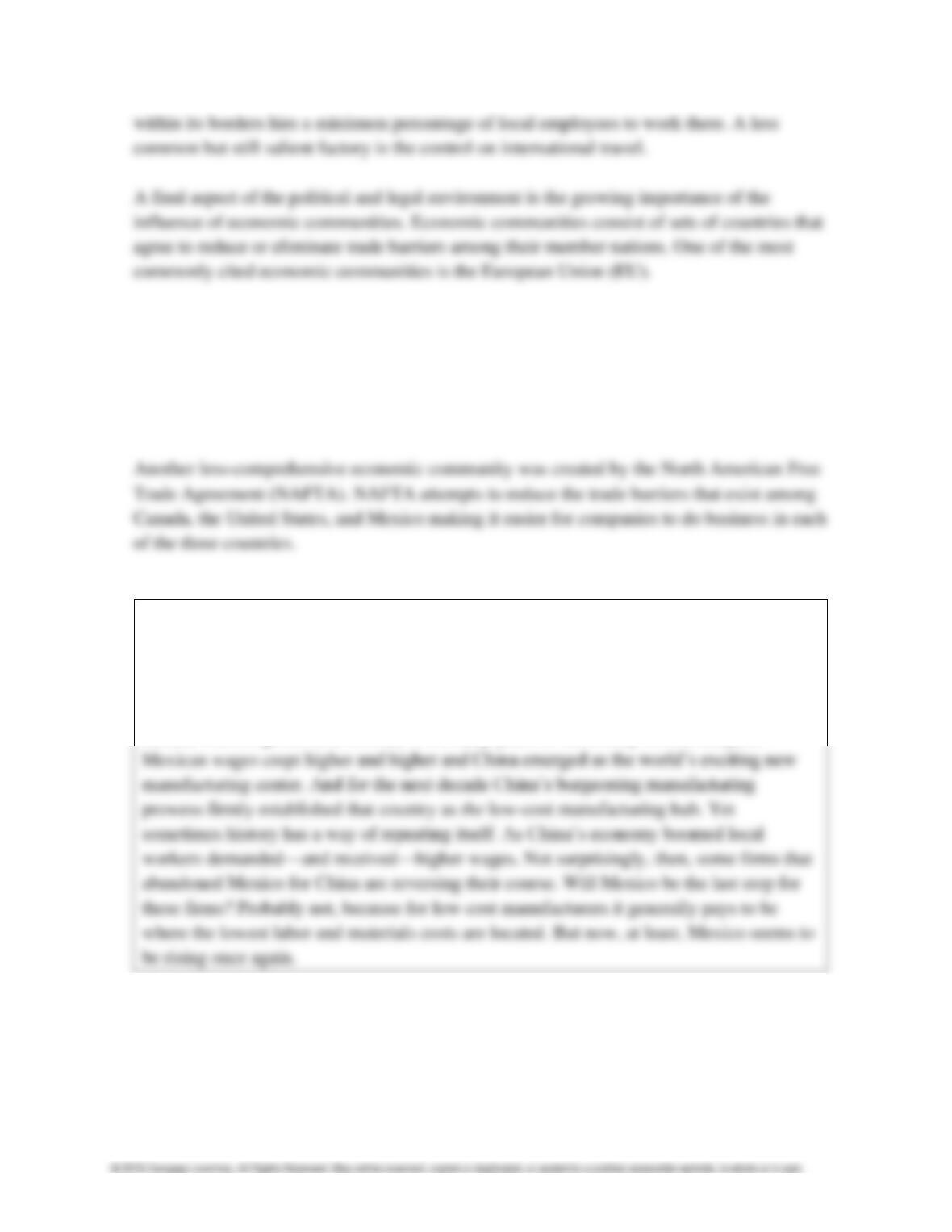
Figure 3.3 illustrates four fundamental aspects of the political and legal environment of
international business that are of primary concern for HR managers: government stability,
potential incentives for international trade, controls on international trade, and the influence of
economic communities on international trade.
In addition, some firms continue to face situations in which their managers are closely
watched or even harassed by local government officials on the grounds that they are alleged
illegal informants or spies for the U.S. government. Still another risk is the extent to which a
business itself might become nationalized, or seized by a foreign government, which claims
the company’s facilities.
A third dimension of the political and legal environment of international business consists of
those very controls that some countries place on international trade. One is a tariff, essentially
a tax that is collected on goods that are shipped across national boundaries. The most common
form of trade control, however, is the quota, a limit on the number or value of goods that can
be traded.
7
Chapter 3: The Global Environment
This European Union became much more formidable with the introduction of the euro, a
common currency designed to eliminate exchange-rate fluctuations and make cross-national
transactions easier. Twelve early members of the EU officially converted their domestic
currencies to the euro on January 1, 2002. These twelve countries now make up what is called
the eurozone.
III. The Human Resource Function in International Business
The HR function, for example, must deal with several general, fundamental management
challenges in international business. These challenges are illustrated in Figure 3.4.
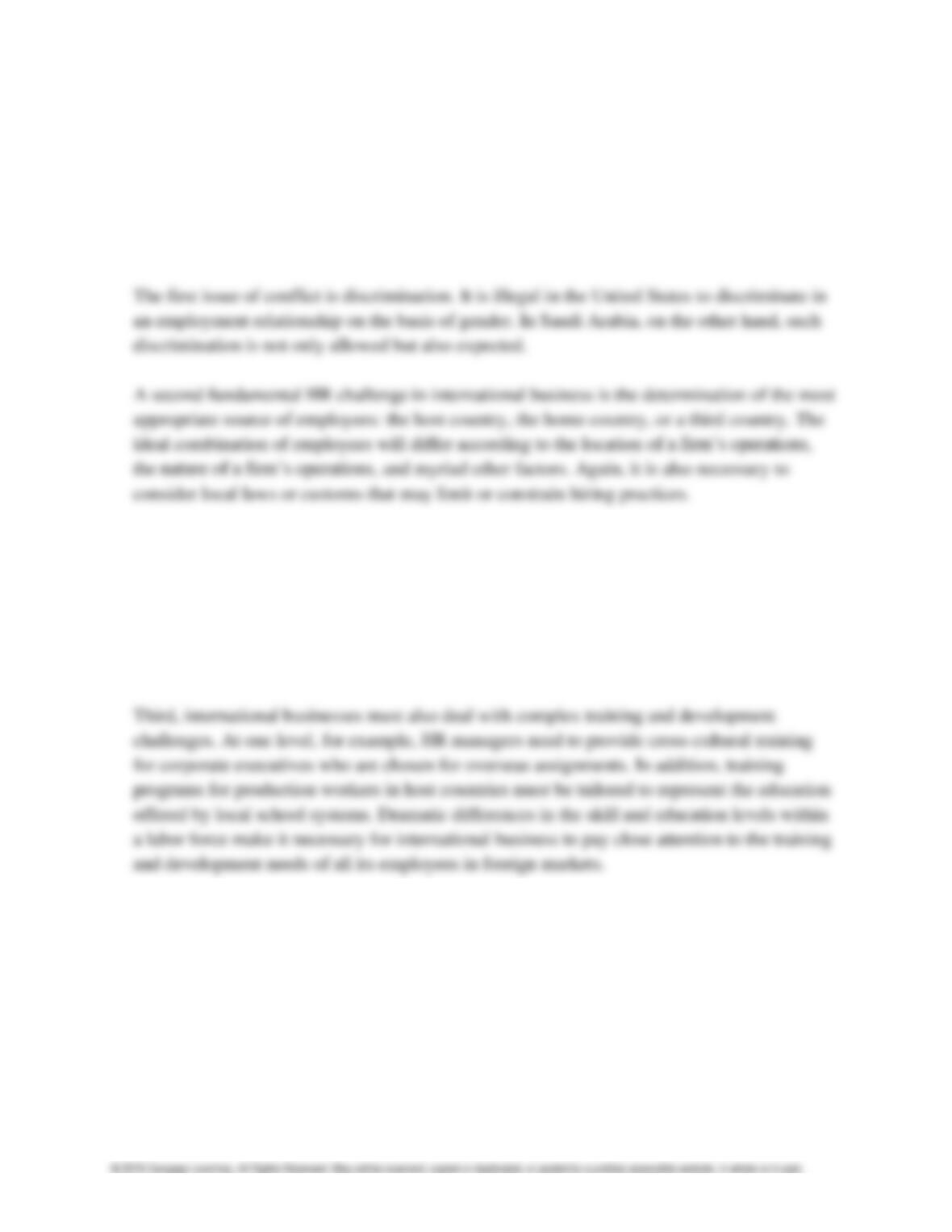
HR in the 21st Century: Moving Here, Moving There
It seems like just yesterday that manufacturers were moving their production facilities to
Mexico. The North American Free Trade Agreement (NAFTA) made it relatively painless
for businesses to move materials and finished goods back and forth across the border as
needed. But the good times slowed in the early years of the twenty-first century, as
8
Chapter 3: The Global Environment
A. General Human Resource Issues in International Business
One general set of challenges relates to differences that may exist in culture, levels of
economic development, and legal systems that typify the countries where the firm operates. A
particularly difficult set of issues arises when conflict exists between the laws or cultures of
the home country and those of the host country.
Twenty-five years ago, companies doing business in places such as Singapore would have
would have relied on the local labor market for hourly employees only. Over the years,
however, Singapore and other countries have made significant investments in their human
capital. As a result, a large pool of well-educated (often at Western universities), highly
motivated locals who are qualified for and interested in management positions now exists in
these same countries.
The fourth important international HRM question relates to working conditions,
compensation, and the cost of living. Thus, HR managers must determine how to compensate
executives who accept overseas assignments and who may face higher costs of living, a
reduction in their quality of life, or unhappiness or stress because of separation from family or
friends.
B. Specific Human Resource Issues in International Business
9
Chapter 3: The Global Environment
Organizations can adopt a wide variety of strategies for competing in the international
environment. One common strategy is exporting, which is the process of making a product in
the firm’s domestic marketplace and then selling it in another country. Exporting can involve
both goods and services.
If the firm functions solely as an exporter, the human resource function faces no meaningful
differences in responsibilities from those in a domestic business. Another popular form of
international business strategy is called licensing. Under this agreement, a company grants its
permission to another company in a foreign country to manufacture or market its products in
the foreign country’s local market.
A third international strategy for doing business is direct foreign investment. A direct
investment occurs when a firm headquartered in one country builds or purchases operating
facilities or subsidiaries in a foreign country; that is, the firm actually owns physical assets in
the other country.
10
Chapter 3: The Global Environment
At this level of international business activity, the HR function changes from that of a
domestic firm or business using a pure exporting or licensing strategy. This difference stems
from the fact that in a direct investment, employees of the firm are working in foreign
locations.
IV. Domestic Issues in International Human Resource Management
Regardless of their level of internationalization, all firms dealing in foreign markets must
confront three sets of domestic issues in the management of their human resources. These
domestic issues, are shown in Figure 3.5, are local recruiting and selection, local training, and
local compensation.
A. Local Recruiting and Selection Issues
Nonmanagerial employees, such as blue-collar production workers and white-collar clerical
and office workers, are usually HCNs in international business. Simply put, host-country
11
Chapter 3: The Global Environment
B. Local Training Issues
Human resource managers must also understand the training and development needs of the
host-country’s workforce to help host-country nationals perform their jobs most effectively.
C. Local Compensation Issues
Compensation must also be addressed at a local level for international businesses. Some
countries, such as the United States, focus compensation on assessing an individual’s
V. Managing International Transfers and Assignments
Expatriates are employees who are sent by a firm to work in another country; they may be
either parent-country or third-country nationals.
A. Expatriates and Corporate International Strategy
To a large extent, how a firm deals with expatriates should depend on the strategy the firm is
pursuing in terms of its international operations. This process involves the acquisition of