
Lecture Notes
Lussier, Human Resource Management, Third Edition
SAGE Publishing, 2018
Lecture Notes
Chapter 3: The Legal Environment and Diversity Management
Learning Objectives
After studying this chapter, you should be able to do the following:
3-2 Identify the major equal employment opportunity (EEO) laws and the groups of people that
each law protects.
3-4 Discuss the differences among equal employment opportunity, affirmative action, and
diversity.
3-5 Identify the two primary types of sexual harassment and how to reduce company risk from
harassment lawsuits.
Annotated Chapter Outline
I. Protecting Your Organization
A primary responsibility of an HR manager is to assist in avoiding any discriminatory
situations that can create legal, ethical or social problems with employees, former
employees, communities, or other stakeholders.
Lecture Notes
Lussier, Human Resource Management, Third Edition
SAGE Publishing, 2018
II. Discrimination Versus Illegal Discrimination
a. Discrimination
i. In HR, discrimination is making distinctions among people.
b. Illegal Discrimination
i. Making distinctions that harm people by inappropriately using a individual’s
membership in a protected class as a basis for an employment decision.
One of the primary jobs of an HR manager in any organization is to assist in avoiding any
discriminatory employment situations that can create legal, ethical, or social problems with
III. The OUCH Test
To maintain fairness and equity whenever contemplating any employment action.
a. Objective—fact–based and quantifiable.
d. Has job relatedness—action must relate to the essential job functions.
e. The 4/5ths rule: Used by federal courts, Department of Labor, and Equal Employment
Opportunity Commission to determine whether disparate impact exists in an
employment test.
The OUCH test is a rule of thumb used whenever you are contemplating any employment
Lecture Notes
Lussier, Human Resource Management, Third Edition
SAGE Publishing, 2018
OUCH is an acronym that stands for Objective, Uniform in application, Consistent in effect,
Has job relatedness.
The Department of Labor and the Equal Employment Opportunity Commission (EEOC) have
given us the Four-Fifths Rule, which is a test used by various federal courts, the Department
of Labor, and the EEOC to determine whether disparate impact exists in an employment test.
If the selection ratio for any group (e.g., Asian males) is less than four fifths of the selection
rate for the majority group (e.g., White males) in an employment action (e.g., promotions),
then it constitutes evidence of potential disparate impact.
IV. Equal Pay Act of 1963
a. Requires women who do the same job as men (“equal skill, effort, and responsibility and
performed under similar working conditions”) in the same organization to receive the
same pay.
Major employment laws
In any management position within any organization today, you need a basic understanding of
the major employment laws that are currently in effect. If you don’t understand what is legal
and what isn’t, you can inadvertently make mistakes that may cost your employer significant
amounts of money and time, and if that happens, your employer may not remain your employer
Lecture Notes
Lussier, Human Resource Management, Third Edition
SAGE Publishing, 2018
for very long. You don’t want that to happen, so let’s take a chronological look at some of the
laws listed in Exhibit 3-3.
Exhibit 3-3 Major EEO Laws in Chronological Order
Law
Description
Equal Pay Act of 1963
Vietnam Era Veterans Readjustment Assistance Act of 1974
Prohibits discrimination against Vietnam veterans by all employers with federal contracts or
subcontracts of US$100,000 or more. Also requires that affirmative action be taken.
Pregnancy Discrimination Act of 1978
Prohibits discrimination against women affected by pregnancy, childbirth, or related medical
conditions
regular (nonmilitary) jobs by U.S. government orders
Veterans Benefits Improvement Act of 2004
Amends USERRA to extend health care coverage while away on duty, and requires employers to
post a notice of benefits, duties, and rights of reemployment
Genetic Information Nondiscrimination Act of 2008
Prohibits the use of genetic information in employment, prohibits intentional acquisition of
same, and imposes confidentiality requirements
Lilly Ledbetter Fair Pay Act of 2009
Amends the 1964 CRA to extend the period of time in which an employee is allowed to file a
lawsuit over pay discrimination
SHRM
Equal Pay Act of 1963 (EPA)
The first modern equal employment opportunity (EEO) law that we will review is the Equal Pay
Lecture Notes
Lussier, Human Resource Management, Third Edition
SAGE Publishing, 2018
an Equal Pay complaint with the EEOC in 2016 based on a disparity in the per-game and win-
incentives paid to the men’s and women’s team members. They claim that if the U.S. men’s team
won a game, they would receive average compensation of US$13,166 while if the women’s
team won a game their compensation would average US$4,950.The EPA says that, if pay
differences are the result of differences in seniority, merit, quantity or quality of production, or
V. Title VII of the Civil Rights Act of 1964
a. Illegal for an employer to fail or refuse to hire, discharge, or otherwise discriminate
against any individuals with respect to compensation, terms, conditions, or privileges of
employment, due to race, color, religion, sex, or national origin;
who work 20+ weeks a year.
d. Introduced important concepts:
i. Disparate treatment
ii. Disparate (a.k.a. Adverse) impact
iii. Pattern or practice
iv. Bona Fide Occupational Qualification (BFOQ)
v. Business necessity
vi. Job relatedness
Title VII of the Civil Rights Act of 1964 (CRA)
This act was probably the most significant single piece of legislation regulating EEO in the
history of the United States. It changed the way that virtually every organization in the country
Lecture Notes
Lussier, Human Resource Management, Third Edition
SAGE Publishing, 2018
compensation, terms, conditions, or privileges of employment, because of such individual’s race,
color, religion, sex, or national origin; or (2) to limit, segregate, or classify his employees or
applicants for employment in any way which would deprive or tend to deprive any individual of
employment opportunities or otherwise adversely affect his status as an employee, because of
such individual’s race, color, religion, sex, or national origin.”
The act applies to organizations with 15 or more employees who are working 20 or more weeks
a year and who are involved in interstate commerce. Why does the organization have to be
involved in interstate commerce? Mainly because of the 10th Amendment to the US
VI. Types of Discrimination Addressed by Title VII
a. Disparate (adverse) treatment
i. When an employee is intentionally treated differently based on his/her
membership in a protected class.
b. Disparate (adverse) impact
c. Pattern or practice
i. When an employer engages in actions over time that intentionally deny the
rights provided by Title VII to a member of a protected class.
Types of discrimination. The 1964 CRA identified, really for the first time, three specific types of
discrimination. While it didn’t name them, it did describe the process of each of the three in
Lecture Notes
Lussier, Human Resource Management, Third Edition
SAGE Publishing, 2018
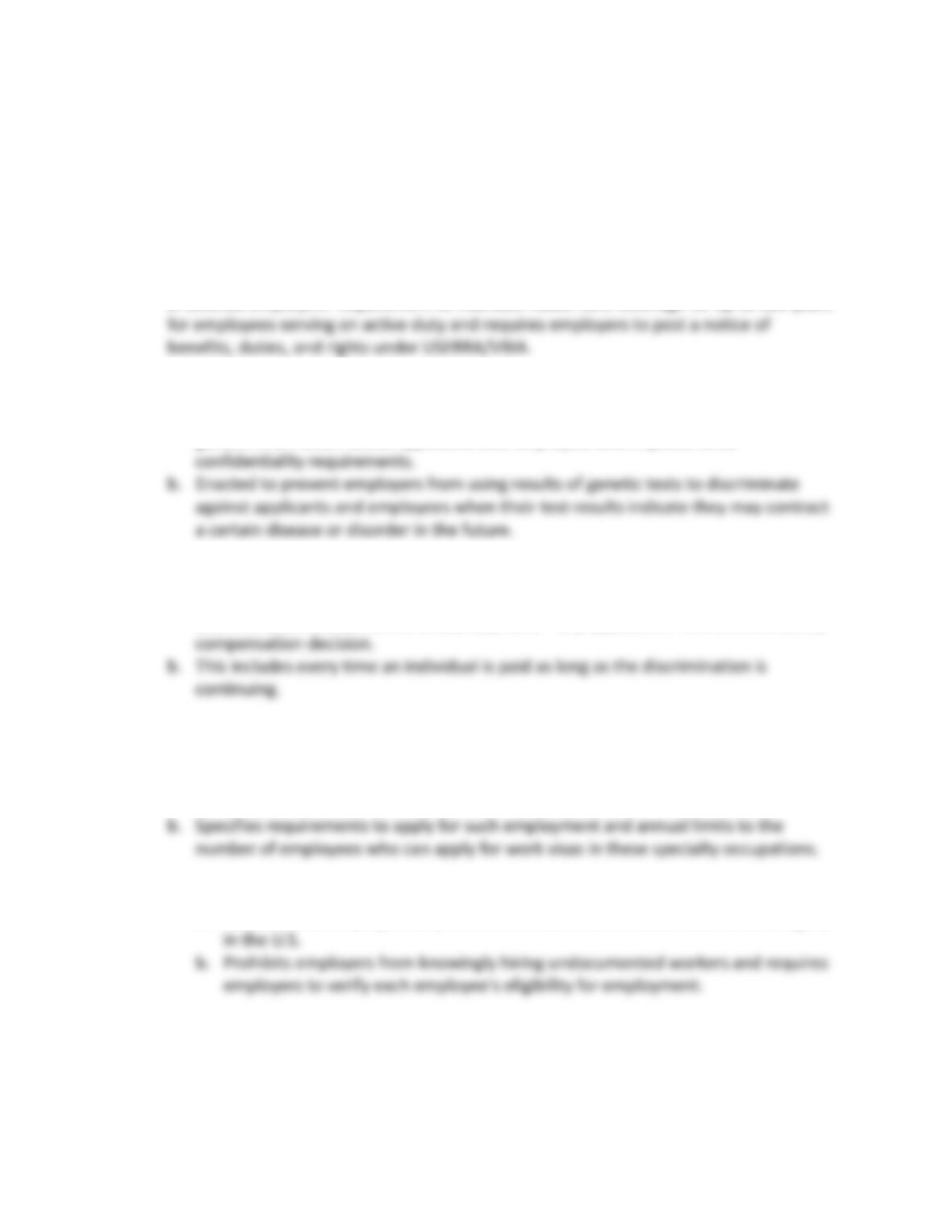
Disparate (adverse) treatment. Disparate treatment exists when individuals in similar situations
are intentionally treated differently and the different treatment is based on an individual’s
membership in a protected class. In a court case, the plaintiff must prove that there was a
discriminatory motive—that is, that the employer intended to discriminate—in order to prove
disparate treatment. Disparate treatment is generally illegal unless the employer can show that
Disparate (adverse) impact. Disparate impact occurs when an officially neutral employment
practice disproportionately excludes the members of a protected group; it is generally
considered to be unintentional, but intent is irrelevant. For there to be discrimination under
disparate treatment, there has to be intentional discrimination. Under disparate impact, intent
does not matter.
As an example, some characteristics (e.g., height and strength) are not distributed equally
across race and gender groups, and in some jobs, these characteristics may be related to
successful performance in the job. Therefore, disparate impact is not necessarily illegal. The
important question is whether the characteristic is related to successful performance on the job,
meaning whether it has job relatedness. Disparate impact is generally judged by use of the Four-
Fifths Rule that we discussed earlier. Both the Department of Labor (through their Uniform
Guidelines on Employee Selection Procedures) and the EEOC have expressed a preference for
using the Four–Fifths Rule to determine disparate impact. If the four-fifths requirement is not
satisfied, discrimination is considered to have occurred but illegal discrimination has not
Lecture Notes
Lussier, Human Resource Management, Third Edition
SAGE Publishing, 2018
VII. Pattern or Practice Landmark Lawsuit
a. Paving the way for fair treatment.
b. The Alabama state troopers long symbolized systematic oppression in the South and,
as late as 1972, remained an all-white institution.
VIII. Organizational Defenses to Illegal Discrimination Charges
IX. The Age Discrimination in Employment Act of 1967 (ADEA)
a. Prohibits discrimination against employees age 40 or older in organizations that have
20 or more workers.
X. Vietnam Era Veterans Readjustment Assistance Act of 1974 (VEVRAA)
a. Employers with federal contracts/subcontracts of US$100,000 or more must provide
XI. Pregnancy Discrimination Act of 1978 (PDA)
a. Under Title VII, this act requires employers to treat pregnant women the same as
XII. Americans with Disabilities Act (ADA) of 1990 as Amended in 2008
a. Prohibits discrimination based on disability. Requires employers to make “reasonable
XIII. Civil Rights Act of 1991
a. Corrects major omissions of the 1964 CRA and overturns several U.S. court decisions.
i. Allows compensatory and punitive damages when intentional or reckless
discrimination is proven.
Lecture Notes
Lussier, Human Resource Management, Third Edition
SAGE Publishing, 2018
ii. Prohibits “discriminatory use,” also called race-norming, of test scores.
XIV. The Uniformed Services Employment and Reemployment Rights Act of 1994
a. Ensures civilian reemployment rights of military members who were called away
from their non-military jobs by U.S. government orders.
XV. The Veteran’s Benefits Improvement Act of 2004 (VBIA)
a. Extends employers’ requirement to maintain health care coverage for up to two years
XVI. Title II of the Genetic Information Nondiscrimination Act of 2008
a. Prohibits use of genetic information in employment and intentional acquisition of
genetic information about applicants and employees and imposes strict
XV. Lilly Ledbetter Fair Pay Act of 2009 (LLFPA)
a. Extends period of time in which an employee is allowed to file a compensation
discrimination lawsuit to within 180 days after “any application” of a discriminatory
XVI. The Immigration and Nationality Act of 1952 (INA)
a. Allows employment of immigrant workers in certain specialty occupations, such as
engineers, teachers, computer programmers, medical doctors, and physical
therapists.
XVII. The Immigration Reform and Control Act of 1986 (IRCA)
a. Requires that employers only hire individuals who are authorized to work legally
XVIII. The Equal Employment Opportunity Commission (EEOC)
a. Investigate and resolve discrimination complaints through either conciliation or
litigation.
b. Gather and compile statistical information on such complaints.
Lecture Notes
Lussier, Human Resource Management, Third Edition
SAGE Publishing, 2018
c. Provide education and outreach programs on what constitutes illegal discrimination.
d. Reminder: State and Local EEO Laws May Be Different
As with any introductory textbook, we can’t tell you all of the laws that would apply in the
various locations across the United States, and we certainly can’t go into all the labor laws in
other countries around the world. We can only cover the major laws that affect virtually
XIX. Employee Rights Under EEOC
a. To bring discrimination complaints against an employer by filing a complaint with the
EEOC.
b. To participate in an EEOC investigation, hearing or other proceeding without threat
of retaliation.
XX. Employee Rights Under EEOC
a. All employees who work in the U.S. or its territories are protected by EEOC laws
whether they work for a U.S. or foreign employer.
b. U.S. citizens employed outside the U.S. by a U.S. employer or a foreign company
Lecture Notes
Lussier, Human Resource Management, Third Edition
SAGE Publishing, 2018
XXI. Foreign Corrupt Practices Act of 1977 (FCPA)
a. Enacted for the purpose of making it unlawful for certain classes of persons and
entities to make payments to foreign government officials to assist in obtaining or
retaining business.
b. The anti-bribery provisions prohibit the willful use of the mails or any means of
instrumentality of interstate commerce corruptly in furtherance of any offer,
XXII. Employer Prohibitions Under EEOC
a. To retaliate against employees who participate in an EEOC action.
b. To create a hostile work environment that results in the employee quitting or
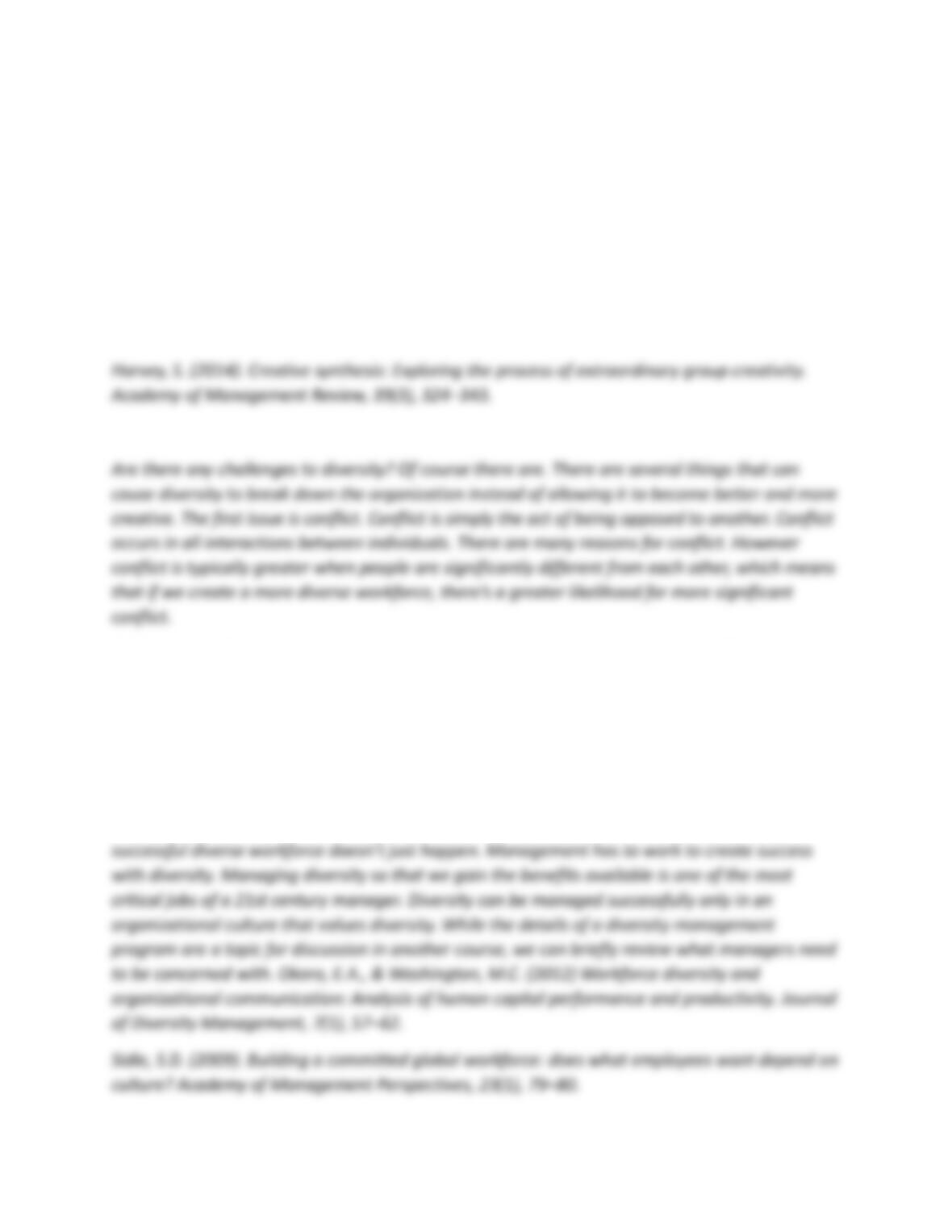
XXIII. Equal Employment Opportunity, Affirmative Action, and Diversity
Lecture Notes
Lussier, Human Resource Management, Third Edition
SAGE Publishing, 2018
that deals with a series of laws and regulations put in place at the federal and state government
level over the last 45 years. As such, EEO is very specific and narrowly defined within federal and
state laws.
On the other hand, affirmative action was created in the 1960s through a series of policies at
the presidential and legislative levels in the United States. Affirmative action, except in a few
circumstances, does not have the effect of law. We will discuss those circumstances in the next
section. Therefore, affirmative action is a much broader concept based on policies and executive
XXIV. The Office of Federal Contract Compliance Programs (OFCCP)
a. Monitors and enforces Executive Order (EO) 11246, Section 503 of the 1973
Rehabilitation Act, and 974 VEVRAA.
b. EO 11246 and Rehab Act require federal contractors who receive more than a certain
dollar value in contracts from the federal government per year to provide equal
opportunity and take affirmative action toward protected class individuals.
The OFCCP is in charge of monitoring and enforcing Executive Order (EO) 11246, Section 503 of
the 1973 Rehabilitation Act, and the 1974 VEVRAA. We have already discussed VEVRAA above,
so let’s take a look at EO 11246 and the Rehabilitation Act as they relate to the OFCCP.
XXV. Diversity in the Workforce
a. Diversity is the existence of differences.
Lecture Notes
Lussier, Human Resource Management, Third Edition
SAGE Publishing, 2018
b. Diversity fosters creativity and innovation through divergent thinking, so to exclude
qualified people because they are “different” is counterproductive to business
success.
What are the advantages of a diverse workforce? The primary advantages of a diverse
workforce come from the ability to stimulate and provide more creative and innovative solutions
to organizational problems. How does a more diverse workforce add to the creativity and
innovation in an organization? Creativity is a basic ability to think in unique and different ways
and apply those thought processes to existing problems, and innovation is the act of creating
useful processes or products based on creative thought processes.
Tekleab, A. G., & Quigley, N. R. (2014). Team deep-level diversity, relationship conflict, and team
members’ affective reactions: A cross-level investigation. Journal of Business Research, 67(3),
394–402.
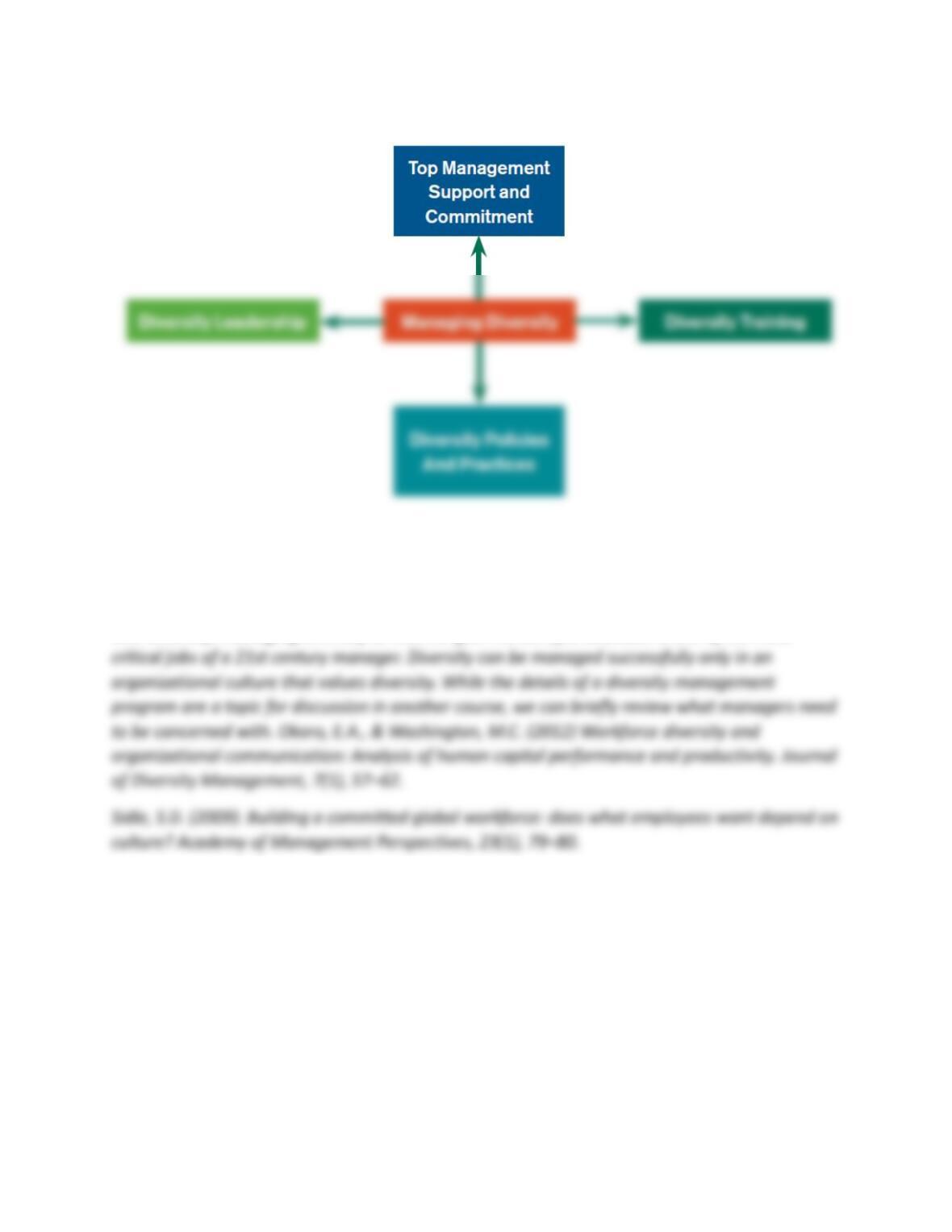
XXVI. Managing Diversity
Diversity affects bottom-line profits, but so do some of the challenges associated with diversity,
like conflict and reduced cohesiveness. In other words, if our diverse employees don’t work well
together, the organization does not work well. Creating a cohesive, operational, and highly
Lecture Notes
Lussier, Human Resource Management, Third Edition
SAGE Publishing, 2018
Diversity affects bottom-line profits, but so do some of the challenges associated with diversity,
like conflict and reduced cohesiveness. In other words, if our diverse employees don’t work well
together, the organization does not work well. Creating a cohesive, operational, and highly
successful diverse workforce doesn’t just happen. Management has to work to create success
with diversity. Managing diversity so that we gain the benefits available is one of the most
XXVII. Sexual Harassment
a. “Unwelcome sexual advances, requests for sexual favors, and other verbal or
physical conduct of a sexual nature constitutes sexual harassment when submission
to or rejection of this conduct explicitly or implicitly affects an individual’s
employment, unreasonably interferes with an individual’s work performance or
creates an intimidating, hostile or offensive work environment.” – EEOC
b. Two types
i. Quid Pro Quo
ii. Hostile Work Environment
Lecture Notes
Lussier, Human Resource Management, Third Edition
SAGE Publishing, 2018
Sexual harassment is a special type of discrimination identified as part of the 1964 CRA (the
prohibition of discrimination based on sex), but it is one of the two items we mentioned earlier
in the chapter that was not specifically recognized as a separate type of discrimination until
Quid pro quo harassment. Literally, quid pro quo means “This for that.” Quid pro quo
harassment is harassment that occurs when some type of benefit or punishment is made
contingent upon the employee submitting to sexual advances. “If you do something for me, I
will do something for you, or conversely if you refuse to do something for me, I will harm you.”
Quid pro quo is a direct form of harassment aimed at an individual and is most commonly seen
Quid pro quo harassment Harassment that occurs when some type of benefit or
punishment is made contingent upon the employee submitting to sexual advances
Hostile work environment. Hostile work environment is a very specific legal term in HRM
meaning harassment that occurs when someone’s behavior at work creates an environment
that is sexual in nature and that makes it difficult for someone of a particular sex to work in that
environment. Hostile work environment sexual harassment happens when a “reasonable
XXVIII. Religious Discrimination
Lecture Notes
Lussier, Human Resource Management, Third Edition
SAGE Publishing, 2018
a. Employers need to make reasonable accommodation of employees’ religion-based
requests that are not in keeping with the normal workday practices of the
organization, unless the requests prevent the employee from carrying out the
essential functions of his/her job or create an undue hardship.
Religion-based discrimination and the ability of employers to create work rules that may affect
religious freedom continue to be an issue in the workplace. For instance, the issue of standards
answers.
Remember, the federal courts have determined that religious discrimination is a violation of the
1964 CRA because it identifies religion as a protected class. Because religion was specifically
identified in the CRA, we can’t use it as a factor in making “any employment decision” with our
employees. Religion is a less obvious characteristic than gender or race, so it is usually not a