18 – 1 Compensation – Thirteenth Edition Gerhart │Newman │Milkovich
CHAPTER EIGHTEEN
MANAGEMENT: MAKING IT WORK
Overview
The financial conditions of an organization, the competitive pressures it faces, and budgeting
are integral to managing compensation. The cost implications such as updating the pay
structure, increasing merit pay, or instituting gain sharing are critical to making sound
decisions. Consequently, budgets are an important part of managing compensation. Creating a
compensation budget requires tradeoffs among the basic pay policies—how much of an
increase in market rates should be budgeted according to employee contributions to an
organization’s success compared to automatic across-the-board increases. Budgeting also
requires understanding the potential returns gained from each compensation program. The
returns might be productivity increases expected from a new profit-sharing plan or the value
gained from attracting and retaining the best people. In the past, budgeting was all about costs.
This chapter focuses on several critical components of managing compensation:
• Costs
• Communication
• Change
Six administrative issues necessary to manage the pay system are discussed in the chapter.
They include:
Chapter Eighteen: Management: Making It Work 18 – 2
• Communication and appeals
Learning Objectives
• Identify the unique aspects of managing labor costs.
• Understand how to use compensation to retain top employees while managing pay to
support strategy and change.
Lecture Outline: Overview of Major Topics
I. Managing Labor Costs and Revenues
II. Managing Labor Costs
A. Number of Employees (a.k.a.: Staffing Levels or Headcount)
B. Hours
C. Benefits
III. Managing Revenues
A. Using Compensation to Retain (and Recruit) Top Employees
IV. Managing Pay to Support Strategy and Change
V. Communication: Managing the Message
A. Say What? (Or, What to Say?)
B. Opening the Books
VI. Structuring the Compensation Function and Its Roles
A. Centralization – Decentralization (and/or Outsourcing)
B. Ethics: Managing or Manipulating?
VII. Your Turn: Communication by Copier
VIII. Still Your Turn: Managing Compensation Costs, Headcount, and
Participation/Communication Issues
18 – 3 Compensation – Thirteenth Edition Gerhart │Newman │Milkovich
Lecture Outline: Summary of Key Chapter Points
Why bother with a formal system at all? If management is that important, why not simply let
every manager pay whatever works best?
• Such total decentralization of decision-making could create a chaotic array of rates.
This was the situation in the United States in the early 1900s.
• The “contract system” made highly skilled workers managers as well as workers.
• The employer agreed to provide the “contractor” with floor space, light, power, and the
Any discussion of managing pay must again raise the basic questions: So what is the impact of
the decision or technique? Does it help the organization achieve its objectives? How?
Although many pay management issues have been discussed throughout the book, a few
remain to be called out explicitly. These include:
I. Managing Labor Costs and Revenues
• The cost implications of actions such as updating the pay structure, increasing merit
pay, or instituting gain sharing are critical for making sound decisions.
o Creating a compensation budget requires tradeoffs, such as how much of an
Chapter Eighteen: Management: Making It Work 18 – 4
organizations.
▪ Yet, most companies have not tried to analyze the returns from their
compensation decisions.
II. Managing Labor Costs
• Exhibit 18.1 shows a simple labor cost model. Using this model, there are three main
factors to control in order to manage labor costs:
o Employment (e.g., number of workers and the hours they work)
A. Number of Employees (a.k.a.: Staffing Levels or Headcount)
• Using information about competitors’ average pay helps improve
understanding of labor costs.
o Exhibit 18.2A shows how one organization pays its engineers relative to
its competitors at each of five job levels, E5–E1.
• Exhibit 18.2B provides more insight into the organization’s labor costs.
o This part of the exhibit compares the organization’s distribution of
engineers among the five job levels to its competitors’ distributions.
o A larger percentage of the organization’s engineers are at higher levels, E4
18 – 5 Compensation – Thirteenth Edition Gerhart │Newman │Milkovich
Copyright © McGraw-Hill Education. All rights reserved. No reproduction or distribution without the prior written consent of McGraw-Hill
Education.
mislead since the total employment level could be identical to
competitors’ but deployment among job levels may vary.
▪ Here, the organization differs from its competitors most at E4, where it
employs a larger percentage of engineering talent and also pays them
more.
▪ Something is going on at E4.
▪ More information is required to better understand what underlies these
differences.
▪ Are the organization’s engineers more experienced and thus promoted
into E4?
▪ Does the company do more sophisticated work that requires more
experienced engineers?
Reducing Headcount
o Organizations often reduce headcount to cut labor costs.
▪ Such cuts may take the form of layoffs (often with severance benefits
that depend on length of service) or exit incentives that are designed to
encourage employees to leave “by choice.”
o A major advantage of a reduction in force (RIF) is that it also reduces
benefits costs, something that a pay cut, furlough, or reduction in hours
o There are, however, several potential problems with headcount reductions.
▪ Regulatory requirements make it difficult to make targeted cuts.
• The Age Discrimination in Employment Act (ADEA) often comes
Chapter Eighteen: Management: Making It Work 18 – 6
Copyright © McGraw-Hill Education. All rights reserved. No reproduction or distribution without the prior written consent of McGraw-Hill
Education.
ways.
• These and other provisions tend to make it difficult to single out
high-wage and/or poor- performing workers.
▪ Workforce reductions, especially if not handled well, can harm
employee relations.
▪ Organizations that make greater (involuntary) workforce reductions
also experience greater voluntary turnover.
▪ RIFs, while reducing costs over time, are very costly in tangible terms
up front due to increases in unemployment insurance tax rates,
disruption of work processes and serving customers, and
administrative costs of handling exits.
• Exit incentives, if provided, further drive up costs.
▪ Some companies have learned to run so “lean” (i.e., very few
employees on manufacturing lines), and have controlled hiring so
successfully, that there may be little room to cut headcount.
▪ Where cuts can be made, if the cuts are too deep, an organization will
be poorly positioned to generate revenue if business picks up again.
o The regulatory environment differs from country to country.
▪ Many European countries have legislation as part of their social
contracts that makes it very difficult to reduce headcount or wages.
Managing labor costs is a greater struggle in such circumstances.
o Many employers seek to buffer themselves from getting into a position
where layoffs are necessary – use of overtime is part of this strategy.
▪ In addition, organizations establish different relationships with
different groups of workers.
▪ As Exhibit 18.3 depicts, the two groups are commonly referred to as:
18 – 7 Compensation – Thirteenth Edition Gerhart │Newman │Milkovich
Copyright © McGraw-Hill Education. All rights reserved. No reproduction or distribution without the prior written consent of McGraw-Hill
Education.
• Core employees—with whom a long-term relationship is desired.
• Contingent workers—whose employment agreements may cover
only short and specific time periods. They can be employees, but
can also be independent contractors/vendors or may be employed
by staffing services firms/vendors.
o Rather than expand or contract the core workforce, many employers
achieve flexibility and control labor costs by expanding or contracting the
contingent workforce.
▪ The segmented supply of nurses at St. Luke’s Hospital, discussed in
Chapter 7 and shown in Exhibit 18.4, illustrates the variable costs from
use of different sources of nurses.
B. Hours
• Another way to manage labor costs is to examine overtime hours versus hiring
more employees.
• The four factors in the labor cost model—number of employees, hours
worked, cash compensation, and benefit costs—are not independent.
o Overtime hours require higher wages but the incremental benefits cost is
substantially lower than that incurred in hiring an additional regular
• During the most recent recession, a number of firms reduced hours and costs
through the use of mandatory unpaid leave or furloughs to cut hours and thus
labor costs.
• Reducing hours and pay does mean that fewer headcount reductions are
necessary and by avoiding these, there will be less disruption and private
sector organizations should be better positioned to respond when business
picks up again.
C. Benefits
Chapter Eighteen: Management: Making It Work 18 – 8
• One of the most common approaches to reducing benefits costs recently has
been for employers to suspend matching contributions (made when employees
contribute) to 401(k) retirement plans.
o Survey data show about one in four companies either have already
• Another action seen is organizations eliminating benefits such as defined
benefit (pension) plans as part of seeking bankruptcy protection from
creditors.
o Examples include several airlines (e.g., United, Delta, USAir, Northwest),
automobile companies (General Motors, Chrysler), and automobile parts
• Other, more typical, ways of controlling or reducing benefits costs have to do
with efforts by companies in the area of health care.
D. Average Cash Compensation (Fixed and Variable Components)
• Average cost compensation includes average salary level plus variable
compensation payments such as bonuses, gain sharing, stock plans, and/or
profit sharing.
• Another major tool used by organizations to control salary costs, in both good
and bad times, is variable pay.
o As Exhibit 18.6 shows, while the size of the merit increase budget has
come down over time, the size of the variable pay (e.g., lump sum merit
18 – 9 Compensation – Thirteenth Edition Gerhart │Newman │Milkovich
Copyright © McGraw-Hill Education. All rights reserved. No reproduction or distribution without the prior written consent of McGraw-Hill
Education.
summed to create an organization-wide salary budget.
E. Budget Controls: Top Down
• Top-down budgeting begins with an estimate from top management of the pay
increase budget for the entire organization.
o Once the total budget is determined, it is then allocated to each manager,
who plans how to distribute it among subordinates.
• There are many approaches to top-down budgeting.
o A typical one, planned pay-level rise, is simply the percentage increase in
average pay for the unit that is planned to occur.
o Several factors influence the decision on how much to increase the
average pay level for the next period.
Current Year’s Rise
• This is the percentage change in the average wage in the past year.
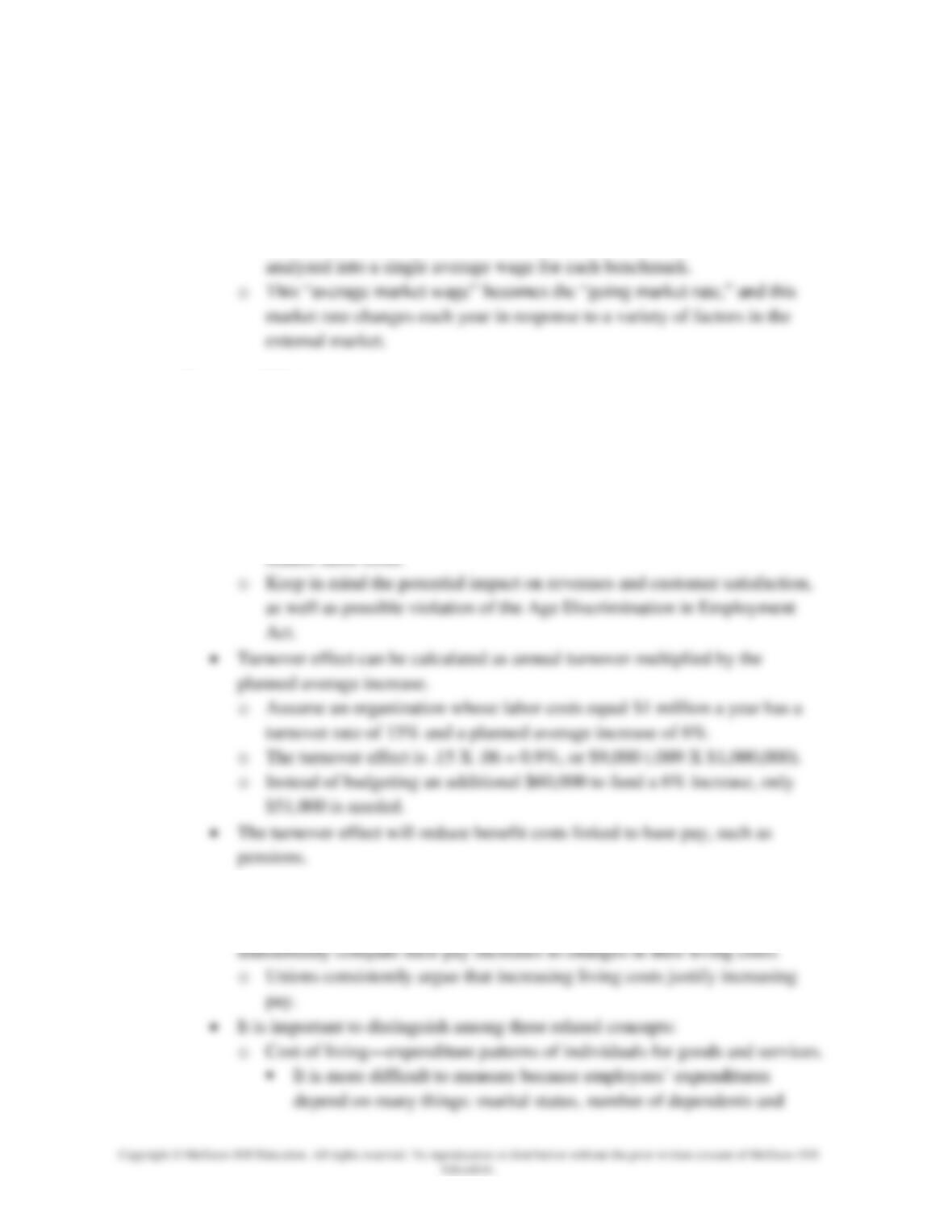
average pay at year end average pay at year beginning
Percent pay–level rise = 100 × average pay at year beginning
−
Ability to Pay
• Any decision to increase the average pay level is in part a function of the
organization’s financial circumstances.
o Financially healthy employers may wish to maintain their competitive
positions in the labor market or share financial success through bonuses
and profit sharing.
Chapter Eighteen: Management: Making It Work 18 – 10
sources of contract employees.
Competitive Market Pressures
• Managers determine an organization’s competitive position in relation to its
competitors.
o A distribution of market rates for benchmark jobs is collected and
Turnover Effects
• Sometimes referred to as “churn” or “slippage,” the turnover effect
recognizes the fact that when people leave (through layoffs, quitting, retiring),
they typically are replaced by employees who earn a lower wage.
o Exhibit 18.2 illustrates where an organization is overstaffed compared to
competitors.
o Reducing levels at E5 and E4 and replacing them with E1s and E2s will
reduce labor costs.
Cost of Living
• Although there is little research to support cost of living increases, employees
Copyright © McGraw-Hill Education. All rights reserved. No reproduction or distribution without the prior written consent of McGraw-Hill
Education.
several government indexes, one of which is the consumer price index.
o Changes in wages in labor markets—as Exhibit 18.7 shows, changes in
wages in labor markets are measured through pay surveys.
▪ These changes are incorporated into the system through market
adjustments in the budget and updates of the policy line and range
cost of living.
▪ Instead, it measures changes in prices over time.
o Changes in the CPI indicate only whether prices have increased more or
less rapidly in an area since the base period.
o If employers decide to use the CPI rather than labor market salary surveys
Rolling It All Together
• Let us assume that the managers take into account all these factors—current
year’s rise, ability to pay, market adjustments, turnover effects, changes in the
cost of living, and geographic differentials—and decide that the planned rise
in average salary for the next period is 6.3%.
o This means that the organization has set a target of 6.3% as the increase in
Distributing the Budget to Subunits
Copyright © McGraw-Hill Education. All rights reserved. No reproduction or distribution without the prior written consent of McGraw-Hill
Education.
subunit.
• Once salary budgets are allocated to each subunit manager, they become a
constraint: a limited fund of money that each manager has to allocate to
subordinates.
o Typically, merit increase guidelines are used to help managers make
these allocation decisions.
F. Budget Controls: Bottom Up
• In contrast to top-down budgeting, where managers are told what their salary
budget will be, bottom-up budgeting begins with managers’ pay increase
recommendations for the upcoming plan year.
o Exhibit 18.8 shows the process involved.
1. Instruct managers in compensation policies and techniques
▪ Train managers in the concepts of a sound pay-for-performance policy,
2. Distribute forecasting instructions and worksheets
▪ Furnish managers with the forms and instructions necessary to preplan
increases.
▪ Most firms offer managers computer software to support these
Copyright © McGraw-Hill Education. All rights reserved. No reproduction or distribution without the prior written consent of McGraw-Hill
Education.
3. Provide consultation to managers
4. Check data and compile reports
▪ Audit the increases forecasted to ensure that they do not exceed the
5. Analyze forecasts
6. Review and revise forecasts and budgets with management
7. Conduct feedback with management
8. Monitor budgeted versus actual increases
▪ Control the forecasted increases versus the actual increases by tracking
and reporting periodic status to management.
• The result of the forecasting cycle is a budget for the upcoming plan year for
each organization’s unit as well as estimated pay treatment for each employee.
o The budget does not lock in the manager to the exact pay change
recommended for each employee.
Chapter Eighteen: Management: Making It Work 18 – 14
G. Embedded (Design) Controls
• Controls on manager’s pay decisions come from two different aspects of the
compensation process:
o Controls that are inherent in the design of the techniques
o The formal budgeting process
• Many other techniques include:
o Job analysis and evaluation
Range Maximums and Minimums
• Ranges set the maximum and minimum dollars to be paid for specific work.
• The maximum is an important cost control.
o Ideally, it represents the highest value the organization places on the
output of the work.
o With job-based structures, skills and knowledge possessed by employees
red circle rates.
▪ Most employers “freeze” red circle rates until the ranges are shifted
upward by market update adjustments so that the rate is back within
the range again.
▪ An organization also has the option to combine a salary freeze with the
use of merit bonuses, which unlike merit increases, do not become part
of base salary.
▪ If red circle rates become common throughout an organization, then
18 – 15 Compensation – Thirteenth Edition Gerhart │Newman │Milkovich
the minimum.
• Range minimums are the minimum value placed on work.
Broad Bands
• Broad bands are intended to offer managers greater flexibility compared to
a grade-range design.
o Usually broad bands are accompanied by external market “reference
rates” and “shadow ranges” that guide managers’ decisions.
Promotions and External versus Internal Hires
• Promotion-based pay increases are often substantial, meaning that cost control
efforts must monitor both rates of promotion and the salary increase that is
given with promotions.
o Some organizations limit the number of promotions permitted within a
time period and some also limit the number of grades/levels that an
employee can advance as well as the size of the promotion salary increase.
Compa-Ratios
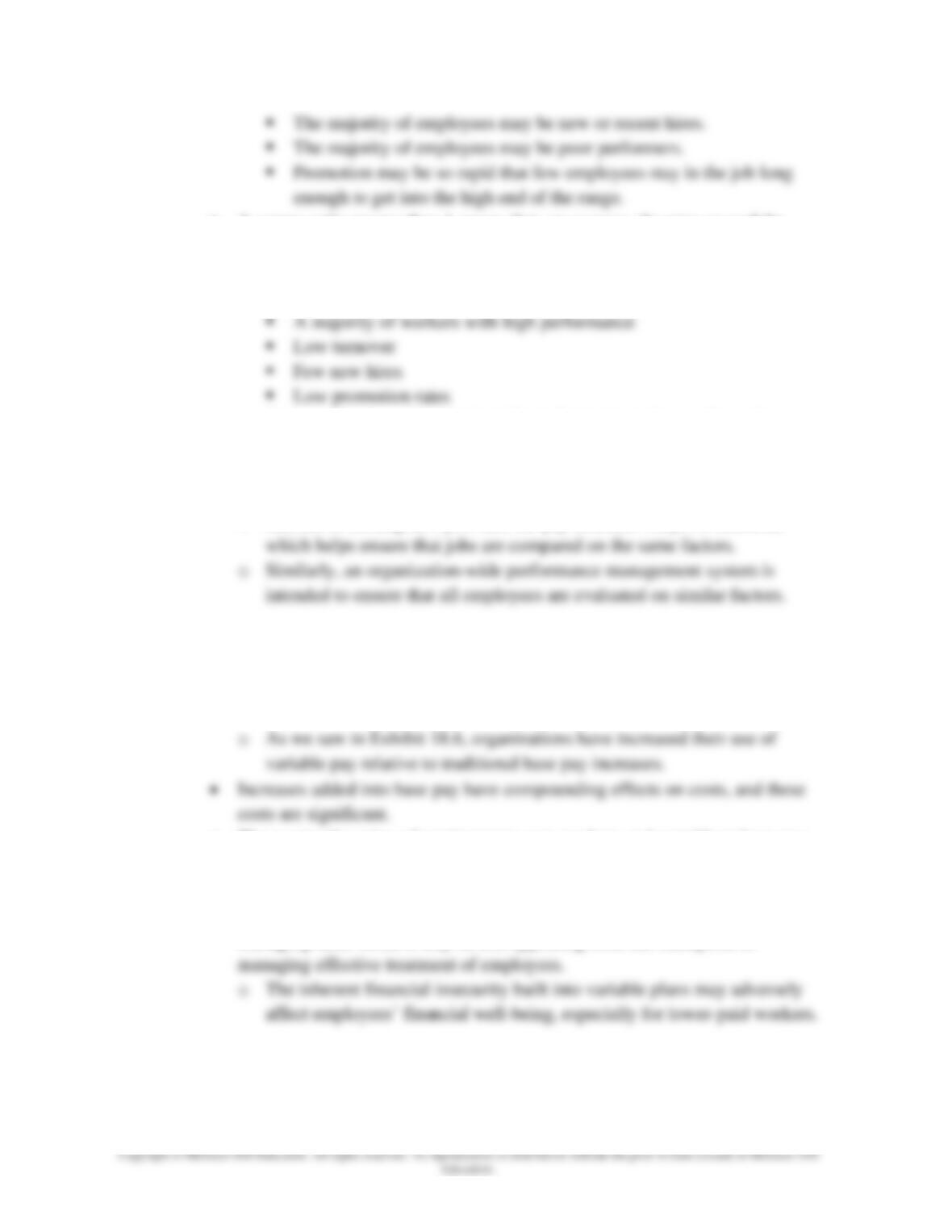
• Range midpoints reflect the pay policy line of the employer in relationship to
external competition.
o To assess how managers actually pay employees in relation to the
• A compa-ratio of less than 1 means that, on average, employees in a range are
paid below the midpoint.
o That is, managers are paying less than the intended policy.
o There may be several valid reasons for such a situation:
Chapter Eighteen: Management: Making It Work 18 – 16
Copyright © McGraw-Hill Education. All rights reserved. No reproduction or distribution without the prior written consent of McGraw-Hill
Education.
▪ The majority of employees may be new or recent hires.
▪ The majority of employees may be poor performers.
▪ Promotion may be so rapid that few employees stay in the job long
enough to get into the high end of the range.
• A compa-ratio greater than 1 means that, on average, the rates exceed the
intended policy.
o The reasons for this are the reverse of those mentioned above:
▪ A majority of workers with high seniority
o Compa-ratios may be calculated for individual employees, for each range,
for organization units, or for functions.
• Other examples of controls designed into the pay techniques include the
mutual sign-offs on job descriptions required of supervisors and subordinates.
o Another is slotting new jobs into the pay structure via job evaluation,
Variable Pay
• The essence of variable pay is that it must be re-earned each period, in
contrast to conventional merit pay increases or across-the-board increases that
increase the base on which the following year’s increase is calculated.
• The greater the ratios of contingent to core workers and variable to base pay,
the greater the variable component of labor costs and the greater the options
available to managers to control these costs.
• Although variability in pay and employment may be an advantage for
managing labor costs, it may be less appealing from the standpoint of
Analyzing Costs
• Costing out wage proposals is commonly done prior to recommending pay
increases, especially for collective bargaining.