17 – 19 Compensation – Thirteenth Edition Gerhart │Newman │Milkovich
Copyright © McGraw-Hill Education. All rights reserved. No reproduction or distribution without the prior written consent of McGraw-Hill
Education.
▪ This is “analyzed for possible systemic discrimination indicators (i.e., a
potential affected class of 10 or more applicants/workers).”
▪ If such indicators are found, additional information for the desk audit will be
requested.
▪ After the desk audit is completed, if the OFCCP decides the employer is in
compliance, it ends the process by issuing a closure letter.
o The OFCCP has also recently proposed an additional source of data for it to target
its enforcement efforts.
▪ Currently, as Exhibit 17.7 indicates, employers who are federal contractors
and subcontractors are required to file EEO-1 forms, which report the number
o If the OFCCP believes systemic discrimination may be present, it conducts an
onsite review, where it will delve deeper into statistical analyses of data
(including using multiple regression analysis) and also conduct interviews with
management and non-management employees for “anecdotal evidence” to
consider along with statistical evidence.
o If an NOV is issued, the OFCCP will seek to have the employer sign a
conciliation agreement under which it agrees to stop and remedy practices
identified as discriminatory.
o If the OFCCP cannot reach a settlement with the employer, it can refer the case to
the Office of the Solicitor and disputes are addressed in a hearing in front of an
administrative law judge.
• In 2013, the OFCCP rescinded its previous standards and issued new standards –
Directive 307, giving it more “flexibility.”
o Under its new rules, the OFCCP will examine a broader range of employment
practices than previously.
Chapter Seventeen: Government and Legal Issues in Compensation 17 – 20
Copyright © McGraw-Hill Education. All rights reserved. No reproduction or distribution without the prior written consent of McGraw-Hill
Education.
reason to believe it will be modified by the U.S. Department of Labor under
President Trump.
• In order to avoid running afoul of Economic Order 11246 and the OFCCP, companies
should not discriminate and collect and analyze data to document that they do not
discriminate.
XI. Pay Discrimination and Dissimilar Jobs
• In 1981, the Supreme Court, in Gunther v. County of Washington, determined that
pay differences for dissimilar jobs may reflect discrimination.
o The Court stated that a Title VII pay case was not bound by the definitions in the
Equal Pay Act.
A. Evidence of Discrimination: Use of Market Data
• The courts continue to uphold use of market data to justify pay differences for
different jobs.
• Spaulding v. University of Washington developed the argument in greatest
detail.
o In this case, the predominantly female faculty members of the Department
of Nursing claimed that they were illegally paid less than faculty in other
departments.
17 – 21 Compensation – Thirteenth Edition Gerhart │Newman │Milkovich
• But the courts have been dubious of this statistical approach.
B. Evidence of Discrimination: Jobs of Comparable Worth
• A second approach to determining pay discrimination on jobs of dissimilar
content hinges on finding a standard by which to compare the value of jobs.
The standard must do two things.
• Job evaluation has become that standard.
• If an employer’s own job evaluation study shows that jobs of dissimilar
content are of equal value to the employer (equal total job evaluation points),
then isn’t failure to pay them equally proof of intent to discriminate?
o That was the issue considered in AFSCME v. State of Washington, where
the state commissioned a study of the concept of comparable worth and its
projected effect on the state’s pay system.
o The study concluded that by basing wages on the external market, the state
was paying women approximately 20% less than it was paying men in
• Comparable-worth proponents in the U.S. continue to lobby for either new
legislation or voluntary action on the part of employers that would include the
comparable-worth standard.
C. The Mechanics
• Establishing a comparable-worth plan typically involves the following four
basic steps:
o Adopt a single “gender neutral” point job evaluation plan for all jobs
within a unit.
Chapter Seventeen: Government and Legal Issues in Compensation 17 – 22
Copyright © McGraw-Hill Education. All rights reserved. No reproduction or distribution without the prior written consent of McGraw-Hill
Education.
▪ The key to a comparable-worth system is a single job evaluation plan
for jobs with dissimilar content.
▪ What a “gender neutral” point job evaluation plan is remains open to
debate and there is little research to provide guidance.
o All jobs with equal job evaluation results should be paid the same.
▪ Although each factor in the job evaluation may not be equal, if the
total points are equal, the wage rates must also be equal.
o Identify the percentages of male and female employees in each job group.
▪ A job group is defined as a group of positions with similar duties and
responsibilities that require similar qualifications, are filled by similar
• These steps are based on the state of Minnesota’s law that mandates
comparable worth for all public-sector employees.
• To understand the mechanics more clearly, consider Exhibit 17.10.
o The solid dots represent jobs held predominantly by women.
o The circles represent jobs held predominantly by men.
• A mandated job evaluation, especially a single point plan that specifies a
hierarchy of all jobs, seems counter to the direction in which most
organizations are moving today.
• People who advocate a point job evaluation as a vehicle for comparable worth
credit the technique with more explanatory power than it possesses.
D. Union Developments
• The amount of union support for comparable worth appears to be related to its
effects on the union’s membership.
• AFSCME and the Communication Workers of America (CWA) actively
17 – 23 Compensation – Thirteenth Edition Gerhart │Newman │Milkovich
support comparable worth and have negotiated comparable-worth based pay
increases, lobbied for legislation, filed legal suits, and attempted to educate
their members and the public about comparable worth.
XII. Earnings Gaps
• Exhibit 17.11 shows that, across all races combined, women’s median annual
earnings compared to men’s has changed from about 60.2% to 80.5% from 1980 to
2016.
o The wage gap varies according to wage level, being relatively large at very high
wages and even larger at very low wage levels.
• Exhibit 17.12 shows that Asian men’s earnings have risen over time to now be higher
(by 25%) than those of white men.
• Exhibit 17.13 compares earnings of Asian, Black, and Hispanic women to white
women.
• Some of the more important sources of these gaps, shown in Exhibit 17.14, include
the following:
o Work/occupation differences
o Work-related behavior
o Labor market conditions
Chapter Seventeen: Government and Legal Issues in Compensation 17 – 24
o Discrimination
A. Sources of the Earnings Gaps
• Considerable research has examined the factors shown in Exhibit 17.14,
which are the central sources of the wage differences between men and
women and the racial/ethnic groups.
• In contrast, differences in qualifications, especially educational levels and
work-related experience as well as differences in occupations, are important
sources of the gaps for both blacks and Hispanics compared to white men.
Differences in Occupations and Qualifications
• There is evidence that women of all ethnic groups are more likely than men to
seek part-time and flexible work arrangements and that they are more likely
than men to interrupt their careers due to family responsibilities.
o Today, the number of women in managerial jobs are at parity with men.
• Despite progress, one notable concern remains: lack of representation of
women in executive and director level positions in organizations, sometimes
referred to as the “Glass Ceiling” effect.
o Exhibit 17.15 shows how the representation of women declines at higher
levels of organizations.
• Evidence of increased levels of occupational attainment does not
automatically mean that the wage gap will close.
• For a variety of reasons, a relatively small wage gap among younger cohorts
(i.e., recent college graduates) tends to increase as the cohort ages.
o Perhaps women continue to be more likely to drop out of the labor force at
17 – 25 Compensation – Thirteenth Edition Gerhart │Newman │Milkovich
some point for family reasons, or perhaps the barriers to continued
advancement become more substantial (the Glass Ceiling concept) at
higher levels in the job hierarchy.
• One reviewer of all this research conjectures that some of the observed
differences in wages paid in different occupations may be stuck due to inertia
or “original sin.”
• Level of schooling and work-related experience appear to be primary sources
of the pay gaps among both black and Hispanic men and women.
o Almost half of Hispanic men have not completed high school and only 9%
are college graduates.
o Generally, the longer Hispanic immigrants stay in the U.S., the better they
• All the research and discussion about sources of the earnings does not mean
there are not any discriminatory pay practices; it does mean that important
sources of the pay gaps reside in other productivity-related factors such as
level and quality of education, work-life/career tradeoffs, and occupational
choices.
Differences in Industries and Firms
• Other factors that affect earnings differences between men and women and
among race/ethnic groups are the industries and the firms in which they are
employed.
• A study of middle-aged lawyers revealed large differences between men and
women lawyers in the types of firms that employed them.
o Men were much more likely than women to be in private practice and to
be at large firms (over 50 lawyers).
Copyright © McGraw-Hill Education. All rights reserved. No reproduction or distribution without the prior written consent of McGraw-Hill
Education.
o The unknown here is whether within an industry some firms are more
likely to attract women or minorities than other firms because of these
pay-mix differences and whether this has any effect on earnings gaps.
• Within a firm, differences in policies for different jobs may even exist.
o For example, many firms tie pay for secretaries to the pay for the manager
to whom the secretary is assigned.
• The size of a firm is systematically related to differences in wages.
o Female employment is more heavily concentrated in small firms.
• To the extent that these differences in job setting are the result of an
individual’s preference or disposition, they are not evidence of discrimination.
• To the extent that these differences are the result of industry and firm
practices that steer women and minorities into certain occupations and
industries or lower-paying parts of a profession, they may reflect
discrimination.
B. Challenges in Estimating Amount of Discrimination
• Many factors affect pay and that discrimination can be one of them but
disagreement remains over what constitutes evidence of discrimination.
• A standard statistical approach for determining whether discrimination
explains part of the gap is to try to relate pay differences to the factors like
occupation, type of work, experience, education, etc.
o The procedure typically regresses some measure of earnings on those
factors thought to legitimately influence earnings.
o If the average wage of men with a given set of values for these factors is
significantly different from the average wage of women with equal
Copyright © McGraw-Hill Education. All rights reserved. No reproduction or distribution without the prior written consent of McGraw-Hill
Education.
o So, measurable factors may underestimate the effects of past
discrimination
• Statistical analysis needs to be treated as part of a pattern of evidence and
needs to reflect the wage behaviors of specific firms.
C. Gaps are Global
• The gender wage gap is fairly universal. However, in a number of countries,
the size of the gap is smaller than in the United States.
o One analysis concludes that the difference can be found in narrower pay
structures in European countries.
• In many countries, rates negotiated by federations of employers, unions, and
government agencies rather than individual companies and employees mean a
XIII. Compliance: A Proactive Approach
• Compliance with laws and regulations can be a constraint and/or an opportunity for a
compensation manager.
• A proactive compensation manager can influence the nature of regulations and their
interpretation.
• A compensation manager can:
o Join professional associations to stay informed on emerging issues and to act in
concert to inform and influence public and legislative opinion.
Chapter Seventeen: Government and Legal Issues in Compensation 17 – 28
XIV. Your Turn: From Barista to Manager
Summary of Case
You started as a barista at an upscale coffee shop that is part of a nationwide chain of 200 such
stores, but have moved up to become the store manager. Currently, you are having some issues
over the fact you get paid for only 40 hours per week, although you put in 55 hours. Since your
Learning Objective
Discuss the issues of legal compliance with Fair Labor Standards Act (FLSA) and analyze the
consequences of non-compliance. Identify if the classification of a store manager as exempt
Teaching Guideline
Use this case to discuss the features of the Fair Labor Standards Act (FLSA) and help students
understand the challenges in doing a self-evaluation
Discussion of Case Issues
1. Is this company running afoul of the Fair Labor Standards Act (FLSA)? Refer back
to the discussion earlier in this chapter. Would this company be able to document
that the store managers are exempt from the FLSA (not to mention similar state
laws)? Also, what would it cost to re-classify your store managers as non-exempt?
For illustrative purposes, the following recommendations can be considered:
The FLSA requires overtime compensation (one-and-half times the standard) for all “hours
worked” over a prescribed “threshold” (typically 40 hours per week), for “nonexempt”
employees.
FLSA overtime claims may involve:
17 – 29 Compensation – Thirteenth Edition Gerhart │Newman │Milkovich
• Employers failing to include “wage augments” such as longevity pay when
calculating an employee’s overtime rate
FLSA recoveries can include compensation in the following types of situations (plus
liquidated damages and attorneys’ fees):
• Employees may perform a variety of potentially compensable job-related activities
during their “off-the-clock” time, such as taking work home, making/receiving job-
To qualify for the executive employee exemption, all of the following tests must be met:
• The employee must be compensated on a salary basis (as defined in the regulations)
at a rate not less than $455 per week.
• The employee’s primary duty must be managing the enterprise, or managing a
customarily recognized department or subdivision of the enterprise.
The store manager satisfies the last three qualifying conditions for the executive employee
compensation.
• The salary level test for exempt employees mandates that employees who are paid
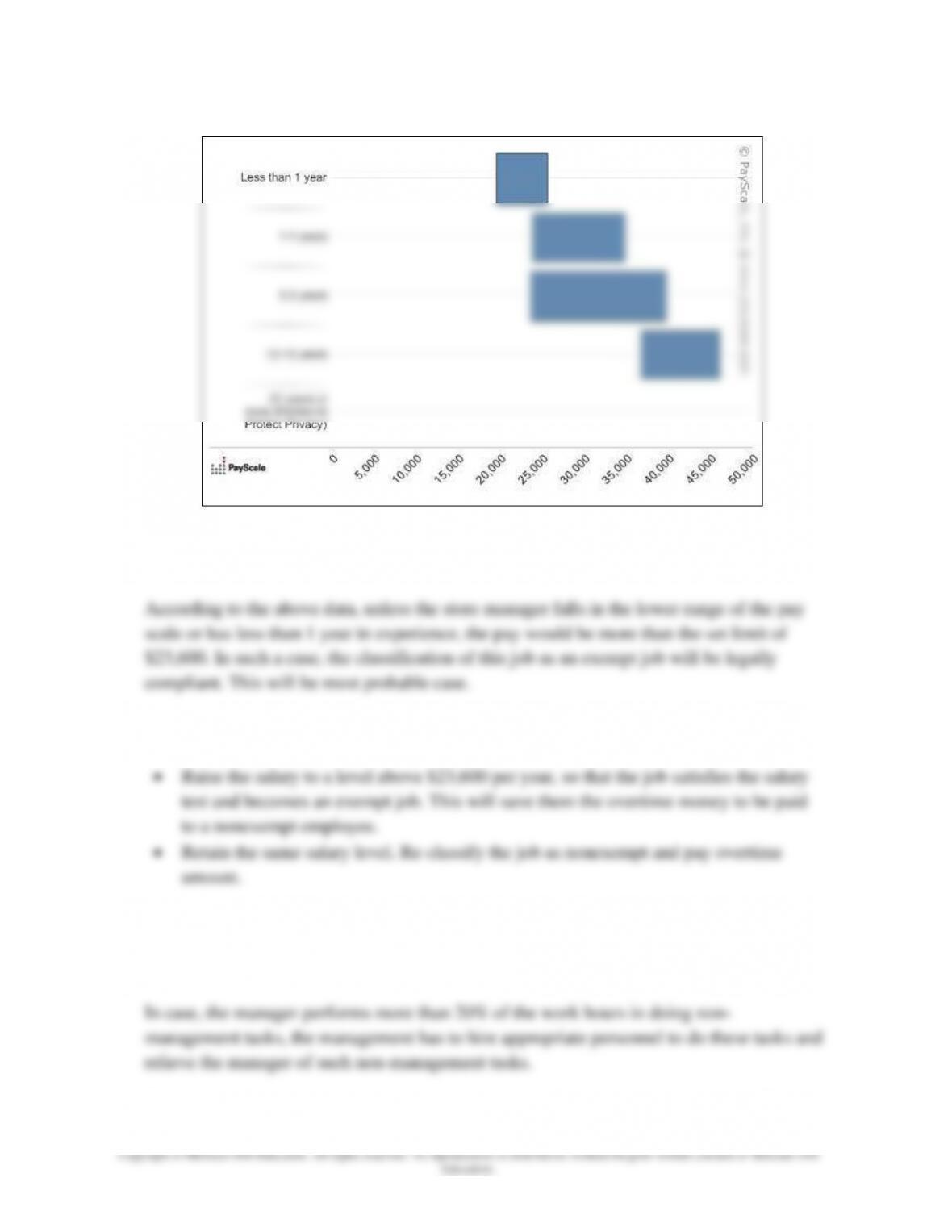
An Internet search for the median wages for coffee shop managers yields the following
results:
Job: Coffee Shop Manager
Experience
Median Salary Range
Less than 1 year
$19,533-$25,602
1-4 years
$23,787-$34,773

Chapter Seventeen: Government and Legal Issues in Compensation 17 – 30
5-9 years
$23,610-$39,682
10-19 years
$36,732-$46,021
17 – 31 Compensation – Thirteenth Edition Gerhart │Newman │Milkovich
Hence, the actual salary of the manager and the time devoted to non-management tasks
will decide whether the job can be classified as exempt or non-exempt.
In case, the salary is less than $23,600 per year, the management has two options to
consider:
The second option would be more costly to the company. But, it will address the issue of
equity and the concerns of the store manager. The cost to the company would be either the
increase in the salary or the overtime amount to be paid, depending on the option taken.
2. If managers feel overworked and underpaid, what do you project that they will do
Chapter Seventeen: Government and Legal Issues in Compensation 17 – 32
when the economy picks back up? Is that a concern for the company? Is the company
in compliance with the FLSA?
When managers feel overworked and underpaid, a sense of inequity creeps in and this will
lead to employee dissatisfaction and, possibly, result in lesser commitment, productivity,
3. What would it cost to have a lawsuit filed against the company? Have other
companies in your industry (e.g., Starbucks, Caribou, Peet’s, etc.) had any FLSA
issues? If so, what can you learn from their experiences? Would you advise meeting
with corporate counsel? What facts and observations would you recommend be
presented at such a meeting?
The FAQ section in the FLSA website provides the answer for the costs to be incurred for
a lawsuit filed against the company as follows:
To some extent this is between the individual employee and the attorney. If the
employee hires attorneys on a contingency fee basis, there are no “up front” expenses
A lot of high-profile cases alleging unpaid overtime and wrong classification have been
witnessed. Historically, lawsuits have been filed by assistant store managers regarding
overtime pay.
• Starbucks has faced overtime lawsuits time and again. It has settled a case with store
managers for $18 million in 2003. Store managers regularly allege that their job is
wrongly classified as exempt employee, although they do the work of a barista most
of the time.
o A similar case was filed, in June 2004, by two managers alleging that 70% of
17 – 33 Compensation – Thirteenth Edition Gerhart │Newman │Milkovich
managers.
It should be understood that the managers are entitled to overtime pay if their salary is less
than $23,600. The easiest option for a company to avoid an overtime lawsuit is to pay an
amount that meets the salary test and ensure that the manager is not required to spend
more than 20% of work-hours on non-management tasks.
In the meeting with the corporate counsel, the following data can be provided:
The meeting should analyze if higher labor costs are worth the lawsuits and the negative
publicity associated with it.
XV. Still (yes, still) Your Turn: “I was Gaga’s Slave”
Summary of Case
This case focuses on how Jennifer O’Neill, employed by Pop superstar Lady Gaga as a
personal assistant, sues Gaga’s touring company, Mermaid Touring, in the United States
District Court for the Southern District of New York, alleging violations of the FLSA and New
York State Labor Law (NYSLL).
Learning Objective
Better understand the Fair Labor Standards Act and the provisions that it covers—especially
relating to minimum wage and hours of work.
Teaching Guideline
Use this case to understand the FLSA and issues relating to minimum wage and overtime when
employing anyone in a business.
Discussion of Case Questions
1. Is Ms. O’Neill exempt or non-exempt under the Fair Labor Standards Act? Which
Chapter Seventeen: Government and Legal Issues in Compensation 17 – 34
exemption would be most relevant in this case?
Ms. O’Neill is non-exempt under the Fair Labor Standards Act. Ms. O’Neill alleges that
• The employee must be compensated on a salary or fee basis (as defined in the
regulations) at a rate not less than $455 per week.
2. Can you find any other examples in the news of similar lawsuits? If so, please again
form an opinion on whether the plaintiff is exempt or not and which exemption is
most relevant.
Answers to Review Questions
1. What is the nature of government’s role in compensation?
The exact role government plays in the contemporary workplace depends, in part, on one’s
political ideology. Different countries and cultures have different perspectives on the role
the government should play. In the U.S., the government affects compensation:
• Directly—government affects compensation directly through wage laws requiring
specific wages under certain conditions. Government is a key stakeholder in
compensation decision-making, affecting decisions in several areas:
o Fairness of procedures for determining pay (pay discrimination)
Chapter Seventeen: Government and Legal Issues in Compensation 17 – 36
Copyright © McGraw-Hill Education. All rights reserved. No reproduction or distribution without the prior written consent of McGraw-Hill
Education.
• Differences in occupational attainment and jobs held by men and women
• Differences in personal work-related characteristics and work behaviors (experience,
seniority, education)
• Differences among industries and firms; differences in contingent pay
• Differences in union membership
• Discrimination
6. What kinds of proactive activities can an employer undertake to enhance the
regulatory environment?
Compliance with laws and regulations can be a constraint or an opportunity. A proactive
compensation manager can influence the nature of regulations and their interpretation via
several efforts: