Lecture Notes
Lussier, Human Resource Management, Third Edition
SAGE Publishing, 2018
Lecture Notes
Chapter 15: Organizational Ethics, Sustainability, and Social
Responsibility
Learning Objectives
After studying this chapter, you should be able to do the following:
15–2 Briefly discuss each of the identified ethical approaches and the factors to consider
in creating codes of organizational ethics.
15–4 Identify some of the common ethical issues that managers face in business.
15-5 Define corporate social responsibility (CSR) and briefly discuss the “business case”
for CSR.
Annotated Chapter Outline
I. Ethics and Trust
Lecture Notes
Lussier, Human Resource Management, Third Edition
SAGE Publishing, 2018
a. Unethical behavior by companies risks loss of public trust and threatens integrity of
business.
Dishonesty has become an accepted part of daily life for many people in their personal,
government, and businesses lives. Some people ask, Does it pay to be ethical? The simple
answer is yes. Research studies have reported a positive relationship between ethical behavior
and leadership effectiveness. Being ethical may be difficult, but it has its rewards. It actually
makes you feel better. Honest people have fewer mental health and physical complaints, like
anxiety and back pain, and better social interactions. On the reverse side, unethical behavior is
costly, as it contributed to the 2007–2009 financial crisis that resulted in the world economy
going into recession.
Bonanos, C. (2013, February 4–10). The lies we tell at work. BusinessWeek, pp. 71–73.
II. What Traits Contribute to Unethical Behavior?
a. Personality traits and attitudes
i. That is, integrity, honesty, and sincerity.
b. Moral development
i. Ability to distinguish right from wrong constitutes moral development
ii. Preconventional level
iii. Conventional level
iv. Postconventional Level
Lecture Notes
Lussier, Human Resource Management, Third Edition
SAGE Publishing, 2018
Moral development. A second factor affecting ethical behavior is moral development, which
refers to distinguishing right from wrong and choosing to do the right thing. People’s ability
to make ethical choices is related to their level of moral development. There are three levels
of personal moral development. At the first level, the preconventional level, a person chooses
III. Situations and Justification
a. Situations often dictate ethical behavior
i. Unethical behavior is often found in organizations with no formal ethics policies
or when unethical behavior goes unpunished.
b. Justification for unethical behavior
i. People respond to incentives and can be manipulated to behave ethically or
unethically depending on incentive.
The situation. In addition to incentives, in certain situations, it can be tempting to be unethical,
such as when you are negotiating. Unsupervised people in highly competitive situations are
IV. Common Ethical Approaches
a. Golden
b. Four-way test
c. Stakeholders’ approach to ethics
d. Research indicates making decisions without using ethical guides lead to less ethical
choices.
Lecture Notes
Lussier, Human Resource Management, Third Edition
SAGE Publishing, 2018
Golden rule. Do you know the Golden Rule? “Do unto others as you would have them do unto
you,” or “Don’t do anything to anyone that you would not want someone to do to you.” It is a
lesson that our body knows, and when we follow it, we feel an immediate reward. Most
successful people live by the Golden Rule. This is a moral principle in virtually every religious text
in the world. Following the golden rule will help you to be ethical. The workplace and world
could change overnight if we all followed this one simple guide to our behavior.
Stakeholders’ approach to ethics. The stakeholders’ approach tries to create win-win results for
all stakeholders affected by the decision. You can’t always create a win for everyone, but you can
try. Unfortunately, this is not easy because multiple stakeholders often have conflicting interest,
such as in a layoff. However, as Salesforce.com CEO Marc Benioff says, to successfully manage a
V. Codes of Ethics
a. Values
b. Principles
c. Management support—If senior managers pay no attention to code of ethics,
subordinate managers and employees will follow suit.
Lecture Notes
Lussier, Human Resource Management, Third Edition
SAGE Publishing, 2018
application of the values of honesty and integrity. Another example would be the principle to
treat all employees fairly, which would match up with the value of equality.
Management support. Managerial support, and especially top management support, is
absolutely critical to a successful code of ethics. Remember what Jack Welch of GE said: “We
need to walk the talk.” If senior managers pay no attention to the code of ethics, subordinate
managers and employees will pay no attention as well. In addition, we need to encourage
VI. Four Principles of Ethical Organizations
a. Authority
b. Responsibility
c. Accountability
i. Lies and cover-ups, not the initial unethical behavior, usually escalate problems
to unmanageable proportions.
d. Doing the right thing
Authority is the right to give orders, enforce obedience, make decisions, and commit resources
toward completing organizational goals.
VII. Just Because It Is Legal, Does Not Mean It Is Ethical
a. Bribery—payments made to encourage favorable decisions that may benefit a person or
an organization while causing harm to other organizations or stakeholders.
b. Corrupt payments to government officials—payments made to allow companies to
avoid regulatory scrutiny by government agencies.
Lecture Notes
Lussier, Human Resource Management, Third Edition
SAGE Publishing, 2018
d. Marketing practices—dishonest and predatory marketing practices can devastate a
company’s image in the marketplace.
e. Impact on economy and environment—disregard for health and safety in use and abuse
VIII. Corporate Social Responsibility
a. CSR is belief that organizations have a duty to all societal stakeholders to operate in a
manner that takes each of their needs into consideration.
b. Social responsibility goes beyond legal and economic obligations to make sound
IX. Levels of CSR
What is corporate social responsibility, and what do managers need to know about it? The
concept is based on the belief that “companies have some responsibilities to society beyond that
of making profits for the shareholders.” CSR is about doing good and doing no harm and
relationships with stakeholders. A.B. Carroll, K.M. Shabana, “The Business Case for Corporate
Social Responsibility: A Review of Concepts, Research and Practice,” International Journal of
Management Reviews (2010), 12(1), pp. 85–105.
C. L. Pearce, C. L. Wassenaar, and C. C. Manz, “Is Shared Leadership the Key to Responsible
Leadership?” Academy of Management Perspectives 28, no. 3 (2014): 275–288.
M. Washburn and P. Bromiley, “Managers and Analysts: An Examination of Mutual Influence,”
Academy of Management Journal 56, no. 4 (2013): 1002–1023.
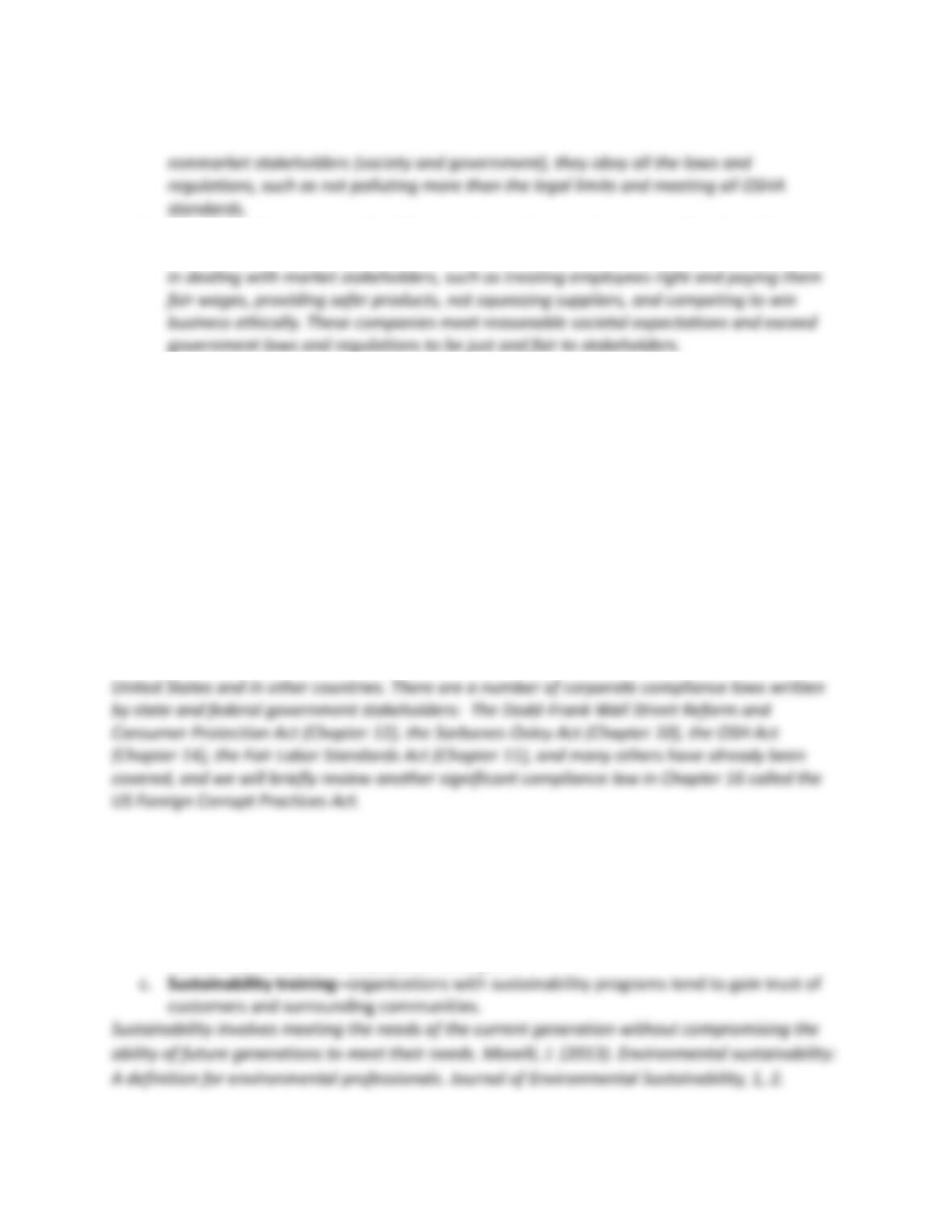
1. Legal CSR focuses on maximizing profits while obeying the law; it focuses on increasing
Lecture Notes
Lussier, Human Resource Management, Third Edition
SAGE Publishing, 2018
2. Ethical CSR focuses on profitability and doing what is right, just, and fair. Providing
ethical leadership and avoiding questionable practices mean doing more than is required
3. Benevolent CSR focuses on profitability and helping society through philanthropy. This
highest level of CSR is also called “good corporate citizenship.” Benevolent firms are
philanthropic, giving gifts of money, or other resources, to charitable causes. Employees
are expected, encouraged, and rewarded for being active volunteers in the community,
often on company time.
X. Stakeholders and CSR
a. Corporate compliance laws at state and federal levels dictate adherence to ethical
standards.
b. Laws protecting older workers
c. Female executives and the “glass ceiling”
d. LGBT employees
e. Diversity management
In addition to being good public practice, CSR is also being codified more often in law in the
XI. Sustainability
a. State of physical and psychological wellness in workforce. Meeting needs without
compromising ability to meet future needs.
b. HR and organizational sustainability—green companies act to minimize damage to
environment. Nearly all of the world’s top 150 companies have a sustainability officer
who serves at rank of vice president or higher.
Lecture Notes
Lussier, Human Resource Management, Third Edition
SAGE Publishing, 2018
XII. The Sustainable 21st Century Organization
a. Benefits of sustainability
i. 86% of companies indicate sustainability initiatives are necessary to
remain competitive in world markets.
XIII. Diversity Initiatives
a. Diversity training
i. Early efforts to promote diversity training focused on compliance with equal
opportunity laws.
Diversity training has been around in some form since the 1960s. In its earlier days, diversity
training primarily focused on organizational compliance with equal opportunity laws. Later on,
diversity training moved through a sequence of options—from attempting to assimilate different