Lecture Notes
Lussier, Human Resource Management, Third Edition
SAGE Publishing, 2018
Lecture Notes
Chapter 14: Workplace Safety, Health, and Security
Learning Objectives
After studying this chapter, you should be able to do the following:
14–2 Briefly discuss EAPs, EWPs, and ergonomics and what the value of each of these is to
companies and employees.
14–3 Briefly discuss the causes of stress and how it can be managed.
Annotated Chapter Outline
I. Workplace Safety and the Occupational Safety and Health Act (OSHA) 1970
a. Requires employers to pursue workplace safety.
b. Workplace safety deals with physical protection of employees from injury or illness while
on job.
c. Employers must meet all OSHA safety standards, maintain records of injuries and deaths
due to workplace accidents, and submit to on-site inspections when notified.
Workplace Safety and The Occupational Safety and Health Act (OSH Act) 1970
Lecture Notes
Lussier, Human Resource Management, Third Edition
SAGE Publishing, 2018
II. OSHA
a. General duties clause covers all firms and states that:
i. Employers furnish a place of employment free from hazards that cause or are likely
to cause death or physical harm.
III. What does OSHA do?
a. Sets and communicates federal safety and health standards to employers.
b. Occupational safety and health inspections must be made without any advance notice in
response to:
i. Imminent dangers
ii. Catastrophes
iii. Worker complaints
iv. Targeted inspections
v. Follow-up inspections
OSHA is responsible for setting federal safety and health standards and promulgating those
standards to employers. OSHA is also the responsible agency of the federal government for
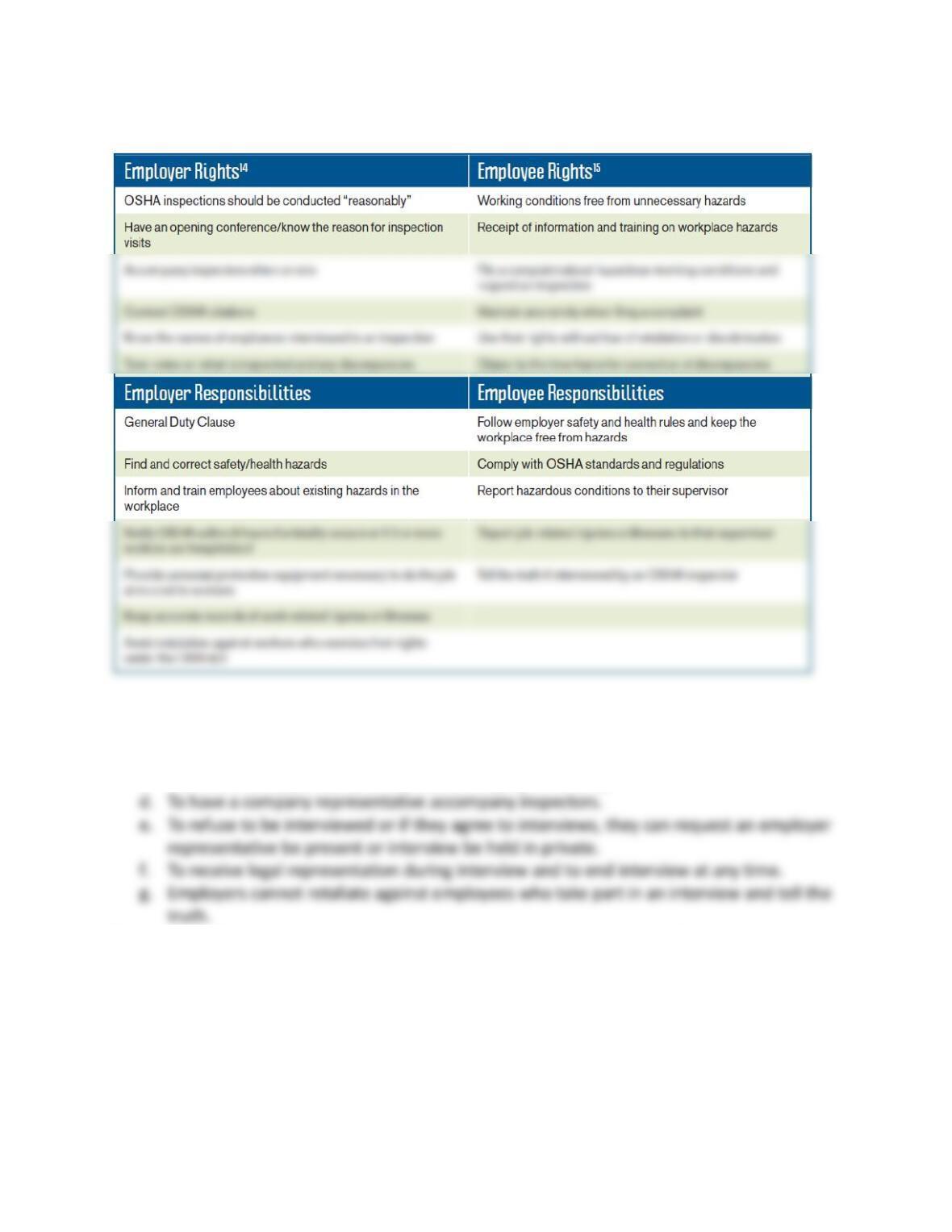
IV. Employer and Employee Rights and Responsibilities Under OSHA
Lecture Notes
Lussier, Human Resource Management, Third Edition
SAGE Publishing, 2018
V. OSHA Inspections and Employer Rights
a. To get inspector’s credentials and receive information on reason for inspection.
b. To refuse to allow inspection without a court order.
c. To receive a copy of complaint (without employee’s name).
So assuming that the inspection is allowed, we need to be aware of some things that we have a
right to, and that we should do, during the inspection.
If the inspection is being conducted due to a worker complaint, we have the right to get a copy
of the complaint (without the employee’s name), and we want to do so because we want to
know what is being alleged.
Lecture Notes
Lussier, Human Resource Management, Third Edition
SAGE Publishing, 2018
Secondly, we have a right to have a company representative accompany inspectors as they go
through their site visit, and we, as the HR representative, want to accompany them.
VI. OSHA and Hazard Communication Standards
a. Employers keep information at work sites that describes any chemical hazards that may
be present on site.
b. Material Safety Data Sheets (MSDS) provide information on a hazardous chemical and its
characteristics.
OSHA requires that all employers maintain information at each work site that describes any
chemical hazards that may be present on-site. A new set of Hazard Communication Standards
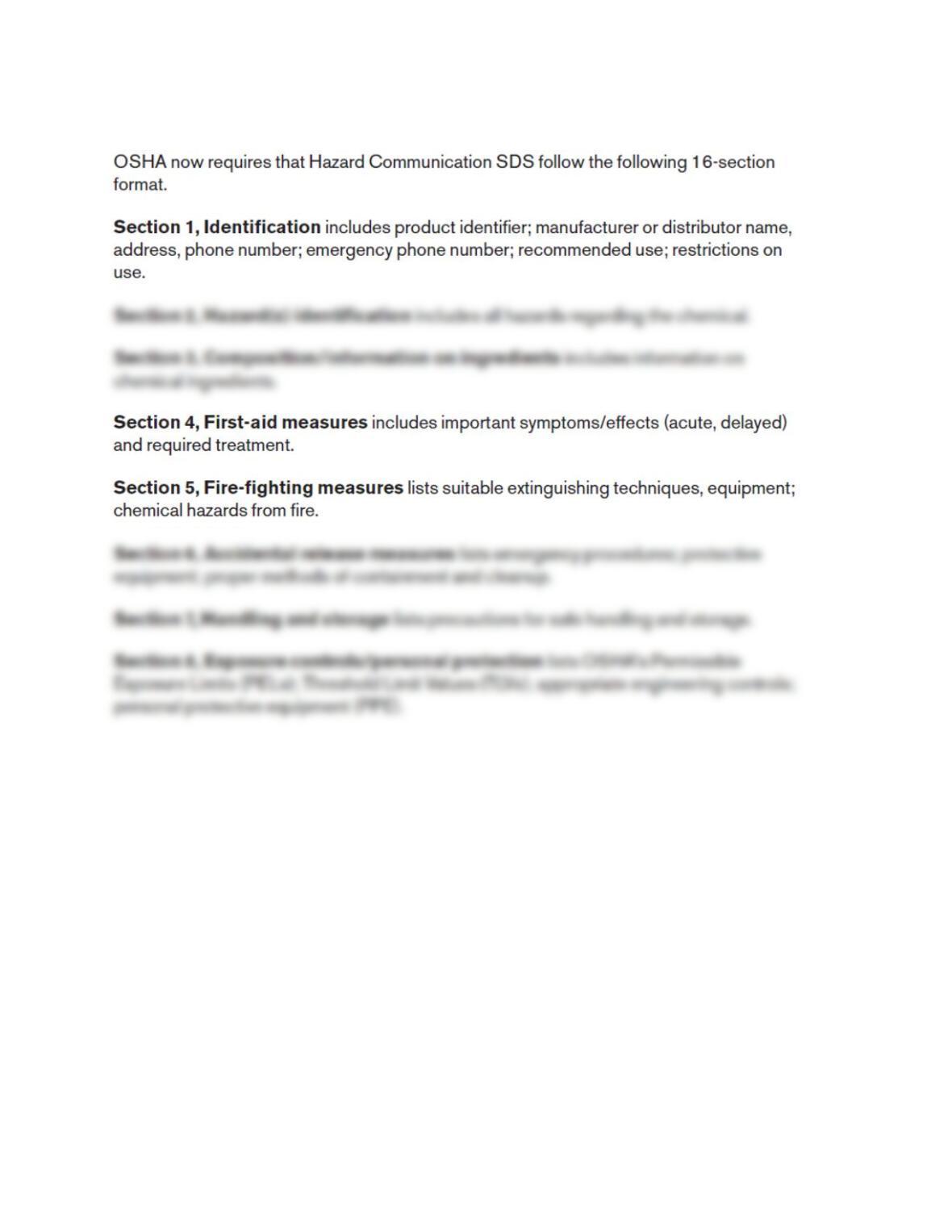
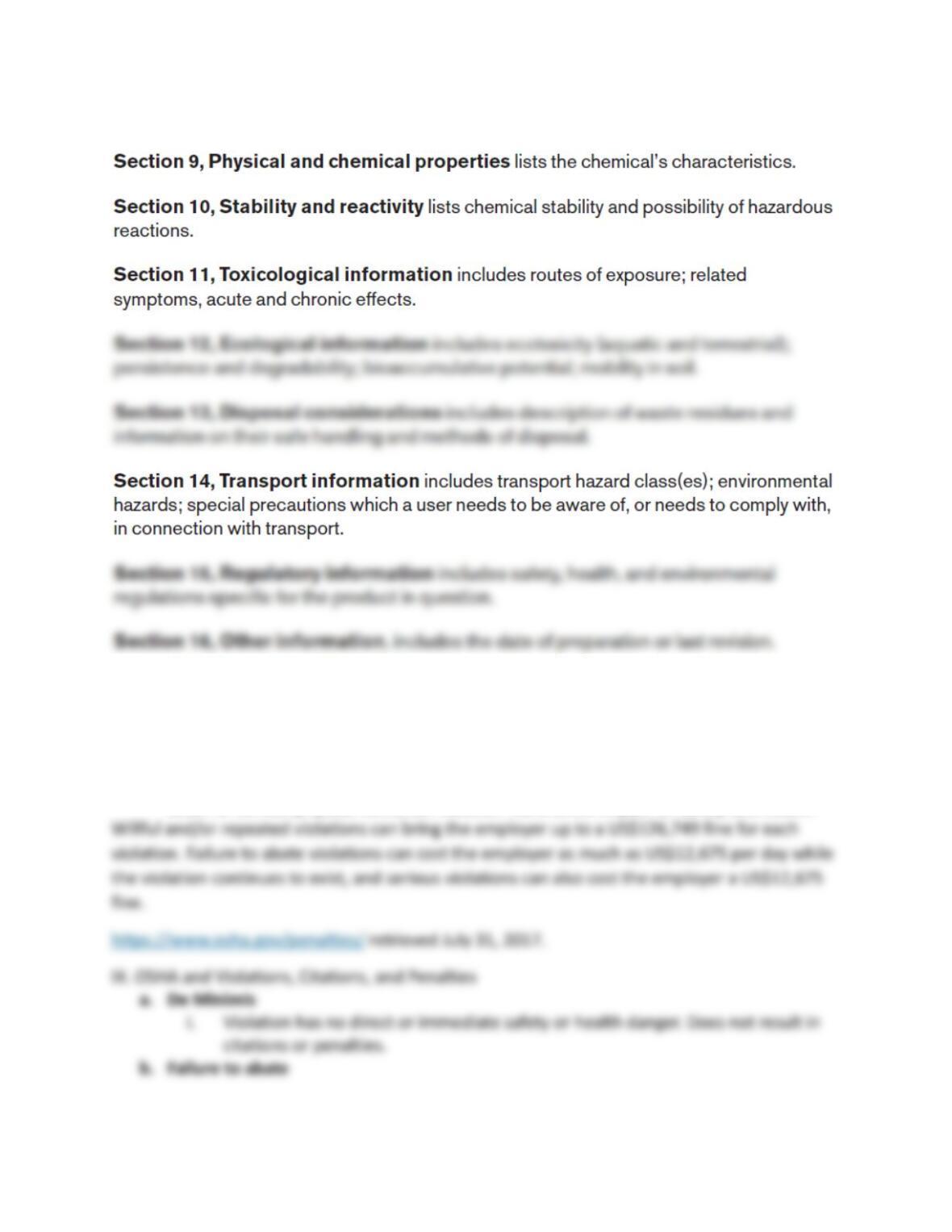
VII. Material Safety Data Sheet Format
Lecture Notes
Lussier, Human Resource Management, Third Edition
SAGE Publishing, 2018
Lecture Notes
Lussier, Human Resource Management, Third Edition
SAGE Publishing, 2018
VIII. OSHA and Violations, Citations, and Penalties
a. Willful—employer knew a hazardous condition existed but made no effort to eliminate it.
b. Serious—hazard could cause injury or illness that would most likely result in death or
significant physical harm.
c. Other than serious—any illness or injury likely to result from hazard is unlikely to cause
death or serious physical harm, but violation has a direct impact on safety and health.
Lecture Notes
Lussier, Human Resource Management, Third Edition
SAGE Publishing, 2018
i. Employer has not corrected a previous violation for which a citation was issued
and settlement date has passed.
c. Repeated
i. Employer has been previously cited for same type of violation within previous 5
years.
X. National Institute of Industrial and Occupational Health (NIOSH)
a. Works under umbrella of Centers for Disease Control and Prevention (CDC).
XI. Employee Health
a. State of physical and psychological wellness in workforce.
b. Work-life balance
i. Spillover—effect of work and family on one another that generate similarities
between two domains.
c. To keep a better work-life balance, firms offer more work-family benefits, such as flexible
work schedules, child and elder care.
In analyzing the needs of the workforce, work–life balance is high on the list of issues facing
both employers and employees. Thus, individual employees and their leaders are seeking work–
life balance. Work-life balance is a perpetually hot topic. With mobile technology, especially the
smartphone, the boundary between work and nonwork hours becomes fuzzy. Some 44% of
XII. Employee Health Programs
a. Employee assistance programs (EAP)
i. Counseling and other services provided to employees that help resolve personal
issues that may affect their work.
b. Employee wellness programs (EWP)
Lecture Notes
Lussier, Human Resource Management, Third Edition
SAGE Publishing, 2018
XIII. Employee Health and Musculoskeletal Disorders (MSD)
a. Ergonomics
i. Science of fitting workplace conditions and job demands to capabilities of
working population.
b. Purpose
XIV. Safety and Health Management and Training
a. Includes offering EAPs, EWPs, and stress management training.
XV. Stress
a. Body’s emotional and/or physical reaction to environmental demands.
b. Functional (acute eustress) stress
i. Helps improve performance by challenging and motivating people to meet
objectives.
c. Dysfunctional stress (distress)
i. Decreases performance and may result in burnout—a constant lack of interest
and motivation to perform one’s job.
People often have internal reactions to external environmental stimuli. Stress is the body’s
XVI. Negative Consequences of Dysfunctional Stress
Lecture Notes
Lussier, Human Resource Management, Third Edition
SAGE Publishing, 2018
a. Primary cause of absenteeism and costs an estimated US$300 billion a year in
absenteeism, decreased productivity, employee turnover, and medical, legal, and
insurance fees.
b. Symptoms
i. Weak immune system
ii. Aging
XVII. Causes of Job Stress
a. Type A personalities—experience more stress.
b. Organizational culture and change—the more positive the culture and the less threat of
major changes, the less employee stress.
XVIII. Stress Management
a. Eliminating or reducing stress and making it functional.
b. Six techniques
i. Time management
ii. Relaxation (meditation, deep breathing, muscle relaxation, enjoyable activities,
sleep)
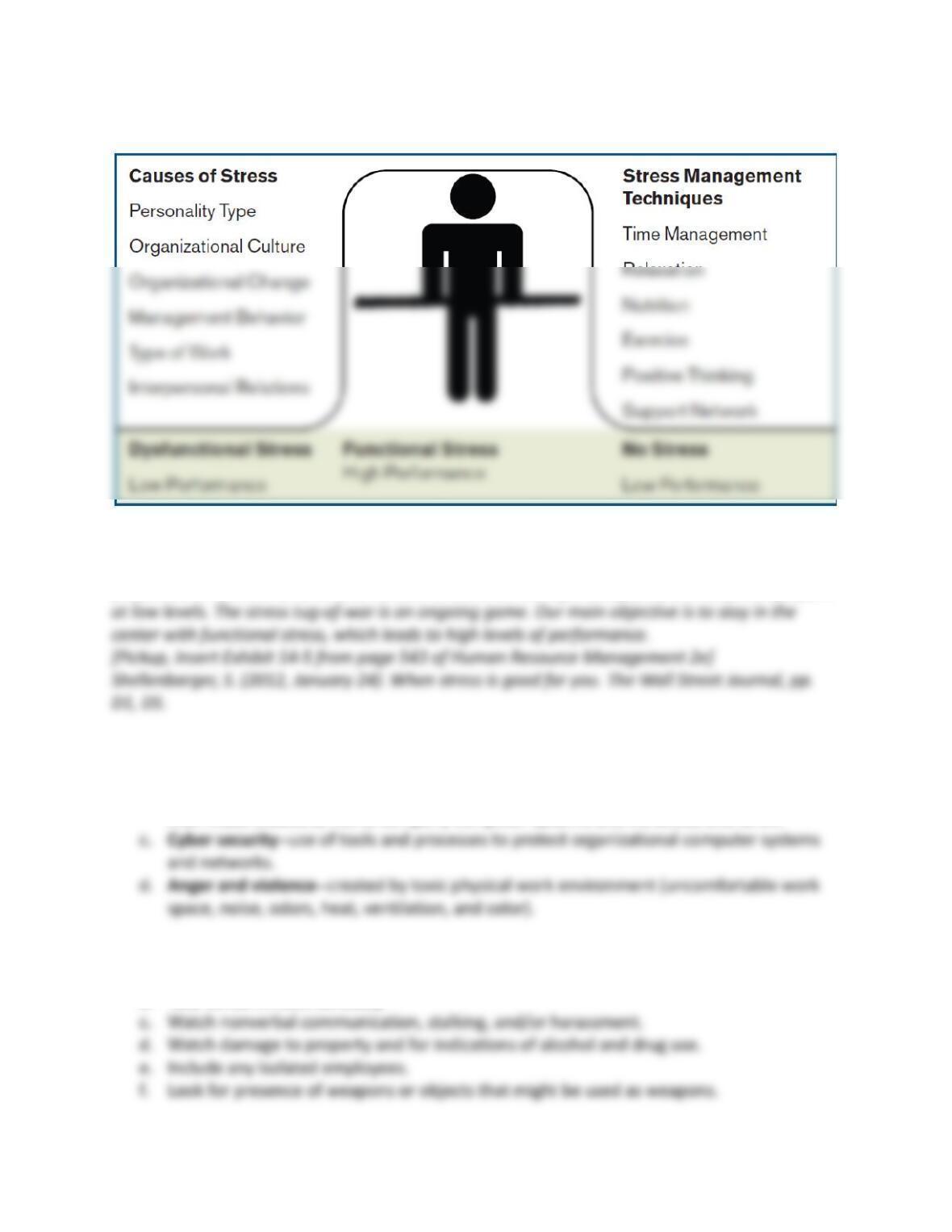
XIX. The Stress Tug-of-War
Lecture Notes
Lussier, Human Resource Management, Third Edition
SAGE Publishing, 2018
On the left are causes of stress trying to pull you toward burnout. On the right are stress
management techniques you use to keep you in the center. If the stress becomes too powerful, it
will pull us off center to the left, and we may suffer burnout and dysfunctional stress with low
performance. If there is no stress, we tend to move to the right and just take it easy and perform
XX. Workplace Security
a. Management of personnel, equipment, and facilities to maintain protection.
b. Concerned with mitigating risks of violence, bomb threats, management of natural and
man-made disasters, risk to company computer systems and intranets, and so on.
XXI. Signs of Potential Workplace Violence
a. Watch for passive-aggressive behavior in rising steps related to an unresolved conflict.
b. Take verbal threats seriously.
Lecture Notes
Lussier, Human Resource Management, Third Edition
SAGE Publishing, 2018
There were 417 workplace homicides in 2015, and workplace shootings rose by 15%. While this
is serious, and we need to take precautions to respond if such incidents happen, we should also
understand that workplace homicides are still extremely rare and that we should not panic over
such statistics. These 417 homicides took place in an environment with tens of millions of
businesses. So for now, let’s focus on anger that can lead to violence and how to prevent it.
XXII. Organizational Prevention of Violence
a. Start with a written zero-tolerance policy.
b. Train employees to deal with anger and prevent violence.
XXIII. Individual Prevention of Violence
a. Screen (perform background checks on) applicants and test them for substance abuse to
prevent “negligent hires.”
XXIV. General Security Policies
a. Prepare and train employees for emergencies, such as fires, floods, earthquakes, severe
weather, terrorist attacks, and bomb threats. Provide grief counseling if needed.
b. Establish an emergency response plan whose priorities:
i. Protect human life and environment