Chapter 14 Conflict and Negotiation Page
188
Chapter 14
Conflict and Negotiation
Chapter Overview
Managers in organizations need to be able to effectively deal with conflict and to negotiate
Chapter Objectives
After studying this chapter, the student should be able to:
1. Define conflict and differentiate between the traditional, interactionist, and
managed-conflict views of conflict.
3. Contrast distributive and integrative bargaining.
5. Show how individual differences influence negotiations.
Suggested Lecture Outline
I. INTRODUCTION
A. This chapter examines both the positive and negative impacts of conflict, as well as
II. A DEFINITION OF CONFLICT
A. Conflict: A process that begins when one party perceives
another party has negatively affected, or is about to negatively
affect something that the first party cares about.
1. Broad Scope. This definition is purposely kept broad to encompass those
2. Flexibility. This definition is flexible enough to cover the full range of conflict
levels, from overt and violent acts to subtle forms of disagreement.
III. TRANSITIONS IN CONFLICT THOUGHT
A. It is entirely appropriate to say there has been conflict over
the role of conflict in groups and organizations with three
1. The Traditional view has argued that conflict must be avoided—that it indicates
a malfunctioning within the group.
2. The Interactionist view proposes not only that conflict can be a positive force in
PPT 14.1
PPT 14.2
PPT 14.3
PPT 14.4
3. The Managed Conflict view argues that instead of encouraging “good” or
discouraging “bad” conflict, it’s more important to resolve naturally occurring
conflicts productively.
B. The Traditional View of Conflict.
1. In the earliest approach (1930s through 1940s) to
2. Conflict was seen as a dysfunctional outcome resulting from poor
3. This somewhat simplistic view of conflict allowed for relatively easy solutions:
seek out the sources of conflict and correct those malfunctions.
4. While still commonly held in the workplace, this view is not aligned with
modern research findings.
C. The Interactionist View of Conflict.
1. The interactionist view of conflict encourages conflict on the grounds that a
3. Functional Conflict. Conflict that supports the goals of the group and improves
its performance: it is constructive.
5. Look at the type of conflict.
a. Task Conflict. This type of conflict relates to the
content and goals of the work. High levels of task
conflict become dysfunctional when they create uncertainty about task
D. Resolution Focused View of Conflict
1. Researchers, including those who had strongly advocated the interactionist
view, have begun to recognize some problems with encouraging conflict.
a. There are some very specific cases in which conflict can be beneficial.
b. However, workplace conflicts are not productive; they take time away from
job tasks or interacting with customers, and hurt feelings and anger often
linger after conflicts appear to be over.
PPT 14.5
PPT 14.6

Chapter 14 Conflict and Negotiation Page
191
6) Reward systems are designed so that one member gains at another’s
expense.
7) The group is dependent upon another group.
3. Personal Variables.
a. Personality types, values, and emotions can lead to conflict.
b. The potential for conflict increases when:
1) Conflict-oriented personality types, such as highly authoritarian or
dogmatic personalities, exist in the work group.
2) Members who are highly emotional in the work environment (no matter
what the cause of those emotions).
B. Stage II: Cognition and Personalization.
1. If the antecedent conditions of the first stage negatively
2. As we noted in our definition of conflict, one or more of the parties must be
aware that antecedent conditions exist.
a. However, because a conflict is a perceived conflict does not mean it is
personalized.
b. In other words, “A may be aware that B and A are in serious disagreement…
but it may not make A tense or anxious, and it may have no effect
whatsoever on A’s affection toward B.” It is at the felt conflict level, when
individuals become emotionally involved, that parties experience anxiety,
tension, frustration, or hostility.
3. Keep in mind two points.
a. First, stage II is important because it’s where conflict issues tend to be
defined.
1) This is the point when the parties decide what the conflict is about.
2) The definition of a conflict is important because it typically delineates
the set of possible settlements.
b. Second, emotions play a major role in shaping perceptions.
2) In contrast, positive feelings increase our tendency to see potential
relationships among the elements of a problem, take a broader view of
the situation, and develop more innovative solutions.
C. Stage III: Intentions.
1. Intentions intervene between people’s perceptions and
emotions and their overt behavior.
a. They are decisions to act in a given way.
PPT 14.9
PPT 14.10
2. Using two dimensions—cooperativeness (the degree to which one party
attempts to satisfy the other party’s concerns) and assertiveness (the degree to
which one party attempts to satisfy his or her own concerns)—we can identify
five conflict-handling intentions: competing (assertive and uncooperative),
collaborating (assertive and cooperative), avoiding (unassertive and
uncooperative), accommodating (unassertive and cooperative), and
compromising (midrange on both assertiveness and cooperativeness).
a. Competing.
2) You compete when you place a bet that only one person can win, for
example.
b. Collaborating.
1) When parties in conflict each desire to fully satisfy the concerns of all
2) In collaborating, the parties intend to solve a problem by clarifying
differences rather than by accommodating various points of view.
3) If you attempt to find a win–win solution that allows both parties’ goals
to be completely achieved, that’s collaborating.
c. Avoiding.
2) Examples of avoiding include trying to ignore a conflict and avoiding
others with whom you disagree.
d. Accommodating.
1) A party who seeks to appease an opponent may be willing to place the
2) We refer to this intention as accommodating.
3) Supporting someone else’s opinion despite your reservations about it,
for example, is accommodating.
e. Compromising.
2) Rather, there is a willingness to ration the object of the conflict and
3) The distinguishing characteristic of compromising, therefore, is that
each party intends to give up something.
3. Intentions are not always fixed.
1) During the course of a conflict, they might change if the parties are able
2) However, research indicates people have preferences among the five
3) We can predict a person’s intentions rather well from a combination of
Chapter 14 Conflict and Negotiation Page
193
D. Stage IV: Behavior.
1. When most people think of conflict situations, they tend
3. As a result of miscalculations or unskilled enactments, overt behaviors
sometimes deviate from these original intentions.
5. For example,
6. Exhibit 14.2 provides a way of visualizing conflict behavior.
a. All conflicts exist somewhere along this continuum.
b. At the lower part are conflicts characterized by subtle,
indirect, and highly controlled forms of tension, such as a student
questioning in class a point the instructor has just made.
c. Conflict intensities escalate as they move upward along the continuum until
they become highly destructive.
d. Strikes, riots, and wars clearly fall in this upper range.
e. For the most part, you should assume conflicts that reach the upper ranges
of the continuum are almost always dysfunctional.
f. Functional conflicts are typically confined to the lower range of the
continuum.
g. If a conflict is dysfunctional, what can the parties do to de-escalate it?
1) This brings us to techniques of conflict management. We have already
described several as conflict-handling intentions.
2) Under ideal conditions, a person’s intentions should translate into
comparable behaviors.
E. Stage V: Outcomes.
2. As our model demonstrates (see Exhibit 14.1), these
3. Functional Outcomes.
a. Normally associated with low-to-moderate levels of
1) The quality of decisions is improved by allowing multiple points of view
to be considered: reduces the potential for groupthink.
Exhibit 14.2
PPT 14.11
PPT 14.13
3) Interest and curiosity among group members is encouraged.
5) An environment of self-evaluation and change is created.
c. Research Results.
2) Additionally, heterogeneous groups (those with a greater likelihood for
4. Dysfunctional Outcomes.
1) Group effectiveness is reduced.
3) Group cohesiveness is reduced.
5) The group is threatened with destruction.
c. Research Results.
5. Managing Functional Conflict
a. If managers recognize that in some situations conflict can be beneficial, what
can they do to manage conflict effectively in their organizations?
1) This is easier said than done.
3) Groups that resolve conflicts successfully discuss differences of opinion
openly and are prepared to manage conflict when it arises.
5) An open discussion makes it much easier to develop a shared perception
of the problems at hand; it also allows groups to work toward a mutually
acceptable solution.
strategies may be based on collectivistic tendencies and
PPT 14.14
1) As a result, collectivists are more likely to seek to preserve relationships
and promote the good of the group as a whole.
2) They will avoid direct expression of conflicts, preferring indirect
methods for resolving differences of opinion.
g. Collectivists may also be more interested in demonstrations of concern and
working through third parties to resolve disputes, whereas individualists
will be more likely to confront differences of opinion directly and openly.
V. NEGOTIATION
A. Negotiation permeates the interactions of almost everyone in groups and
organizations.
2. There’s the not so obvious: Managers negotiate with
4. In today’s loosely structured organizations, in which members work with
5. We can define negotiation as a process that occurs when two or more parties
decide how to allocate scarce resources.
a. Although we commonly think of the outcomes of negotiation in one-shot
6. Note that we use the terms negotiation and bargaining interchangeably.
a. In this section, we contrast two bargaining strategies, provide a model of the
negotiation process, ascertain the role of moods and personality traits on
bargaining, review gender and cultural differences in negotiation, and take a
brief look at third-party negotiations.
B. Bargaining Strategies.
1. There are two general approaches to negotiation:
distributive bargaining and integrative bargaining.
2. Distributive Bargaining.
management negotiations over wages.
1) Each has a unique target point (what he or she would like to achieve)
Exhibit 14.3
PPT 14.16
PPT 14.17
2) The area between each negotiator’s target and resistance points is that
negotiator’s aspiration range.
a) If the two ranges overlap, this common area is referred to as the
settlement range.
3) When you are engaged in distributive bargaining, research consistently
shows one of the best things you can do is make the first offer—and
make it an aggressive one.
4) A savvy negotiator sets an anchor with the initial offer, and scores of
3. Integrative Bargaining.
a. This type of bargaining operates under the assumption
that one or more settlements can create a win-win
solution.
b. In terms of intraorganizational behavior, all things being equal, integrative
bargaining is preferable to distributive bargaining because the former builds
long-term relationships.
2) Distributive bargaining, however, leaves one party a loser. It tends to
build animosities and deepen divisions when people have to work
together on an ongoing basis.
c. Research shows that over repeated bargaining episodes, when the “losing”
party feels positive about the negotiation outcome, he is much more likely to
bargain cooperatively in subsequent negotiations.
d. This points to an important advantage of integrative negotiations: even
when you “win,” you want your opponent to feel good about the negotiation.
e. Necessary Conditions. Because of these requirements for integrative
bargaining, is not as common in business as perhaps it should be.
1) Parties must be open with information and candid about their concerns.
3) The parties must be able to trust each other.
4) Both parties must be willing to maintain flexibility.
f. Integrative Bargaining Tactics. To achieve higher joint-gain settlements, put
more issues on the table: this allows for better outcome as issues are traded.
1) Avoid compromise as it reduces the pressure to bargain integratively.
g. Results of Using Integrative Bargaining. This is the preferable means of
bargaining as it builds long-term relationships and positive feelings about
the other party for both parties.
PPT 14.18

Chapter 14 Conflict and Negotiation Page
197
B. Negotiation Process.
1. This simplified model of the negotiation process is
composed of five steps.
e. Step One: Preparation and Planning.
1) Before you start negotiating, you need to do your homework.
a) What’s the nature of the conflict?
b) What’s the history leading up to this negotiation?
c) Who’s involved and what are their perceptions of the conflict?
d) What do you want from the negotiation?
e) What are your goals?
(1) It often helps to put your goals in writing and develop a range of
(3) What are they likely to ask/request?
(4) How entrenched is their position likely to be?
(5) What intangible or hidden interests may be important to them?
(6) On what might they be willing to settle?
(7) When you can anticipate your opponent’s position, you are
2) Determine Strategic Limits.
a) An important consideration in any negotiation is to determine the
best alternative to a negotiated agreement (BATNA) for both the
negotiator and the opponent.
b) This is similar in concept to a resistance point: the negotiator must
determine when it is better strategically to cease negotiations and
accept some other alternative.
c) One possible negotiation strategy is to get the opponent to modify
his or her BATNA to increase the settlement range.
f. Step Two: Definition of Ground Rules.
1) In this initial stage of negotiations, the methodology of the negotiation
itself is determined.
3) The initial proposals or demands will be exchanged between the parties.
g. Step Three: Clarification and Justification.
2) This step should be more explanatory in nature, rather than
confrontational; it should be used to build understanding between the
parties.
h. Step Four: Bargaining and Problem Solving.
1) This step is what is typically thought of as negotiations.
Exhibit 14.5
PPT 14.19
3) It is likely that both parties will have to make some concessions in order
to reach agreement.
i. Step Five: Closure and Implementation.
1) The final step in the process is formalizing the negotiated agreement and
2) This step can be accomplished by anything from creating a formal
contract through simply shaking hands on it.
C. Individual Differences in Negotiation Effectiveness.
1. Can you predict an opponent’s negotiating tactics if you
know something about his or her personality?
e. Because personality and negotiation outcomes are related but only weakly,
the answer is, at best, “sort of.”
f. Negotiators who are agreeable or extraverted are not very successful in
distributive bargaining.
2) And agreeable people are more interested in finding ways to cooperate
rather than to butt heads.
g. These traits, although slightly helpful in integrative negotiations, are
liabilities when interests are opposed.
1) So the best distributive bargainer appears to be a disagreeable
2) People who are highly interested in having positive relationships with
3) These people tend to be very anxious about disagreements and plan to
2. Moods/Emotions in Negotiations.
e. Do moods and emotions influence negotiation?
1) They do, but the way they do appears to depend on the type of
negotiation.
2) In distributive negotiations, it appears that negotiators in a position of
4) On the other hand, for those in a less powerful position, displaying anger
leads to worse outcomes. So if you’re a boss negotiating with a peer or a
subordinate, displaying anger may help you, but if you’re an employee
negotiating with a boss, it might hurt you.
f. In integrative negotiations, in contrast, positive moods and emotions appear
to lead to more integrative agreements (higher levels of joint gain).
1) This may happen because, as we noted in a previous chapter, positive
PPT 14.20
3. Culture in Negotiation.
e. Compared with the research on conflict, there is more research on how
negotiating styles vary across national cultures.
1) One study compared U.S. and Japanese negotiators and found the
2) A follow-up study showed that whereas among U.S. managers making
early offers led to the anchoring effect we noted when discussing
distributive negotiation, for Japanese negotiators early offers led to more
information sharing and better integrative outcomes.
f. In another study, managers with high levels of economic power from Hong
Kong, which is a high power-distance country, were more cooperative in
negotiations over a shared resource than German and U.S. managers, who
were lower in power distance.
1) This suggests that in high power-distance countries, those in positions of
power might exercise more restraint.
g. Another study looked at differences between U.S. and Indian negotiators.
1) Indian respondents reported having less trust in their negotiation
counterparts than did U.S. respondents.
2) These lower levels of trust were associated with lower discovery of
3) In both cultures, use of question–and–answer methods of negotiation
4. Gender Differences in Negotiation.
e. Although men and women do not tend to negotiate differently, the
negotiation outcomes do differ based on gender.
f. Men have been found to negotiate better outcomes than women do, although
the difference is relatively small.
VI. IMPLICATIONS FOR MANAGERS
2. As shown in Exhibit 14.6, levels of conflict can be either too
3. An optimal level is one that prevents stagnation, stimulates creativity, allows
Exhibit 14.6

4. Managing Conflict
a. Competition. Use this method when:
2) Deciding important issues for which unpopular actions need to be
implemented (such as cost cutting and discipline).
4) Negotiating with people who take advantage of noncompetitive
behavior.
b. Collaboration. Use this method when:
1) There is a need to find an integrative solution when both sets of
concerns are too important to be compromised.
3) The desire is to merge insights from people with different perspectives.
5) Working through feelings that interfered with the relationship.
c. Avoidance. Use this method when:
2) You perceive no chance of satisfying your concerns.
4) You desire to let people cool down and regain perspective.
6) Others can resolve the conflict more effectively.
7) Issues seem tangential or symptomatic of other issues.
d. Accommodation. Use this method when:
1) You find you are wrong and wish to allow a better position to be heard in
order to learn and to show your reasonableness.
3) You wish to build social credits for later issues.
5) Harmony and stability are especially important.
6) You wish to allow subordinates to develop by learning from their
mistakes.
e. Compromise. Use this method when:
2) Opponents have power equal to yours and they are committed to
mutually exclusive goals.
4) Wishing to arrive at expedient solutions under time pressure.
5. Negotiation is an ongoing activity in groups and
organizations.
a. Distributive bargaining can resolve disputes, but it often
negatively affects the satisfaction of one or more negotiators because it is
PPT 14.22
Chapter 14 Conflict and Negotiation Page
201
b. Integrative bargaining, in contrast, tends to provide outcomes that satisfy all
parties and that build lasting relationships.
c. When engaged in negotiation, make sure you set aggressive goals and try to
find creative ways to achieve the goals of both parties, especially when you
VII. KEEP IN MIND
A. Conflict is an inherent part of organizational life: probably
necessary for optimal organizational function.
B. Task conflict is the most constructive.
C. Most effective negotiators use both types of bargaining and know the appropriate
tactics.
Discussion Questions
1. Define conflict.
2. Differentiate between the traditional, human relations, and interactionist views of
conflict.
Answer: The Traditional View: in the earliest approach (1930s through 1940s) to
conflict in organizations, it was assumed that all conflict was harmful and needed to
be avoided. Conflict was seen as a dysfunctional outcome resulting from poor
3. Contrast task, relationship, and process conflict.
PPT 14.23
PPT 14.24
4. Outline the conflict process.
5. Contrast distributive and integrative bargaining.
6. Identify the five steps in the negotiation process.
7. Discuss whether there are individual differences in negotiator effectiveness.
Answer: There are three such differences. (1) Personality. There is little evidence
to support the idea that personality can predict negotiation ability. However, it may
be that several of the Big Five traits are related to negotiation outcomes. A
Exercises
1. Self-analysis. Remember your last negotiation activity. This activity could have
been as simple as asking someone out for a date or as complex as trying to purchase
a home. Describe that negotiation using the terms and concepts from this chapter.
What could you have done better to increase your likelihood of success in the
negotiation? Be specific.
2. Web Crawling. Using your favorite search engine, seek out the term “conflict
management.” Find five different and varied sources (perhaps one from a
consultant, one from an institute of higher learning, one from a government source,
one from a general-purpose site, and one from a business site) and read them
carefully to see what they would tell the average manager about conflict
management. Write up a brief synopsis of your findings. Compare and contrast
your findings with the materials from this chapter and be ready to present them in
class.
3. Teamwork. Have students work in small groups to develop a script to role-play the
following scenarios in front of the class. You can assign a different scenario to each
group, or have two groups role-play the same scenario to discuss comparisons and
contrasts in style. Require each group to first role-play the scenario from a
distributive bargaining perspective, and then from an integrative bargaining
benefit, as you and many of your fellow workers would like to go back to school
(part-time) and earn your MBA degree. But, the cost of tuition is expensive, and you
would like your company to help with the expenses. Many of the other companies in
your locale and industry do offer their employees this educational reimbursement,
and you would like your company to do so as well.
4. Analyzing Your Organization (Cumulative Project). Observe the negotiations that
take place around you at work. Focus on one negotiation that appears typical for
5. Try It in Real Life. Have students create a negotiation scenario where they may not
have thought of negotiating. For example, it is common and accepted that in the U.S.
culture we will negotiate for automobiles, but not as widely accepted when
purchasing furniture, for example. Challenge the class to negotiate their next non-
convenience purchase, and have them bring to the class the results of their
negotiation attempts. For example, was the negotiation integrative or distributive?
Did they implement any of the methods discussed in class for improving negotiation
skills? What was the outcome? Did gender or other variables affect the outcome?
Did they actually save any money? This can be submitted as a written report or
given as an in-class exercise.
Chapter 14 Conflict and Negotiation Page
204
Suggested Assignment
Conflict-Management Style Survey.* Make copies of the survey instrument provided
in the next two pages and distribute them to your class. Give the students the
following instructions:
When you have completed all fifteen items, add your scores into the “column total”
spaces provided. Your highest score is your dominant conflict management
strategy. All of us use all four strategies at one time or another. Your dominant style
is the one you prefer and will certainly come out in more intense conflict situations.
Knowing your style will help you be more effective in dealing with conflict.
Column 1. Competition. When one party seeks to achieve certain goals or to further
personal interests, regardless of the impact on the parties to the conflict, he or she
competes and dominates.
Column 2. Collaboration. When each of the parties in conflict desires to satisfy fully
the concerns of all parties, we have cooperation and the search for a mutually
beneficial outcome. In collaboration, the behavior of the parties is aimed at solving
the problem and at clarifying the differences rather than accommodating various
points of view.
* Adapted from the work of Marc Robert, in the 1987 University Associates, Inc.
Conflict-Management Style Survey
Instructions: Answer the following questions from a single frame of reference—work-
related conflicts, family conflicts, or social conflicts. Allocate ten points among the four
alternative answers given for each of the fifteen items below.
Example: When the people I supervise become involved in a personal conflict, I
usually:
Intervene to settle
the dispute.
Call a meeting to
talk over the
problem.
Offer to help if I
can.
Ignore the
problem.
Point
Total
3
6
1
0
=10
Be certain that your answers add up to 10.
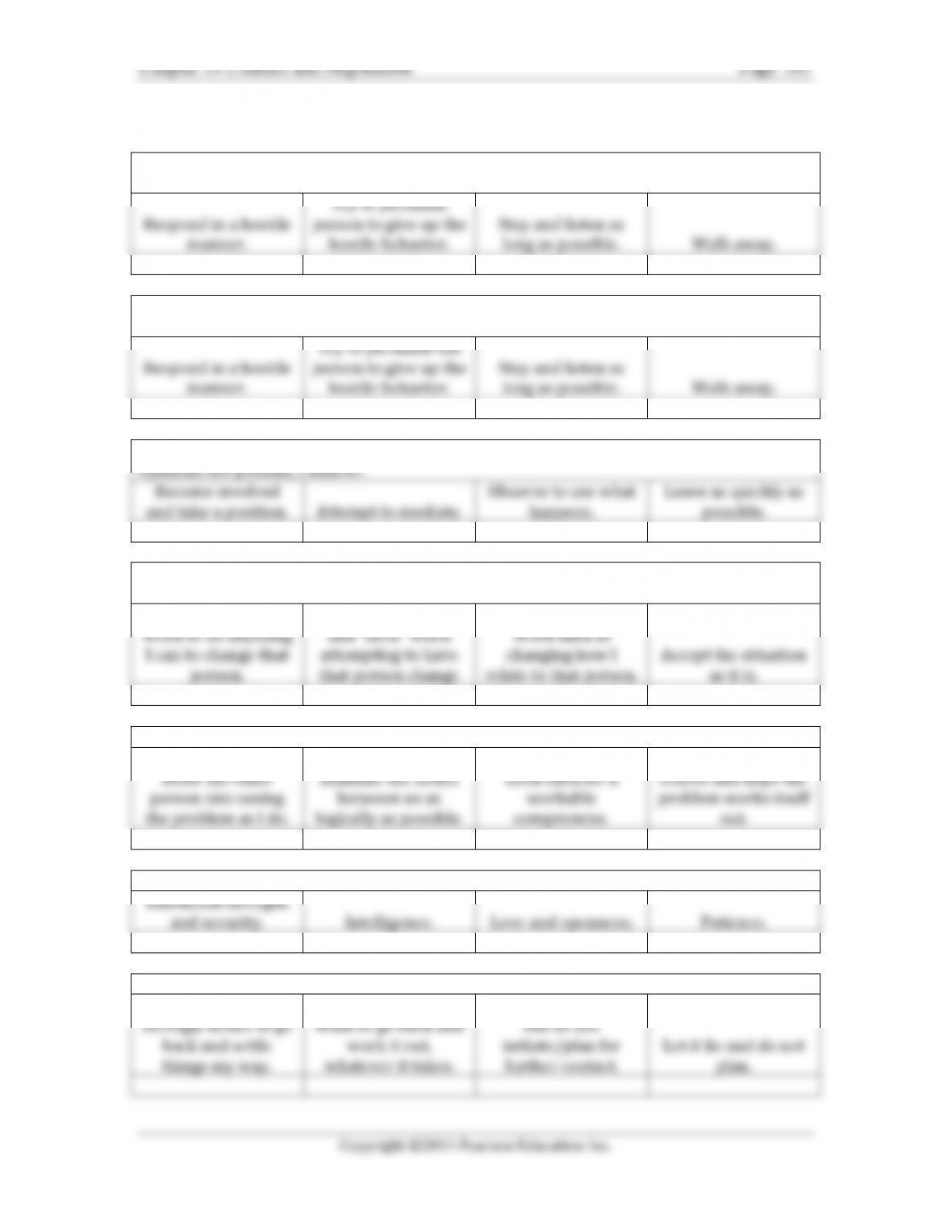
1. When someone I care about is actively hostile toward me, (yelling, threatening,
abusive), I tend to:
Respond in a hostile
manner.
Try to persuade
person to give up the
hostile behavior.
Stay and listen as
long as possible.
Walk away.
2. When someone who is unimportant to me is actively hostile toward me, i.e.,
yelling, threatening, abusive, and so on, I tend to:
Respond in a hostile
manner.
Try to persuade the
person to give up the
hostile behavior.
Stay and listen as
long as possible.
Walk away.
3. When I observe people in conflict, where anger, threats, hostility, and strong
opinions are present, I tend to:
Become involved
and take a position.
Attempt to mediate.
Observe to see what
happens.
Leave as quickly as
possible.
4. When I perceive another person as meeting his or her needs at my expense, I am apt
to:
Work to do anything
I can to change that
person.
Rely on persuasion
and “facts” when
attempting to have
that person change
Work hard at
changing how I
relate to that person.
Accept the situation
as it is.
5. When involved in an interpersonal dispute, I generally:
Draw the other
person into seeing
the problem as I do.
Examine the issues
between us as
logically as possible.
Look hard for a
workable
compromise.
Let time take its
course and hope the
problem works itself
out.
6. The quality that I value the most in dealing with conflict would be:
Emotional strength
and security.
Intelligence.
Love and openness.
Patience.
7. Following a serious altercation with someone I care for deeply, I:
Strongly desire to go
back and settle
things my way.
Want to go back and
work it out,
whatever it takes.
Worry about it a lot,
but do not
initiate/plan for
further contact.
Let it lie and do not
plan.
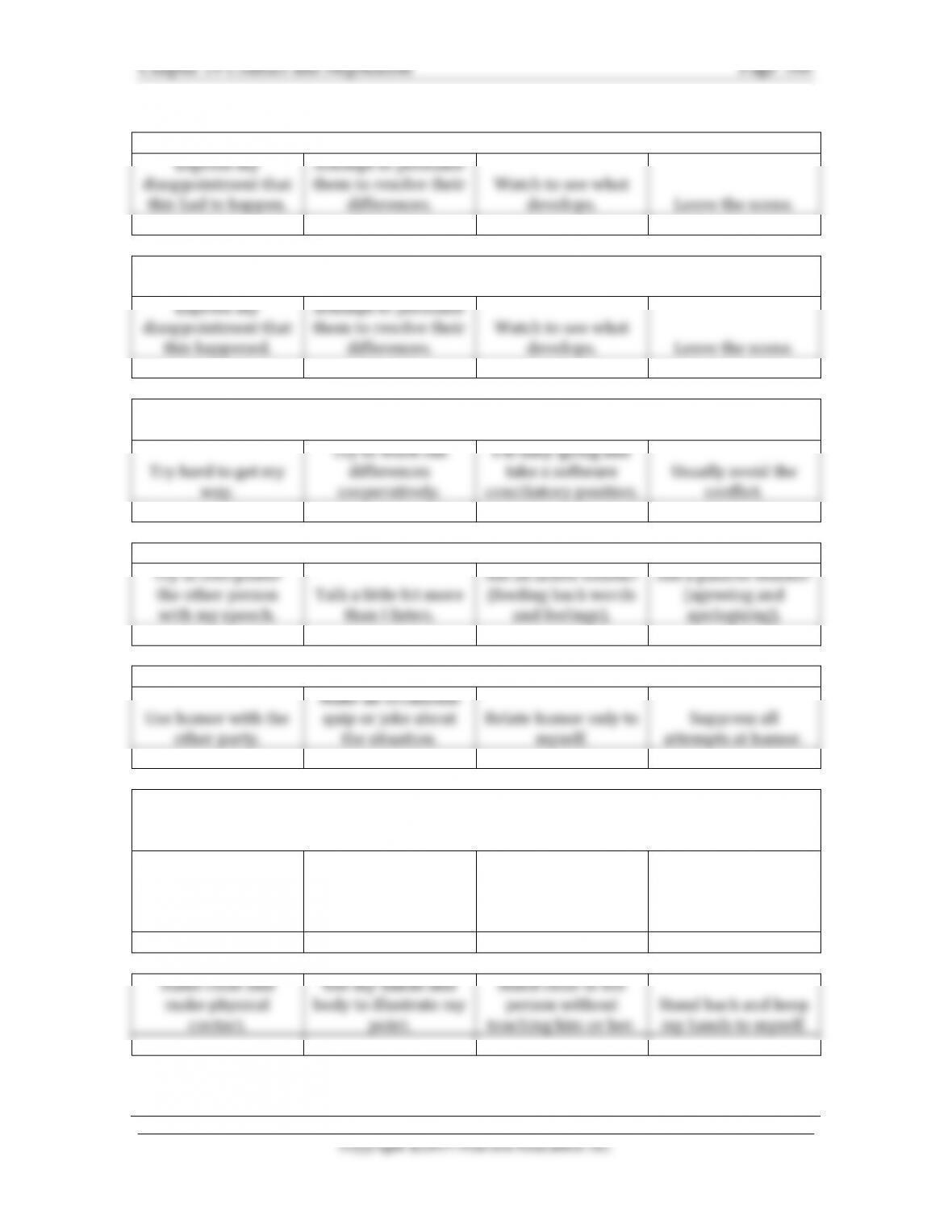
8. When I see a serious conflict developing between two people I care about, I tend to:
Express my
disappointment that
this had to happen.
Attempt to persuade
them to resolve their
differences.
Watch to see what
develops.
Leave the scene.
9. When I see a serious conflict developing between two people who are unimportant
to me, I tend to:
Express my
disappointment that
this happened.
Attempt to persuade
them to resolve their
differences.
Watch to see what
develops.
Leave the scene.
10. The feedback that I receive from most people about how I behave when faced with
conflict and opposition indicates that I:
Try hard to get my
way.
Try to work out
differences
cooperatively.
I’m easy-going and
take a software
conciliatory position.
Usually avoid the
conflict.
11. When communicating with someone with whom I am having a serious conflict, I:
Try to overpower
the other person
with my speech.
Talk a little bit more
than I listen.
Am an active listener
(feeding back words
and feelings).
Am a passive listener
(agreeing and
apologizing).
12. When involved in an unpleasant conflict, I:
Use humor with the
other party.
Make an occasional
quip or joke about
the situation.
Relate humor only to
myself.
Suppress all
attempts at humor.
13. When someone does something that irritates me (e.g., smokes in a nonsmoking area
or crowds in line in front of me), my tendency in communicating with the offending person
is to: (select an answer for each row)
Insist that the
person look me in
the eye.
Look the person
directly in the eye
and maintain eye
contact.
Maintain
intermittent eye
contact.
Avoid looking
directly at the
person.
Stand close and
make physical
contact.
Use my hands and
body to illustrate my
point.
Stand close to the
person without
touching him or her.
Stand back and keep
my hands to myself.

Chapter 14 Conflict and Negotiation Page
207
Use strong, direct
language and tell the
person to stop.
Try to persuade the
person to stop
Talk gently and tell
the person what my
feelings are.
Say and do nothing