
Lussier, Human Resources Management 3e
SAGE Publishing, 2019
Sample Answers
Chapter 13: Employee Benefits
Answers to Applying the Concept Exercises
Applying the Concept 13-1: Statutory Benefit Laws
Place the letter of the relevant statutory benefit law on the line next to the statement below.
a. FMLA
b. ACA
c. COBRA
d. HIPAA
e. ERISA
1. I don’t trust my company’s financial future, so I like this law because it will allow me to
move my funds out of my company fund to a new account with the stockbroker of my
choice.
2. I like this law because it will allow me to take time off from work to take care of my sick
mother.
3. I’m going to quit and look for a new job, so I like this law because I need to continue to
have health insurance while I search for a new job.
4. I currently have health insurance and medical problems, but when I change jobs, the new
company can’t refuse to give me insurance based on any medical problems I have when I
join the firm.
D. HIPAA. The law prohibits not giving health insurance based on prior preexisting medical
problems.

Lussier, Human Resources Management 3e
SAGE Publishing, 2019
5. I’m out of school and almost 25, so I like this law that allows me to continue on my
parents’ insurance plan.
Applying the Concept 13-2: Group Health Insurance
Place the letter of each type of health insurance option offered on the line next to the
statement describing it.
a. Traditional
b. HMO
c. PPO
d. HSA
e. MSA
6. I don’t like the new insurance plan because I can only go to doctors and hospitals that are
approved by the plan. I have to stop seeing my doctor and start with a new one that I’m
assigned to.
7. I have expensive health problems, and my insurance plan requires me to pay 20% of my
health-care costs, making it very expensive for me.
8. I like my insurance plan because I’m healthy and pay the full cost, but I don’t use it all
every year and it has accumulated in case I need it someday.
9. I have the same insurance deal that you have (#8), but my company only has 25
employees.
E. MSA. They are for companies with less than 50 employees.
10. I do have copays and deductibles, but at least I can go to any doctor or hospital I want to
at an extra cost.

Lussier, Human Resources Management 3e
SAGE Publishing, 2019
Applying the Concept 13-3: Retirement Plans
Recommend the appropriate retirement plan based on the person’s situation.
a. 401(k)
b. 403(b)
c. IRA
d. Roth IRA
e. SEP
11. I work for a church, but we do have a retirement account.
12. My company doesn’t offer any retirement benefits for part-time employees, so how
should I save for retirement?
13. I work for a major corporation, and it offers the standard retirement plan with a 5%
match.
14. I already have a retirement plan at work and put in the maximum tax-deferred
contribution. What other options do I have to save even more for my retirement?
D. Roth IRA. The person can’t put any more into a tax-deferred account, so a Roth IRA is a
good option.
15. I started my own business and want to save for retirement. What retirement plan should I
use?
Applying the Concept 13-4: Flexible Benefit Plans
Place the letter of the type of flexible plan on the line next to statement that describes it.
a. modular
b. core-plus
Lussier, Human Resources Management 3e
SAGE Publishing, 2019
c. full-choice
16. I don’t think our benefit plan is fair because I use my spouse’s health insurance plan and I
just lose the benefit. To be fair, I should be able to use the money for other benefits I want.
17. I sure wish we got more of our compensation in benefits, but at least with my benefit
package, I can choose any benefit I want to every year.
18. My benefit plan has five packages, and I get to pick any one of them that I want every
year. But it’s difficult to select one.
A. Modular. A set package is a modular plan.
19. I definitely want to get health care and retirement benefits, and it’s nice to have the
option of selecting a few other benefits with a set dollar value.
20. The hard part about my benefit plan is that there are so many options to choose from that
I have a hard time selecting the ones I may really need.
Answers to Skill Builder Exercises
Skill Builder 13-1: Developing Flexible Employee Benefit Plans
Skill Builder 13-2: Selecting Flexible Employee Benefit Plans
You can select either of the two exercises or combine the two to cover developing modular,
core plus (13-1), and selecting from a full choice plan (13-2).
13-1 Modular and core plus flexible plans. The textbook does give some ideas for developing
modular and core plus plans. Student might simply copy these ideas.
Lussier, Human Resources Management 3e
SAGE Publishing, 2019
Conclusion
Lead a class discussion and/or make concluding remarks. I ask the class, who wants to be a
millionaire? Then, I put this example on the board illustrating that they can become
millionaires at retirement:
Assumptions:
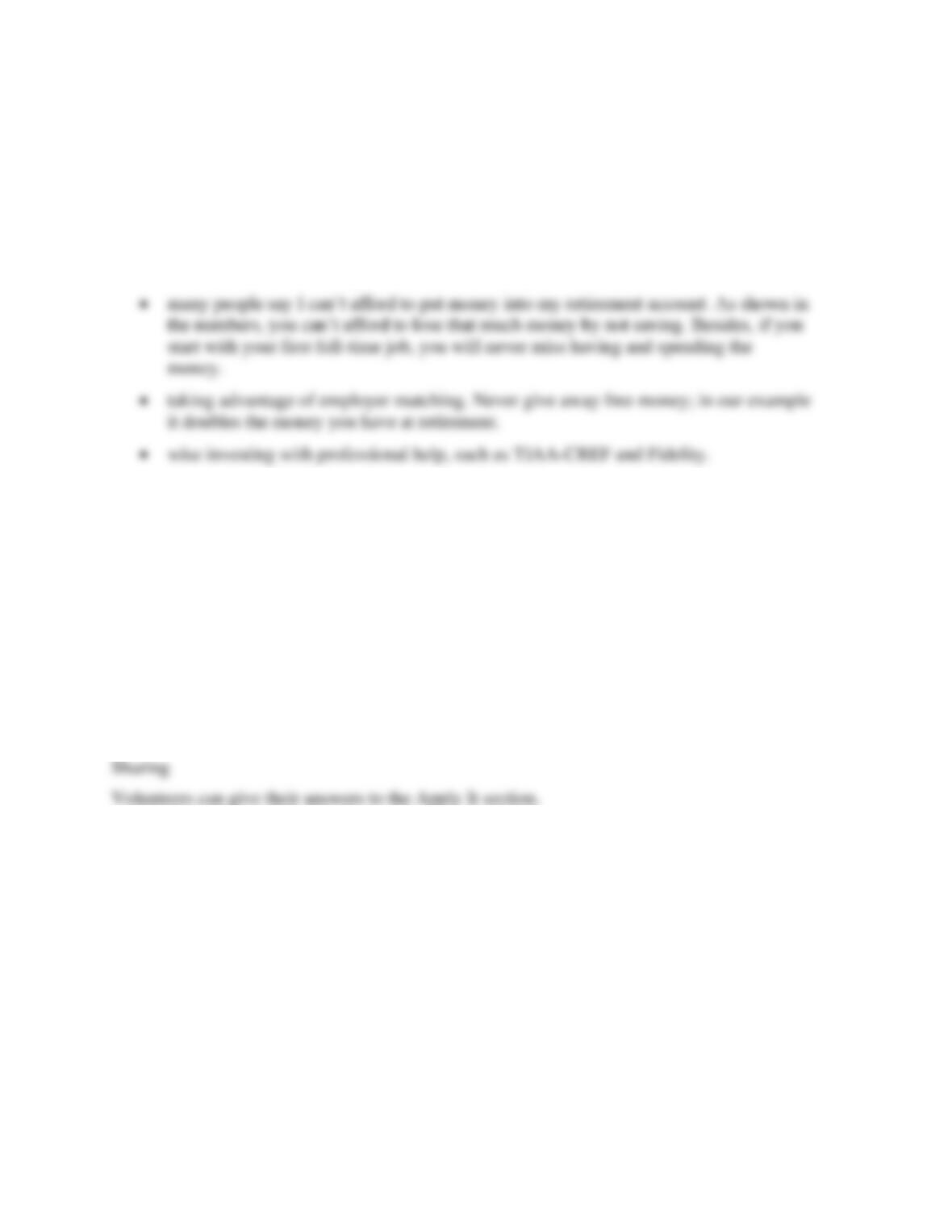
Your rate of return is 10% compound cumulative so that every 7 years your money will
double. You save $2,000 at age 22.
Question: Based on these assumptions, what will be the value of the retirement account at
age 64?
Answer:
Age $ value With Employer Match
22 2,000 4,000
29 4,000 8,000
Lussier, Human Resources Management 3e
SAGE Publishing, 2019
only $2,000. You can see that if you put away $2,000 every year from age 22 to retirement
being a millionaire at retirement is VERY possible.
I remind student of:
• the importance of starting their retirement saving as soon as possible
Remember the “save 10% of your income no matter how low it is” rule. If you get a job
paying $30,000, 10% would be $3,000. So even if you dropped down to $2,000 (6.67%)
every year you can still be a millionaire. Also, remember that the $2,000 saved is not a full
$2,000 out of your paycheck because of the tax saving. You can ask the HR person to do the
calculations for any given amount of pay deduction for retirement effect on your take-home
pay.
Apply It
You can have students answer these questions; it is better if they write them down. What did
I learn from this exercise? How will I use this knowledge in the future?