12 – 13 Compensation – Thirteenth Edition Gerhart │Newman │Milkovich
• The benefits perceived to best satisfy individual needs are the most highly
desired.
• These needs arise out of feelings of perceived equity or inequity.
Equity
• The perceived unfairness of difference need not be rational, but it is,
nevertheless, a factor that must be considered in determining employee needs.
• Occasionally this comparison process leads to a “bandwagon” effect, in
which new benefits offered by a competitor are adopted without careful
consideration, simply because the employer wants to avoid hard feelings.
o This phenomenon is particularly apparent for employers with strong
Personal Needs of Employees
• One way to gauge employee preferences is to look at demographic
differences.
o The demographic approach assumes that demographic groups (e.g.,
• There is some evidence that these assumptions are only partially correct.
o In an extensive review of employee preference literature, Glueck traced
patterns of group preferences for particular benefits.
▪ Older workers show stronger preferences than younger workers for
pension plans.
▪ Traditionally, it has been assumed that benefit preferences ought to
differ among males versus females, blue collar versus white collar,
and married versus single.
▪ Few of these expectations have been borne out by the studies.
Copyright © McGraw-Hill Education. All rights reserved. No reproduction or distribution without the prior written consent of McGraw-Hill
Education.
variation in individuals with respect to desired benefits.
• The weakness of the demographic approach has led some organizations to
undertake a second and more expensive empirical method of determining
employee preferences: surveying individuals about needs.
o One way of accomplishing this requires development of a questionnaire
• A third empirical method to identify employee preferences is commonly
known as a flexible benefit plan (also called a section 125 plan after the
section of the Tax Code or a cafeteria-style plan).
o Employees are allotted a fixed amount of money and permitted to spend
that amount in the purchase of benefit options.
V. Administering the Benefit Program
• The job description for an employee benefit manager at Warner Brothers, shown in
Exhibit 12.10, indicates that administrative time is spent on three functions requiring
further discussion:
o Communicating about the benefits program
A. Employee Benefit Communication
• Benefits communications revolves around four issues:
o what is communicated,
• Much of the effort to achieve benefit goals today focuses on identifying
methods (how) of communication.
12 – 15 Compensation – Thirteenth Edition Gerhart │Newman │Milkovich
of coverage and eligibility requirements.
• An effective communications package should match the message with the
appropriate medium.
o Technological advances have made tremendous improvements in
employee benefit communication and self-service.
▪ Exhibit 12.11 shows some benefits communication methods and the
percentage of HR professionals rating each method as very effective.
• Benefits communication, however conducted, remains very important
because failure to understand benefit components and their value is still one
of the root causes of employee dissatisfaction with a benefit package.
o An organization must spell out its benefit objectives and ensure that any
B. Claims Processing
• Claims processing arises when an employee asserts that a specific event
(e.g., disability, hospitalization, and unemployment) has occurred and
demands that the employer fulfill a promise of payment.
• As such, a claims processor must first determine whether the act has, in fact,
occurred.
o If the event did occur, the second step involves determining if the
employee is eligible for the benefit.
C. Cost Containment
• Increasingly, employers are auditing their benefit options for cost
containment opportunities. The most prevalent practices include:
o Probationary periods exclude new employees from benefit coverage
until some term of employment (e.g., three months) is completed.
o Benefit limitations—it is not uncommon to limit disability income
payments to some maximum percentage of income and to limit
• Exhibit 12.13 provides definitions of some common cost containment terms.
• Probably the biggest cost containment strategy is the movement to
outsourcing.
o As with payroll, companies may find that a company specializing in
VI. Your Turn: World Measurement
Summary of Case
World Measurement is the world leader in product testing for safety. Lewis Jacobs, the
President of the company, is convinced he must get concessions from the employees if World
Learning Objective
Understand the value of cost ramifications associated with different types of employee
benefits.
Teaching Guideline
Use this case to help students practice the concepts learned until now to design a
12 – 17 Compensation – Thirteenth Edition Gerhart │Newman │Milkovich
compensation benefit plan.
Discussion of Case Questions
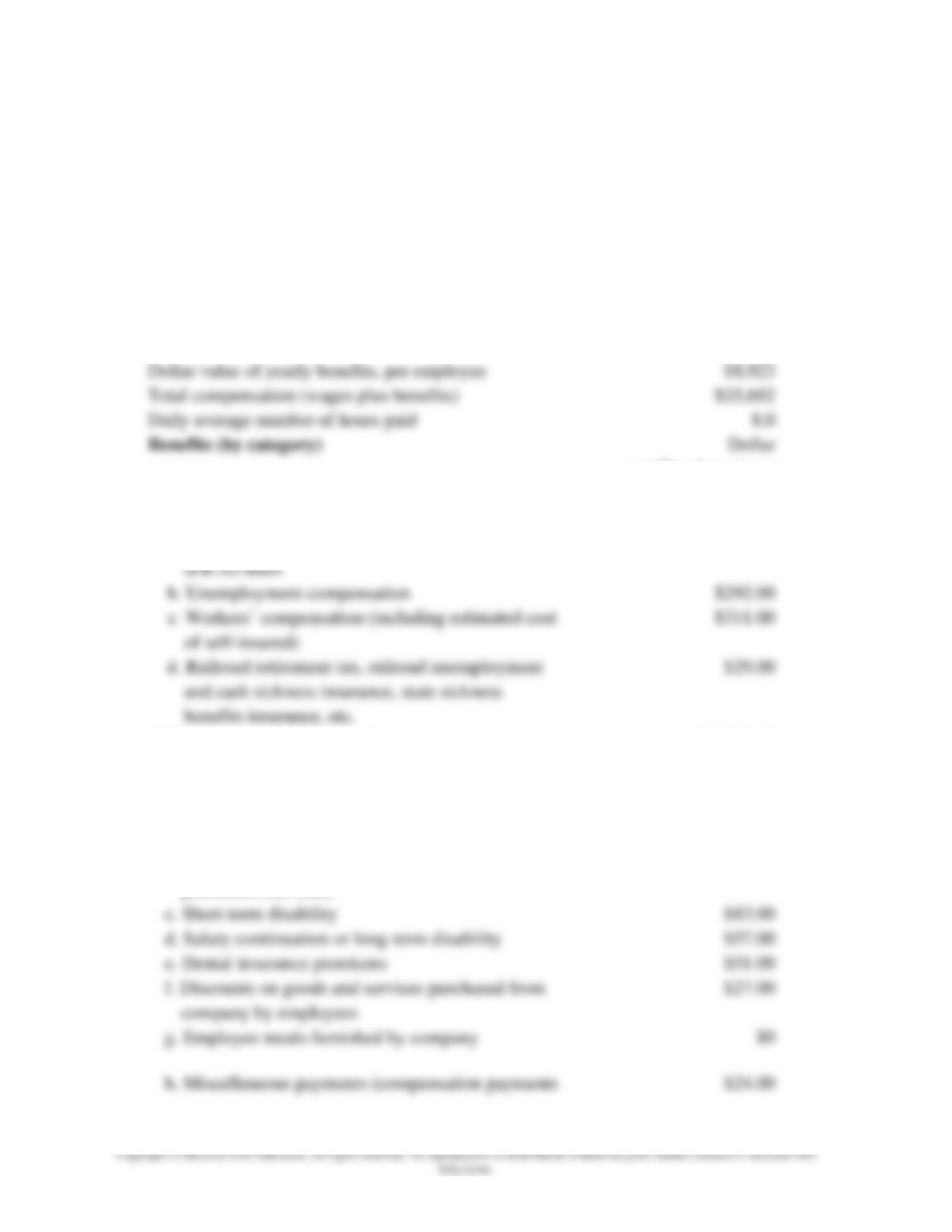
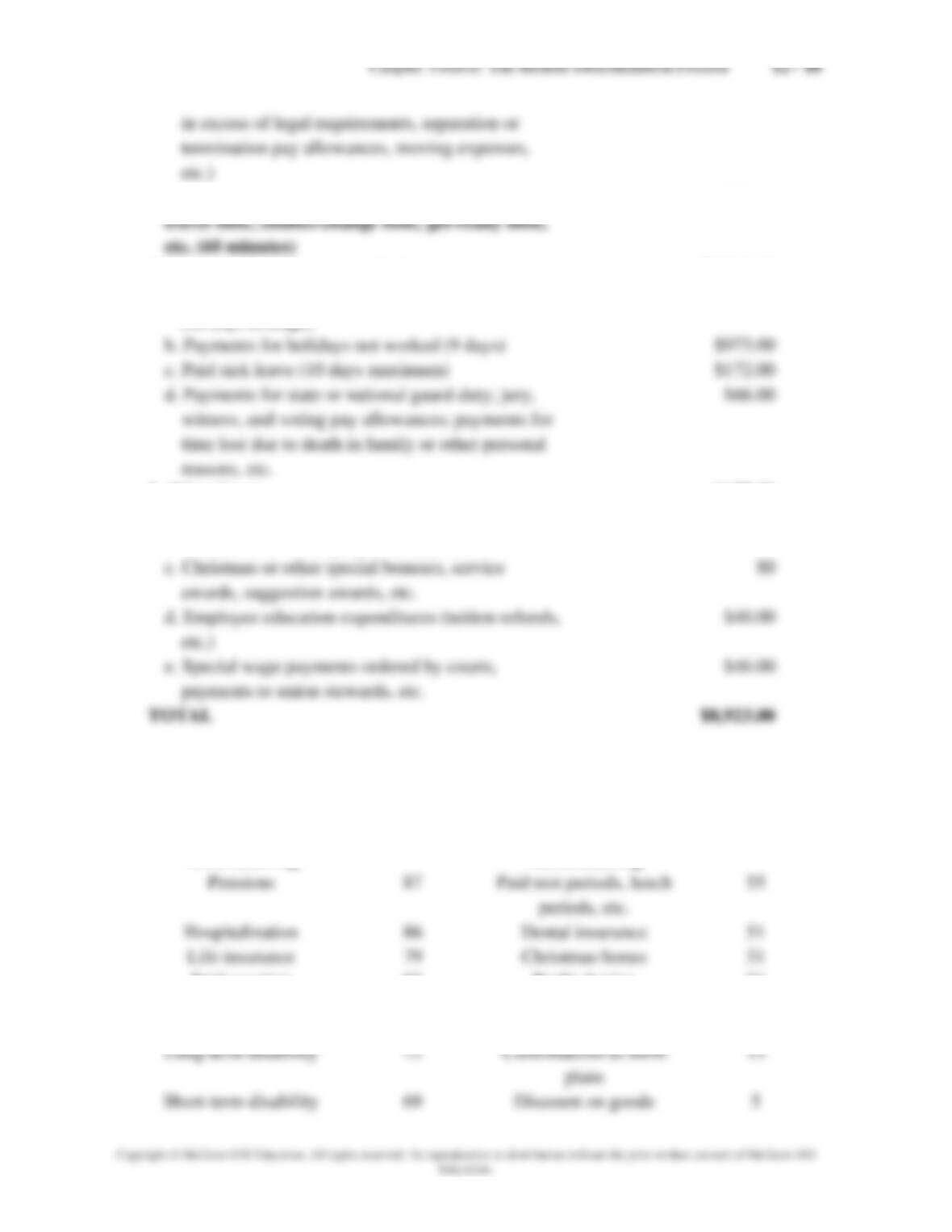
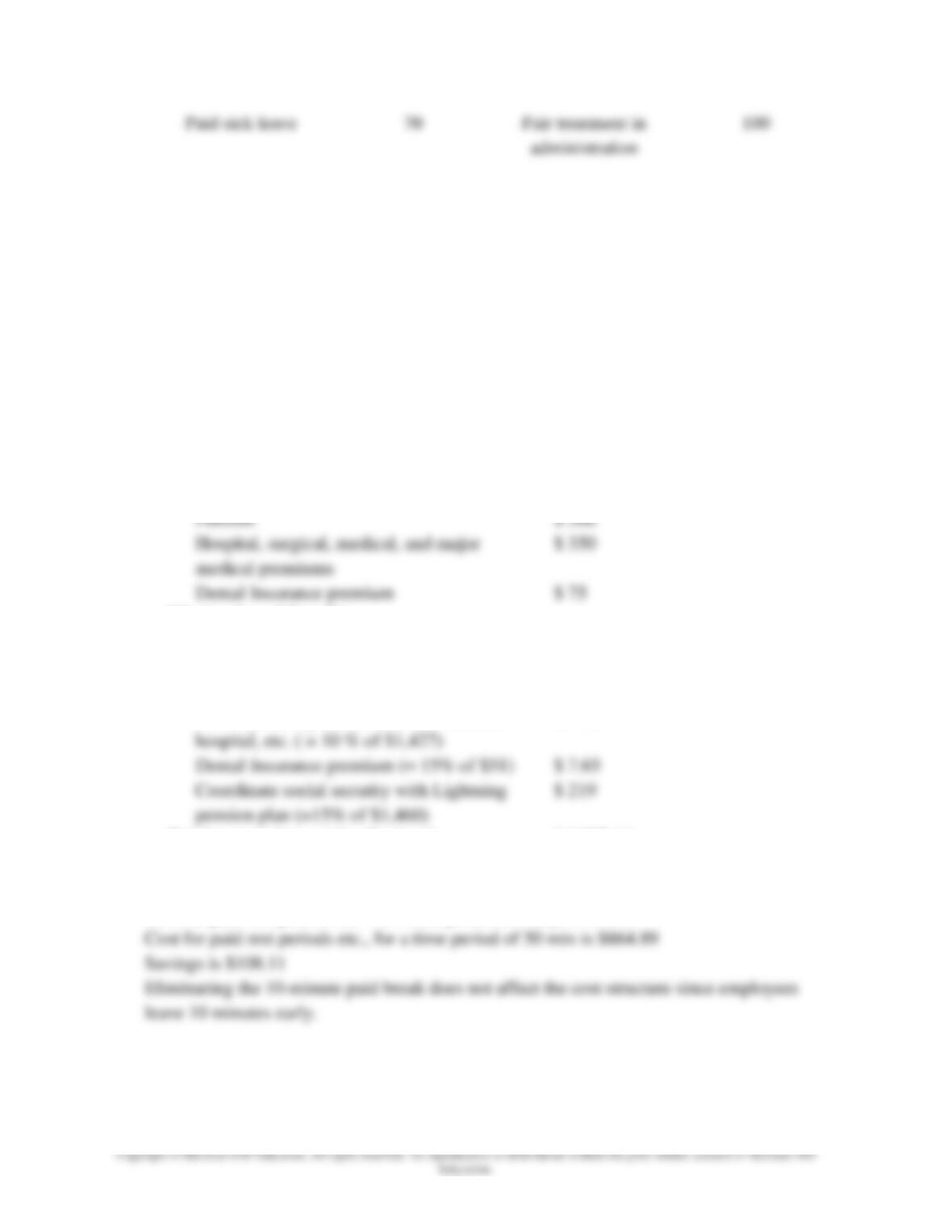
1. Cost out these packages given the data in Exhibits 1 and the information obtained
from various insurance carriers and other information sources (Exhibit 4).
Exhibit 1: Current compensation costs
Average yearly wage
$26,769
Average hourly wage
$13.12
Dollar value of yearly benefits, per employee
$8,923
Total compensation (wages plus benefits)
$35,692
Daily average number of hours paid
8.0
Benefits (by category)
Dollar
cost/Employee/year
1. Legally required payments (employer’s share
only)
$2,141.00
a. Old age, survivors, disability, and health insurance
(FICA) taxes
$1,509.00
b. Unemployment compensation
$292.00
c. Workers’ compensation (including estimated cost
of self-insured)
$311.00
d. Railroad retirement tax, railroad unemployment
and cash sickness insurance, state sickness
benefits insurance, etc.
$29.00
2. Pension, insurance, and other agreed-upon
payments (employer’s share only)
$3,124.00
a. Pension plan premiums and pension payments not
covered by insurance-type plan (net)
$1,460.00
b. Life insurance premiums; death benefits; hospital,
surgical, medical, and major medical insurance
premiums; etc. (net)
$1,427.00
c. Short-term disability
$83.00
d. Salary continuation or long-term disability
$57.00
e. Dental insurance premiums
$51.00
f. Discounts on goods and services purchased from
company by employees
$27.00
g. Employee meals furnished by company
$0
h. Miscellaneous payments (compensation payments
$24.00
12 – 19 Compensation – Thirteenth Edition Gerhart │Newman │Milkovich
Paid sick leave
70
Fair treatment in
administration
100
Refer to Exhibit 3: Two Possible Packages for Cutting Benefits Costs
Refer to Exhibit 4: Analysis of Cost Implications for Different Cost-Cutting
Strategies: World Measurement
Cost Savings Calculation:
Under Option 1:
The following table shows the cost implications of the new plan – Option 1 on the cost
structure.
Benefit
Cost Savings
Dollar – on –dollar savings equal to copay
amount
Pension
$ 300
Hospital, surgical, medical, and major
medical premiums
$ 350
Dental Insurance premium
$ 75
Elimination of Benefits
Savings from reduction of one paid holiday
(refer benefit category 4 b)
$ 108.11
Savings as Percent of Benefit- Type Cost
Life insurance premiums, death benefits,
hospital, etc. ( = 10 % of $1,427)
$ 142.7
Dental Insurance premium (= 15% of $51)
$ 7.65
Coordinate social security with Lightning
pension plan (=15% of $1,460)
$ 219
Total cost savings under Option 1
$ 1,202.46
Calculation for savings from reduction of one paid holiday:
Cost for paid rest periods etc. for a time period of 9 days is $973.
Total cost savings under Option 1 is $ 1,202.46Under Option 2:
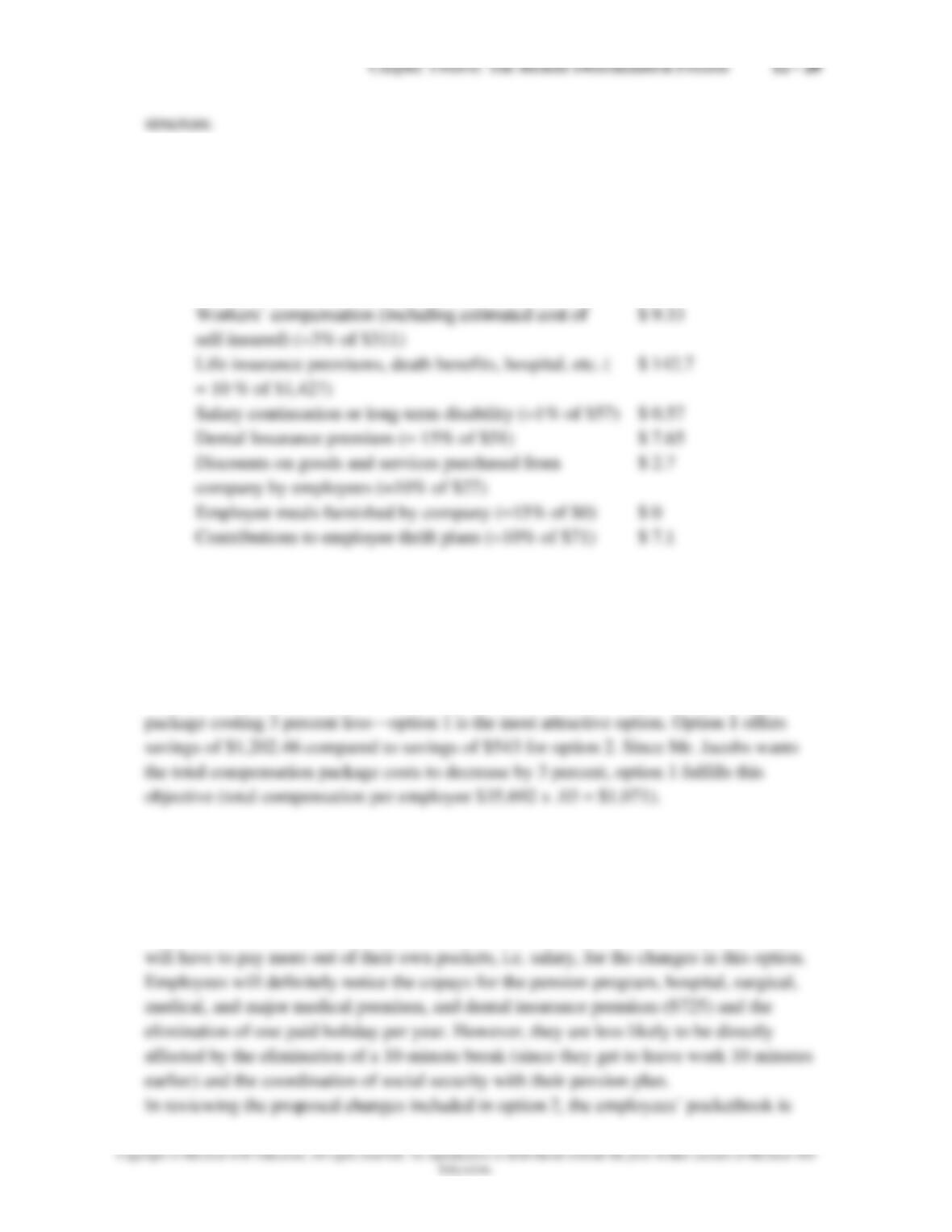
The following table shows the cost implications of the new plan – Option 2 on the cost
Copyright © McGraw-Hill Education. All rights reserved. No reproduction or distribution without the prior written consent of McGraw-Hill
Education.
Benefit
Cost Savings
Dollar – on –dollar savings equal to copay amount
Hospital, surgical, medical, and major medical
premiums
$ 350
Savings as Percent of Benefit- Type Cost
Unemployment compensation (=8% of $292)
$ 23.36
Workers’ compensation (including estimated cost of
self-insured) (=3% of $311)
$ 9.33
Life insurance premiums, death benefits, hospital, etc. (
= 10 % of $1,427)
$ 142.7
Salary continuation or long-term disability (=1% of $57)
$ 0.57
Dental Insurance premium (= 15% of $51)
$ 7.65
Discounts on goods and services purchased from
company by employees (=10% of $27)
$ 2.7
Employee meals furnished by company (=15% of $0)
$ 0
Contributions to employee thrift plans (=10% of $71)
$ 7.1
Total cost savings under Option 2
$ 543
2. Which package should you recommend to Jacobs? Why?
Based on Mr. Jacob’s objectives—maximum 3 percent wage increase and a compensation
3. Which of the strategies do you think will require less input from employees in terms
of their reactions?
Option 2 will definitely require less employee input than option 1. While option 1 offers
over twice the cost savings, compared to option 2, to World Measurement, the employees
12 – 21 Compensation – Thirteenth Edition Gerhart │Newman │Milkovich
Copyright © McGraw-Hill Education. All rights reserved. No reproduction or distribution without the prior written consent of McGraw-Hill
Education.
definitely less affected. Although improved claims processing for unemployment,
workers’ compensation, and long-term disability saves the company $33.26, this does not
impact an employee’s salary. While the current probationary period and the number of
employees with less than one year of service is unknown, it will be assumed the majority
of current employees will not be affected by these changes. Thus, the impact of these
changes on their salary is minimal. The major impact on an employee’s salary is the
deductible for life insurance and dental insurance and the copay for hospital, surgical,
medical, and major medical premiums. Overall, the costs associated with option 2,
compared to the costs associated with option 1, is less for the employees.
Answers to Review Questions
1. Early in this chapter, we identified reasons for the historical growth in the size of
benefits packages. Which of these reasons still affect the growth of employee benefits
today? Which actually might be current reasons for declines in the size of benefit
packages?
Among the reasons identified as being responsible for the growth in the size of benefit
packages, unions, cost effectiveness of benefits, and government impetus still affect the
2. Erinn Kelly, VP of Human Resources at Lawson Chemical, just purchased a local
salary survey that has employee benefits data. She was shocked to see that Lawson
has a larger benefits bill (38 percent of payroll) than the average in the community
(31 percent). In a memo to you, she demands an explanation for why our package is
significantly bigger. What sound reasons might save you from getting fired?
Employees expect benefits and a competitive benefit package can help an organization
attract and retain good employees. Also, some benefits are legally required and must be
Copyright © McGraw-Hill Education. All rights reserved. No reproduction or distribution without the prior written consent of McGraw-Hill
Education.
3. You are the benefits manager in a firm metaphorically described as part of the rust
belt, in Syracuse, NY. The average age of your 600-person workforce is 43. Eighty-
eight percent of your workforce is male, and there is hardly any turnover. Not much
is happening on the job front. How do these facts influence your decisions about
designing an employee benefit program?
The external market definitely influences decisions about designing an employee benefit
program. Syracuse is a declining market where labor supply exceeds demand, i.e. low
turnover. In the short run, it is possible to save on both benefit and wage costs. A decision
4. As HR director at Crangle Fixtures, your bonus this year is based on your ability to
cut employee benefit costs. Your boss has said that it’s okay to shift some of the costs
over to employees (right now they pay nothing for their benefits) but that he doesn’t
want you to overdo it. In other words, at least one-half of your suggestions should
not hurt the employee’s pocket book. What alternatives do you want to explore, and
why?
The first step is to determine if Crangles’ benefit costs are competitive in the industry. A
survey of the competitors should be conducted; the objective is to obtain information
Copyright © McGraw-Hill Education. All rights reserved. No reproduction or distribution without the prior written consent of McGraw-Hill
Education.
5. Google is famous for paying wages significantly above the market and also providing
employee benefits that one might call lavish. Currently the European Union is suing
Google for its monopolistic behavior, claiming that the company’s internet search
function systematically favors its own comparison shopping products in its search
results pages. (Their products turn up earlier in the search effort.) Assume the
European Union wins this antitrust case resulting in significant financial loss to
Google. Speculate on what Google might change about its benefits package as a
consequence of this ruling.
The best guess is that Google wouldn’t change anything about either its wage or benefits
policy and practices. Their basic organization strategy, the thing that drives compensation