Lecture Notes
Lussier, Human Resource Management, Third Edition
SAGE Publishing, 2018
Lecture Notes
Chapter 12: Incentive Pay
Learning Objectives
After studying this chapter, you should be able to do the following:
12–2 Identify the advantages and disadvantages of both individual and group incentives.
12–4 Briefly discuss options for group-based incentives.
12–5 Discuss the major reasons why incentive plans fail and the challenges involved.
Annotated Chapter Outline
I. Variable Pay Plans
a. Depends on measure of individual performance or results to be awarded.
b. Types of variable pay plans
i. Bonuses
ii. Profit sharing
Lecture Notes
Lussier, Human Resource Management, Third Edition
SAGE Publishing, 2018
c. Variable pay plans tend to raise the bar and reward effort.
Compensation that depends on some measure of individual performance or results in order to be
awarded.
II. Why Give Incentives?
a. To reward employees for past performance in hope they will repeat desired behaviors
and want similar rewards in future.
III. Individual or Group-based Incentives?
a. Individual incentives
i. Reinforce performance with rewards that are significant to a person.
b. Group incentives
i. Provide reinforcement for actions of more than one individual within organization.
There are two basic choices in incentive pay—individual or group-based incentives. Groups can
be small (a work cell of three people who assemble a computer) or large (an entire
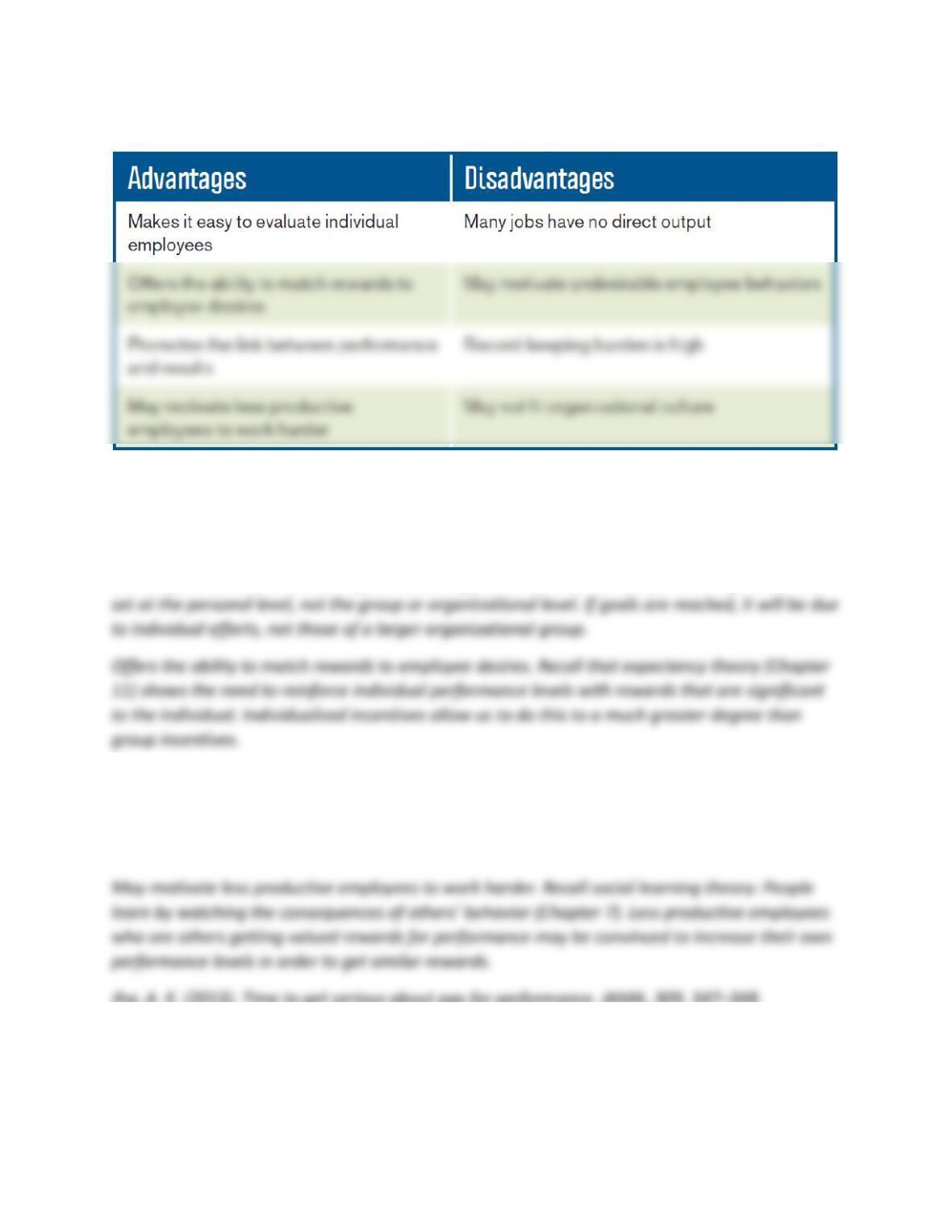
IV. Individual Incentive Plan: Advantages and Disadvantages
Lecture Notes
Lussier, Human Resource Management, Third Edition
SAGE Publishing, 2018
V. Individual Incentives Work Best When
a. There are distinct, measurable outcomes for individual efforts.
b. Individual jobs require autonomy.
Makes it easy to evaluate individual employees. Individual incentive programs, if designed
correctly, make it easier to identify individual efforts. This is because performance goals will be
Promotes the link between performance and results. Individual incentives provide a direct link
between performance levels and the rewards received—pay for performance. A side benefit to
this link is that we get equitable (fair) distribution of incentives; higher incentive payments go to
those who perform at a higher level.
Jha, A. K. (2013). Time to get serious about pay for performance. JAMA, 309, 347–348.
VI. Group Incentives Work Best When . . .
a. Employees need to cooperate.
b. Individual contributions are difficult to identify.
Lecture Notes
Lussier, Human Resource Management, Third Edition
SAGE Publishing, 2018
c. Members possess similar or complementary skills.
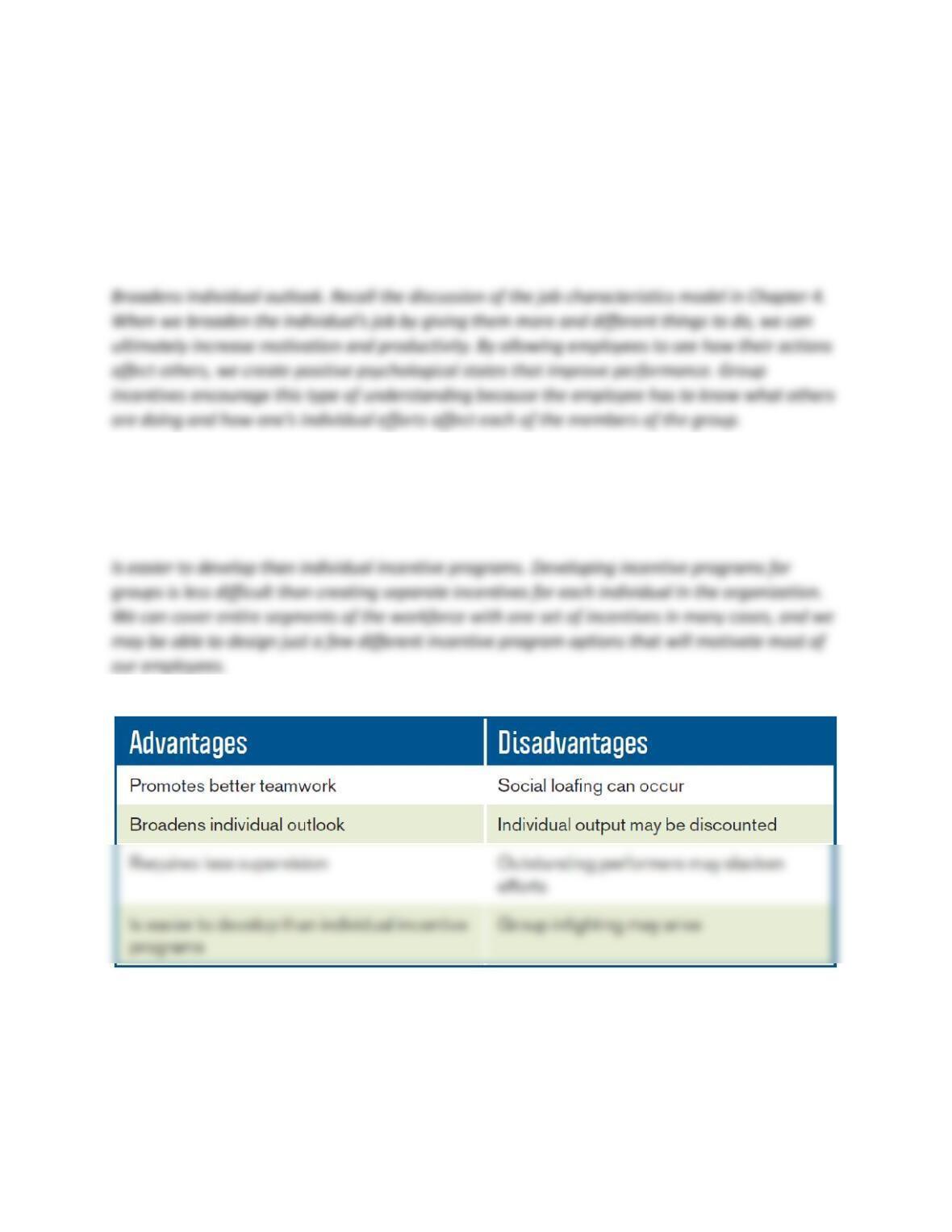
Promotes better teamwork. Group incentives, to no one’s surprise, tend to encourage higher
levels of teamwork and group cohesiveness. They can foster loyalty and trust between group
members. Rewarding members for successfully working within the group creates an enticement
to perform in ways that improve group outcomes, not just individual outcomes.
Requires less supervision. Group incentives, at least in some cases, tend to require less
supervision. This is due to the tendency for the group to police its own members when they are
not performing as well as they can. The “social loafers” in the group will feel pressure to improve
their efforts from others in the group who are performing up to standards.
VII. Group Incentive Plan: Advantages and Disadvantages
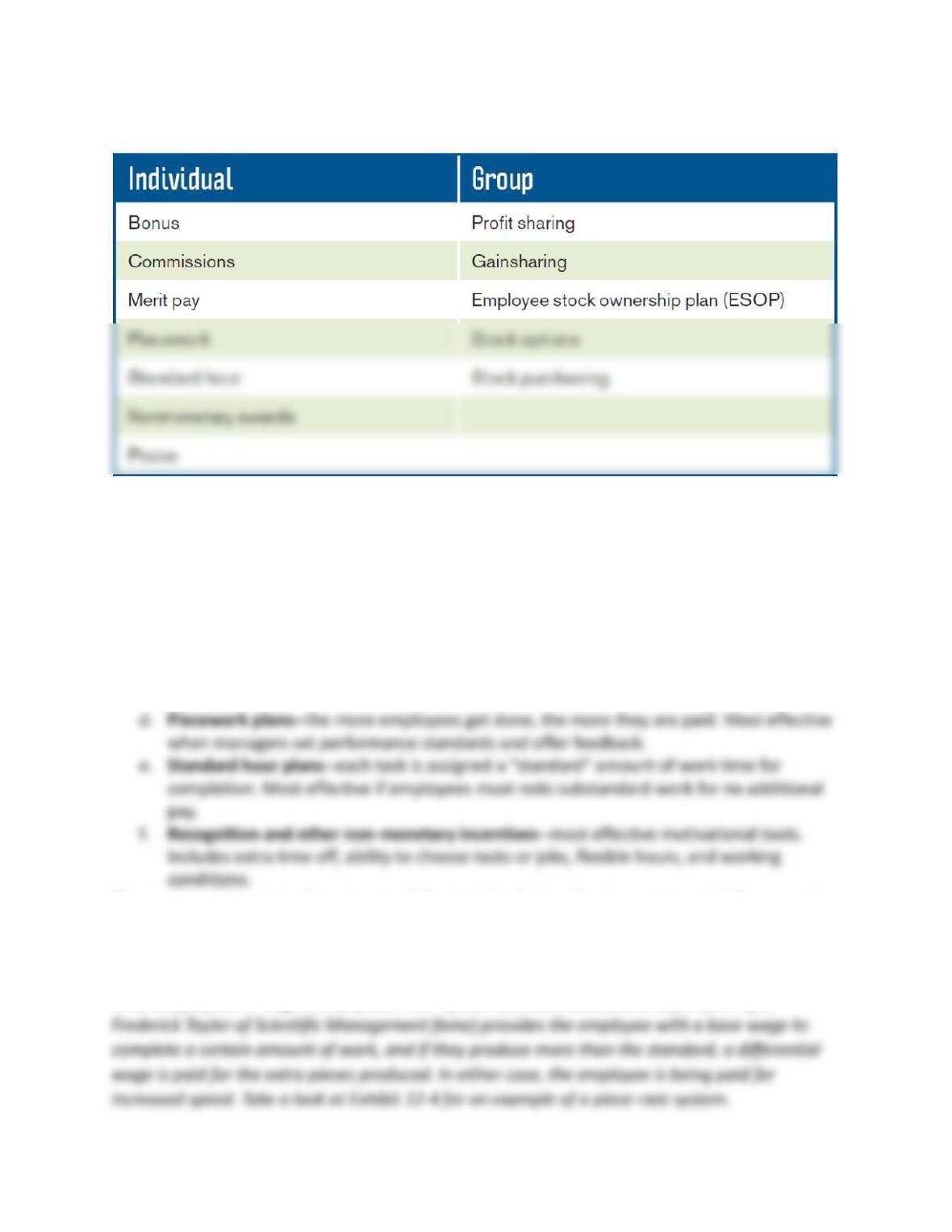
VIII. Individual and Group Incentive Options
Lecture Notes
Lussier, Human Resource Management, Third Edition
SAGE Publishing, 2018
VIX. Incentive Options for Individuals
a. Bonus—a lump sum payment given to employees at end of a period. Most effective after
employees reach a specific goal.
b. Commission—payment for selling an item, usually calculated as a percentage of item’s
price. Most effective when it provides a return but also a disincentive to make a “quick
sale.”
c. Merit pay—rewards top performers with increases in annual wage that carry over years.
Most effective when employees understand benefits of incentive and when top
performers are rewarded.
Piecework or piece-rate plans are one of the simplest forms of compensation, and they can act
as an incentive to produce at a higher level because the more workers produce, the more they
get paid. In a “straight piece–rate” compensation system, the employee gets paid for every
“piece” that they complete. If they are faster than the average, they can make more money than
other employees. A “differential piece-rate” system (sometimes called a Taylor plan after
Lecture Notes
Lussier, Human Resource Management, Third Edition
SAGE Publishing, 2018
L.A. Myers Jr., “One Hundred Years Later: What Would Frederick W. Taylor Say?” International
Journal of Business and Social Science (2011), 2(20), pp. 8–11.
Standard hour plans are used quite a bit in some types of service work. In a standard hour plan,
each task is assigned a “standard” amount of work time for completion. Generally, this time will
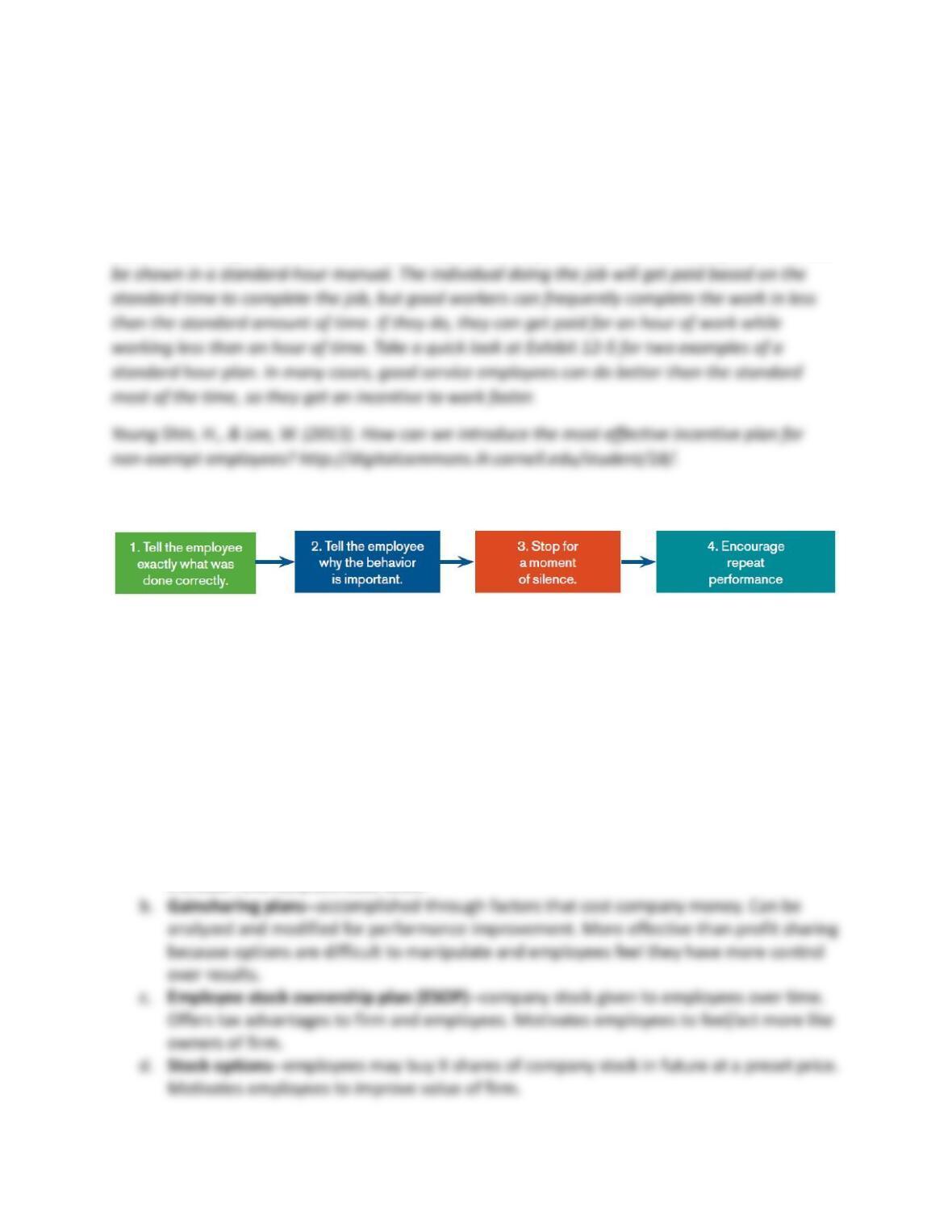
X. The Giving Praise Model
Praise as recognition. Empirical research studies have found that feedback and social
reinforcers (praise) may have as strong an impact on performance as pay. Tom Gimbel, CEO of
LaSalle Network and one of the INC. “Best Workplaces 2016”, believes this wholeheartedly. He
constantly talks with his employees, and says “I may say the wrong thing sometimes, but I’m
never going to have somebody leave here for something I did not say. People want to be
appreciated.
Want to make your team feel great? Shower them with appreciation. INC, (June 2016), p. 57.
XI. Incentive Options for Groups
a. Profit sharing plans—portion of company proceeds paid over time (usually quarterly or
annually) through bonus payment. Most effective when management doesn’t minimize
profits and posts records of revenues and profits. Also when employees are trained to
increase revenues/decrease costs.
Lecture Notes
Lussier, Human Resource Management, Third Edition
SAGE Publishing, 2018
e. Stock purchasing plans—ability to purchase company stock anytime, usually at discount.
XII. Evenly Distributed or Fairly Distributed Group Incentives?
a. Even
i. Each member receives same reward. Best to use when group cohesion is needed.
b. Fairly
XIII. Failure, Challenges, and Guidelines in Creating Incentive Pay Systems
a. Many incentive systems are poorly designed and implemented due to:
i. Poor system management and complicated programs
XIV. Challenges to Incentive Pay Systems
a. Group versus individual incentives—work better than individual ones when people have
to cooperate to complete tasks.
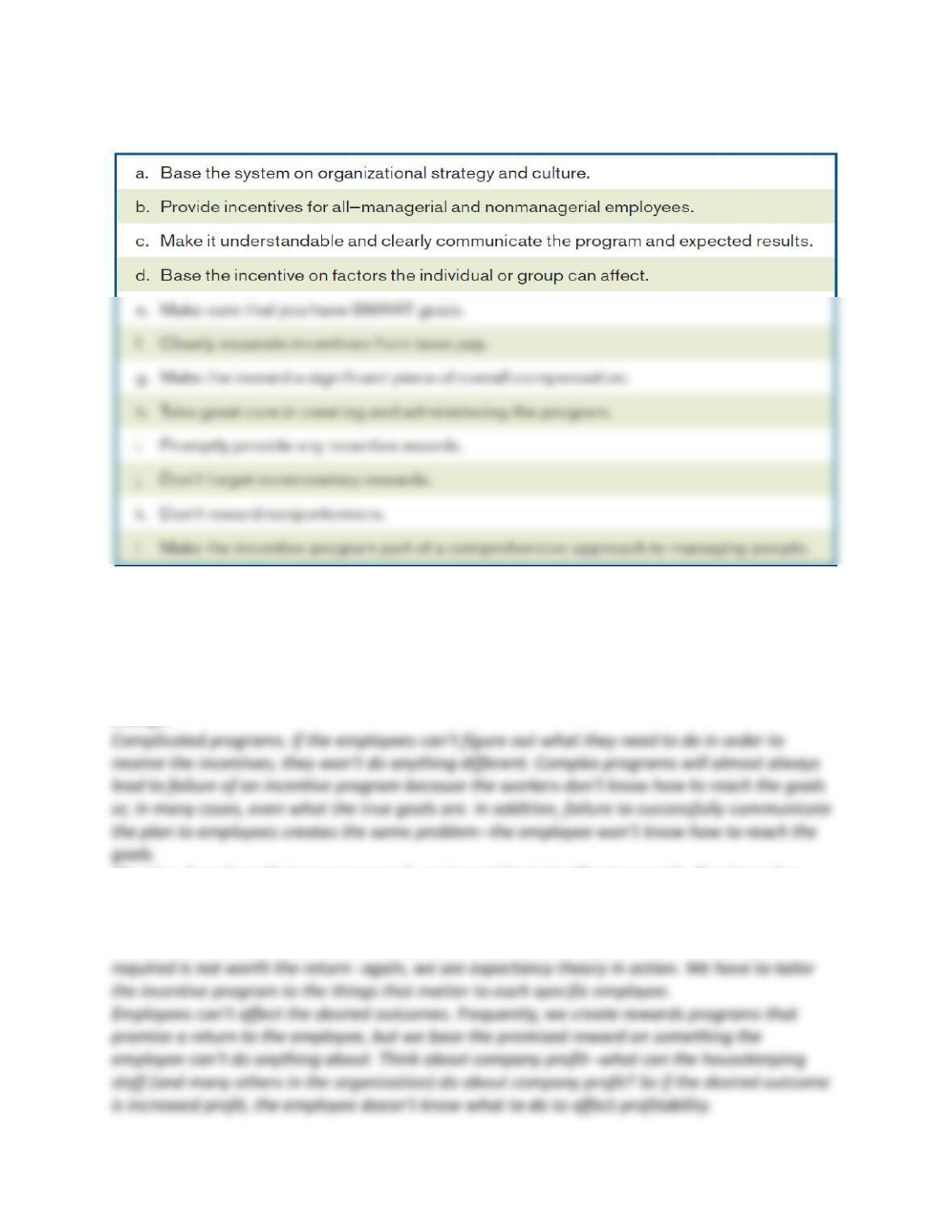
XV. Guidelines for Creating Motivational Incentive Systems
Lecture Notes
Lussier, Human Resource Management, Third Edition
SAGE Publishing, 2018
Why do incentive pay systems fail?
Too often, incentive systems are poorly designed and badly implemented.
Poor management. Even the best incentive plan won’t work with bad management. Managers
are the core of any incentive program, because they have to keep track of individual and group
performance in order to reward those who perform the best. Management also has to monitor
the program and adjust things as necessary when the environment or the organizational tasks
change.
The plan doesn’t really increase rewards, or it provides insignificant rewards. If a plan takes
away from base pay in order to add incentive pay, the employee isn’t really gaining anything.
The net result is the same, and employees will see right through such a “rewards” program.
Even if there is a minimal increase in pay, often employees will figure that the extra effort
Lecture Notes
Lussier, Human Resource Management, Third Edition
SAGE Publishing, 2018
Employees don’t know how they are doing. In order for an incentive plan to motivate, the
employee has to know how they are doing compared to the desired outcomes. If you know that
you have to reach a certain production goal by the end of next week in order to get a desired
reward and you are currently behind schedule, you will likely work harder to reach the goal.
XVI. Executive Compensation: Too Much or Just Enough?
a. Excesses in executive pay
i. For example, when CEO’s pay increases while employees take pay cuts and are
laid off. Results in questions about ethics and social responsibility.
b. Harms stakeholders (including employees and shareholders) to reward relatively few
executives.
c. Affects market value of firms and result in Dodd-Frank Wall Street Reform and Consumer
Protection Act.
XVII. Dodd-Frank Wall Street Reform and Consumer Protection Act of 2010
a. Limits executive pay in public corporations and adds requirements for reporting
compensation and shareholder involvement with executive compensation.
b. Intent is to create a sound economic foundation to grow jobs, protect consumers, rein in
Lecture Notes
Lussier, Human Resource Management, Third Edition
SAGE Publishing, 2018
compensation of all employees and provide a ratio of these two figures. A 2015 survey on CEO
pay by Glassdoor found that in Fortune 500 firms, the CEO–to–median employee pay ratio was
204 to 1, staying fairly stable since 2013. It would be very easy to argue that this pay ratio is
significantly out of line with performance, though even the smallest of these firms have a
XVIII. Dodd-Frank Wall Street Reform and Consumer Protection Act of 2010
a. Significant provisions:
i. Shareholders can vote on executives’ compensation packages (“say on pay”) and
“golden parachutes.”
ii. Public companies must disclose CEO’s total compensation and total median
XIX. Executive Incentives
a. Should be designed to motivate executives to make decisions that benefit the
organization in the short term and the long term.
i. Perquisites
XX. Goal of Executive Compensation
a. Creating a system that aligns the behavior of the executive (agent) with the interests of
the owners of the firm.