Chapter 10 – Managing the Employee-Benefits System
10-1
Chapter 10 Managing the Employee-Benefits System
I. Learning Objectives (use PP 10.2)
1. Methods for managing benefits costs
3. Essentials for communicating the benefits program
4. Outsourcing employee benefits
II. A Comparison between Traditional Benefits Plans and Flexible Benefits Plans
A. Overview (use PP 10.3)
2. Offering the same benefits to all employees creates administrative ease and
represents a one-size-fits-all approach
4. Exhibits 10.1 and 10.2 depict the structures of traditional and flexible benefit
plans
B. One-Size Fits All Approach (use PP 10.4)
1. Predetermined set and level of benefits
3. Differences in employee needs and preferences strongly influence the
adequacy of this company-sponsored benefit
5. By allowing employees to select the benefits most pertinent to their personal
needs, the employer is likely to maximize the value of its benefits expenditures
by not spending money on unwanted benefits
C. Employer Choice to Customize Benefits
1. Initiated in response to increased demographic diversity of workforce
3. Since 1978, Internal Revenue Code Section 125 created tax benefits to
companies that permitted employee choice
5. Under these plans, employers grant employees the opportunity to accept or
reject benefits
6. Limited evidence suggests positive reactions to flexible plans, including
benefits satisfaction, overall job satisfaction, pay satisfaction, and
understanding of benefits, which increases after the implementation of a
flexible benefits plan
D. Cafeteria Plans Under Section 125 of IRC (use PP 10.5)
2. Qualified benefits refer to any employer-sponsored benefits for which an
employee may exclude the cost from federal income tax calculation
Chapter 10 – Managing the Employee-Benefits System
10-2
5. Besides including only permissible benefits, employers have to
follow several guidelines to maintain a Section 125 cafeteria plan.
6. Specifically, the plan must: (use PP 10.6)
a. Be in writing
b. Allow employees the opportunity to choose between two or more
benefits, consisting of at least one nontaxable benefit and at least one
7. Non-discrimination rules (use PP 10.7)
a. Prohibit employers from giving preferential treatment to highly
compensated participants and key employees
b. In Section 125 plans, satisfying nondiscrimination rules permits plan
participants to take tax deductions for qualified benefits
E. Types of Flexible Benefit Plan Arrangement
1. The four most common types of flexible plans include: (use PP 10.8)
a. Salary reduction plans
10-3
© 2014 by McGraw-Hill Education. This is proprietary material solely for authorized instructor use. Not authorized for sale or
distribution in any manner. This document may not be copied, scanned, duplicated, forwarded, distributed, or posted on a website, in
whole or part.
b. Cost to the employer
3. An employer’s cost generally rises as the level of flexibility increases
F. Pretax Salary Reduction Plans (use PP 10.9)
2. Employees exclude allocated wages or salaries from the calculation of annual
federal income tax or state income tax
3. There are two well-known versions of salary reduction agreements:
4. Flexible spending accounts permit employees to pay for certain benefits
6. Prior to each plan year, employees elect the amount of salary-reduction
dollars they wish to allocate to this kind of plan.
7. Premium-only plans enable employees to pay their share of the cost to
G. Modular Plans (use PP 10.10)
2. Examples of groups include single employees with no dependents, single
parents, married workers with dependents, and employees nearing retirement.
4. Employees contribute the cost difference between a more extensive benefits
package and the lowest-cost package.
H. Core-Plus-Option Plans (use PP 10.11)
1. Extend a preestablished set of benefits such as medical insurance and
retirement plans as a program core
3. Companies establish upper limits of benefits values available to each
employee.
I. Mix-and-Match Plans (use PP 10.12)
2. Mix-and-match plans permit employees to purchase any benefit (and benefit
level)
Chapter 10 – Managing the Employee-Benefits System
5. Employees use credits to purchase the benefits they require
III. Communicating the Employee Benefits Program (use PP 10.13)
A. Overview
1. Elements of sound benefits communication include:
a. What is communicated?
b. Who are the recipients of benefits information?
B. Legal Considerations in Benefits Communication
1. Legally, employers must satisfy disclosure requirements set forth in the
Employee Retirement Income Security Act of 1974
2. Employers satisfy these requirements by providing employees with written:
3. ERISA specifies that written notices be written so that the “average”
4. Summary plan descriptions describe the following information: (use PP
10.14)
a. Names and addresses of the employees responsible for developing
and administering the benefits plan.
b. A description and explanation of the benefits such as health insurance
5. Employers are obligated to distribute summary plan descriptions to
7. Employers must supply participants with completely updated summary plan
8. A summary of material modification describes important (i.e., material)
changes to the benefits plan.
10-5
9. Material information applies to changes in the benefits program, including
10. ERISA obligates employers to distribute summaries of material
modifications within 210 days after the end of the plan year in which the
material change occurred. Summaries of material modifications go to
employees and the Department of Labor.
C. The “Good Business Sense” of Benefits Communication
1. An effective communication program should have three primary objectives:
a. To create an awareness of and appreciation for the way current
2. A variety of media can be used to communicate such information to
employees:
a. Printed brochures
b. Initial group meeting
IV. Managing the Costs of Employee Benefits
1. Some alternative methods to assist companies manage benefits costs: (use PP
10.15)
a. Employee contributions
3. Employees typically share the cost of benefits with pretax contributions or
after-tax contributions
4. Pre-tax contributions: various tax regulations permit employees to exclude
6. Waiting periods specify the minimum number of months or years an
Chapter 10 – Managing the Employee-Benefits System
10-6
7. Role of high-deductible health care plans in cost control that shift more of the
8. Five additional cost-control methods: employee education, utilization reviews,
case management, provider payment systems, and lifestyle interventions
V. Cost-Control Methods (use PP 10.17)
A. Employee Education (use PP 10.18)
1. Educating employees about the cost of health care is essential to controlling
the rising costs of health care insurance, because past employer and insurance
company practices of not educating employees about costs may have
inadvertently led them to overuse health insurance benefits for at least two
reasons:
a. Offering health insurance coverage provided companies with
lucrative tax breaks, and including health insurance in the benefits
2. Since the U.S. economy began weakening substantially in 2000 compared to
3. Educating employees about health care costs and the reasons for rising costs
should promote cost containment
B. Utilization Reviews (use PP 10.19)
2. Employers offering group health benefits and also insurers depend on
3. Three types of utilization reviews may be conducted:
a. Prospective reviews or precertification reviews (use PP 10.20)
i. Verifying a patient’s coverage.
Chapter 10 – Managing the Employee-Benefits System
10-7
c. Retrospective reviews
i. Determination of whether the health insurance program covers
C. Case Management
1. Many health insurance plans use the services of independent case
2. Usually, registered nurses or social workers, who are employed as case
3. Serious health problems arising from injuries or illnesses may be acute
(short-term) or chronic (ongoing).
D. Provider Payment Systems (use PP 10.21)
1. Payment arrangements between managed care insurers and health care
providers.
3. Provider payment systems begin with negotiations over amounts that system
4. Agreements may include one or more cost saving features, including
5. Percentage discounts are fees that are discounted from the amounts that
health care providers would usually charge
6. Percentage discounts are not the most cost-effective methods for two reasons:
a. Managed care plans do not enforce a limit on the number of services,
8. Partial capitation systems pay primary care physicians a fixed dollar amount
for each patient assigned to them
9. Full capitation systems also pay primary care physicians a fixed amount for
Chapter 10 – Managing the Employee-Benefits System
10-8
E. Lifestyle Interventions (use PP 10.22)
1. Some companies believe they should decide whether employees require
3. In 2007, Scotts Miracle-Gro Company made controversial news headlines by
setting a policy to terminate employees who did not quit smoking on or off
the job
a. A newly hired employee, Scott Rodrigues, was fired when a drug test
identified nicotine in his urine
b. Rodrigues maintains that the Scotts Company’s antismoking policy
violates the ERISA because it discriminates against participants in the
VI. Outsourcing the Benefits Function (use PP 10.23)
1. Outsourcing refers to a contractual agreement by which an employer
transfers responsibility to a third-party provider
3. Outsourcing HR functions is on the rise
5. Among benefits practices, companies tend to outsource 401(k) programs,
pension program administration, and health insurance benefits
6. Two factors drive the decision to outsource:
8. Over time, efficient arrangements can be less costly than devoting several
Chapter 10 – Managing the Employee-Benefits System
10-9
Summary
This chapter described the importance of linking benefits program design to overall
strategic considerations and included company examples to illustrate this business
imperative. Building effective benefits programs requires a review and interpretation of
Discussion Questions
1. Respond to the following statement: “Flexible benefits plans are more trouble than
they are worth.” Do you agree or disagree with this statement? Provide a rationale for
your answer.
Main Points
Chapter 10 – Managing the Employee-Benefits System
10–10
2. Discuss how IRC Section 125 plans create advantages for employees and employers.
Main Points
• Since 1978, Internal Revenue Code Section 125 has offered tax benefits to
3. What is the “good business sense” of benefits communications?
4. List and describe three specific ways insurance providers control costs. Which is most
effective, and why?
Chapter 10 – Managing the Employee-Benefits System
10–11
o Three types:
• Prospective reviews or precertification reviews
5. Identify one or more additional issues that may influence employee-benefits practices
in the future.
Main Points
Cases
Understanding Your Benefits
Managing Your Health Care Expenses
1. Should you participate in the flexible spending account?
2. How should you determine how much to aside?
Chapter 10 – Managing the Employee-Benefits System
10–12
Instructor Notes
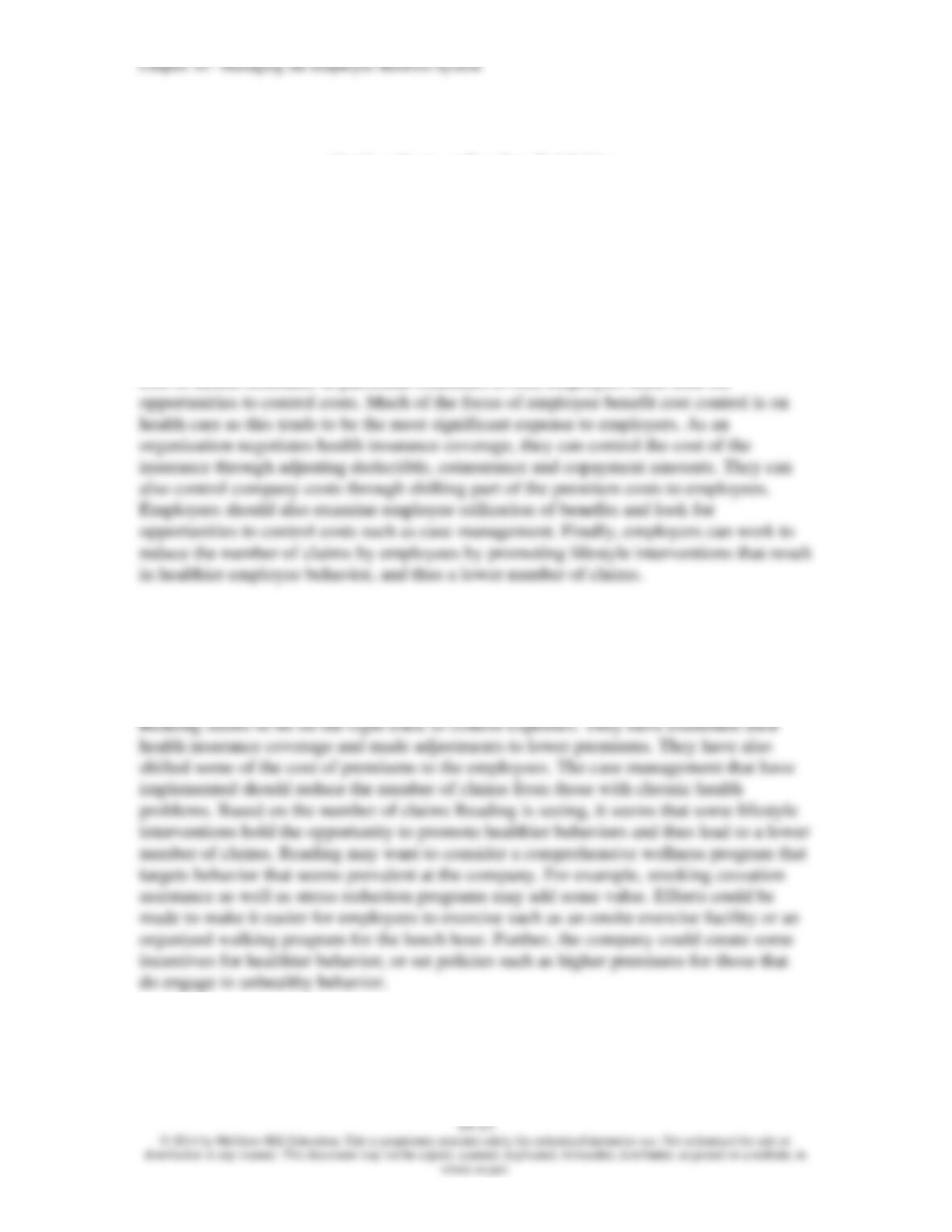
Flexible spending accounts provide employees the opportunity to set aside money on a
pre-tax basis to pay for their out-of-pocket health care expenses. By setting aside the
money on a pre-tax basis, employees gain cost savings through reduced overall tax
Student Responses
1. Should you participate in the flexible spending account?
2. How should you determine how much to aside?
10–13
© 2014 by McGraw-Hill Education. This is proprietary material solely for authorized instructor use. Not authorized for sale or
distribution in any manner. This document may not be copied, scanned, duplicated, forwarded, distributed, or posted on a website, in
whole or part.
1. What are some examples of steps that Reading could take to lower the cost of the
company’s health insurance?
2. What are some other areas that Reading should explore to reduce the overall costs
of benefits?
Instructor Notes
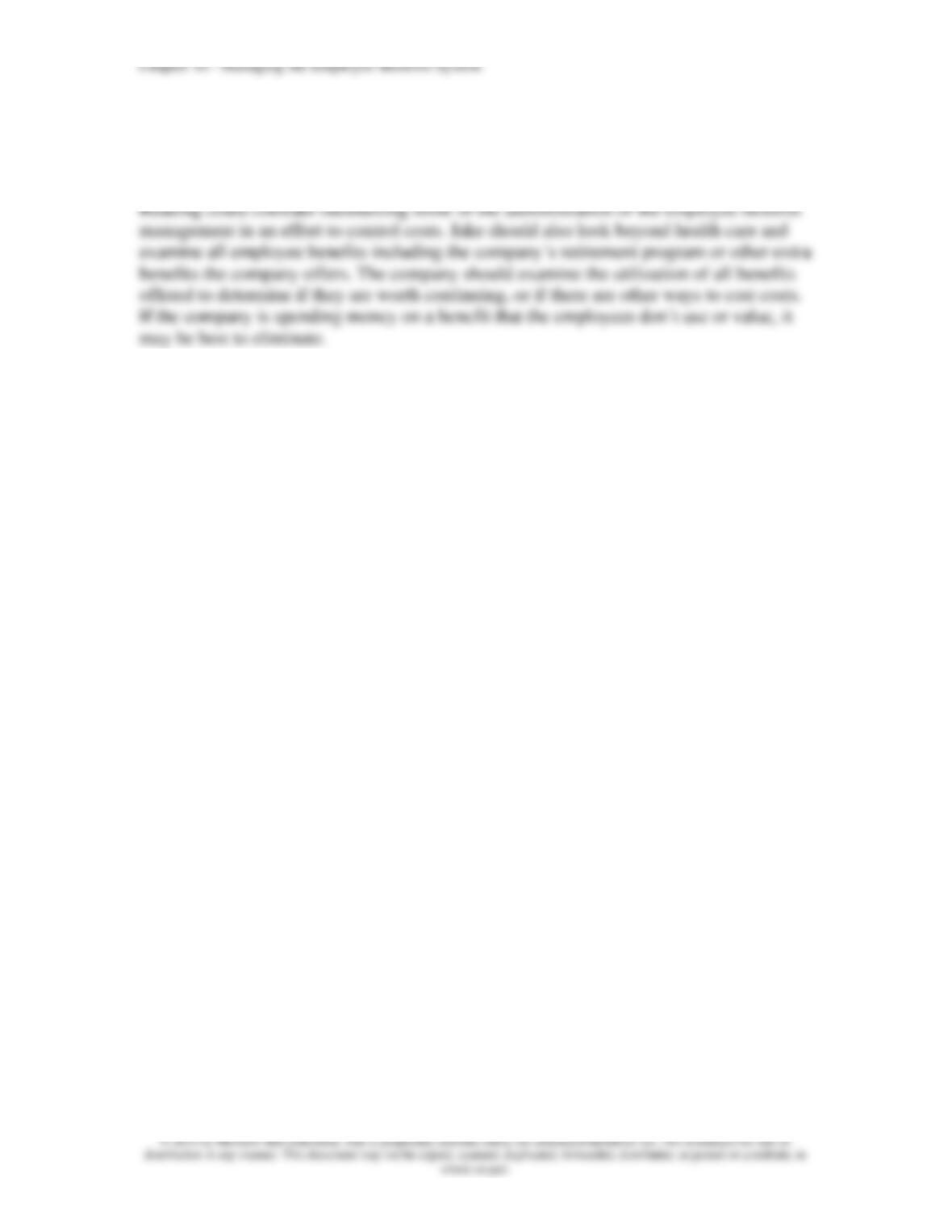
Controlling the cost of employee benefits is an ongoing concern for companies. As the
cost of health insurance in particular continues to rise, employers must look for
Student Responses
1. What are some examples of steps that Reading could take to lower the cost of the
company’s health insurance?
10–14
2. What are some other areas that Reading should explore to reduce the overall costs
of benefits?