
Johnson, Human Resource Information Systems, 5e
SAGE Publishing, 2021
1
Training Evaluation at Opticity Power Consumption
Assignment Purpose
Evaluating training programs is a critical but frequently neglected aspect of human resource
management. Organizations may simply accept the value of training programs or they may be
unaware of the importance of evaluation. Nevertheless, evaluation is necessary to determine
how well a training program is achieving its goals. Criteria for evaluating training effectiveness
might include productivity levels, turnover rates, accident rates, and absenteeism rates.
Regardless of the criteria selected, the personnel manager must select an evaluation design.
Background
Opticity Power is an electric generating facility. The company has recently undertaken training
programs to increase energy production by installing a solar farm in the Arizona desert. Top
management firmly believes that this installation will provide significant productivity increases
as well as being good for the environment. However, to effectively leverage this new solar farm,
employees need to be trained on how to maintain the solar arrays as well as the software that
manages the energy distribution from the solar farm. Management is concerned, however, with
showing the effectiveness of the program. You have been hired as a human resource consultant
to complete a training cost/benefit evaluation.

Johnson, Human Resource Information Systems, 5e
SAGE Publishing, 2021
2
Calculations
Make sure you round calculations performed in the spreadsheet when it makes sense. After all
you can’t have 1/3 of a person. Here is how to use the ROUND function in Excel:
The training spreadsheet has the following sections:
Start Row
Section
5
Training Costs
37
Training Benefits
54
Benefit/Cost Analysis
Part I – Training Costs
The first section of the spreadsheet contains all the costs for training. Compute the following
values in the spreadsheet.
Cost of Trainers
The initial number is derived by using a $1,250 per day rate for 15
days of training. The percentage annual growth for each year is
found in cells C9-G9. To compute the cost of trainers for each
subsequent year, multiply the cost of trainers for the immediately
preceding year (e.g. cell B8) by [1 + (the given year’s annual
increase percentage)] (e.g. cell C9). Do this for each year of your

Johnson, Human Resource Information Systems, 5e
SAGE Publishing, 2021
3
Equipment Maintenance
The maintenance service contract initially costs $750/year with
increases in each of the next five years by the percentages in row
18. Compute the increased costs for each year of your analysis (cells
C17-G17).
Trainee Compensation
The trainees will receive their regular compensation while they are
being trained. The $54,000 figure (cell B20) is $180/trainee (direct
plus indirect compensation per day) times 300 trainees.
Compensation costs are projected to increase by a specific
percentage (row 21) for each year for five years. Compute the
compensation increases for each year of your analysis (cells C20-
G20).
with projected increases, included in row 24. Compute the increase
of facility costs for each year of your analysis (cells C23-G23).
Preparation Time
increase of preparation costs for each year of your analysis (cells
C26-G26).
Training Materials
of training materials costs for each year of your analysis (cells C29-
G29).
Compute the total annual cost for year, and place your respective
values in cells B32-G32.
For each year, compute the annual cost per trainee (cells B34-G34).

Johnson, Human Resource Information Systems, 5e
SAGE Publishing, 2021
4
Part II – Training Benefits
This section of the spreadsheet focuses on the projected cost benefits of training. Compute the
following values in the spreadsheet.
Trainee Productivity
The $1,350,000 figure represents and
incremental productive contribution of
$4,500 per trainee times 300 trainees.
Productivity Increase Without Training
The increases in production without training
are expected to be slight (e.g., 3%).
Productivity Increase With Training
The production increases with training are
expected to be substantial (as high as 40%).
but the trainees have been with Opticity
Power at least three years and they were
The increases in turnover costs are expected
to grow at the same rate as compensation.
The decreases in turnover resulting from
training are shown for each of the next five
years.
Finally, compute the costs of annual training
benefits by taking the sums of the increase in
productivity with training and decrease of
turnover due to training (for each year).
Part III – Benefit/Cost Analysis
This section of the spreadsheet focuses on the overall breakdown of benefit/cost analysis. In
this assessment, you will calculate both the absolute value of training as well as the Net Present
Value (NPV) of training.
Johnson, Human Resource Information Systems, 5e
SAGE Publishing, 2021
5
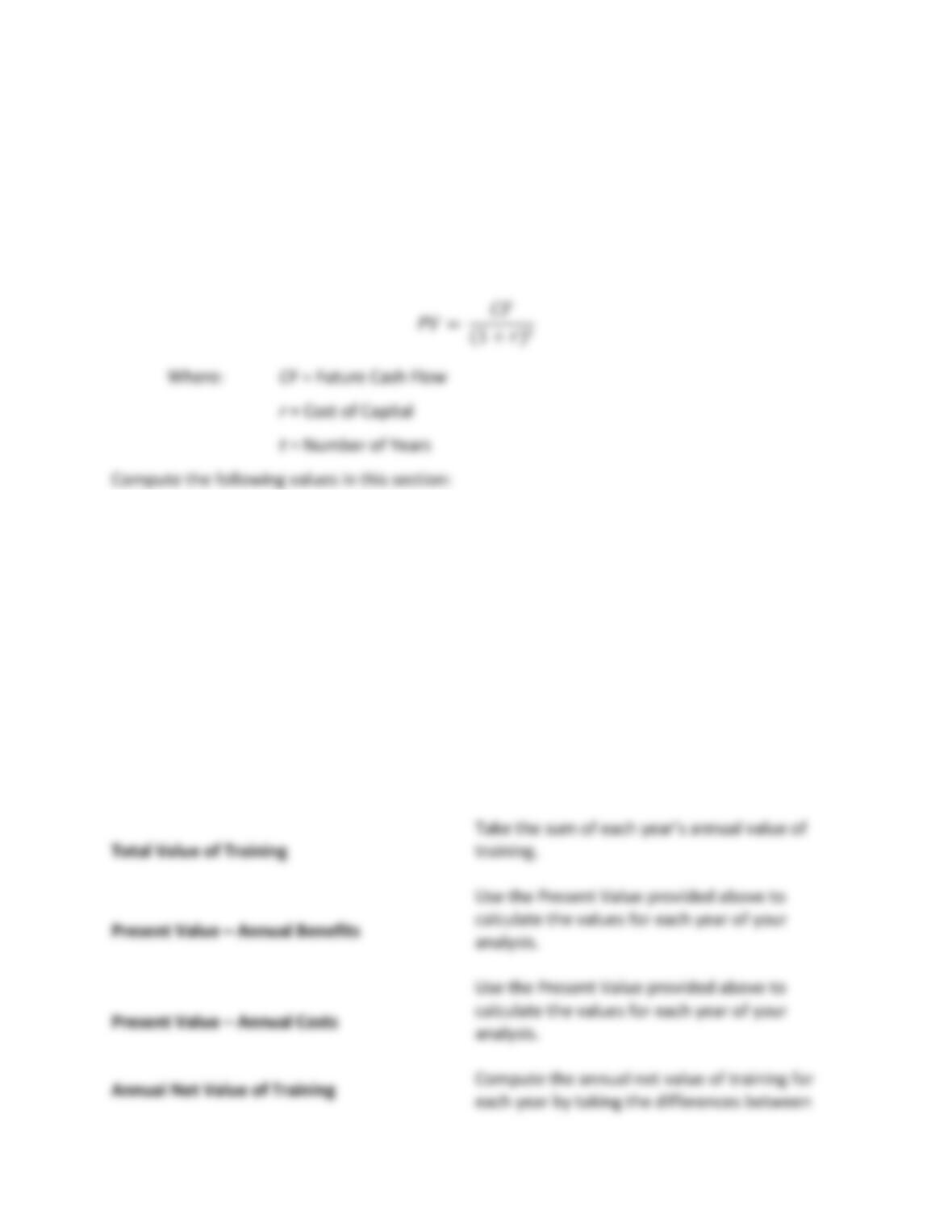
NPV is used to compute the current value of all future cash flows for each year of investment.
In this case, you will need to first compute the present value of both the annual benefits and
annual costs for each year. Thus, using the cost of capital (cell B65) you will discount future
benefits and costs so that they can be assessed in terms of their value today.
The formula for Present Value is as follows:
Annual Benefits
In row 57 starting at cell B57, reference the
values (cells) of annual training benefits for
each year, which you calculated above.
Annual Costs
In row 58 starting at cell B58, reference the
values (cells) of total annual training costs for
each year, which you calculated above.
Annual Value of Training
Compute the annual value of training for
each year by taking the differences between
the annual costs and annual benefits for each
year.
training.
Present Value – Annual Benefits
calculate the values for each year of your
analysis.
Present Value – Annual Costs
Use the Present Value provided above to
calculate the values for each year of your
analysis.
Compute the annual net value of training for

Johnson, Human Resource Information Systems, 5e
SAGE Publishing, 2021
6
the net annual benefits and net annual costs
for each year.
value of training.

Johnson, Human Resource Information Systems, 5e
SAGE Publishing, 2021
7
Study Questions
1. What do the net results indicate about the training program?
2. Based on the cost/benefit analysis should Opticity Power continue the training program?
Briefly explain.
3. The Training Specialists in charge of the training program think that the estimated
productivity increases resulting from training are too high. They are more comfortable with
10% increases. Change each of the entries in the range C43:G43 to reflect 10% increases for all
five years.