Lecture Notes
Lussier, Human Resource Management, Third Edition
SAGE Publishing, 2018
Lecture Notes
Chapter 1: The New Human Resource Management Process
Learning Objectives
1-1 Identify the difference between the traditional view of human resource management (HRM)
and the present view.
1-4 Describe the four major HRM Skill sets.
1-5 Discuss the line manager’s six HRM responsibilities.
1-6 Identify and briefly describe the eight major HRM disciple areas.
1-7 List some of the major resources for HRM careers.
Annotated Chapter Outline
I. Why Study HRM?
a. Competitive advantage
b. Employee engagement
i. Job satisfaction
c. Organizational success
i. Employee engagement
To learn how to engage employees more effectively. Employee engagement is a
combination of both job satisfaction and a willingness to perform for the organization at
a high level over an extended period of time.
II. HRM Past and Present
Lecture Notes
Lussier, Human Resource Management, Third Edition
SAGE Publishing, 2018
a. Past
i. HR managers were paper pushers and simply organized personnel files.
ii. HR functioned more as a cost or revenue center.
b. Present
III. HRM in the 21st Century
a. Advocate for workers
i. Support employees
ii. Reinforce value of workers and their skills
HR professionals fill a vital role in business:
They are advocates for the workers, that is, support initiatives that reinforce the value of
workers and the skills they provide that enhance the success of the company (improve
working conditions and benefits).
IV. Consider This
Imagine the future of two comparable companies with similar revenues and identical market
share:
Company A
Company B
Fails to recruit top talent
Recruits better
Does not nurture talent
Trains and develops better
V. Productivity
a. What is it?
i. Amount of output organizations receive per unit of input.
b. What does it require?
Lecture Notes
Lussier, Human Resource Management, Third Edition
SAGE Publishing, 2018
VI. Challenges for HR Managers
a. Challenges
i. Job satisfaction: the extent to which people like their jobs and the
environment in which they work.
b. Effects
iv. Productivity
v. Employee and organizational performance
c. Challenges for HR Managers
d. HR managers have no direct control over employees’
i. Productivity
e. Therefore, HR managers should
i. foster employee willingness
HR managers have no direct control over people, specifically their:
productivity, job satisfaction, turnover, and absenteeism.
VII. Types of Turnover
a. Functional turnover: loss of a poor performer
b. Dysfunctional turnover: loss of an effective performer
Lecture Notes
Lussier, Human Resource Management, Third Edition
SAGE Publishing, 2018
Turnover can be both voluntary and involuntary
VIII. The HRM Strategic View
a. Took hold within the past 30 years.
HRM’s shift from reactive to proactive (i.e., taking on a strategic role), which took hold within
the past 30 years, gives the organization a sustainable competitive advantage, because HRM
efforts are critical to being able to carry out organizational plans and reach goals that have
been defined by the overall strategic plan.
e. Gain of HR leaders having a “seat at the table” as it pertains to strategic planning.
In addition to the movement that has resulted in the role of HR as a proactive force in the
business world, there has also been a movement whereby the leaders in HR have gained a
“seat at the table” as it pertains to strategic planning.
This collaboration has allowed companies to progress more rapidly in their pursuit of
success.
IX. Main Goals of Strategic HRM
a. Encourage employees through:
i. Motivation
ii. Leadership
Lecture Notes
Lussier, Human Resource Management, Third Edition
SAGE Publishing, 2018
iii. Environmental analysis
iv. Organizational changes
To encourage employees through motivation, leadership, environmental analysis, and
organizational changes that work to improve job satisfaction.
Doing so engages employees, which in turn increases productivity and job satisfaction, and
lowers absenteeism and turnover.
X. Personnel of Organizations
a. HR has positioned itself as a force that supports a well-managed and people-
centric business.
XI. Technology and Knowledge
a. HR managers are experiencing a shift in labor-intensive talents to technology-
intensive and knowledge skills.
b. Technology enhances effectiveness, efficiency, and productivity while “doing more
with less.”
Lecture Notes
Lussier, Human Resource Management, Third Edition
SAGE Publishing, 2018
XII. Talent Pool and Demographic Challenges for HR
a. Talent pool
i. HR managers compete to hire and retain technologically skilled
employees. There is a shortage of employees with the knowledge to
perform these increasingly complex jobs.
b. Demographics
i. HR managers must be culturally conscious of employees with different
work ethics, cultural norms, and language differences.
They will compete to hire and retain technologically skilled workers due to a shortage of people
XIII. Skills for Successful HRM
a. Technological skills: methods and techniques to perform a task.
b. Human relations skills: ability to work well with individuals and groups.
Lecture Notes
Lussier, Human Resource Management, Third Edition
SAGE Publishing, 2018
g. Perceptive and spatial thinking skills: ability to develop lateral thinking and honing
a sense perception. This clarity of thinking is valued for senior level managers.
Technological skills—using methods and techniques to perform a task.
Human relations skills—the ability to work well with individuals and groups.
Conceptual and design skills—the ability to evaluate a situation, identify and select reasonable
alternatives, and make decisions that implement solutions.
Social media skill—the ability to capitalize on the benefits of social networking through the
effective use of social media will be a critical skill necessary for success in the 21st century.
XIV. Line Versus Staff Management
a. Line managers
i. Control what the organization does by creating processes and assisting
employees who produce what the business sells.
b. Staff managers (HR managers)
i. Advise line management on issues within their fields of specialized
knowledge.
XV. HR Responsibilities of Line Management
a. Legal considerations
b. Labor cost controls
c. Leadership and motivation
d. Training and development
Lecture Notes
Lussier, Human Resource Management, Third Edition
SAGE Publishing, 2018
XVI. Disciplines with HRM
a. Legal: EEO and diversity management
b. Staffing
c. Training and development
XVII. HRM Careers
a. These are professional associations and certification programs that help employees
obtain and advance in HR careers:
i. The Society for Human Resource Management (SHRM)
XVIII. Professional Liability
a. The organization and managers can be sued by employees who feel their rights
under employment laws have been violated.
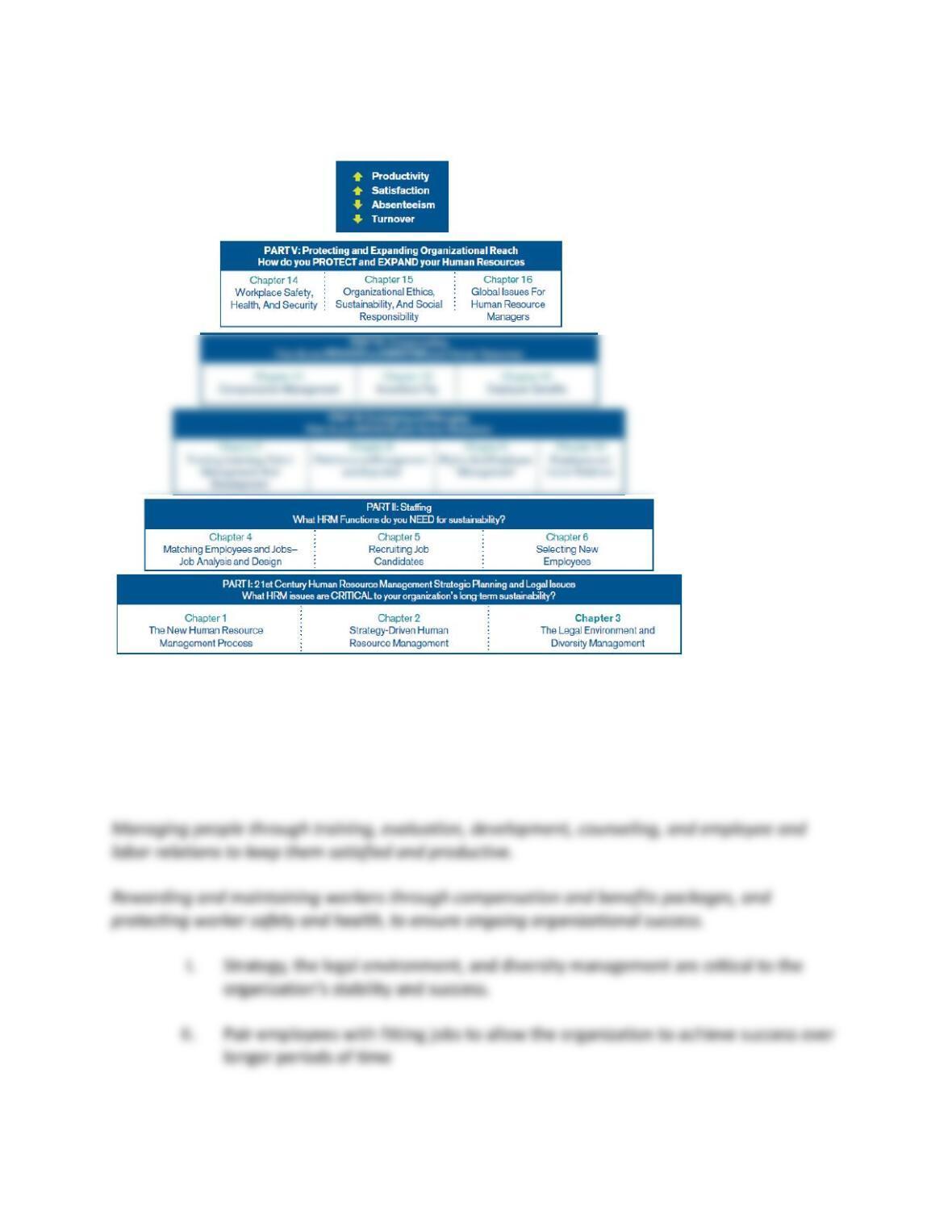
XIV. Practitioner’s Model for HRM
Lecture Notes
Lussier, Human Resource Management, Third Edition
SAGE Publishing, 2018
Strategy, the legal environment and diversity management are the basis for everything else that
a 21st century HR manager does; they are the most critical to the organization’s basic stability
and success.
Getting the right people into the right jobs allows the organization to get its work done
successfully over long periods of time.
Lecture Notes
Lussier, Human Resource Management, Third Edition
SAGE Publishing, 2018
III. Maintain employee satisfaction and productivity through training, evaluation,
development, counseling, and employee and labor relations.
IV. Reward employees through compensation and benefits packages.