Instructor Resource
Kavanagh and Johnson, Human Resource Information Systems: Basics, Applications, and Future Directions, 4e
SAGE Publishing, 2018
Sample Answers to Discussion Questions
Chapter 1: A Brief History and Overview of Technology in
HR
1. What are the factors that changed the primary role of HRM from a caretaker
of records to a strategic partner?
The major factors were as follows:
• The mobilization and utilization of labor during World War II had a
• The increased use of technology and the changed focus of the HRM
function as adding value to the organization’s product or service led to
the emergence of the HR department as a strategic partner. With the
growing importance and recognition of people and people management
Instructor Resource
Kavanagh and Johnson, Human Resource Information Systems: Basics, Applications, and Future Directions, 4e
SAGE Publishing, 2018
2. Describe the historical evolution of HRM and HRIS in terms of the
changing role of HRM and the influence of computer technology on HRM.
• The role of HRM in the firm has changed over time from primarily being
concerned with routine transactional and traditional HR activities to dealing
with complex transformational ones. Transactional activities are the routine
• During the Post–World War II phase, it is important to realize that computer
technology was just beginning to be used at this time, and it was complex and
costly. During the Social Issues phase, effective and correct practices in HRM
were starting to affect the “bottom line” of the firms, so there was a significant
growth of HR departments, and computer technology had advanced to the point
Instructor Resource
Kavanagh and Johnson, Human Resource Information Systems: Basics, Applications, and Future Directions, 4e
SAGE Publishing, 2018
3. What is required for the effective management of human resources in a firm to gain
a competitive advantage in the marketplace?
• The effective management of human resources in a firm to gain a competitive
4. Describe the emergence of strategic human resources management (strategic HRM)
and the influence of computer technology. What are some of the approaches used in
HRM to facilitate the use of strategic HRM in a firm’s business strategy?
• The development of HRIS helped enable HRM to become a strategic partner in
organizations, which then led to the emergence of strategic HRM. While
5. How does technology help deliver transactional, traditional, and transformational
HR activities more efficiently and effectively?
One of the major advantages of the design, development, and
implementation of an HRIS is to reduce the amount of time the HR staff
Instructor Resource
Kavanagh and Johnson, Human Resource Information Systems: Basics, Applications, and Future Directions, 4e
SAGE Publishing, 2018
6. Describe Six Sigma.
• Six Sigma refers to streamlining operations through business process
7. Justify the need for an HRIS.
There are several advantages to firms in using HRIS. They include the following:
• Providing a comprehensive information picture as a single,
comprehensive database; this enables organizations to provide structural
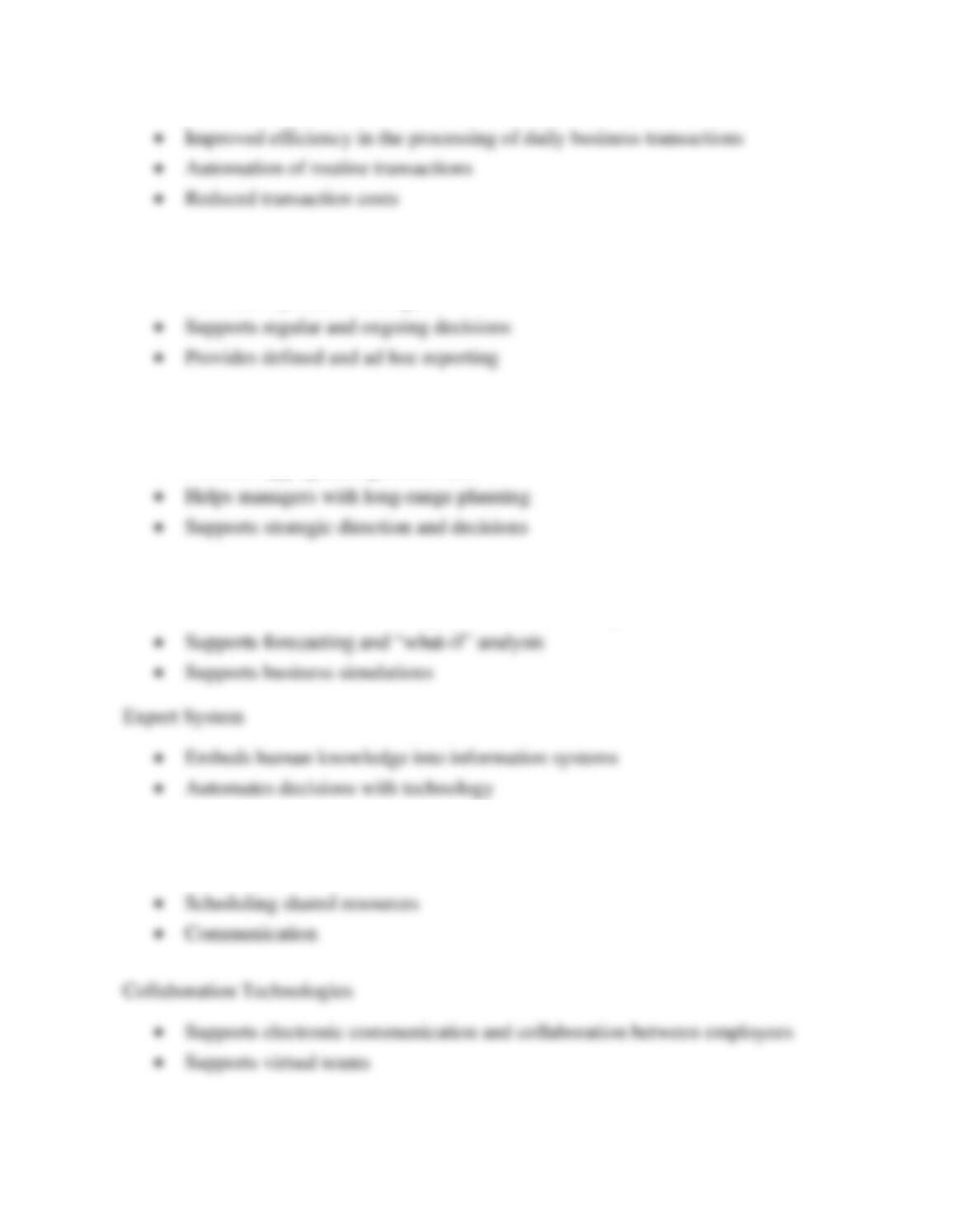
8. Describe and differentiate the major types of information systems.
Listed below are examples of the types of information systems and the types of
information they provide.
Instructor Resource
Kavanagh and Johnson, Human Resource Information Systems: Basics, Applications, and Future Directions, 4e
SAGE Publishing, 2018
Management Information System
• Provides key data to managers
Executive Information System
• Provides aggregate, high-level data
Decision Support System
• Interactive and iterative managerial decision-making
Office Automation Systems
• Designing documents

Instructor Resource
Kavanagh and Johnson, Human Resource Information Systems: Basics, Applications, and Future Directions, 4e
SAGE Publishing, 2018
Enterprise Resources Planning System
• Integration and centralization of corporate data
9. Using the organizational model presented in this chapter, explain why and how
national culture and organizational culture influence the nature and importance of
the HRIS function.
National culture will impact the laws, competition, government regulations,