
TEACHING NOTE—Lincoln Electric Company
1
TEACHING NOTE
LINCOLN ELECTRIC COMPANY
INSTRUCTOR’S NOTE
Lincoln Electric, the world’s largest maker of arc-welding products, employs
2400 workers in two U.S. factories near Cleveland and an equal number in
eleven factories located in other countries. The company has a sales force of
more than 200 persons.
The Lincoln incentive management plan has been a textbook model for
achieving higher productivity. Most of the current management practices at
Lincoln were initiated by James F. Lincoln, who died in 1965. His brother John
had started the company in 1895 with a $200 investment.
One of James’ early innovations was the Advisory Board, consisting of
elected representatives of the employees. This group meets with the CEO twice
monthly to advise the CEO on company operations.
The Lincoln Electric Employees’ Association was formed in 1919 to provide
health benefits and social activities. It has assumed added functions over the
years. About 30% of the Lincoln stock was set aside for key employees in 1914.
And in 1925 a stock was set aside for key employees in 1914. And in 1925 a
stock purchase plan for all employees was begun. A suggestion system was
initiated in 1929.
The legendary Lincoln bonus plan was accepted on a trial basis in 1934.
Recently, bonuses have approximated annual wages.

TEACHING NOTE—Lincoln Electric Company
2
bonuses continued. Most employees were cut back to 30 hours a week for time,
but a sales resurgence brought brighter days.
Each supervisor formally evaluates subordinates twice a year on the basis of
“quality,” “dependability,” “ideas and cooperation,” and output. Marks on the
evaluation cards are converted to numerical scores, which are forced to average
100 for each supervisor. Exceptional scores, above 110, must be separately
justified and are not included in the forced averaging. Basic wage levels are
determined by wage surveys of similar jobs in the area and adjusted quarterly
in accordance with changes in the Cleveland area wage index. As far as
possible, base wage rates are translated into piece rates. Year-end bonuses are
multiples of individual performance scores and earnings during the year.
Formal authority is quite strong at Lincoln. Supervisors have undisputed
authority to assign specific jobs to individual workers and to switch between
over time and short time as required. The Advisory Board only recommends
actions. Management has the final say on all matters.
TEACHING STRATEGY
Lincoln Electric is a versatile case, which can be used to teach a number of
strategic management lessons. Of course, it highlights the impact that
management values, beliefs, and philosophy have on strategy implementation.
It also illustrates how strong corporate cultures can be built around the ideals
of one influential executive, as also seems true of Wal-Mart Stores (Sam Walton)
and as Peters and Waterman (In Search of Excellence) found true of most of
their “excellent” companies. But there is much more.
Lincoln offers extremes along several dimensions, which can be used to
initiate discussion of a wide range of formulation and implementation issues.
Among those issues: optimal capital structure (Can zero debt be optimal?),
statistical control systems (How much of the Lincoln system is based on
numbers?), competitive strategy (How does Lincoln maintain its power position
within the industry?), participative management (Are participation and
autocratic management mutually exclusive?), vertical versus horizontal
CENTRAL THRUST
The use of participation and individual and group incentives to increase
productivity. Right from the start, very innovative management practices were
followed at Lincoln. The Lincoln incentive management plan has been well
known for many years. Many college management texts refer to it as a model for
achieving high worker productivity. Other unique features of the Lincoln
System include the almost complete absence of long term debt, lack of executive
perquisites, the Advisory Board, job security, and the suggestion system.
One of the main achievements of the Lincoln system is productivity
averaging twice that of competitors. Trust exists between management and
labor. Employees own about half of the company stock. This, added to job
security, may help explain the high productivity.
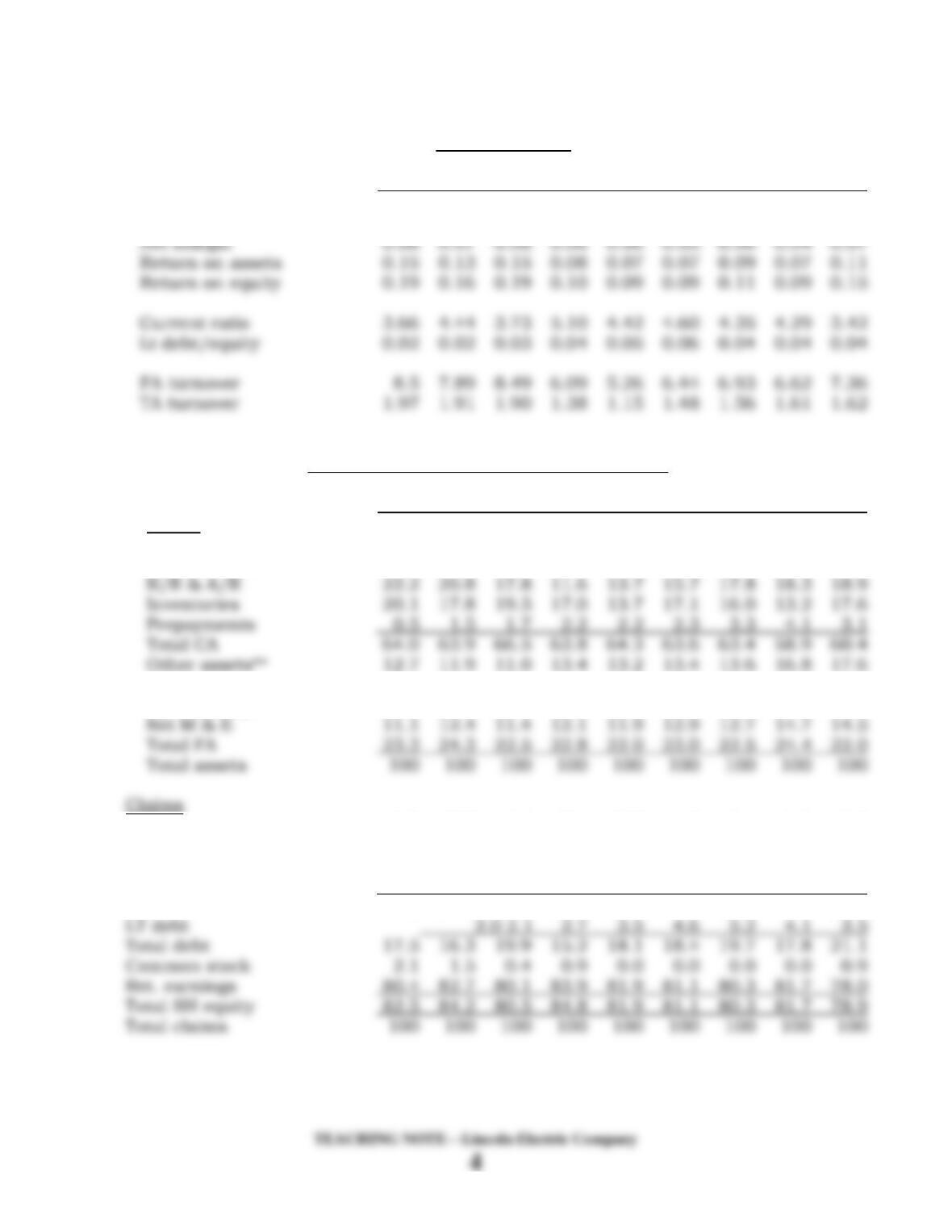
Financial Ratios
1979 1980 1981 1982 1983 1984 1985 1986 1987
Gross margin 0.36 0.34 0.37 0.35 0.35 0.33 0.35 0.33 0.36
Common-Size Comparative Balance Sheets (%)
1979 1980 1981 1982 1983 1984 1985 1986 1987
Assets
Cash 1.1 0.5 1.7 0.4 0.9 1.8 0.9 0.5 3.1
Bonds & CDs 20.1 23.3 26.7 32.1 34.4 26.3 25.8 22.8 18.1
Land 0.5 0.5 0.4 0.4 0.4 0.5 0.5 0.5 0.4
Net buildings 11.6 11.4 10.6 10.3 9.7 9.7 9.4 9.1 7.5
A/P 9.0 7.9 6.4 5.4 7.0 6.9 6.1 5.6 8.8
Accrued wages 0.5 1.0 2.1 1.8 1.3 1.8 2.3 2.5 1.8
Accrued taxes 5.3 3.0 6.4 2.2 3.1 1.8 2.8 2.5 4.0
Accrued div. 3.2 3.0 3.0 3.1 3.1 2.8 3.3 3.0 3.1
Total CL 17.5 14.4 17.8 12.5 14.5 13.8 14.6 13.7 17.6
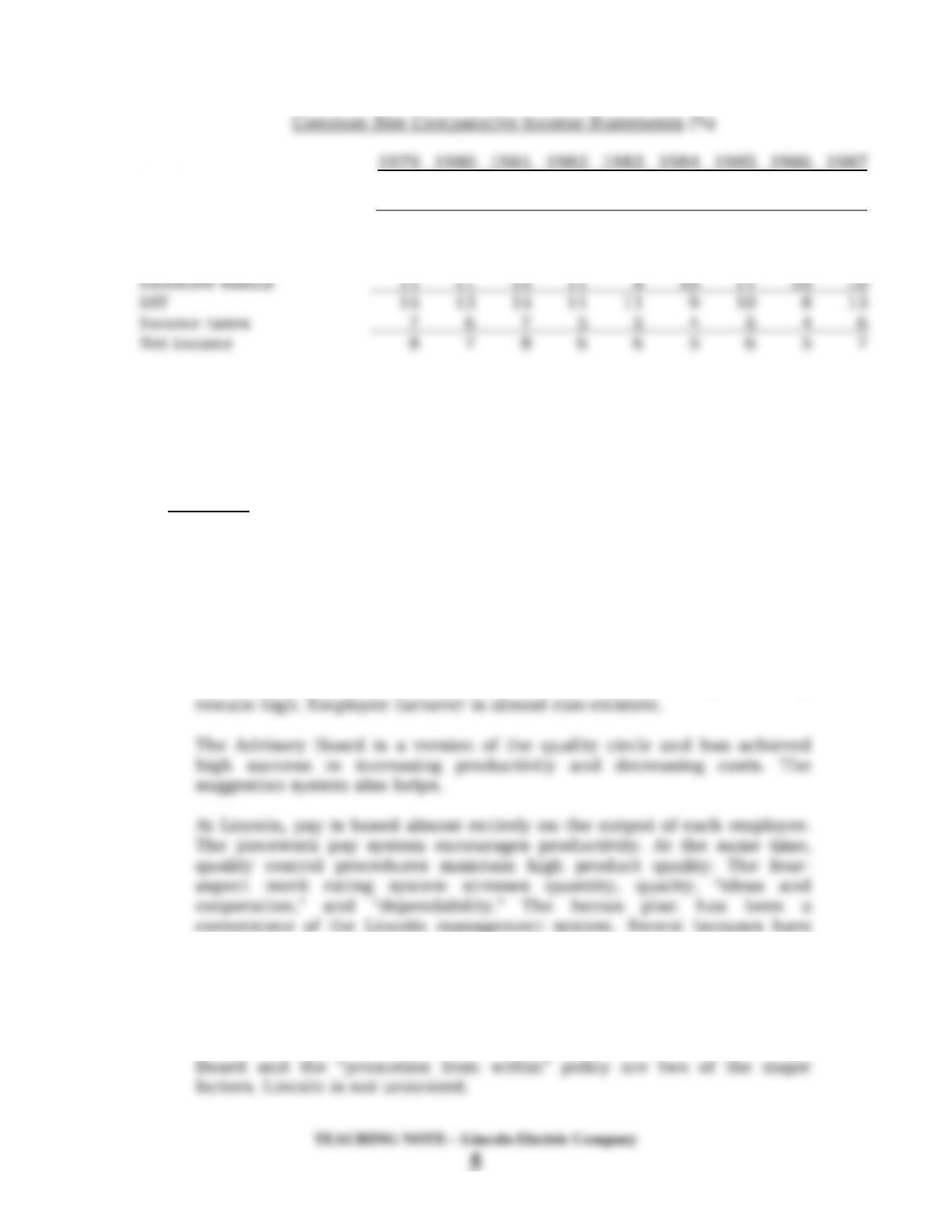
Net Sales 97 97 96 95 95 96 97 98 98
Other Income 3 3 4 5 5 4 3 2 2
Income 100 100 100 100 100 100 100 100 100 100
CGS 63 65 62 65 65 67 64 66 63
Selling, G & A*** 11 11 11 14 16 14 14 15 14
STRENGTHS, WEAKNESSES, THREATS, AND OPPORTUNITIES
Many teachers will find SWOT (for Strengths, Weaknesses, Opportunities,
and Threats) analysis useful.
Strengths
Lincoln Electric is the world’s largest manufacturer of welding machines
and electrodes. The company holds an estimated 40 percent market
share for arc-welding equipment and supplies and has a well-established
reputation.
Lincoln has traditionally applied innovative management techniques. The
company’s incentive management plan has become a textbook model for
achieving high worker productivity. Employee morale and productivity
approximated annual wages. Base wages are comparable with those of
other workers in the Cleveland area and they are periodically adjusted for
inflation. Lincoln claims levels of productivity more than twice those for
other manufacturers since 1945.
Trust and respect exist between workers and managers. The Advisory
TEACHING NOTE—Lincoln Electric Company
6
three levels of supervision between the workers and the President.
Lincoln has a very strong capital structure. It has high liquidity and
almost no long-term debt. All expansion is financed by internally
generated funds. The company has respectable turnover ratios and
earnings on sales.
materials handling, and methods of engineering are closely supervised by
top management. Material and finished goods inventory control, accurate
cost accounting, and attention to sales cost, credit, and other financial
matters have constantly reduced overhead and led to excellent
profitability.
standard product line designed to meet the major needs of the welding
industry. New products must be reviewed by manufacturing and all
production costs verified before begin approved by management.
Management has encouraged education, technical publishing, and long-
range programs that have resulted in industry growth, thereby assuring
market potential for the Lincoln Electric Company.
Weaknesses

TEACHING NOTE—Lincoln Electric Company
7
Advertising expenditures are less than one-fourth of a percent of sales.
Lincoln’s sales force seems rather small.
Management has curtailed research and development expenditures. Any
major breakthrough in the welding area may catch Lincoln unprepared.
There is evidence that competitors spend several times as much on R &
debt were utilized.
Finally, Lincoln is not diversified. It has “all its eggs in one basket.”
Opportunities
Lincoln has almost no long-term debt. There exists a high potential for
expansion with the help of debt. Diversification into other industries
any bedrock principle at Lincoln. This could diminish the impact of
“inbreeding.”
Threats
may result in a collapse of the organizational spirit. Therefore, economic
downturns and technological innovations by others are major threats to
Lincoln.
Lincoln’s employee selection procedure has resulted in partial exclusion
of blacks from the work force. In an area with more than 20 percent
black population, Lincoln employs fewer than 5 percent blacks.
DISCUSSION QUESTIONS AND ANSWERS
1. Relate Lincoln’s conservative financing policies to the company’s ability
to offer guaranteed employment to its workers.
Guaranteed employment is one of the aspects at Lincoln which have
resulted in worker motivation and satisfaction. There has been no layoff
since World War II. Even with the conservatism, it was difficult to avoid

TEACHING NOTE—Lincoln Electric Company
9
2. Who are Lincoln’s constituencies in order of stated priority? Explain how
company practices either do or do not appear to bear this out.
Customers are claimed to be Lincoln’s primary constituency. Lincoln
provides good, standard products, priced low and backed by a highly
professional sales team. Lincoln prices for welding machines and welding
electrodes are acknowledged to be the lowest in the marketplace. Lincoln
3. Why do Lincoln employees produce so much?
Lincoln reinforces the cost and quality concerns through the rewards
given. The structure is flat to facilitate communication and problem
solving. Only highly motivated personnel join the company and their
compensation is based on how well they perform.
There are two basic motivators at work. The first is compensation. About

TEACHING NOTE—Lincoln Electric Company
10
4. Is Lincoln Electric pro- or anti-union? Justify or oppose their position.
Lincoln should probably be viewed as anti-union. James Lincoln
criticized the labor movement for “selfishly attempting to better its
position at the expense of the people it must serve.” He still had kind
5. Relate Lincoln’s marketing Policy in terms of the “four Ps of marketing” to
the free market ethic of theoretical (Adam Smith) capitalism.
Classical capitalism assumes that business is managed for the benefit of
6. Which aspects of the Lincoln system could be effectively applied
elsewhere? Explain.
Most of the features of the Lincoln system could be effectively applied
elsewhere. In fact, such applications have been made. However, success
depends on the suitability of the process to the particular environment. It
is unlikely that all the aspects of Lincoln management could be
duplicated successfully in another organization.
With the above perspective, here is a list of the important features of the
Lincoln system, which may find successful use elsewhere?
a. “statistical control”
TEACHING NOTE—Lincoln Electric Company
11
e. the Advisory Board
f. total reliance upon promotion from within, with every employee
eligible for every job
g. brief on-the-job training as the only organized training
h. a suggestion system which rewards useful suggestions with
performance evaluation “points”
i. a faithfully administered piece-rate pay system which extends to
every job possible
j. a four-aspect merit rating system with ratings forced to average 100
points except for extremely high ratings, which must be justified in
writing
7. Discuss what you consider to be the major weakness of Lincoln Electric,
and explain how the company may or may not be subject to external
threats.
8. Relate the overall Lincoln program to society’s needs, particularly the
needs for increased productivity, reduced inflation, and improved
perception of trust in the business establishment.
Many economists feel that the most desirable solution for the inflation
problem which has existed in the U.S.—and threatens again in 1989—is