CHAPTER 9
Nationalism and Sectionalism, 1815–
1828
This chapter focuses on the dual effects of nationalism and sectionalism following the War of 1812. It
opens by looking at how nationalism is expressed in economic policy—in particular, the debates over the
national bank, the financing of internal improvements, and court decisions. The chapter also considers the
debate over Henry Clay’s “American System” and goes on to examine the expressions of sectionalism in
CHAPTER OUTLINE
I. A New Nationalism
A. Postwar Nationalism
B. The Bank of the United States
C. A Protective Tariff
D. Internal Improvements
E. Postwar Nationalism and the Supreme Court
F. Protecting Contract Rights
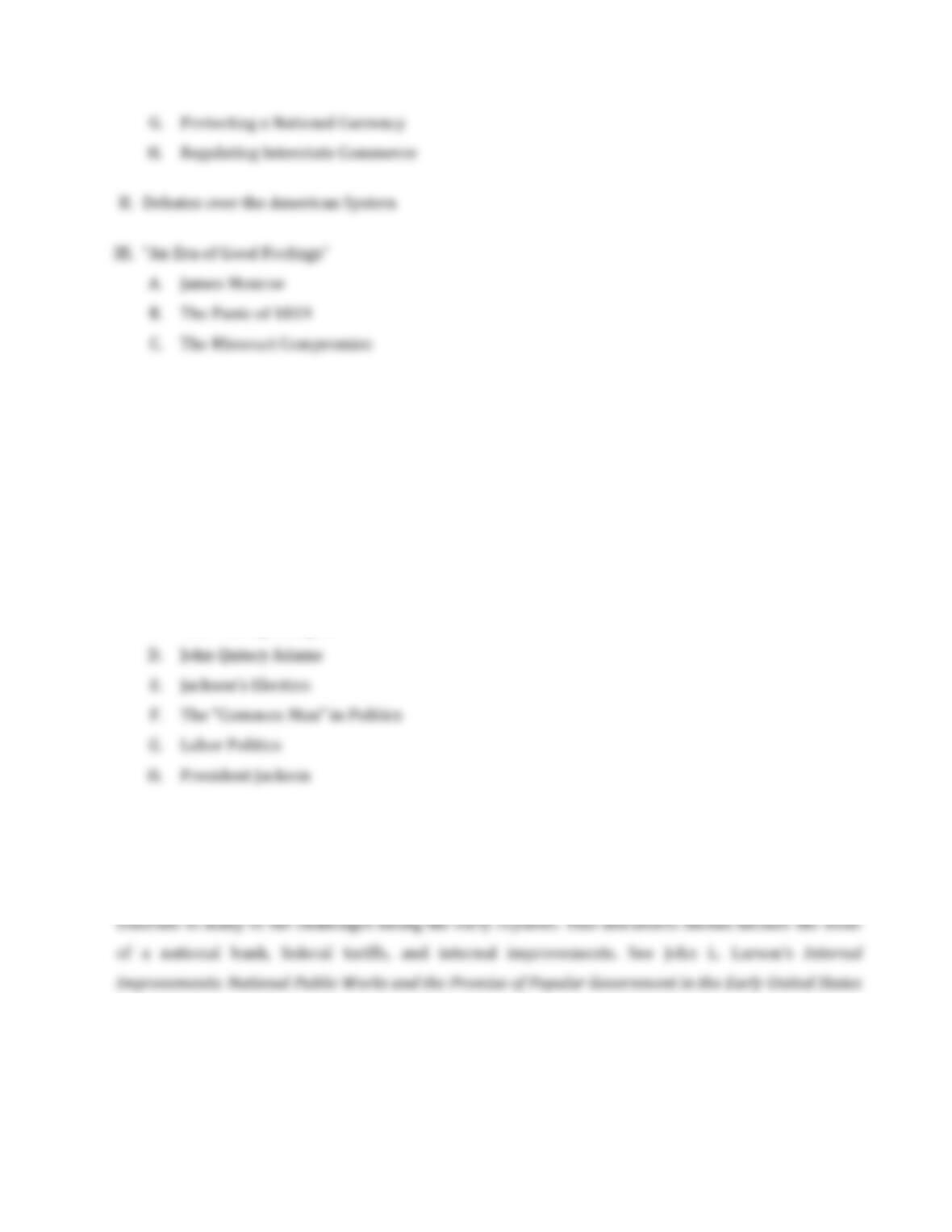
IV. Nationalist Diplomacy
A. Relations with Britain
B. Florida
C. The Monroe Doctrine
V. The Rise of Andrew Jackson
A. Andrew Jackson
B. Presidential Politics
C. The “Corrupt Bargain”
LECTURE IDEAS
1. A lecture on the development of America’s early national economy and its institutions will expose the
(2001) and George Taylor’s The Transportation Revolution, 1815–1860 (1951).
2. A lecture on James Monroe’s presidency will facilitate a class discussion on the accomplishments and
challenges during his administration. Have students look at either domestic or foreign affairs under
3. For a lecture on the important topic of the Supreme Court’s nationalist decisions, see Alfred H. Kelly,
Winfred A. Harbison, and Herman Belz’s The American Constitution: Its Origins and Development (7th
4. An excellent way to cover the presidency of John Quincy Adams and to spark a good classroom
discussion is to use segments from the 1976 PBS series The Adams Chronicles, which is available on
5. A lecture on the election of 1828 would be a good way to show the relationship between Adams and
Jackson. Again, you can emphasize a milestone, as the country had two major political parties again.
6. What was it about Andrew Jackson that made him so popular and made so many Americans—
especially common white men—relate to him? Write a lecture that uses the biographical approach
IN-CLASS ACTIVITIES
1. One of the best known monikers for an American age is the “Era of Good Feelings.” What does this
mean? The best explanation can be found in George Dangerfield’s old but reliable The Era of Good
2. In a brief lecture, examine the Missouri Controversy and its role in developing a sense of American
sectionalism. Then ask the students to draw a timeline of the history from Missouri’s intentions to
apply for statehood, the Tallmadge resolution, the first draft of the Compromise, the origins of 36°30’,
3. Ask your students to consider the rise of Andrew Jackson, from his experiences in the American
Revolutionary War, as a judge and senator, to his involvement in the War of 1812, his battles in
Florida in 1819, and his involvement in presidential campaigns in 1824 and 1828. How might each of
these experiences have shaped his view of the presidency?
4. John Quincy Adams’s presidency has been termed a failure, but his tenure as Secretary of State was
(1952) and Daniel Walker Howe’s What Hath God Wrought: The Transformation of America, 1815–
1848 (2007).
DISCUSSION QUESTIONS
2. Although there was much resistance to the First Bank of the United States, by the end of the War of
1812, there was significant support for chartering a successor bank, the Second Bank of the United
States. Examine this development. In what ways did the debate over the bank reflect regional
differences?
3. Following the War of 1812, political positions shifted with Republicans supporting many former
4. The Tariff of 1816 and the Panic of 1819 revealed deep sectional differences. Discuss those
differences and what was done to bridge some of them. Were these efforts enough?
5. Much has been made of the “corrupt bargain” of the 1824 election. Explain the events in question and
discuss the merits of such a deal.
6. The Monroe Doctrine became a hallmark in U.S. foreign policy and, in fact, remains one of its guiding
7. How might we account for the rise of Andrew Jackson to victory in the election of 1828?
PRACTICING CITIZENSHIP
Jackson’s supporters were understandably outraged that, although their candidate won the popular vote
in 1824, he was denied the presidency. In light of that outcome and also considering the contention
surrounding the 2000 presidential election (Bush vs. Gore), has the time come to abolish the Electoral
College? Research and discuss with fellow students the pros and cons of this matter. Despite the