Angel ad Shreiner: Interactive Computer Graphics; Seventh
Edition
Chapter 9 Solutions
9.1 If the upper arm is longer than the lower arm then, as a first
approximation, the robot can reach all points within a sphere centered at
the joint on the base. However, this answer is only approximate because
the lower arm cannot move below the level of the base, so a second
approximation is a hemisphere above the base. This approximation has to
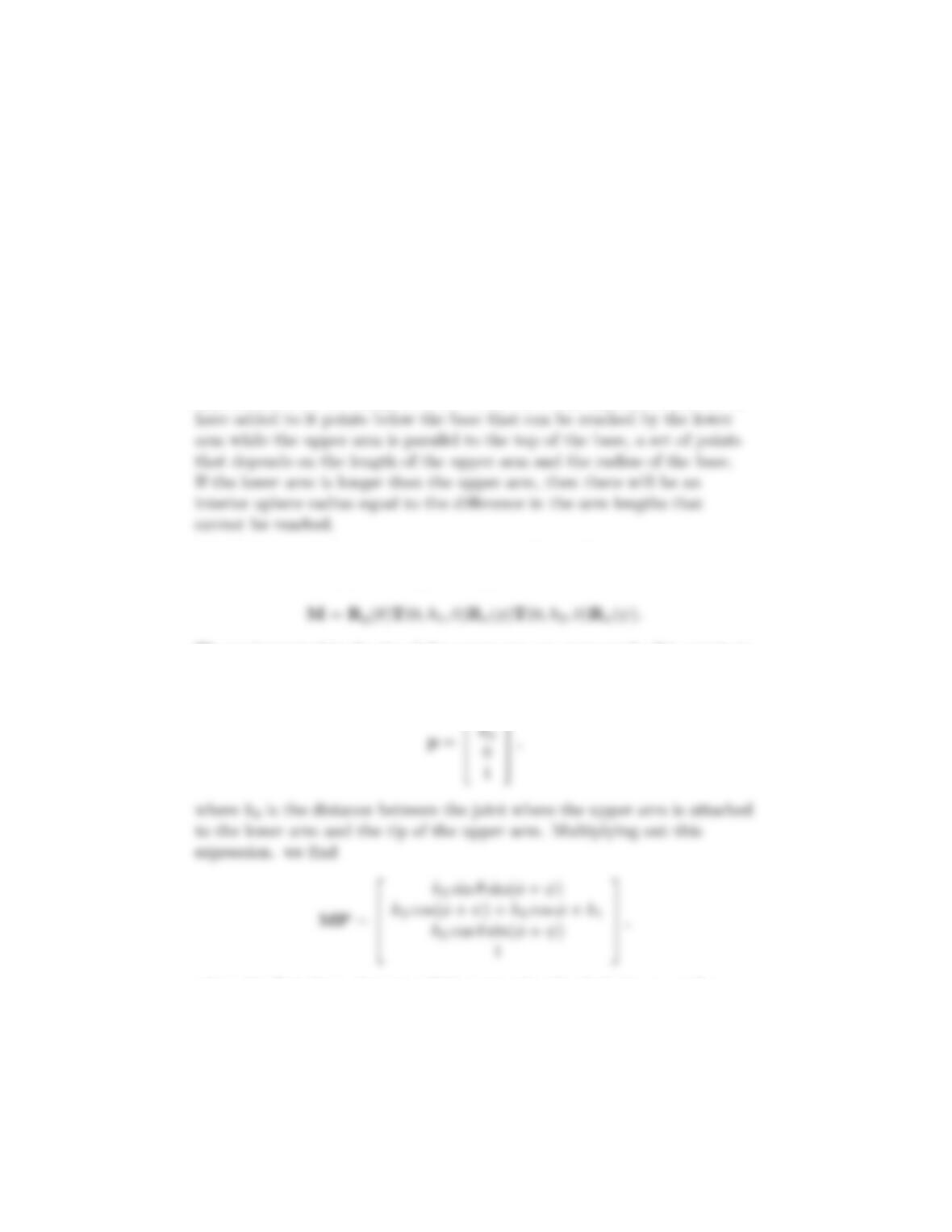
9.2 All points on the upper arm can be transformed from positions in their
own frame to the base frame by the matrix
We are interested in the tip of the upper arm, so must apply this matrix to
the homogeneous coordinate point
0
h3cos θsin(φ+ψ)
1
where the first three elements of the array give the desired x,y, and z
coordinates.
1
9.3 For this simple example, there are three values of the joint angles and
three coordinates in space, so there are a couple of simple approaches that
can work. One is to use the result of the previous problem to solve for the
joint angles in terms of the given x,y, and zvalues, using a numerical
method. We could then simply move the joint angles from their initial to
final positions linearly.
A more interesting possibility is to have the tip of the robot arm trace out
a given path, for example, a line segment between the starting and ending
positions. If use the parametric form of this line, we can obtain a set of
9.10 The objects at the nodes of a CSG tree are usually quadrics. Ray
tracers work well with quadrics because the intersection of a ray with a
9.11 The trick here is to store the average value of the four trees below at
each node. Thus, if we have an 2n×2nimage, the nodes at level nhas the
2