Angel and Shreiner: Interactive Computer Graphics, Seventh
Edition
Chapter 5 Solutions
5.1 Eclipses (both solar and lunar) are good examples of the projection of
an object (the moon or the earth) onto a nonplanar surface. Any time a
shadow is created on curved surface, there is a nonplanar projection. All
5.2 Suppose that the axis of the plane is its z direction and up is the y
direction. In the airplane’s coordinate system, the roll, pitch and yaw
correspond to rotations about the z, x and y axes respectively. Thus we
5.3 Suppose that we want the view of the Earth rotating about the sun.
Before we draw the earth, we must rotate the Earth which is a rotation
about the y axis. Next we translate the Earth away from the origin.
5.4 This problem is very similar to the next problem. We use the VRP to
translate the camera. The VPN becomes the new z direction. We can
5.5 Yes. Any sequence of rotations is equivalent to a single rotation about
a suitably chosen axis. One way to compute this rotation matrix is to form
5.6 If we start with a translation of the COP to the origin, the remaining
problem is to find the intersection of a projector from the origin to a point
1
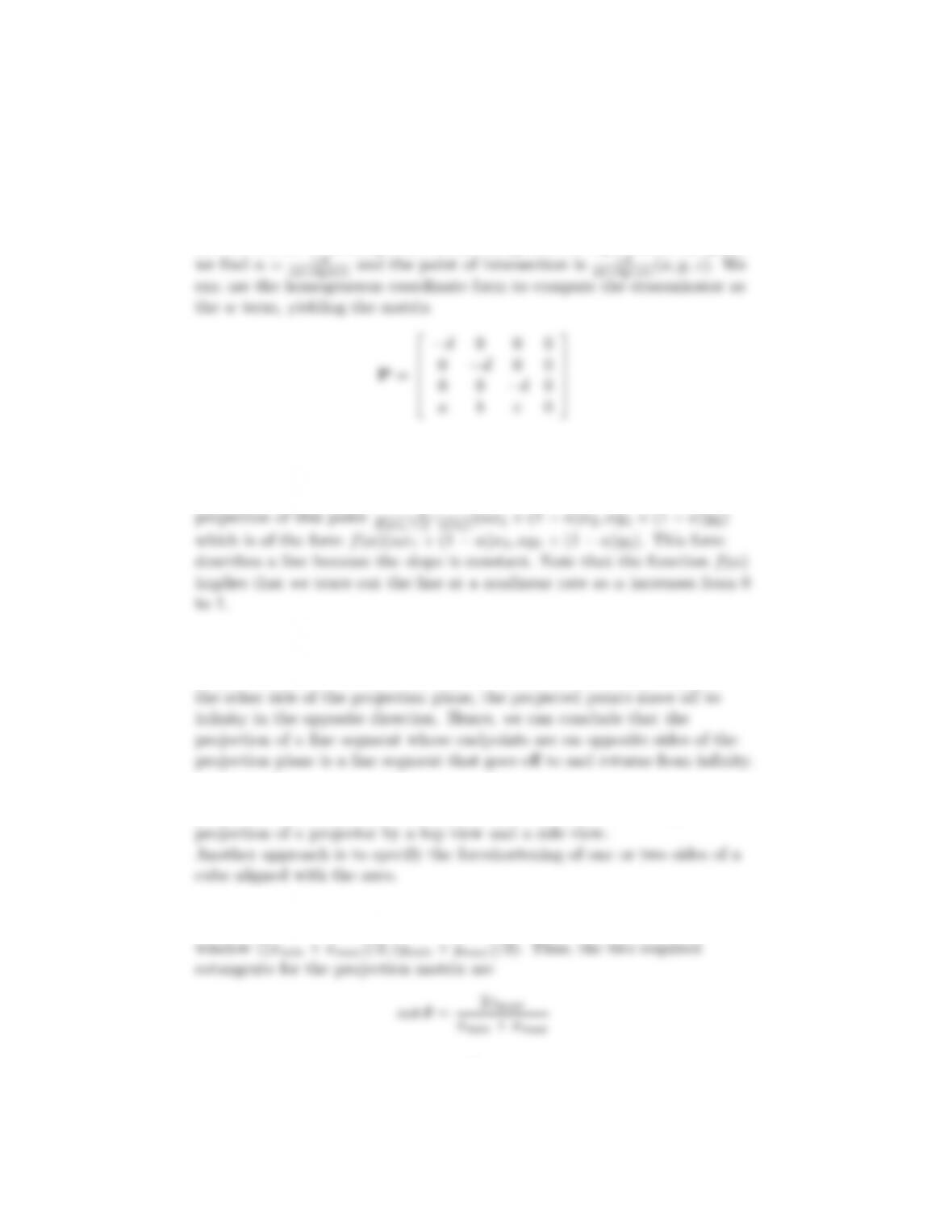
(x, y, z) with the plane ax +by +cz +d= 0. Any point on this projector
can be written as (αx, αy, αz). Substituting into the equation of the plane
a b c 0
5.7 Consider the line determined by the points (x1, y1, z1) and (x2, y2, z2).
Any point along can be written parametrically as
(αx1+ (1 −α)x2, αy1+ (1 −α)y2, αz1+ (1 −α)z2). Consider the simple
5.8 As we project points on one side of the projection plane, getting closer
and closer to where the line segment intersects the projection plane, the
projected points move off to infinity. If we do the same thing for points on
5.9 The specification used in many graphics texts is to use the angles the
projector makes with x,z and y, z planes, i.e the angles defined by the
5.10 If the camera is at the origin, we can assume that the angle of
projection is determined by the line from the origin to the center of the
2
5.11 The CORE system used this approach. Retained objects were kept in
distorted form. Any transformation to any object that was defined with
5.12 All are changed by a translation matrix T(0,0,−d).
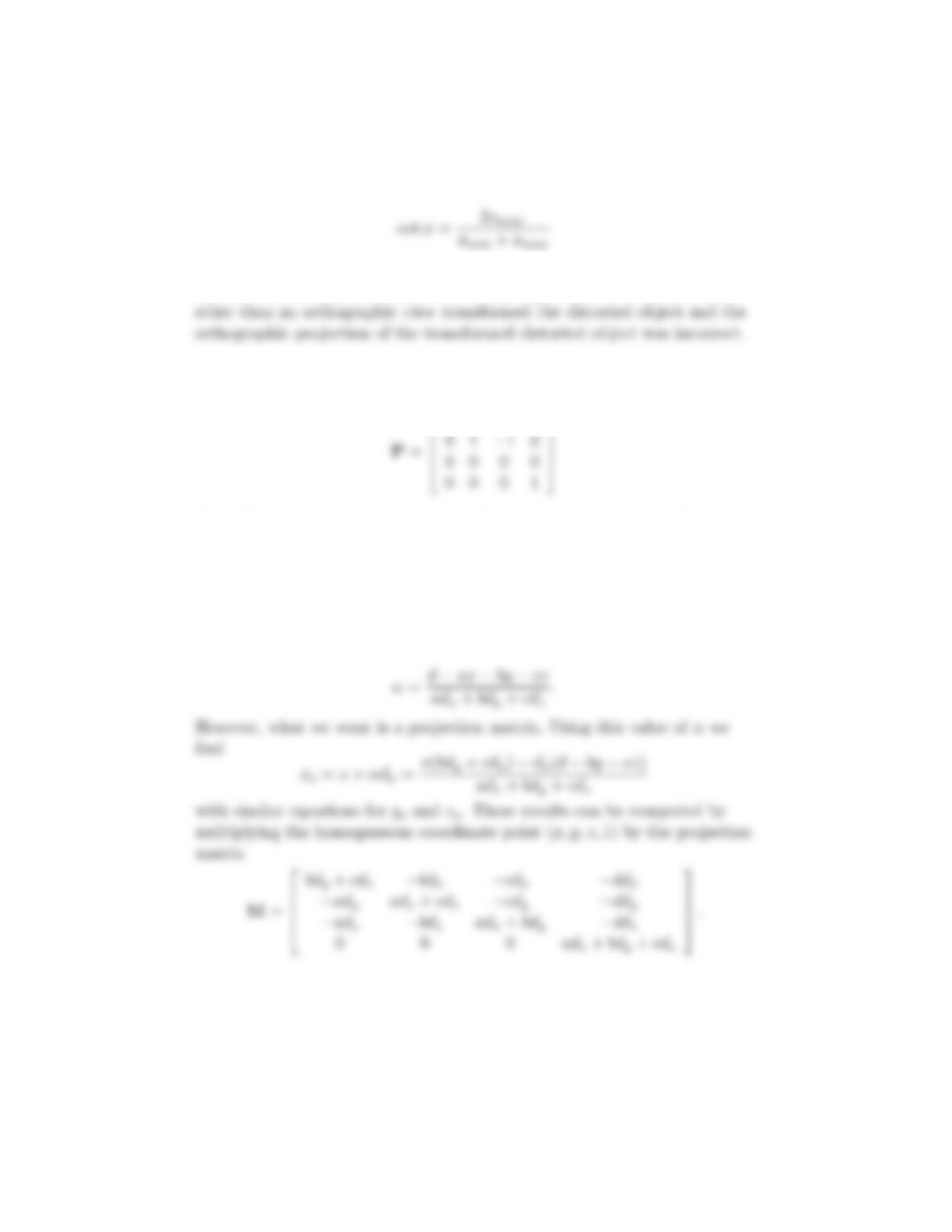
5.15 If we use θ=φ= 45, we obtain the projection matrix
1 0 −1 0
5.17 All the points on the projection of the point (x.y, z) in the direction
dx, dy, dz) are of the form (x+αdx, y +αdy, z +αdz). Thus the shadow of
the point (x, y, z) is found by determining the αfor which the line
intersects the plane, that is
axs+bys+czs=d
Substituting and solving, we find
−adz−bdzadx+bdy−ddz
0 0 0 adx+bdy+cdz
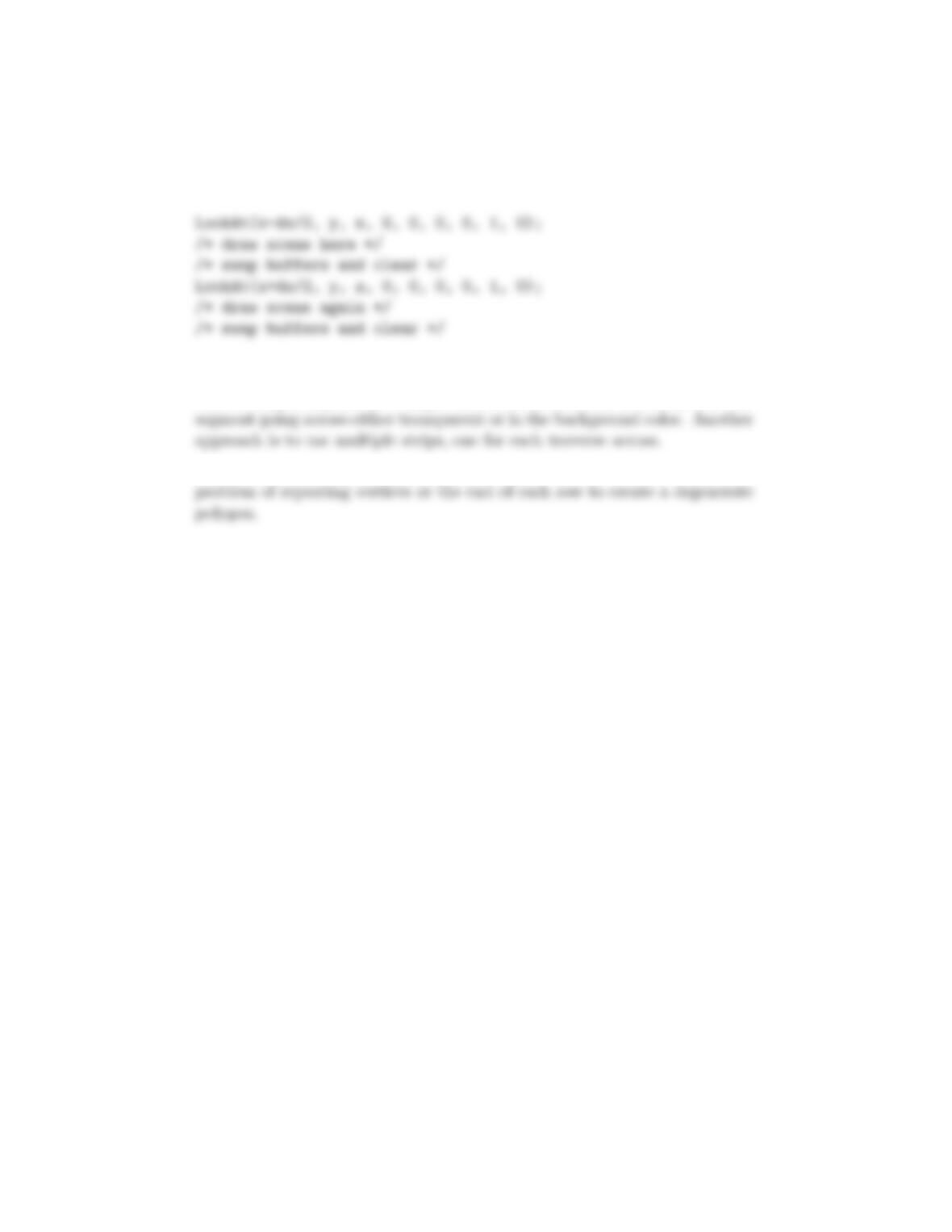
5.21 Suppose that the average of the two eye positions is at (x, y, z) and
the viewer is looking at the origin. We could form the images using the
LookAt function twice, that is
3
5.22 One approach is to use a repeated vertex at the end of each line,
this creating a degenerate triangle with no area. Another is to make the line
5.23 Probably the simplest approach would be the one in the previous
4