Angel and Shreiner: Interactive Computer Graphics, Seventh
Edition
Chapter 4 Solutions
4.1 If the scaling matrix is uniform then
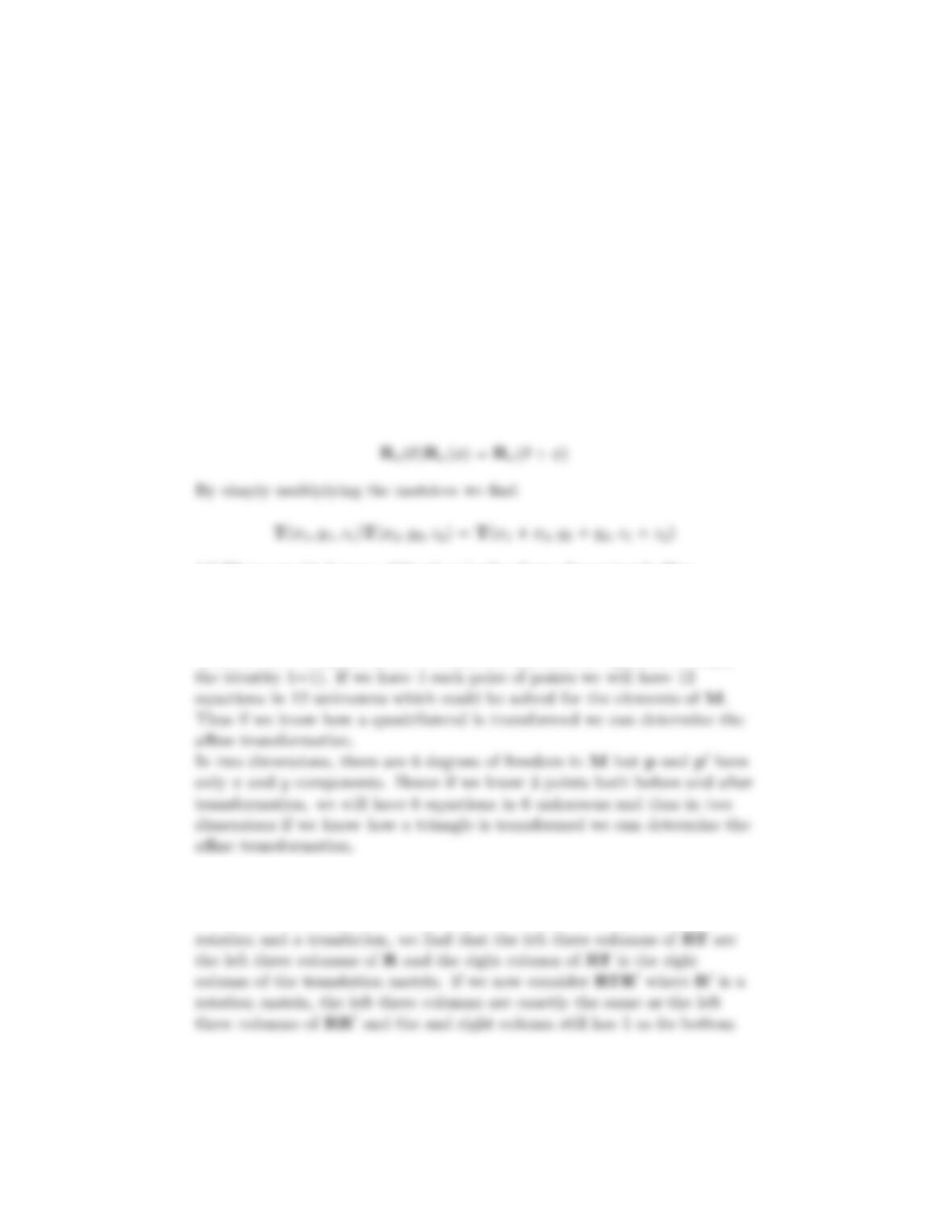
RS =RS(α, α, α) = αR=SR
Consider Rx(θ), if we multiply and use the standard trigonometric
identities for the sine and cosine of the sum of two angles, we find
4.5 There are 12 degrees of freedom in the three–dimensional affine
transformation. Consider a point p= [x, y, z, 1]Tthat is transformed to
p′= [x′y′, z′,1]Tby the matrix M. Hence we have the relationship
p′=Mp where Mhas 12 unknown coefficients but pand p′are known.
Thus we have 3 equations in 12 unknowns (the fourth equation is simply
4.7 It is easy to show by simply multiplying the matrices that the
concatenation of two rotations yields a rotation and that the concatenation
of two translations yields a translation. If we look at the product of a
1
4.9 If we do a translation by -h we convert the problem to reflection about
a line passing through the origin. From m we can find an angle by which
4.11 The most sensible place to put the shear is second so that the instance
transformation becomes I=TRHS. We can see that this order makes
sense if we consider a cube centered at the origin whose sides are aligned
4.13 A vertex in a three-dimensional system is a location. It has no other
4.15 Points, vectors and scalars.
4.19 One test is to use the first three vertices to find the equation of the
plane ax +by +cz +d= 0. Although there are four coefficients in the
4.21 Although we will have the same number of degrees of freedom in the
objects we produce, the class of objects will be very different. For example
2
4.23 The vector a=u×vis orthogonal to uand v. The vector b=u×ais
4.25 Using r= cos θ
2+ sin θ
2v,with θ= 90 and v= (1,0,0),we find for
rotation about the x-axis
r=√2
2(1,1,0,0).
Likewise, for rotation about the yaxis
3