Angel and Shreiner: Interactive Computer Graphics, Seventh
Edition
Chapter 12 Solutions
12.1 Let’s do the problem in two dimensions. The solution in three
dimensions is essentially the same. Assume that the vertices are used in a
consistent clockwise or counterclockwise manner. Starting at some vertex,
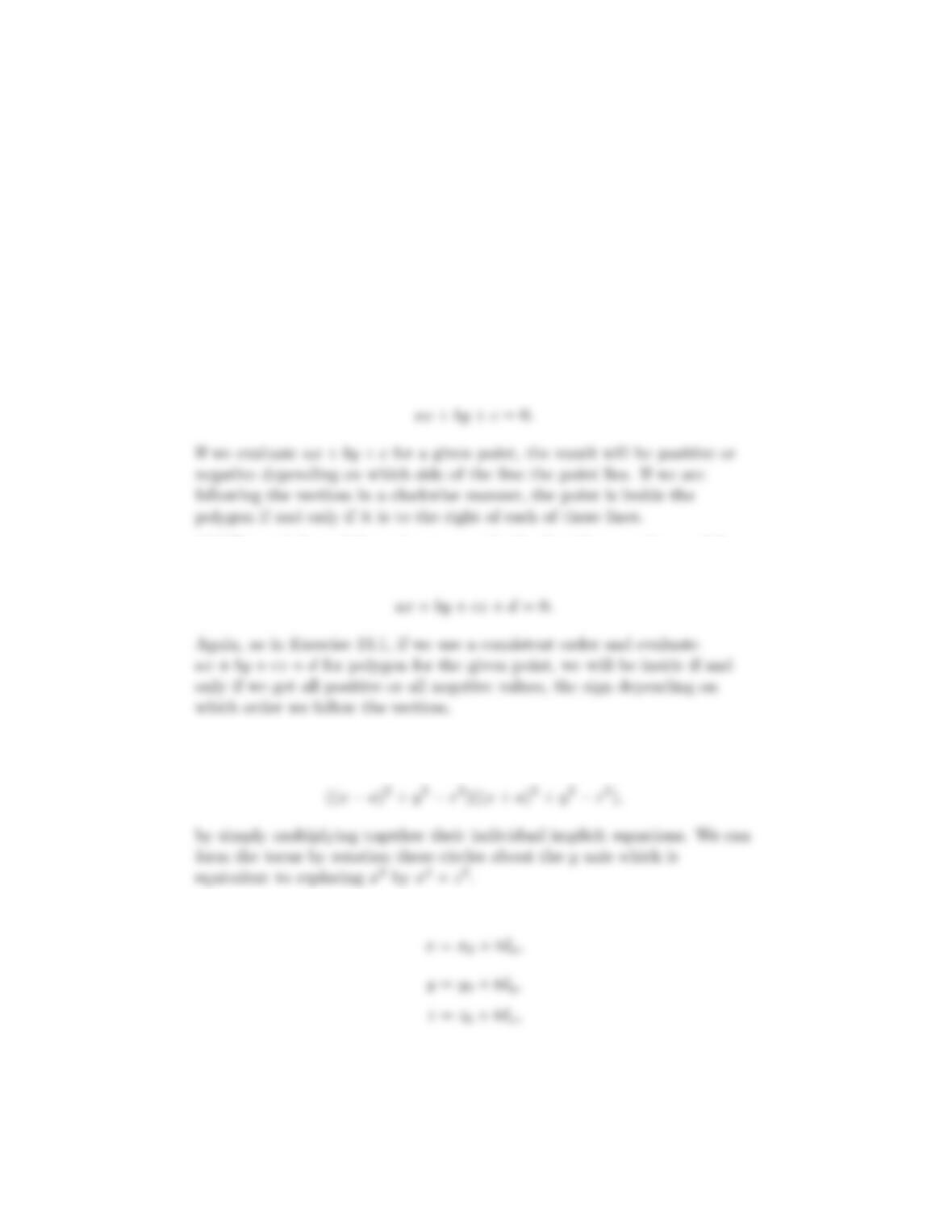
that vertex and the next determine a line of the form
12.2 For each face of the polygon, we take the first three vertices and form
the equation of a plane in the form
12.3 Consider two identical circles of radius rcentered at (a, 0) and
(−a, 0). We can describe them through the single implicit equation
12.4 If we make the usual substitutions
1
12.5 The line from the center of the circle to the closest point on the ray
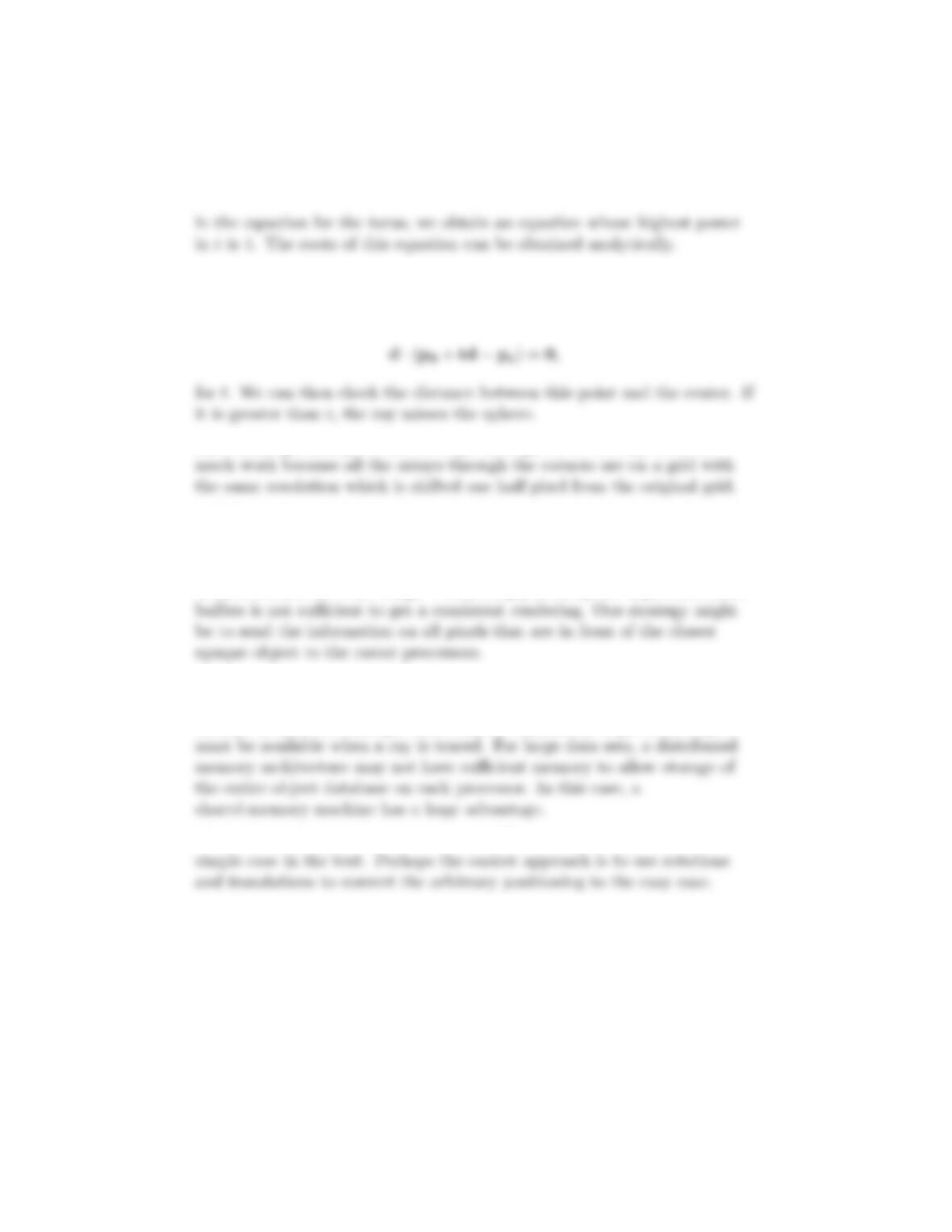
must be perpendicular to the ray. Thus, if the ray is written as
p=p0+td and the circle has radius rand center pc, we can solve
12.6 Although each pixel has five rays through it, we do only twice as
12.7 Generally, the depth information has to be retained so that the raster
processors can determine which entities are in front.
12.8 The greatest difficulty with blending is that order in which objects are
rendered affect the final image. Thus, simply sending the depth and frame
12.9 As was discussed in the text, pipeline strategies can be adapted to
non–shared-memory architectures. Ray tracing is more difficult to adapt
because if there are multiple reflections or translucent objects, all object
12.10 Although ugly, the solution is no different in principle from the
12.13 i+j+k
12.14 The highest power is 3iso there can be 3i+ 1 terms in the
polynomial.
12.18 Eventually each processor is responsible for only a small area of the
screen. Thus, most primitives will overlap boundaries between these
2

12.19 There are 256 (28) ways to color the vertices of a cube. If we take
out symmetries (rotations, swapping colors), there are 14 distinct cases. Of
3