Angel and Shreiner: Interactive Computer Graphics, Seventh
Edition
Chapter 11 Odd Solutions
11.1 (m+ 1)3
11.3 As uvaries over (a, b), v=u−a
b−avaries over (0,1). Substituting into
the polynomial p(u) = Pn
k=0 ckuk, we have
11.5 Consider the Bernstein polynomial
bkd(u) = d
k!uk(1 −u)d−k.
For k= 0 or k=d, the maximum value of 1 is at one end of the interval
(0,1) and the minimum is at the other because all the zeros are at 1 or 0.
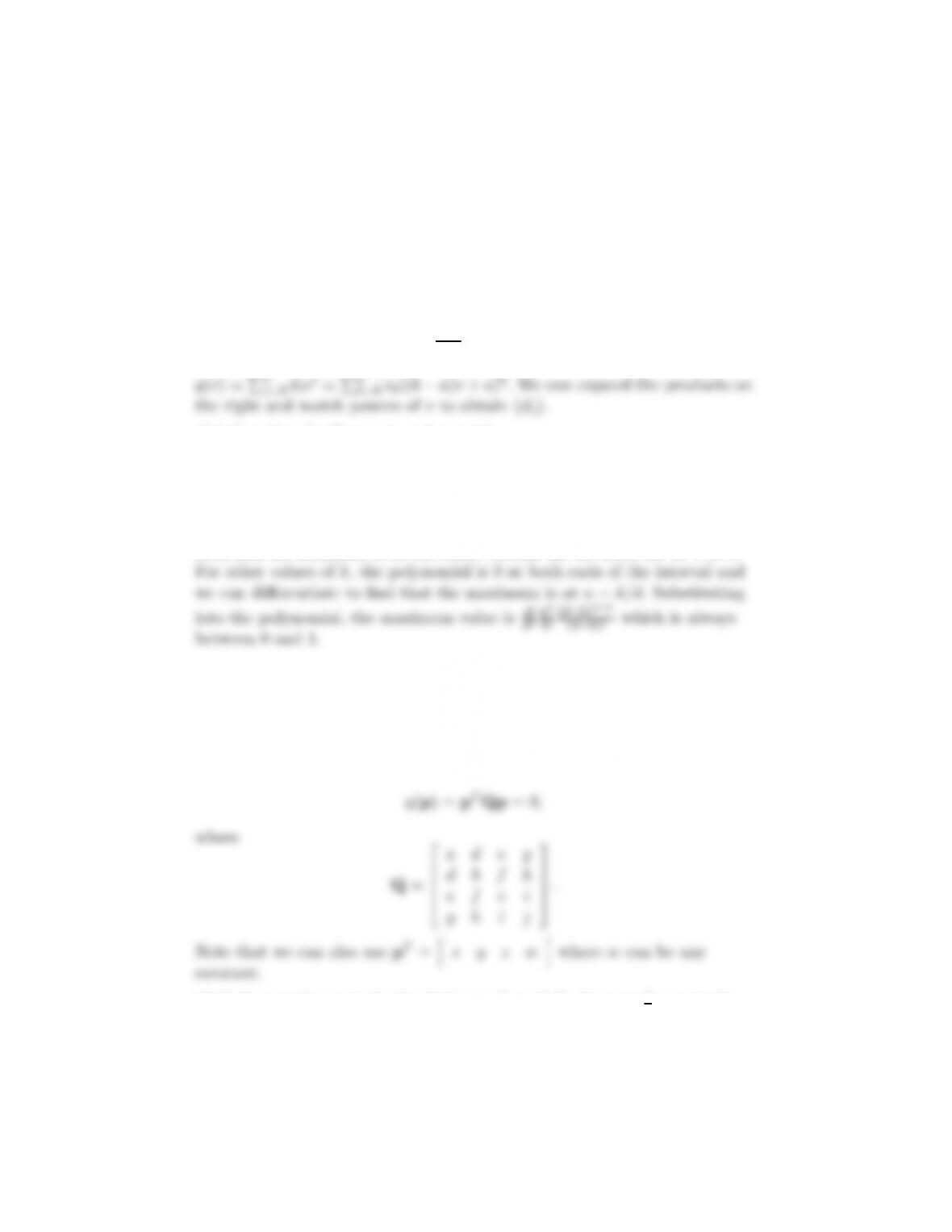
11.7 Any quadric can be written as
q(x, y, z) = ax2+by2+cz2+ 2dxy + 2exz + 2fyz + 2gx + 2hy + 2iz +j= 0,
where a, b, c, d, e, f, g, h, i and jare constants. Let pT=hx y z 1i.
Then, we can rewrite the equation as
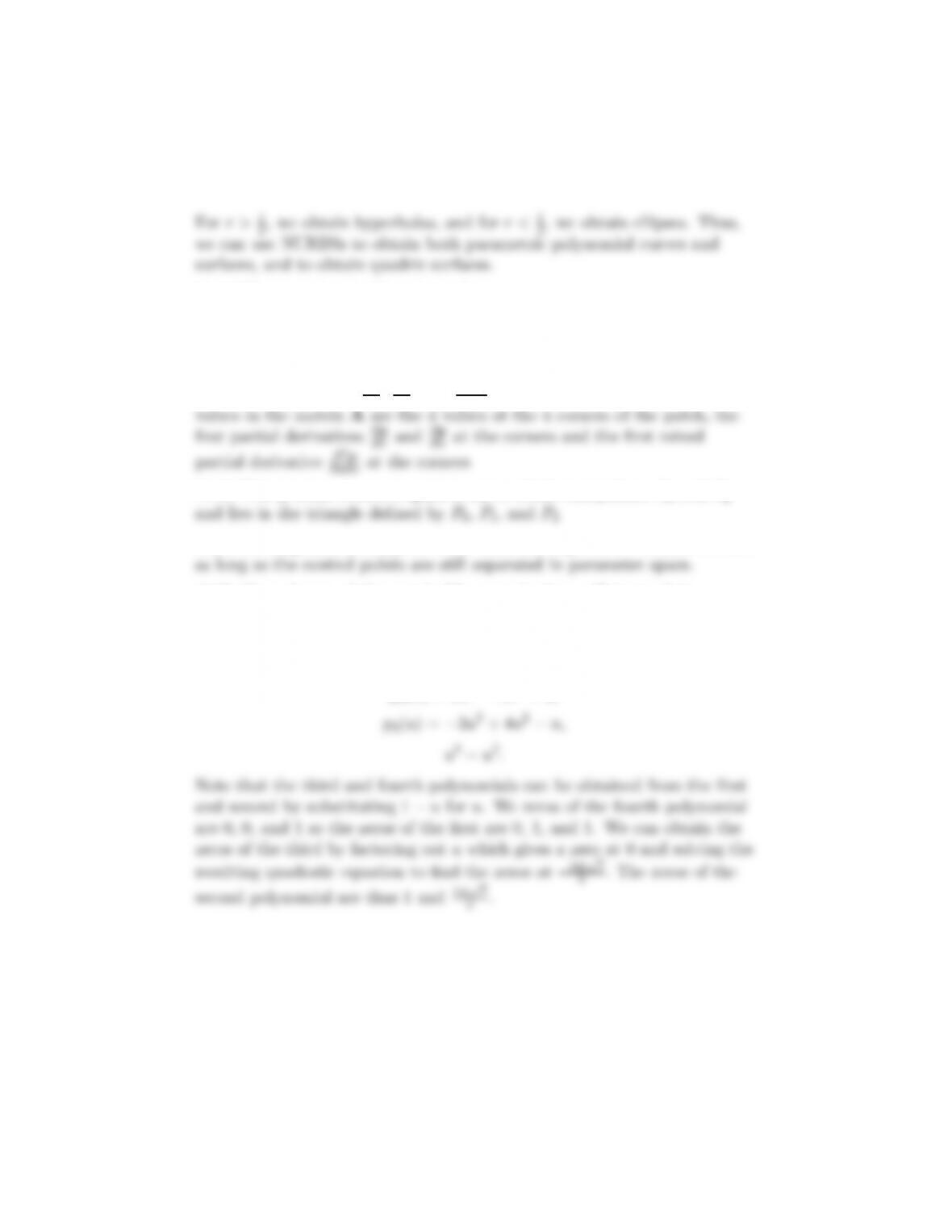
11.15 For r= 0 we get the line between P0and P2. For r=1
2we get the
parabola u2P0+ 2u(1 −u)P1+ (1 −u)2P2which passes through P0and P2.
1
11.17 We can write the Hermite surface as
p(u, v) = uTMHQMT
Hv=uTAv,
where Qcontains the control point data and MHis the Hermite geometry
matrix. If evaluate p,∂p
∂u ,∂p
∂v , and ∂2p
∂u∂v at the corners we find that the 16
11.19 This process creates a quadric curve which interpolates P0and P2
11.21 Nothing unusual happens other than the slope at u= 0 must be zero
11.25 The columns of the matrix MRcontain the coefficients of the
blending polynomials which are
p0(u) = −u3+ 2u2−u,
p1(u) = 2u3−5u2+ 2,
2