Full Feasibility Analysis
From “Preparing Effective Business Plans” by Bruce R. Barringer
Note:
All fields can be expanded to provide additional space to respond to the questions. A
copy of this template, along with each of the assessment tools, is also available in PDF
format at the authors’ Web site at www.prenhall.com/entrepreneurship.
Introduction
A.
Name of the proposed business
B.
Name of the founder (or founders)
C.
One paragraph summary of the business
Part 1: Product/Service Feasibility
Issues Addressed in This Part
A.
Product/service desirability
B.
Product/service demand
Assessment Tools
Concept Statement Test
• Write a concept statement for your product/service idea. Show the concept statement
to 5 to 10 people. Select people who will give you informed and candid feedback.
• Summarize the information you obtain from the concept statement into the following
three categories:
*
Strengths of the product or service idea—things people who evaluated your
product or service concept said they “liked” about the idea
Buying Intentions Survey
• Distribute the concept statement to 15 to 30 prospective customers (do not include
any of the people who completed the concept statement test) with the following
buying intentions survey attached. Ask each participant to read the concept statement
and complete the buying intentions survey. Record the number of people who
participated in the survey and the results of the survey here.
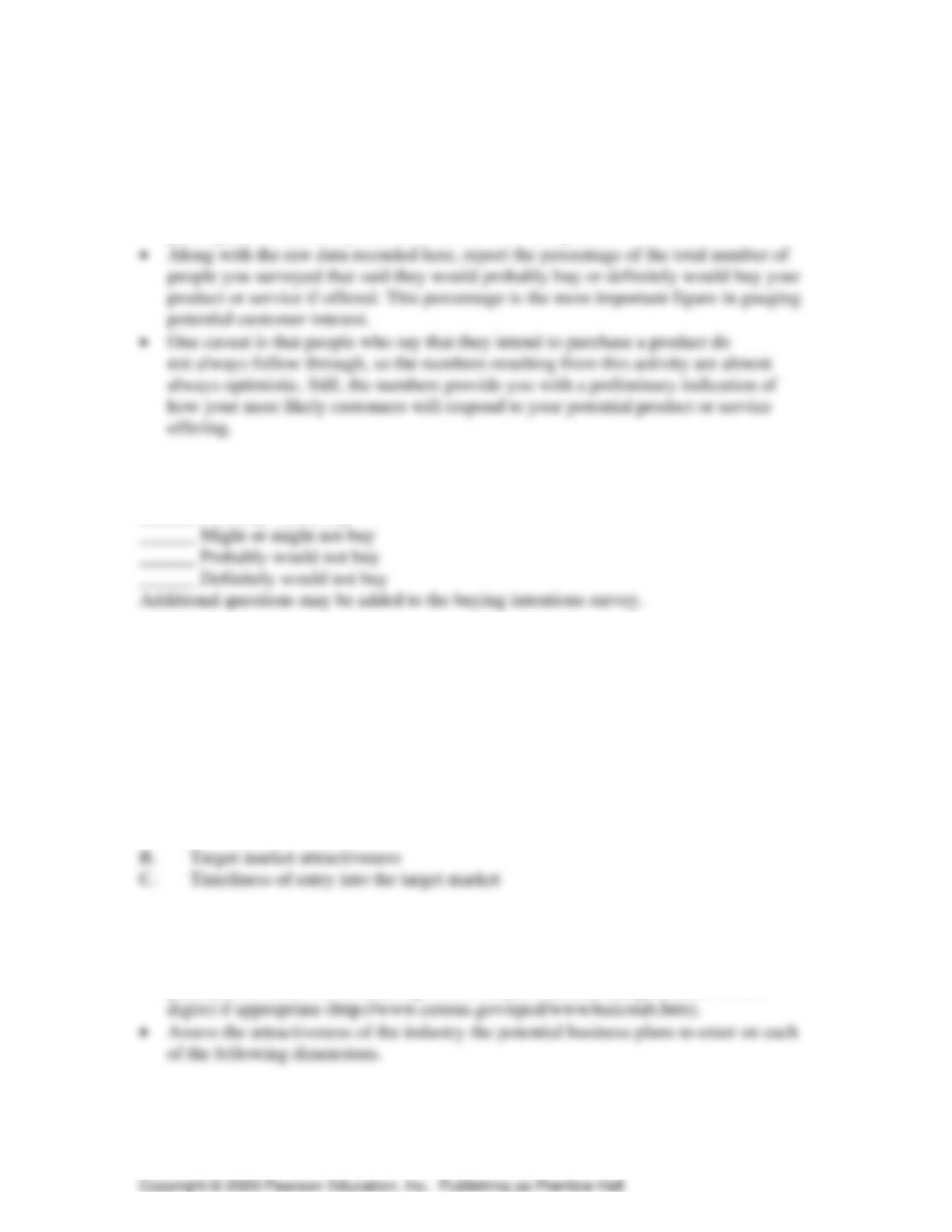
How likely would you be to buy the product or service described above?
______ Definitely would buy
______ Probably would buy
Conclusion (expand fields and report findings, in discussion form, for each area)
A.
Product/service desirability
B.
Product/service demand
C.
Product/service feasibility (circle the correct response)
Not Feasible Unsure Feasible
D.
Suggestions for improving product/service feasibility.
Part 2: Industry/Market Feasibility
Issues Addressed in This Part
A.
Industry attractiveness
B.
Target market attractiveness
C.
Timeliness of entry into the target market
Assessment Tools
Industry Attractiveness
• To the extent possible, assess the industry at the five-digit NAICS code level your
potential business will be entering. Use a broader industry category (less NCICS
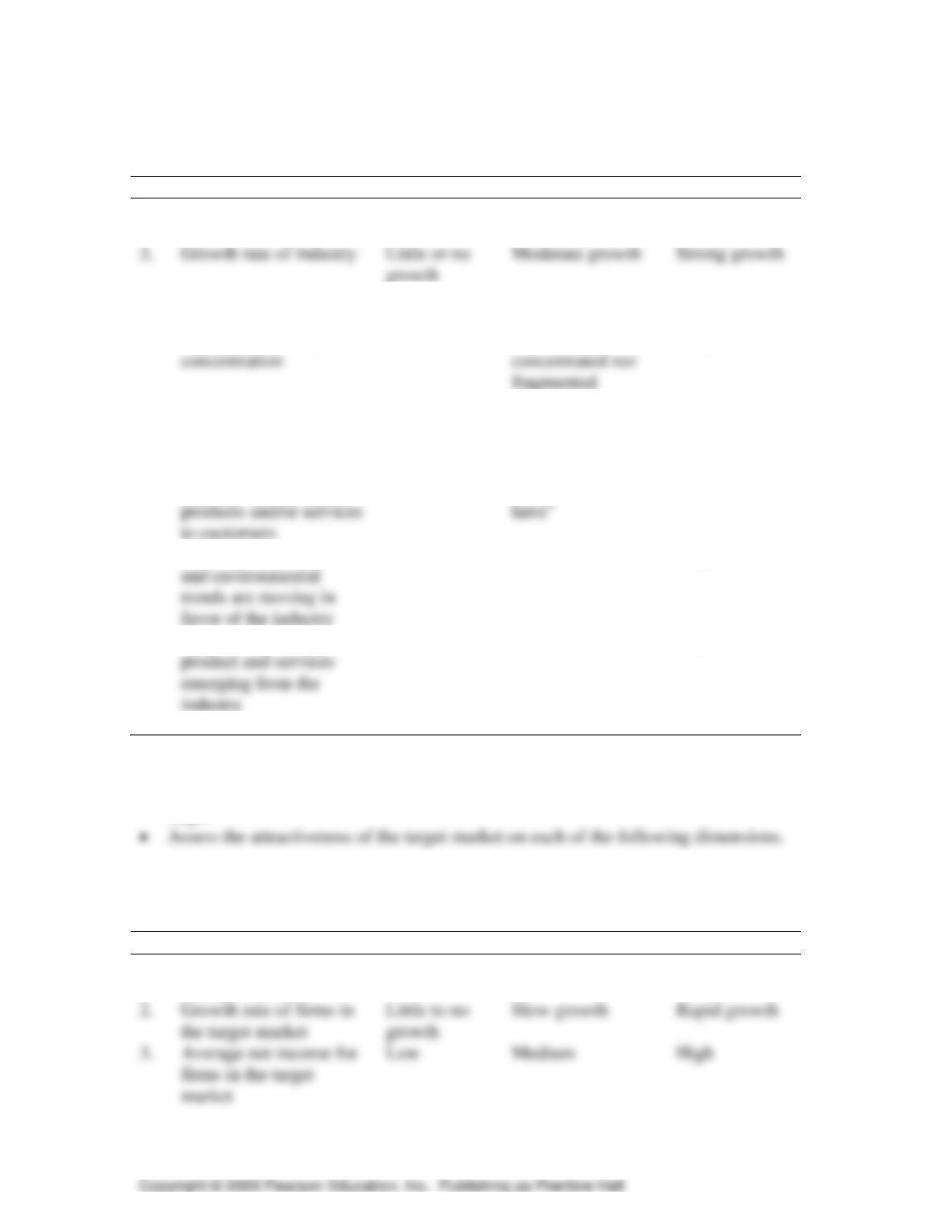
Industry Attractiveness Assessment Tool
(used to assess the broad industry, rather than the specific target market, you plan
to enter)
Low Potential
Moderate Potential
High Potential
1.
Number of competitors
Many
Few
None
2.
Age of industry
Old
Middle aged
Young
3.
Growth rate of industry
Little or no
growth
Moderate growth
Strong growth
4.
Average net income for
firms in the industry
Low
Medium
High
5.
Degree of industry
Concentrated
Neither
Fragmented
6.
Stage of industry life
cycle
Maturity
phase or
decline phase
Growth phase
Emergence
phase
7.
products and/or services
to customers
Importance of industry’s
“Ambivalent”
“Would like to
“Must have”
8.
and environmental
trends are moving in
favor of the industry
Extent to which business
Low
Medium
High
9.
product and services
emerging from the
industry
Number of exciting new
Low
Medium
High
10.
Long-term prospects
Weak
Neutral
Strong
Target Market Attractiveness
• Identify the portion or specific market within your broader industry that you plan to
target.
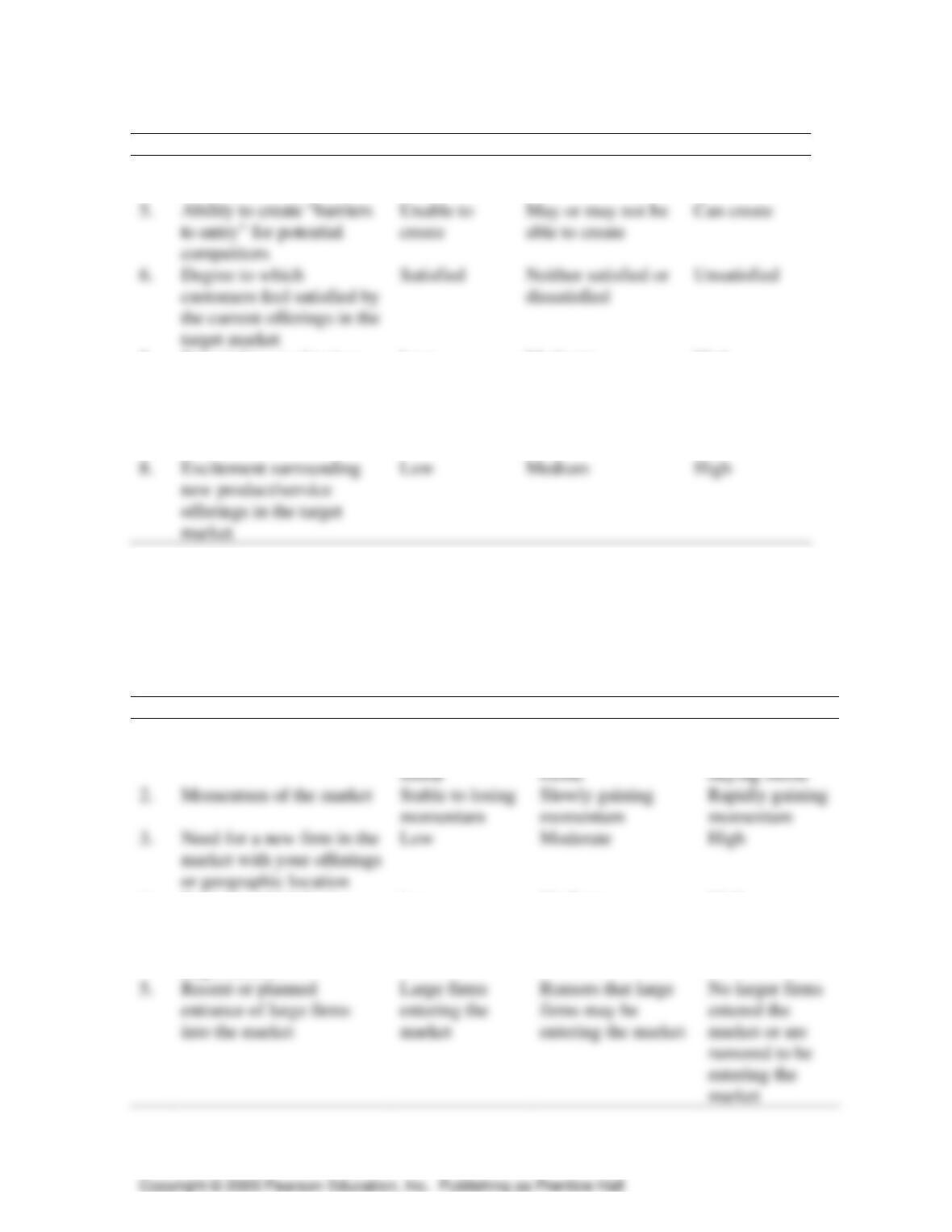
Target Market Attractiveness Assessment Tool
(used to assess the specific target market, rather than the broader industry, you
plan to enter)
Low Potential
Moderate Potential
High Potential
1.
Number of competitors
in target market
Many
Few
None
2.
Growth rate of firms in
the target market
Little to no
growth
Slow growth
Rapid growth
firms in the target
market
Low Potential
Moderate Potential
High Potential
4.
Methods for generating
revenue in the industry
Unclear
Somewhat clear
Clear
5.
to entry” for potential
competitors
Unable to
create
May or may not be
able to create
Can create
customers feel satisfied by
the current offerings in the
target market
dissatisfied
7.
Potential to employ low
cost guerrilla and/or buzz
marketing techniques to
promote the firm’s product
or services
Low
Moderate
High
new product/service
offerings in the target
market
Market Timeliness
• Determine the extent to which the “window of opportunity” for the proposed business
is open or closed based on the following criteria.
• Determine the timeliness of entering a specific target market based on other criteria.
Market Timeliness Assessment Tool
Low Potential
Moderate Potential
High Potential
1.
mood
mood
buying mood
2.
Momentum of the market
Stable to losing
momentum
Slowly gaining
momentum
Rapidly gaining
momentum
3.
Need for a new firm in the
market with your offerings
or geographic location
Low
Moderate
High
Buying mood of
customers
Customers are
not in a buying
Customers are in a
moderate buying
Customers are
in an aggressive
4.
Extent to which business
and environmental trends
are moving in favor of the
target market
Low
Medium
High
entering the
market
Conclusion (expand fields and report findings, in discussion form, for each area)
A.
Industry attractiveness
Target market attractiveness
Market timeliness
Industry/market feasibility (circle the correct response)
Suggestions for improving industry/market feasibility.
Part 3: Organizational Feasibility
Issues Addressed in This Part
A.
Management prowess
Resource sufficiency
Assessment Tools
Management Prowess
• Use the following table to candidly and objectively rate the “prowess” of the founder
or group of founders who will be starting the proposed venture.
Management Prowess Assessment Tool
Low Potential
Moderate Potential
High Potential
1.
Passion for the business
idea
Low
Moderate
High
2.
Relevant industry
experience
None
Moderate
Extensive
experience
4.
Depth of professional
and social networks
Weak
Moderate
Strong
5.
management team
members
Creativity among
Low
Moderate
High
in cash flow
management
6.
Experience and expertise
None
Moderate
High
7.
College graduate
No college
education
Some college
education but not
currently in college
Graduated or
are currently
in college
Resource Sufficiency
• The focus in this section is on nonfinancial resources. Use the following table to rate
your “resource sufficiency” in each category.
• The list of resources is not meant to be exhaustive. A list of the 6 to 12 most critical
nonfinancial resources for your proposed business is sufficient.
An explanation of the rating system used in the first portion of the table is as follows:
1
Available
2
Likely to be available: will probably be available and will be within my budget
3
Unlikely to be available: will probably be hard to find or gain access to, and
may exceed my budget
4
Unavailable
Resource Sufficiency Assessment Tool
Ratings
Resource Sufficiency
1 2 3 4 5
Office space
1 2 3 4 5
Lab space, manufacturing space, or space to launch a
service business
1 2 3 4 5
Contract manufacturers or outsource providers
1 2 3 4 5
Key management employees (now and in the future)
1 2 3 4 5
Key support personnel (now and in the future)
1 2 3 4 5
Key equipment needed to operate the business
(computers, machinery, delivery vehicles)
aspects of the business
1 2 3 4 5
Support of local and state government if applicable for
business launch
1 2 3 4 5
Ability to form favorable business partnerships
Ratings: Strong, Neutral,
or Weak
Proximity to similar firms (for the purpose of knowledge
sharing)
Proximity to suppliers
Proximity to customers
Proximity to a major research university (if applicable)
Conclusion (expand fields and report findings, in discussion form, for each area)
A.
Management prowess
Resource sufficiency
D.
Suggestions for improving organizational feasibility
Part 4: Financial Feasibility
Issues Addressed in This Part
A.
Total startup cash needed
Financial performance of similar businesses
Overall financial attractiveness of the proposed venture
Assessment Tools
Total Start-Up Cash Needed
• The startup costs (which include capital investments and operating expenses) should
include all the costs necessary for the business to make its first sale. New firms
typically need money for a host of purposes, including the hiring of personnel, office
or manufacturing space, equipment, training, research and development, marketing,
and the initial product rollout.
Total Startup Cash Needed (to Make First Sale)
Capital Investments
Amount
Property
Furniture and fixtures
Computer equipment
Other equipment
Vehicles
Operating Expenses
Amount
Legal, accounting, and professional services
Advertising and promotions
Deposits for utilities
Licenses and permits
Prepaid insurance
Lease payments
Salary and wages
Payroll taxes
Travel
Signs
Tools and supplies
Starting inventory
Cash (working capital)
Other expense 1
Other expense 2
Total Startup Cash Needed =
Comparison of the Financial Performance of Proposed Venture to Similar Firms
• Use the following tables to compare the proposed new venture to similar firms in
regard to annual sales (Year 1 and Year 2) and profitability (Year 1 and Year 2).
Comparison of the Financial Performance of Proposed Venture to Similar Firms
Assessment Tool
Annual Sales
Estimate of Proposed Venture’s
Annual Sales—Year 1
Explanation of How the Estimate
Was Computed
Estimate of Year 1 Sales __________
Summary: How proposed annual sales, on
average, compares to similar firms (circle one)
Net Income
Estimate of Proposed Venture’s
Net Income—Year 1
Explanation of How the Estimate
was Computed
Estimate of Year 1 Net Income __________
Summary: How proposed net income, on
average, compares to similar firms (circle one)
Overall Financial Attractiveness of the Proposed Venture
• The following factors are important in regard to the overall financial attractiveness of
the proposed business.
Overall Financial Attractiveness of Proposed Venture Assessment Tool
Low Potential
Moderate Potential
High Potential
1.
three years in a clearly
defined target market
Steady and rapid growth in
Unlikely
Moderately likely
Highly likely
2.
that once you win a client,
recurring sources of
revenue
High percentage of
recurring income—meaning
Low
Moderate
Strong
3.
Ability to forecast income
and expenses with a
reasonable degree of
certainty
Weak
Moderate
Strong
4.
available within two years
to finance growth
Likelihood that internally
Unlikely
Moderately likely
Highly likely
5.
Availability of exit
opportunity for investor if
applicable
Unlikely to be
unavailable
May be available
Likely to be
available
Conclusion (report finding for each area)
A.
Total startup cash needed
Financial performance of similar businesses
Financial feasibility (circle the correct response)
D.
Suggestions for improving financial feasibility
Overall Feasibility: Summary and Conclusion
Overall Feasibility of the
Business Idea Based on
Each Part
Suggestions for Improving
the Feasibility
Product/Market Feasibility
Not feasible
Unsure
Feasible
Industry/Market Feasibility
Not feasible
Unsure
Feasible
Organizational Feasibility
Not feasible
Unsure
Feasible
Financial Feasibility
Not feasible
Unsure
Feasible
Not feasible
Unsure
Feasible
Conclusion—briefly summarize your justification for your overall assessment.