XEROX MISCOPIES FOREIGN INTEREST RATE DATA
1
SUGGESTED ANSWERS TO XEROX MISCOPIES FOREIGN INTEREST RATE DATA
1. What is the purpose and consequence of using a discount rate that is close to the market interest rate in
valuing lease rentals?
2. Why were interest rates so high in Mexico in the late 1990s? What factors were built into these interest
rates?
3. Assuming a $10,000 copier price, $3,500 residual value in present value terms, and a five-year lease,
what was the consequence of Xerox Mexico booking peso revenues using interest rates of 20%, 18% in
1997, 10% in 1998, and 6% in 1999 instead of the comparable Mexican interest rates during this period of
34.4% in 1996, 22.5% in 1997, 24.5% in 1998, and 24.1% in 1999? That is, on each $10,000 copier lease
for each year, how much revenue did Xerox Mexico book? Compare those figures to their present values
using the market rates. Note: The case does not specify that the lease term is five years or that the interest
rate used in 1996 was 20%. Please notify students to assume a five–year lease term and a 20% interest rate
in 1996 that was used to book these leases.
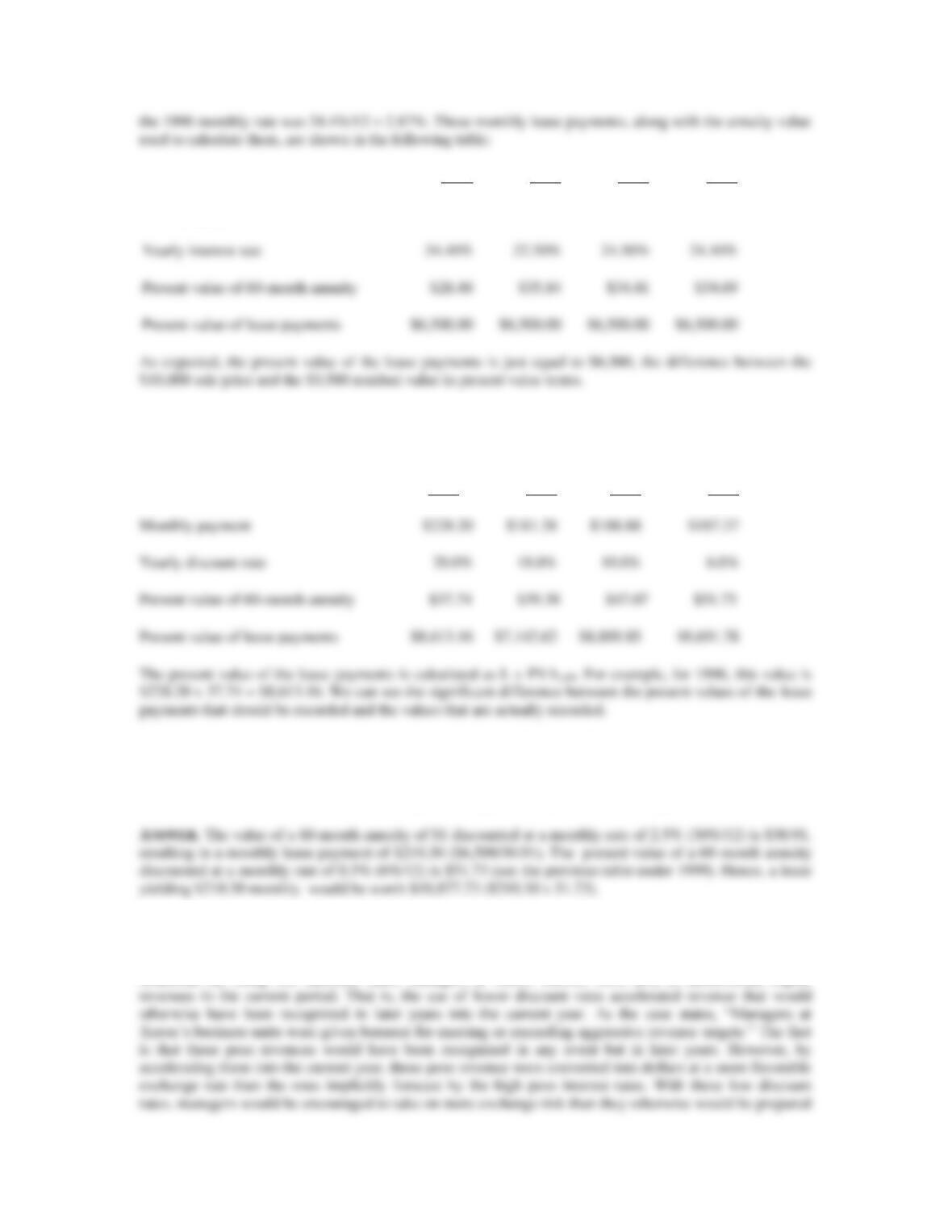
ANSWER. According to the formula given in the case, the lease payment is the solution L to the following
equation:
That is
XEROX MISCOPIES FOREIGN INTEREST RATE DATA
2
1996
1997
1998
1999
Monthly payment
$228.20
$181.38
$188.88
$187.37
Yearly interest rate
Present value of 60-month annuity
Present value of lease payments
The present value of these monthly lease payments and the annuity values using the discount rates that
Xerox actually used are shown in the table below:
1996
1997
1998
1999
$228.20
$181.38
$188.88
$187.37
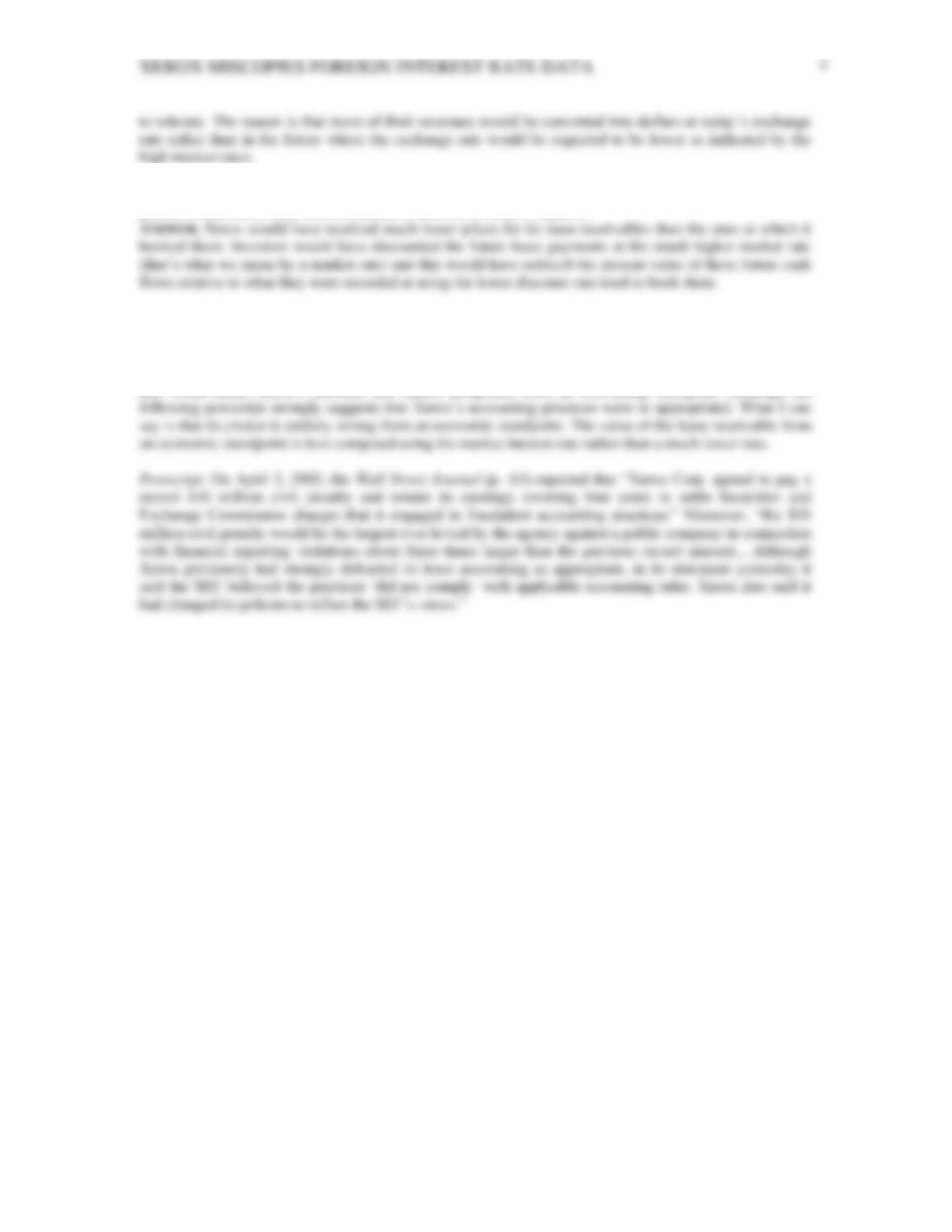
4. Apparently, Xerox used similarly rosy assumptions in Brazil as well. Instead of using a discount rate on
the order of 30%, Xerox used a 6% discount rate to record real revenues. Assuming the same $10,000
copier price and $3,500 residual value in present value terms, how much revenue was booked by using a
6% discount rate on a 60-month lease? Compare this figure to its present value using a 30% discount rate.
5. How did the use of low discount rates help managers at Xerox Mexico get their bonuses? How might
these low discount rates affect the amount of exchange risk that managers were willing to tolerate?
ANSWER. By using low discount rates, managers at Xerox Mexico were able to demonstrate higher
6. Suppose Xerox tried to sell its foreign lease receivables to an investor. What could you say about the
price it would likely receive as compared to their book values? Explain.
7. Do you agree or disagree with Xerox’s claim that it used proper accounting assumptions in booking its
revenues and recording asset values for foreign lease receivables? Explain.
ANSWER. Not being an accountant I cannot say whether these is some accounting peculiarity or technicality
that would make Xerox’s discount rate choice acceptable from an accounting standpoint (although the