230
Part I Case Studies
Case I.1 Will Argentina Devalue Its Peso?
In November 2000, Mike Lanning was reacting
to reports that Argentina might devalue its peso.
Such a decision would have important ramifica-
tions for his company, Wessen Development Inc.,
(WDI). WDI is contemplating entering a joint ven-
leads to capital outflows, which push interest rates
up and restrict the government’s access to interna-
tional debt markets. The currency board also
makes Argentina exposed to devaluations by its
Brazilian neighbor, such as occurred in January
41504_Pt1_Case_Studies_p230-238 2/22/02 10:15 AM Page 230
Case I.1 •Will Argentina Devalue Its Peso? 231
However, devaluation has its own problems.
For one thing, most of Argentina’s liabilities are
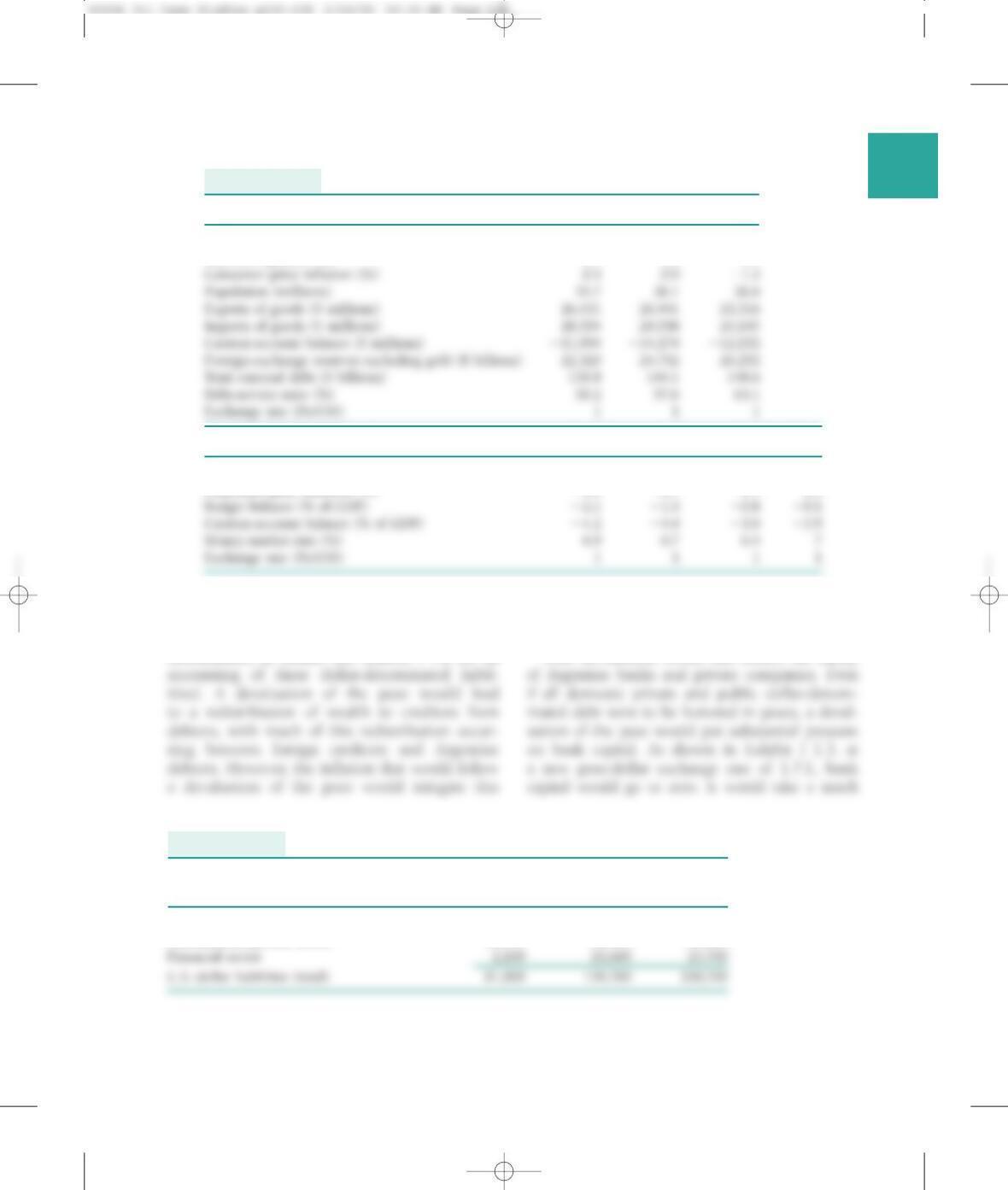
denominated in dollars (see Exhibit I 1.2 for an
wealth redistribution somewhat although it
would bring its own set of problems.
Peso devaluation would also reduce the equity
Exhibit I 1.2 Dollar-Denominated Argentine Liabilities
Local Foreign
creditors creditors Total
Non-financial public sector and central bank 32,200 81,000 113,200
Non-financial private sector 46,700 35,100 81,800
Exhibit I 1.1 Key Argentine Economic Indicators
Key indicators 1997 1998 1999
GDP ($ billions) 293.0 298.3 282.9
Real GDP growth (%) 8.1 3.9 3.1
Key indicators (forecast) 2000 2001 2002 2003
Real GDP growth (%) 0.8 3.7 3.4 3.7
Consumer price inflation (%) 0.9 0.7 0.4 1.3
232 Part I •Case Studies
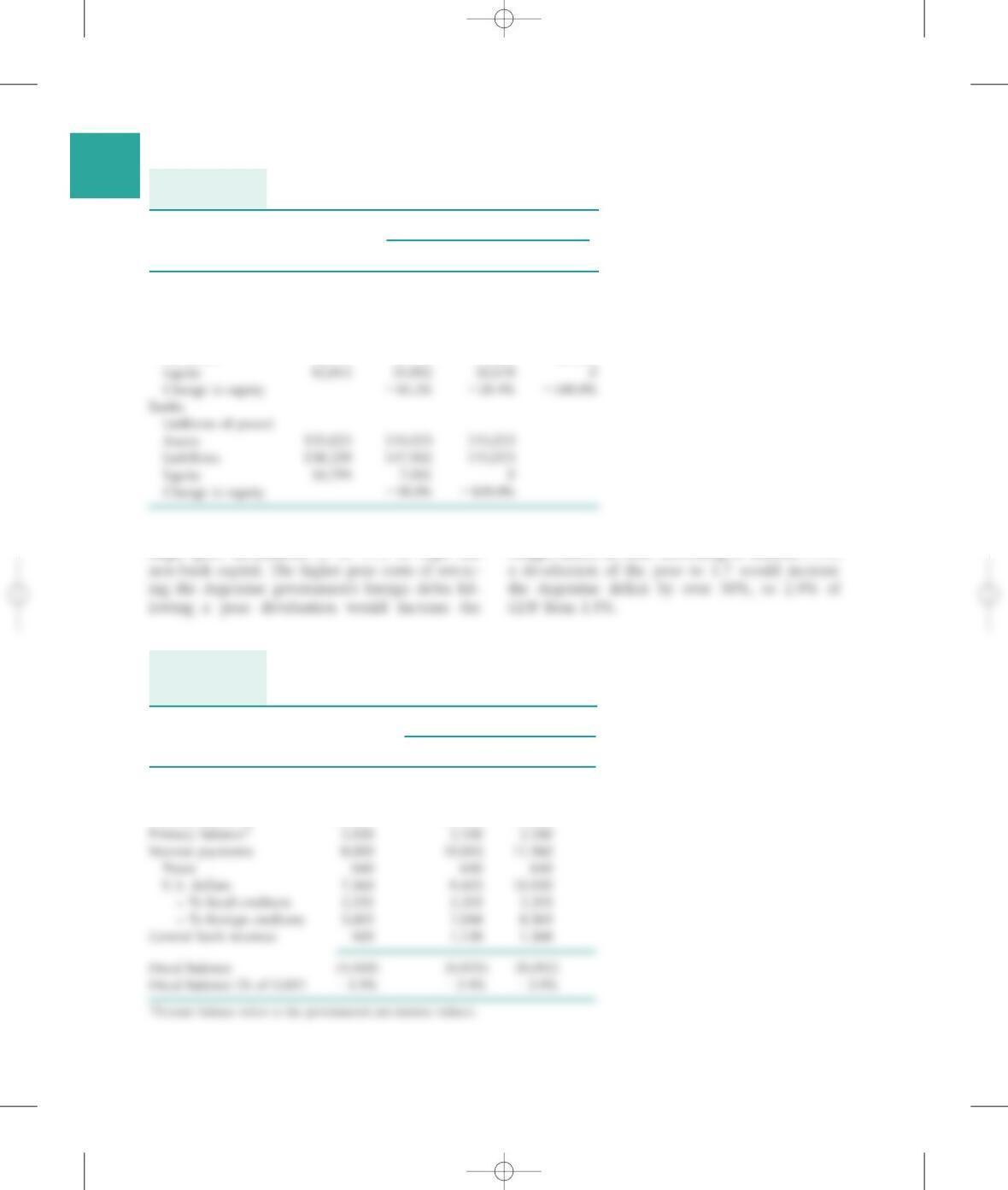
larger peso devaluation (1 to 3.5) to wipe out
budget deficit as well. According to Exhibit I 1.4,
Exhibit I 1.3 Private-Sector Impact of Peso
Devaluation
Post-Devaluation Scenarios
Current 1 2 3
Exchange rate 1.00 1.40 1.70 3.47
Non-financial sector
(millions of pesos)
Assets 80,890 80,890 80,890 80,890
Liabilities 38,046 44,988 50,211 80,890
Exhibit I 1.4
Public-Sector Impact of
Peso Devaluation (In Pesos
Unless Otherwise Indicated)
Post-Devaluation Scenarios
Current 1 2
Exchange rate 1.00 1.40 1.70
Total revenues 54,900 54,900 54,900
Primary spending 52,800 52,800 52,800
41504_Pt1_Case_Studies_p230-238 2/22/02 10:15 AM Page 232
Case I.2 •Brazil Fights a Real Battle 233
In talking to some investment bankers, Mike
Lanning was made aware that pressure for a peso
devaluation would likely decline if the promised
monetary easing by the Federal Reserve takes
place. Lower U.S. interest rates would lead to
lower Argentine rates and stronger economic
result in widening spreads between peso- and
dollar-denominated bonds, leaving the Argentine
economy with high credit costs, less investment,
and slower economic growth. Proponents claim
that dollarization, by reducing the risk of devalu-
ation, would result in lower Argentine interest
rates and faster economic growth. The tradeoff is
the loss of monetary policy options that would
ensue once the Argentine peso is completely
abolished. Most important of these is that dollar-
ization appears to preclude a “lender of last
resort.” However, Argentina has a limited lender–
of-last-resort capacity through its Contingent
Repurchase Facility, which offers a temporary
source of funds to illiquid banks. This facility,
which was arranged in 1996, gives Argentina the
option to sell government bonds to a group of
international banks under a repurchase agree-
ment. Another cost of dollarization would be the
Argentine government’s loss of seignorage.
Currently, the currency board stands ready to
Questions
1. What are the pros and cons of Argentine peso
devaluation?
2. Given these pros and cons, what is the likeli-
hood that Argentina will devalue its peso?
3. What are the pros and cons of dollarization?
4. What are the likely consequences of peso
devaluation for the Mega project?
5. What effects would dollarization likely have
on the Mega project?
6. What alternatives are available to stimulate
Argentina’s economic growth independent of
exchange rate policy?
Case I.2 Brazil Fights A
Real
Battle
In 1994, with inflation running at close to 50%
monthly and Brazil’s economy near collapse,
Fernando Cardoso was elected president. A for-
and the cornerstone of his popularity: a stable
Brazilian real. Fallout from the Asian crisis has
been more acute in Brazil than elsewhere in
234 Part I •Case Studies
sophisticated, traits that are a legacy of the past
three decades when rampant inflation and abrupt
policy shifts forced traders to be brutally prag-
matic and move quickly to survive.
The speculators may have met their match in
ment (see Exhibit I 2.2 for statistics on the
Brazilian economy). However, Brazil’s current
account deficit is mounting, its foreign exchange
reserves are falling, and financial markets are get-
ting nervous that the real will suffer the same
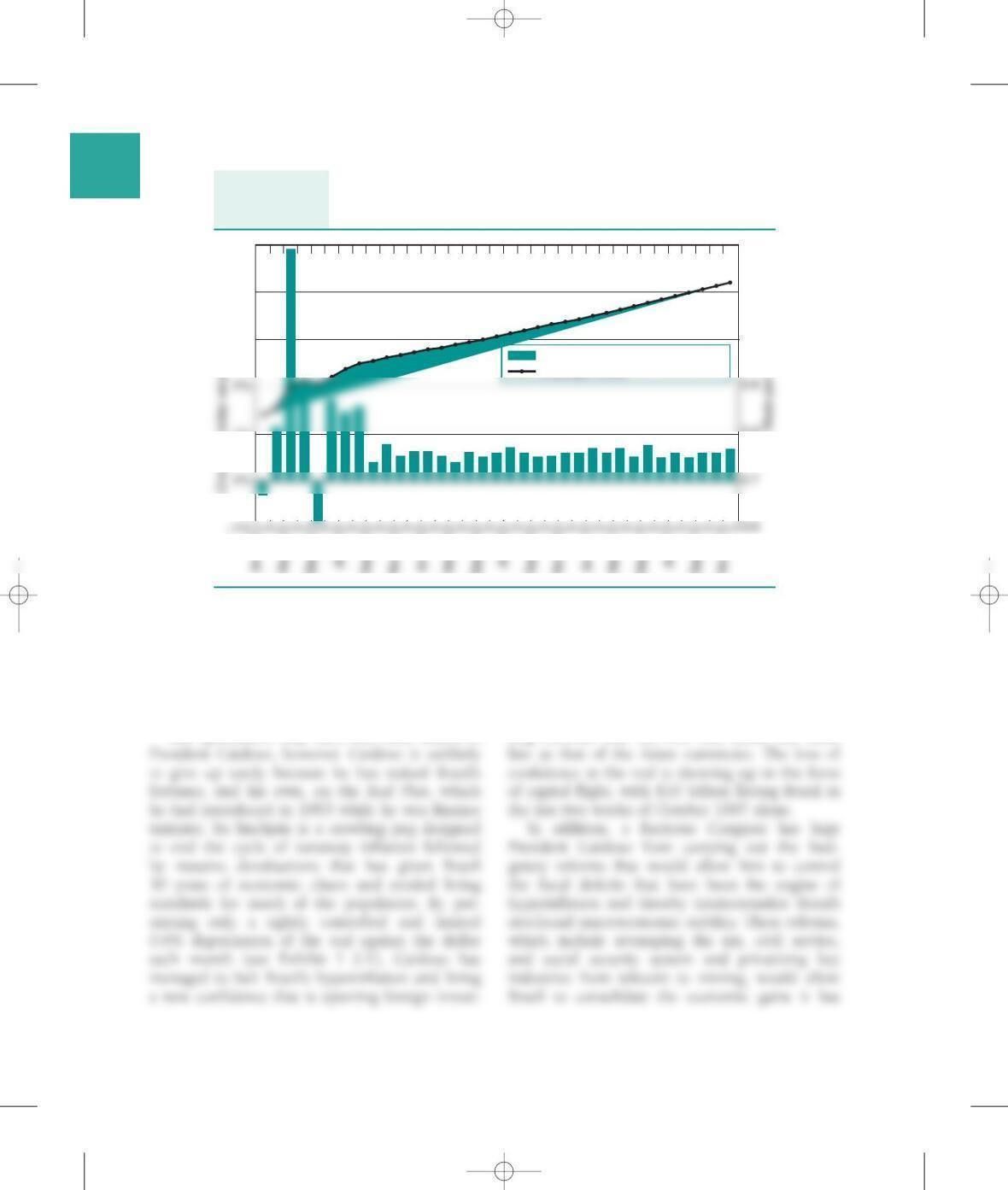
Exhibit I 2.1
Brazil’s Crawling Peg Leads to a Gradual
Devaluation of the
Real
against the U.S.
Dollar
real
5%
4%
3%
1%
Nov-97
Sep-97
May-97
Mar-97
Nov-96
Sep-96
May-96
Mar-96
Nov-95
Sep-95
May-95
Mar-95
1.2
1.1
1
0.8
Change in dollar value of the
real
Reais per dollar
Source: International Financial Statistics, various editions.
41504_Pt1_Case_Studies_p230-238 2/22/02 10:15 AM Page 234
Case I.2 •Brazil Fights a Real Battle 235
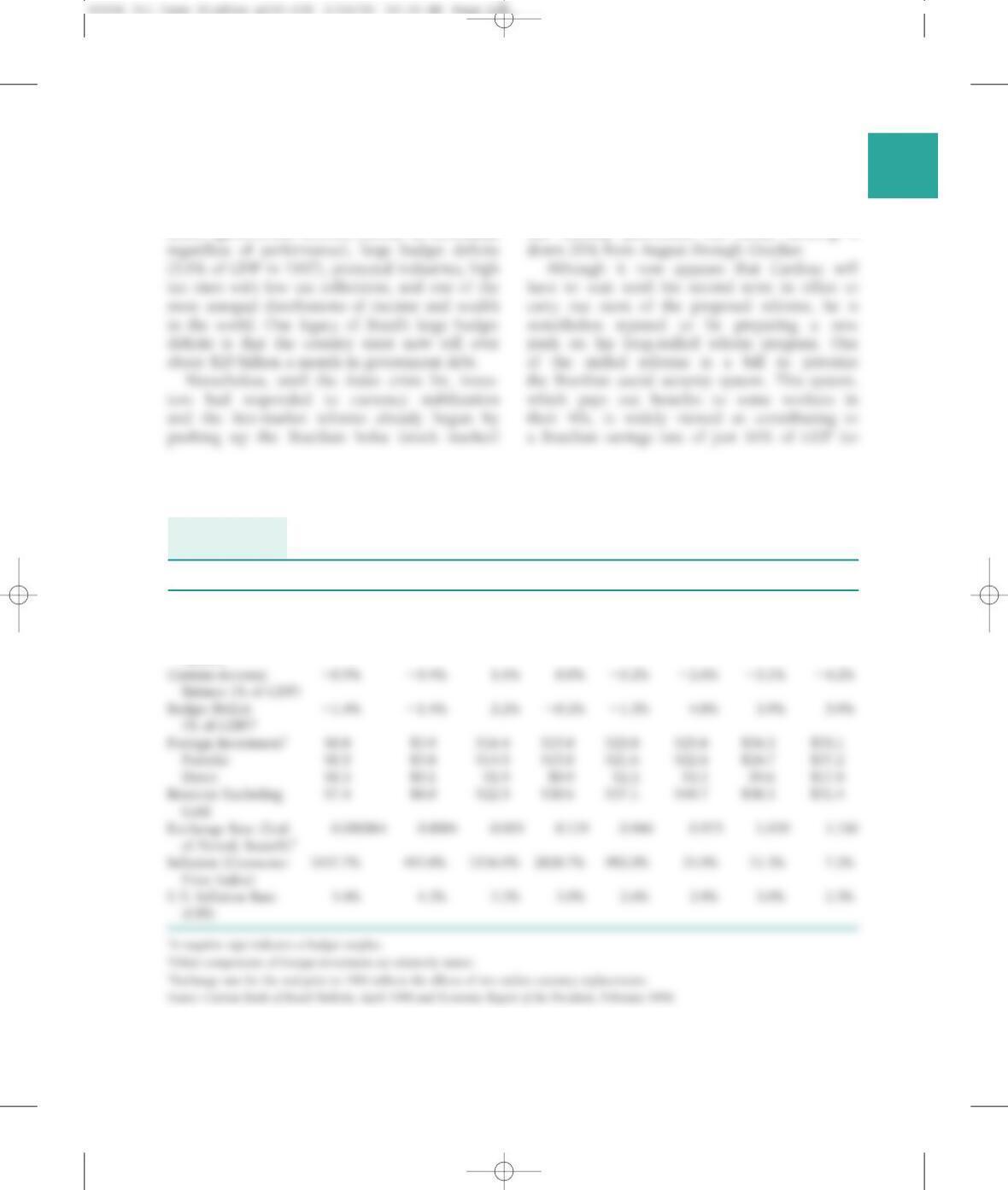
Exhibit I 2.2 Key Brazilian Economic Statistics (In U.S. $ billions unless
otherwise indicated)
1990 1991 1992 1993 1994 1995 1996 1997
Gross Domestic $445.9 $386.2 387.3 $429.7 $543.1 $705.4 $775.4 $803.0
Product
Current-Account $3.8 $1.5 $6.1 $0.0 $1.2 $18.1 $24.3 $33.8
Balance
already made, give investors greater confidence
in the economy’s future, and speed up Brazil’s
growth rate. As of now, Brazil has a bloated public
sector (government workers cannot be dismissed,
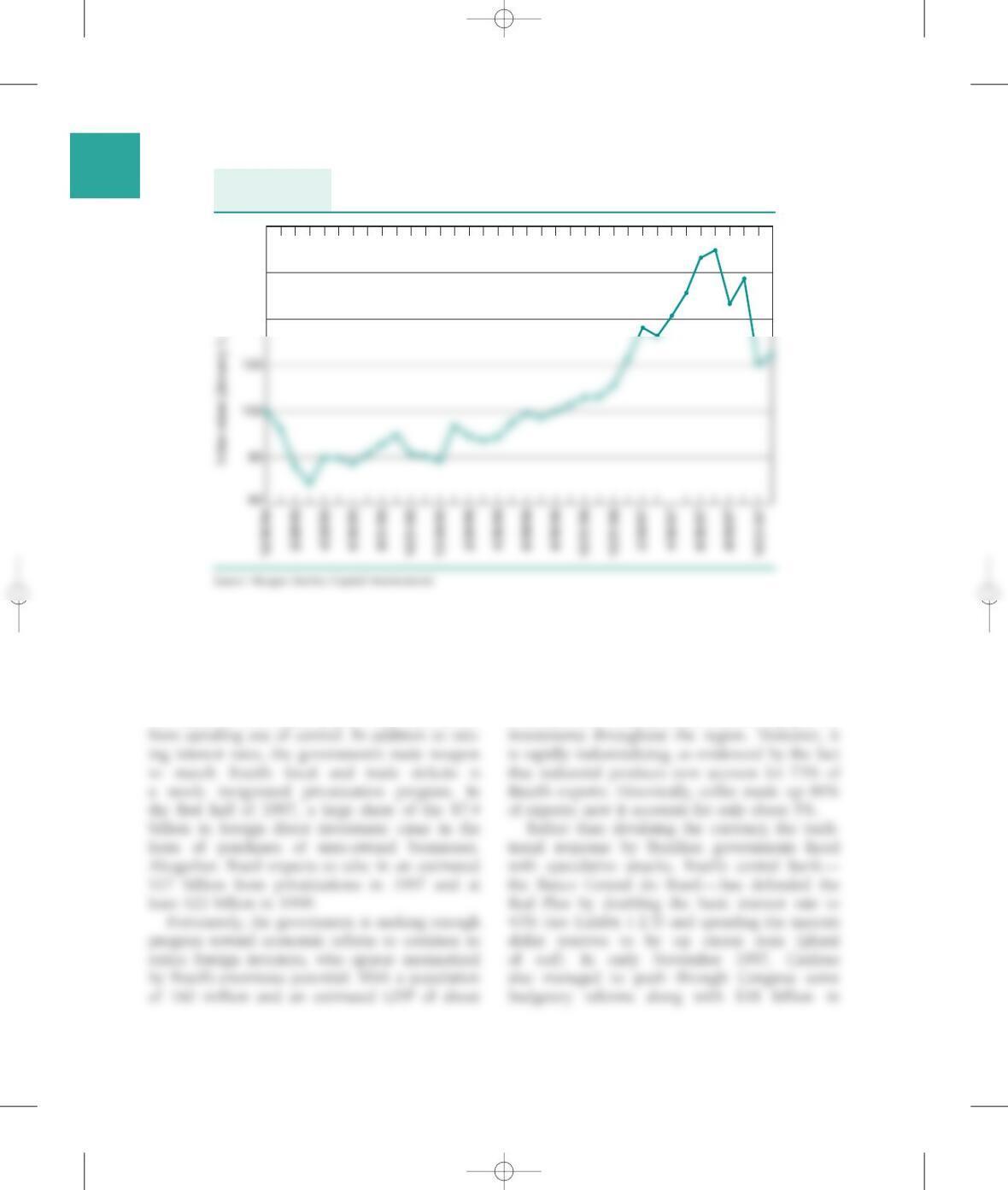
by about 158% from January 1994, when the
Real Plan took hold, to October 1997 (see Exhibit
I 2.3). However, contagion from the Asian crisis
has recently pummeled the bolsa, sending it
236 Part I •Case Studies
put this number into perspective, Asian countries
average closer to 30%). Until the presidential
election in October 1998, Cardoso expects to
maintain a tight-money policy that will support
the real and, it is hoped, prevent the trade deficit
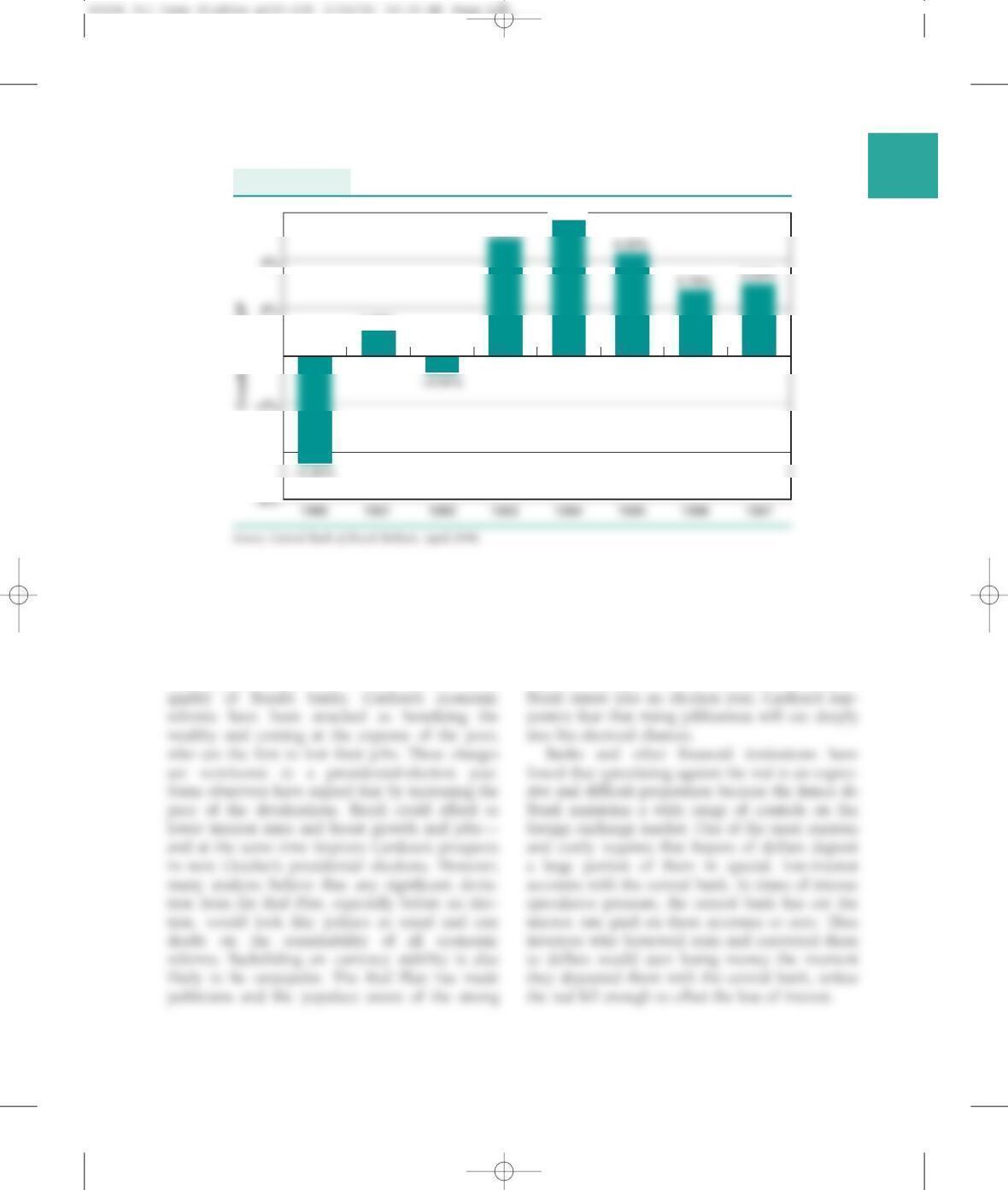
$800 billion that has grown at an average rate of
more than 4% annually since 1993 (see Exhibit I
2.4), Brazil is by far the largest market in Latin
America (representing about 45% of total Latin
American GDP) and provides a launching pad for
Exhibit I 2.3 Brazilian Bolsa in U.S. Dollars:
January 1995– November 1997
180
160
140
41504_Pt1_Case_Studies_p230-238 2/22/02 10:15 AM Page 236
Case I.2 •Brazil Fights a Real Battle 237
spending cuts and tax increases, equivalent to
more than 2% of GDP. The real’s defense is not
cost-free, however. The high real interest rates are
expected to slow GDP growth in 1998 to 1.5%,
from 3% in 1997. They are also pushing up the
unemployment rate and worsening the credit
link between devaluation and inflation. Thus, any
policy changes that threaten the low inflation
wrought by currency stability is likely to be politi-
cally risky. However, the recent austerity measures
are also unpopular and are croding Cardoso’s
approval ratings. With a recession looming as
Exhibit I 2.4 Brazil’s Economic Growth Rate: 1990 –1997
6%
0%
–4%
1.03%
4.92%
5.85%
238 Part I •Case Studies
Questions
1. How does Brazil hope to control its current-
account deficit through a tight monetary
policy? What alternatives are available to
control Brazil’s current-account deficit?
2. How will Brazil’s tight money policy affect its
fiscal deficit? How will it affect Brazil’s real
(inflation-adjusted) interest rates, both short-
term and long-term rates?
3. Why have Brazil’s interest rates generally fall-
en in recent years?
4. How would reform and privatization of
the social security system improve Brazil’s
savings rate? What would be the likely con-
sequences of this improvement for Brazil’s
current-account balance and the real’s value?
Explain.
5. What are the costs and benefits of using cur-
rency controls to defend the real?
6. Why might speculators view the real as
being overvalued? Based on the data in the
case, what is your best estimate as to the
real’s degree of overvaluation?
7. What are the tradeoffs that President
Cardoso must consider in deciding whether
to accelerate the real’s depreciation?
8. Could Brazil have avoided the recessionary
impacts of its monetary policy if it had
devalued the real instead?
9. What would a Brazilian devaluation do to
the currencies and economies of Argentina
and Chile, its neighbors and largest trading
partners?
10. What is the link between Brazil’s budget
deficits and its historical hyperinflation?
11. What mix of fiscal and monetary policy
would you recommend to President
Cardoso? Should he devalue or defend the
real?
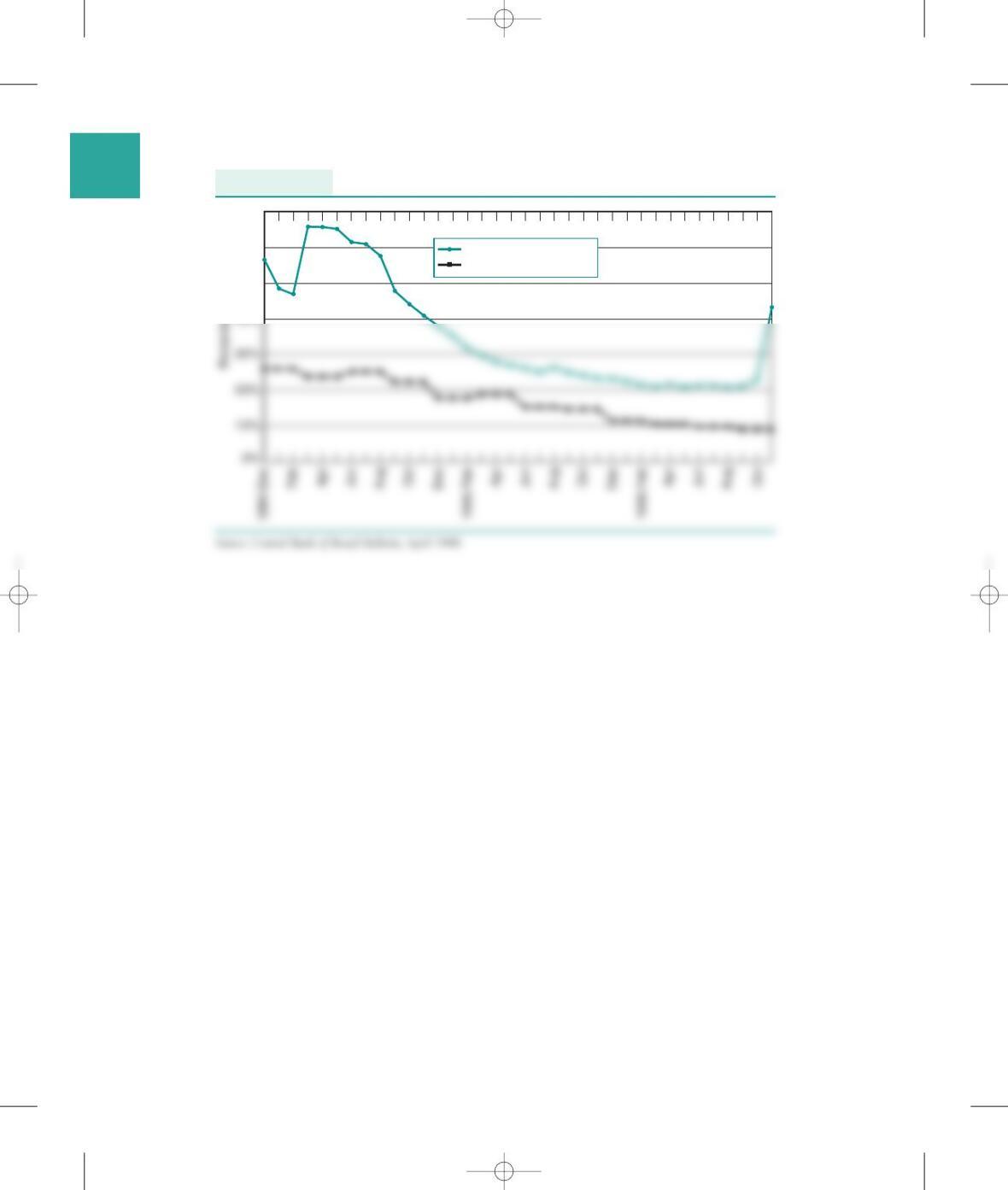
Exhibit I 2.5 Brazilian Interest Rates
70%
60%
50%
Money-market rate
Long-term interest rate
41504_Pt1_Case_Studies_p230-238 2/22/02 10:15 AM Page 238