Chapter 9 Cash Flow and Capital Budgeting 265
c and d.
1
2
3
4
5
NPV at
10%
NPV at
15%
P9-16. TechGiant Inc. (TGI) is evaluating a proposal to acquire Fusion Chips, a young company
with an interesting new chip technology. This technology, when integrated into existing
TGI silicon wafers, will enable TGI to offer chips with new capabilities to companies with
1. TGI’s superior manufacturing capabilities will enable Fusion to increase its gross mar-
gin on its existing products to 45 %.
2. TGI’s massive sales force will enable Fusion to increase sales of its existing products
by 10 % above current projections (for example, if acquired, Fusion will sell $110 mil-
3. TGI’s more efficient receivables and inventory management systems will allow Fusion
to increase its sales as previously described without making investments in receivables
4. TGI’s current cash reserves are more than sufficient for the combined company, so Fu-
sion’s existing cash balances will be reduced to $0.
5. Immediately after the acquisition, TGI will invest $50 million in fixed assets to manu-
facture a new chip that integrates Fusion’s technology into one of TGI’s best-selling
products. These assets will be depreciated on a straight-line basis for eight years. After
6. Both companies face a tax rate of 34 %.
266 Instructor’s Manual
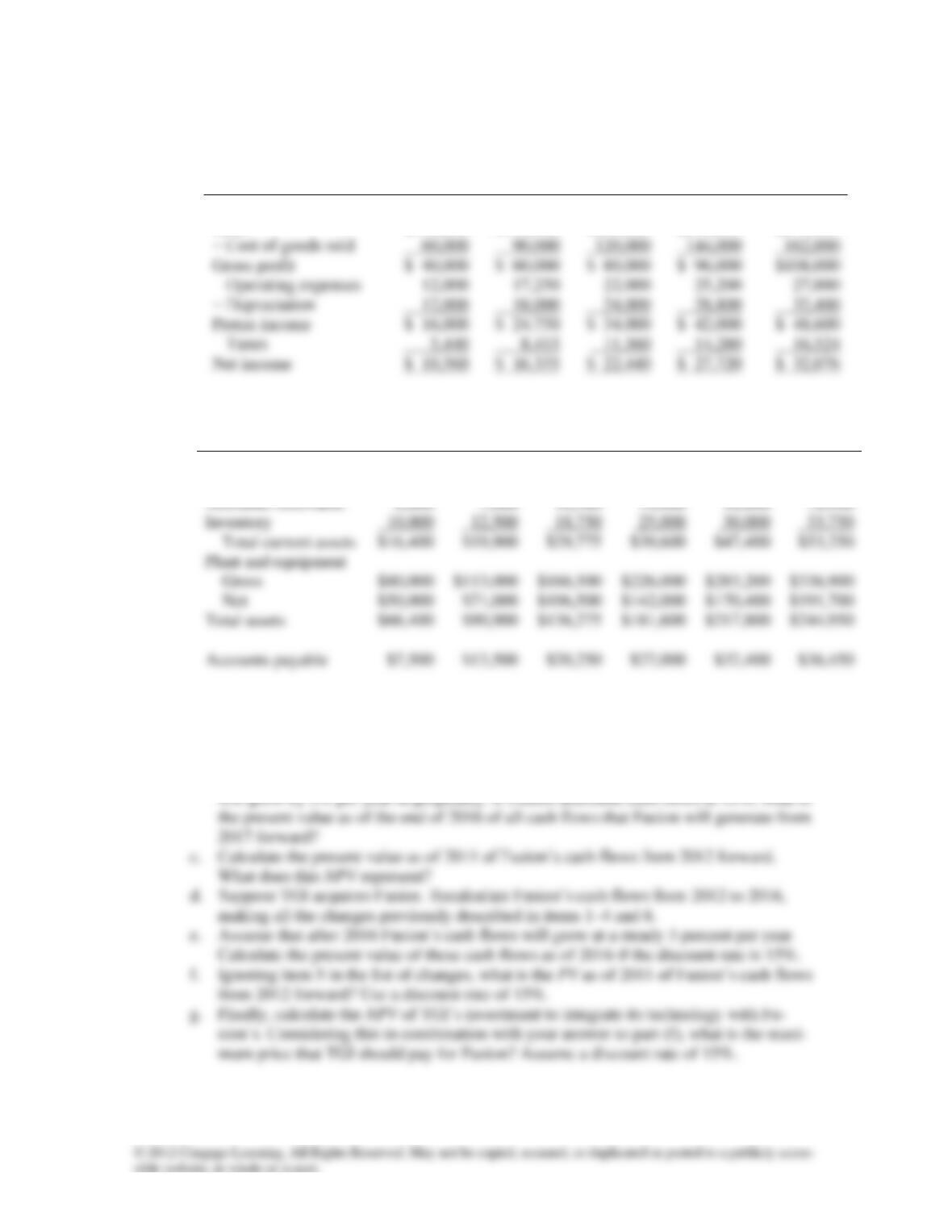
Fusion Chips Income Statements
($ in thousands for years ended December 31)
2012
2013
2014
2015
2016
Sales
$100,000
$150,000
$200,000
$240,000
$270,000
Gross profit
$ 40,000
$ 60,000
$ 80,000
$ 96,000
$108,000
12,000
18,000
24,000
28,800
32,400
Pretax income
$ 16,000
$ 24,750
$ 34,000
$ 42,000
$ 48,600
Net income
$ 10,560
$ 16,335
$ 22,440
$ 27,720
$ 32,076
Fusion Chips Assets and Accounts Payable
($ in thousands on December 31)
2011
2012
2013
2014
2015
2016
Cash
$ 400
$ 400
$ 525
$ 600
$ 600
$ 600
Accounts receivable
Inventory
12,500
18,750
33,750
Total current assets
Plant and equipment
Gross
Net
Total assets
$90,900
Accounts payable
$13,500
$20,250
$27,000
$32,400
$36,450
Note: The 2011 figures represent the balances currently on Fusion’s balance sheet.
a. Calculate the cash flows generated by Fusion as a stand-alone entity in each year from
2012 to 2016.
b. Assume that by 2016, Fusion reaches a “steady state,” which means that its cash flows
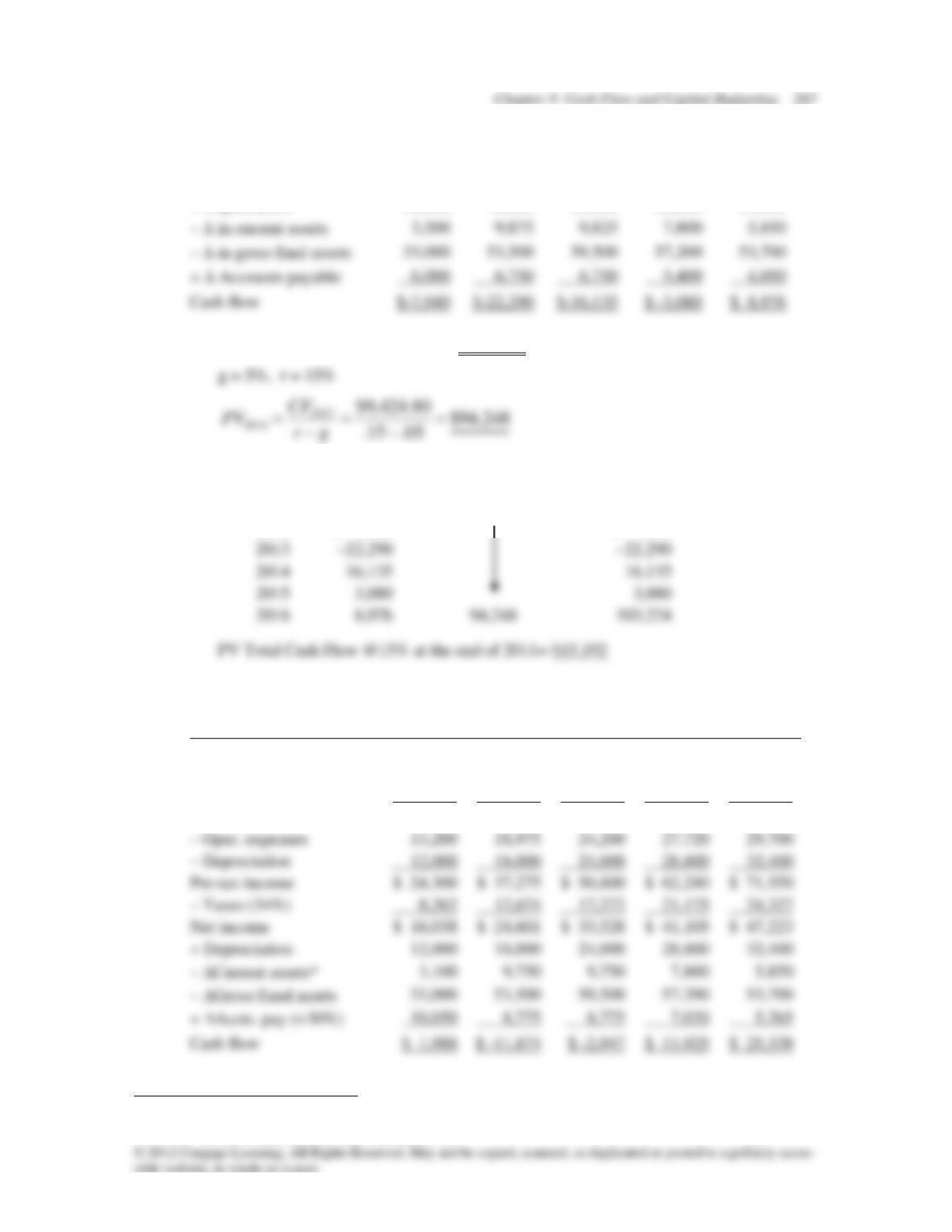
A9-16. a. ($ in thousands)
2012
2013
2014
2015
2016
Net income
$10,560
$ 16,335
$ 22,440
$27,720
$32,076
+ Depreciation
12,000
18,000
24,000
28,800
32,400
– in current assets
b. Cash flow 2017 = 1.05 $8,976 = $9,424.80
c.
End of
Year
Cash Flow
PV of CF
beyond 2014
Total Cash Flow
2012
$ –7,940
$ –7,940
2013
d. Fusion Chips
Income Statement
($ thousands)
2012
2013
2014
2015
2016
Sales (+10%)
$110,000
$165,000
$220,000
$264,000
$297,000
– COGS (1–.45)
60,500
90,750
121,000
145,200
163,350
Gross profit (45%)
$ 49,500
$ 74,250
$ 99,000
$118,800
$133,650
– Oper. expenses
– Depreciation
12,000
18,000
24,000
28,800
32,400
Pre-tax income
Net income
$ 16,038
$ 24,601
$ 33,528
$ 41,105
$ 47,223
+ Depreciation
* Reflects reduction of cash balances to $0
268 Instructor’s Manual
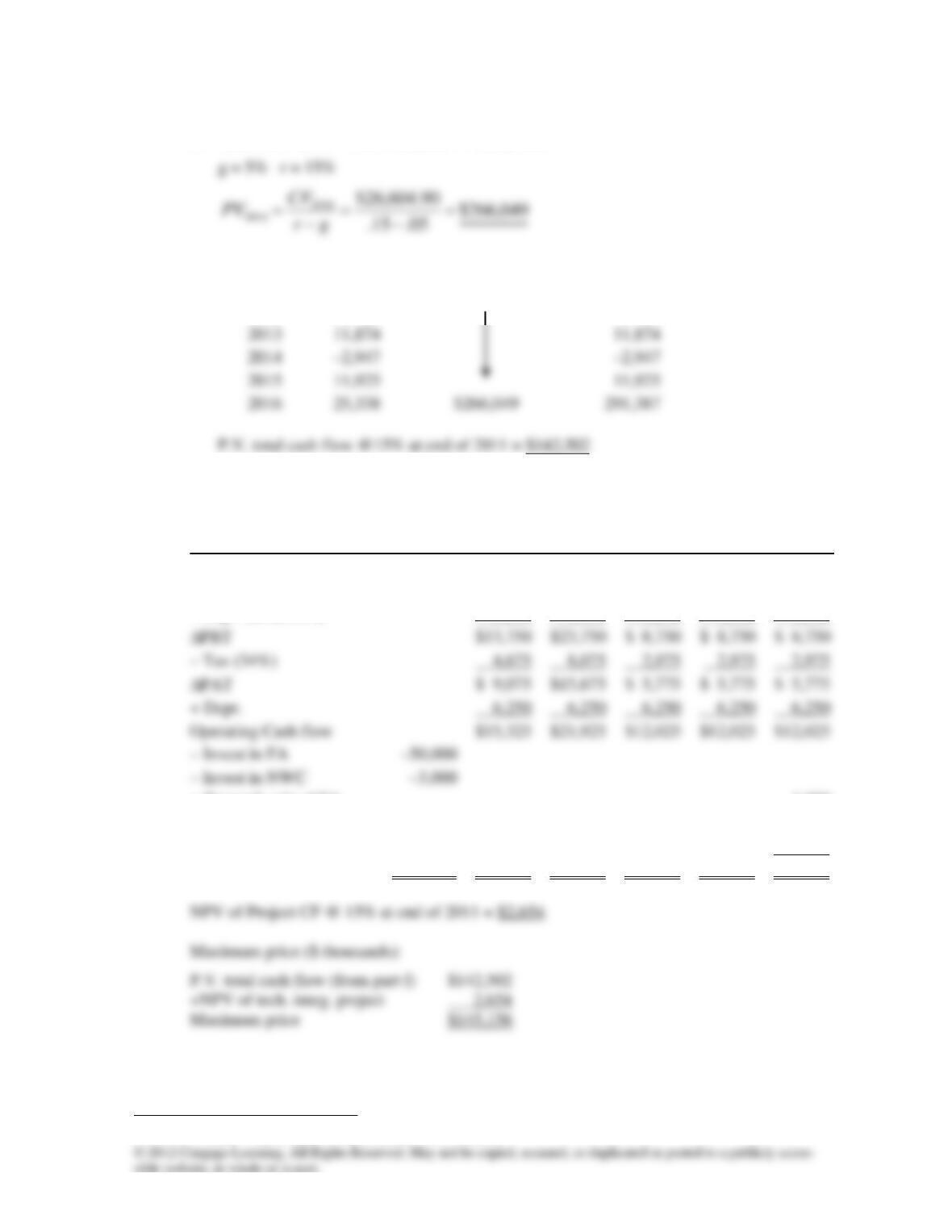
e. Cash Flow 2016 = 1.05 $25,338 = $26,604.90
f.
End of
Year
Cash
Flow
PV of CF
beyond 2014
Total Cash
Flow
2012
$ 1,988
$ 1,988
2014
2015
g.
Fusion Chips
Cash Flows from Technology Integration
($ thousands)
2011
2012
2013
2014
2015
2016
PBDT
$20,000
$30,000
$15,000
$15,000
$15,000
– Depr. ($50,000/8)
6,250
6,250
6,250
6,250
6,250
PBT
– Tax (34%)
4,675
8,075
2,975
2,975
PAT
$ 9,075
$15,675
$ 5,775
$ 5,775
$ 5,775
+ Depr.
6,250
6,250
6,250
6,250
6,250
Operating Cash flow
$15,325
$21,925
$12,025
$12,025
$12,025
– Invest in FA
+ Proceeds sale of FA
1,000
+ Tax savings from Sale*
6,035
+ Recovery of NWC
3,000
Project CF
$–53,000
$15,325
$21,925
$12,025
$12,025
$22,060
* 1,000 – 18,750BU = 17,750 Loss .34 = $6,035
Chapter 9 Cash Flow and Capital Budgeting 269
P9-17. A project generates the following sequence of cash flows over six years:
Year Cash Flow ($ in millions)
0 −59.00
1 4.00
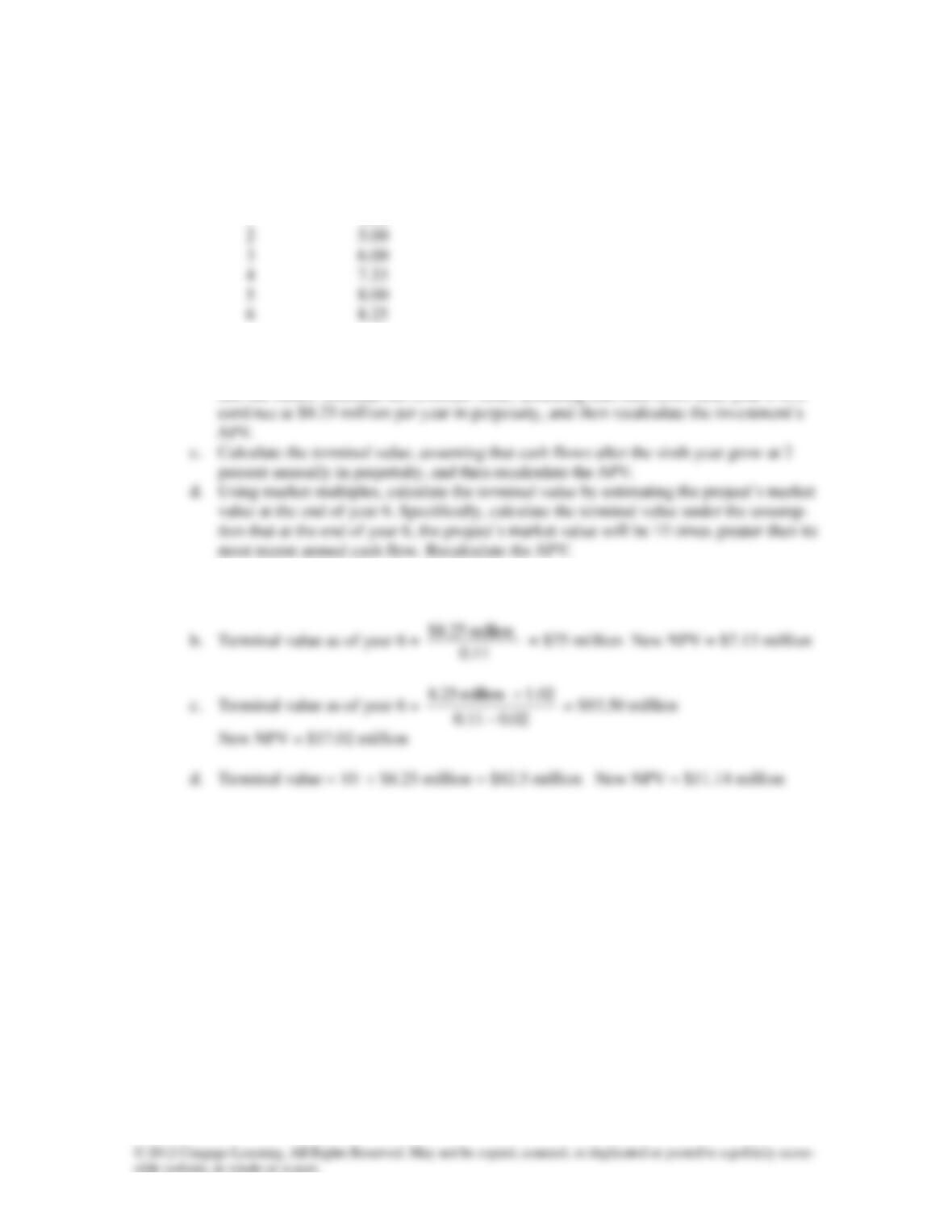
a. Calculate the NPV over the six years. The discount rate is 11%.
b. This project does not end after the sixth year, but instead will generate cash flows far
into the future. Estimate the terminal value, assuming that cash flows after year 6 will
A9-17. a. NPV at 11% = –32.96 million
Special Problems in Capital Budgeting
P9-18. You have a $10 million capital budget and must make the decision about which invest-
ments your firm should accept for the coming year. Projects 1, 2, and 3 are mutually exclu-
sive, and Project 4 is independent of all three. The firm’s cost of capital is 12 %.
Project 1 Project 2 Project 3 Project 4
Initial cash outflow −$4,000,000 −$5,000,000 −$10,000,000 −$5,000,000
Year 1 cash inflow 1,000,000 2,000,000 4,000,000 2,700,000
Year 2 cash inflow 2,000,000 3,000,000 6,000,000 2,700,000
Year 3 cash inflow 3,000,000 3,000,000 5,000,000 2,700,000
a. Use the information on the three mutually exclusive projects to determine which of
those three investments your firm should accept on the basis of NPV.
b. Which of the three mutually exclusive projects should the firm accept on the basis of
PI?
270 Instructor’s Manual
c. If the three mutually exclusive projects are the only investments available, which one
do you select?
d. Now given the availability of Project 4, the independent project, which of the mutually
exclusive projects do you accept? (Note: Remember there is a $10 million budget con-
straint.) Is the better technique in this situation NPV or PI? Why?
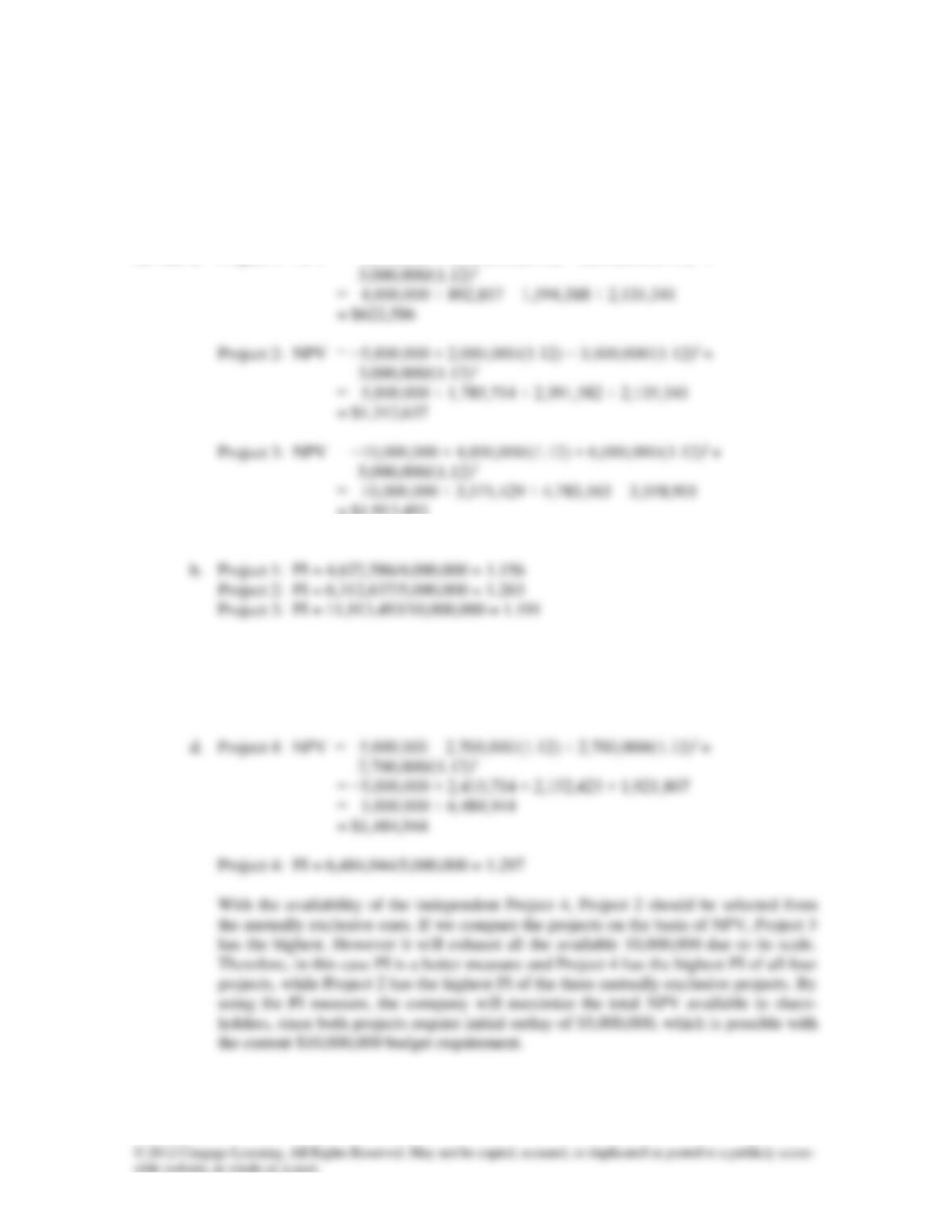
A9-18. a. Project 1: NPV = −4,000,000 + 1,000,000/(1.12) + 2,000,000/(1.12)2 +
= $1,913,493
Project 3 has the highest NPV and should be accepted.
Project 2 has the highest PI and should be accepted
c. Project 3 should be selected because it is a large-scale project and is the one that will
most enhance shareholder value.
P9-19. Semper Mortgage wishes to select the best of three possible computers, each expected to
meet the firm’s growing need for computational and storage capacity. The three comput-
ers—A, B, and C—are equally risky. The firm plans to use a 12 % cost of capital to evalu-
Chapter 9 Cash Flow and Capital Budgeting 271
ate each of them. The initial outlay and annual cash outflows over the life of each computer
are shown in the following table.
Year
Cash Flows
Computer A
Computer B
Computer C
0
-$50,000
-$35,000
-$60,000
1
-$7,000
-$ 5,500
-$18,000
2
-$7,000
-$12,000
-$18,000
3
-$7,000
-$16,000
-$18,000
4
-$7,000
-$23,000
-$18,000
5
-$7,000
-$18,000
6
-$7,000
-$18,000
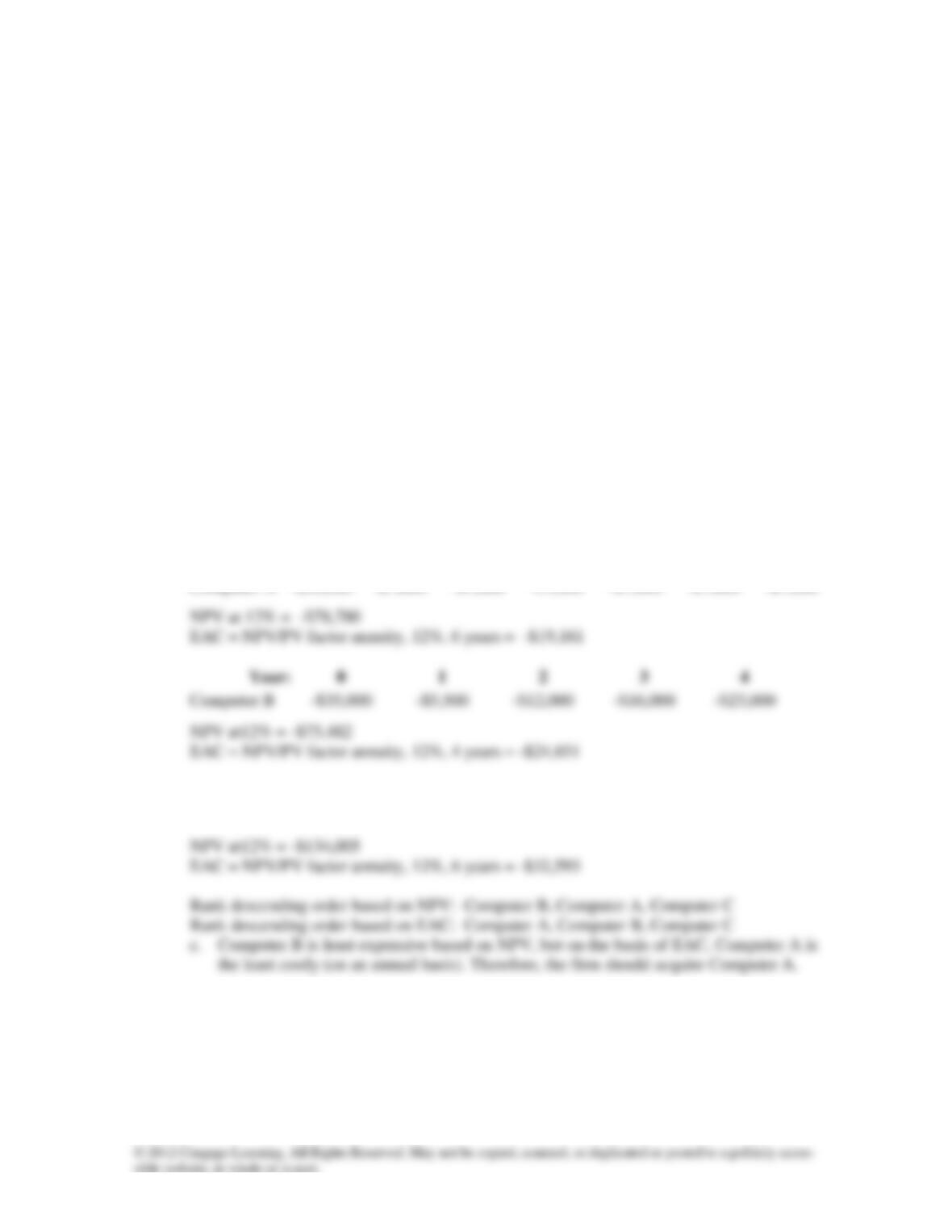
a. Calculate the NPV for each computer over its life. Rank the computers in descending
order based on NPV.
b. Use the equivalent annual cost (EAC) approach to evaluate and rank the computers in
descending order based on the EAC.
c. Compare and contrast your findings in parts (a) and (b). Which computer would you
recommend that the firm acquire? Why?
A9-19. a. and b.
Year:
0
1
2
3
4
5
6
Computer A
-$50,000
-$7,000
-$7,000
-$7,000
-$7,000
-$7,000
-$7,000
Computer B
Year:
0
1
2
3
4
5
6
Computer C
-$60,000
-$18,000
-$18,000
-$18,000
-$18,000
-$18,000
-$18,000
P9-20. Seattle Manufacturing is considering the purchase of one of three mutually exclusive pro-
jects for improving its assembly line. The firm plans to use a 14 % cost of capital to evalu-
ate these equal-risk projects. The initial outlay and annual cash outflows over the life of
each project are shown in the following table.
272 Instructor’s Manual
Cash Flows
Year
Project X
Project Y
Project Z
0
-$156,000
-$104,000
-$132,000
2
5
7
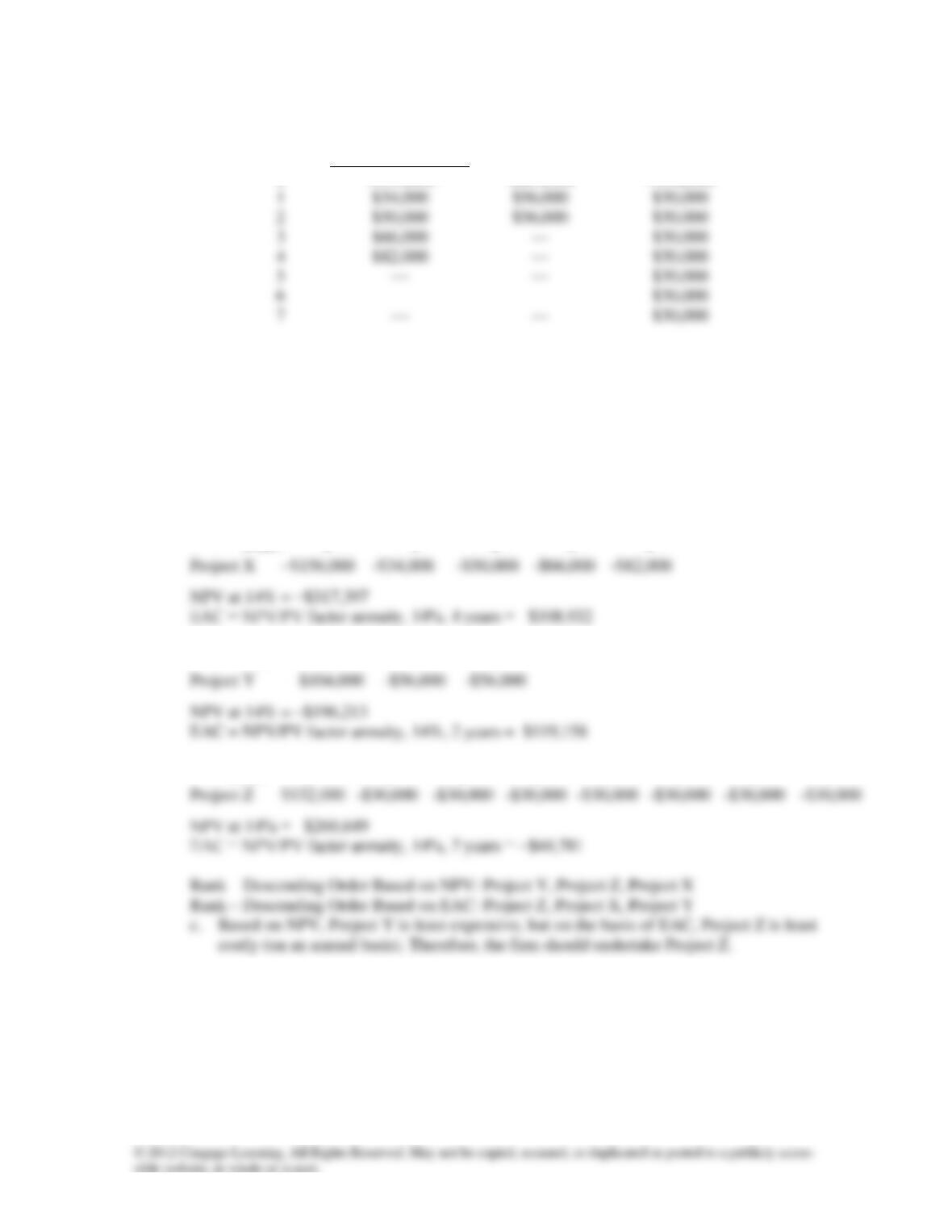
a. Calculate the NPV for each project over its life. Rank the projects in descending order
based on NPV.
b. Use the equivalent annual cost (EAC) approach to evaluate and rank the projects in de-
scending order based on the EAC.
c. Compare and contrast your findings in parts (a) and (b). Which project would you rec-
ommend that the firm purchase? Why?
A9-20. a and b.
Year:
0
1
2
3
4
Year:
0
1
2
Year:
0
1
2
3
4
5
6
7
P9-21. As part of a hotel renovation program, a company must choose between two grades of car-
pet to install. One grade costs $22 per square yard, and the other, $28. The costs of clean-
ing and maintaining the carpets are identical, but the less expensive carpet must be
replaced after six years, whereas the more expensive one will last nine years before it must
be replaced. The relevant discount rate is 13 %. Which grade should the company choose?
A9-21.
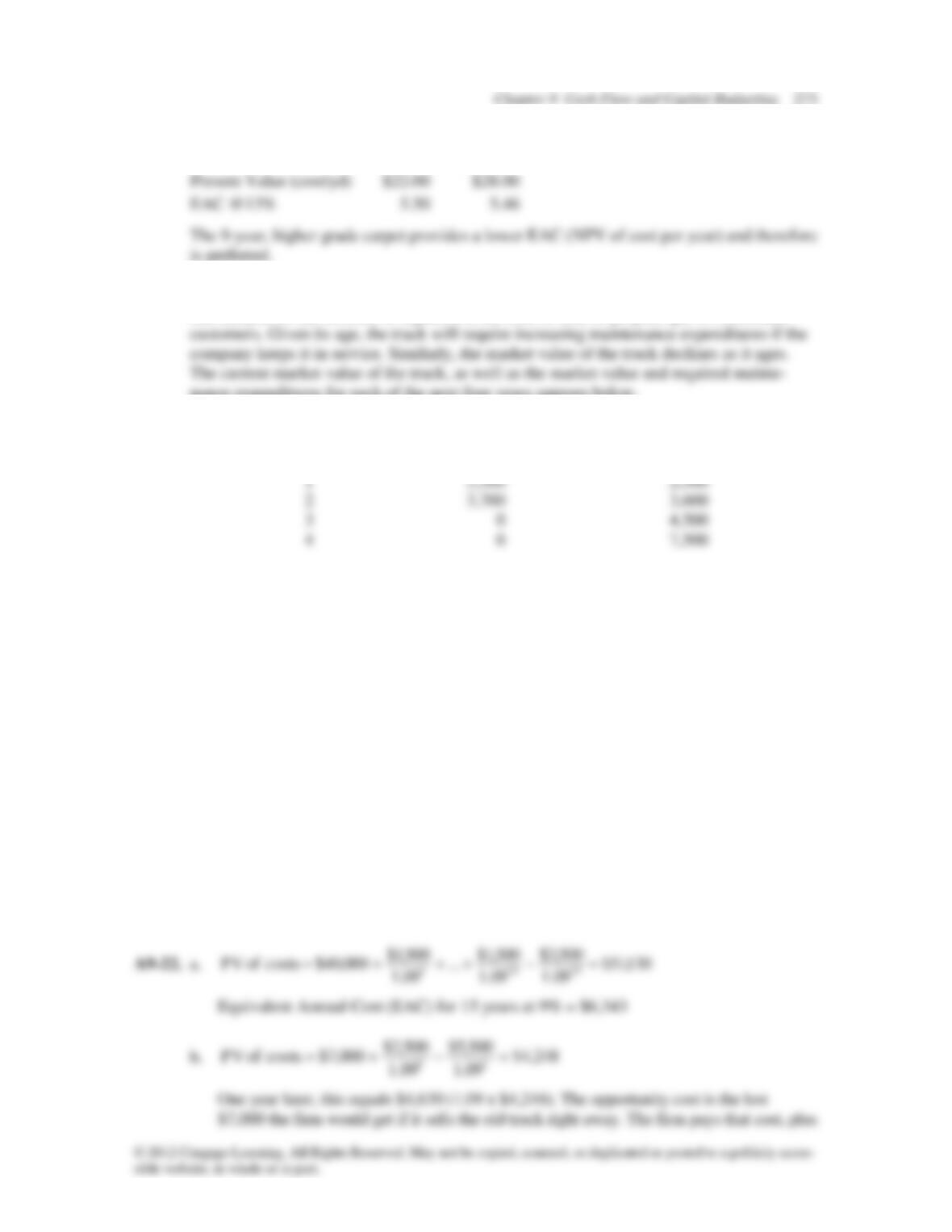
Low Cost
High Cost
EAC @13%
P9-22. Gail Dribble is a financial analyst at Hill Propane Distributors. Gail must provide a finan-
cial analysis of the decision to replace a truck used to deliver propane gas to residential
nance expenditures for each of the next four years appears below.
Year
Market Value
Maintenance Cost
Current
$7,000
$ 0
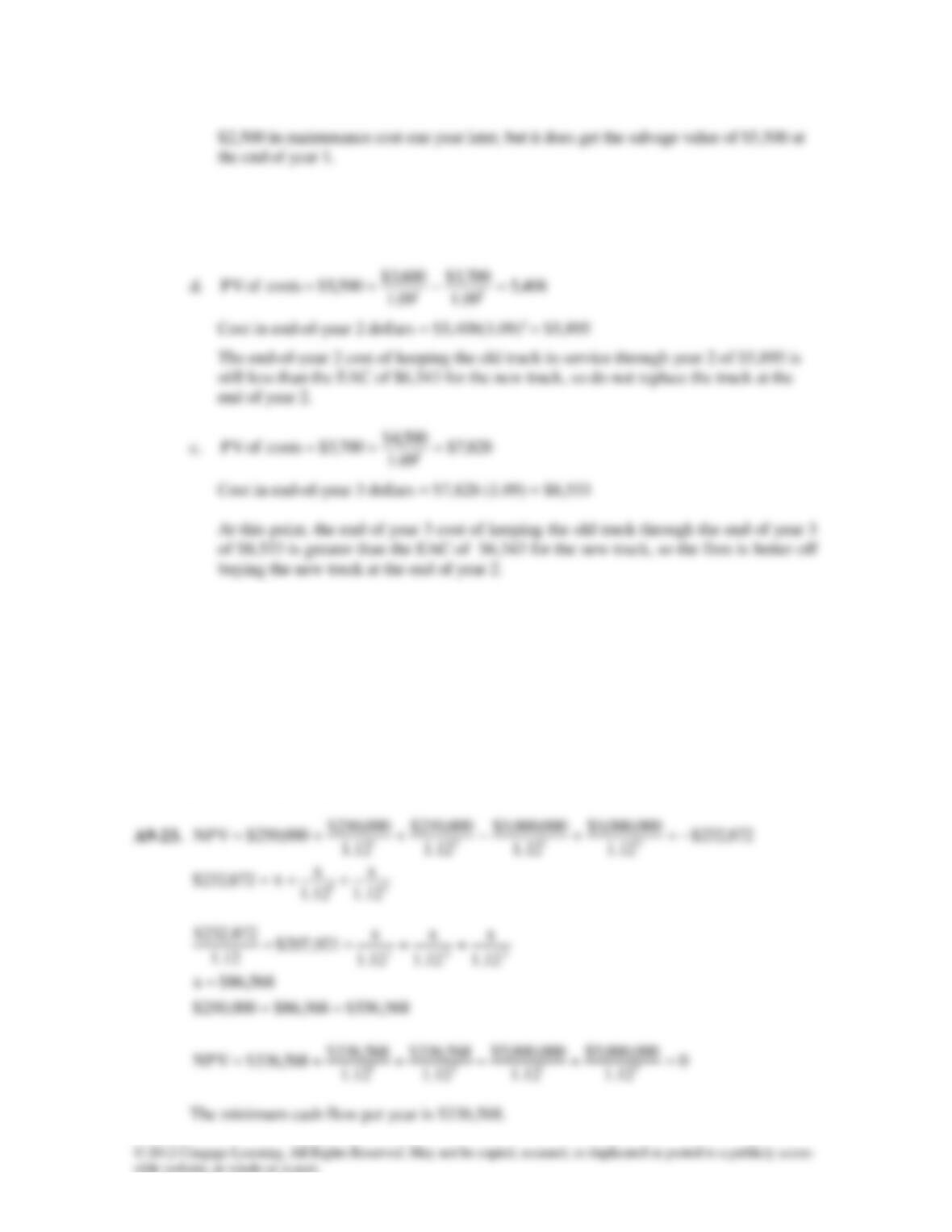
The company can purchase a new truck for $40,000. The truck will last fifteen years and
will require end-of-year maintenance expenditures of $1,500. At the end of fifteen years,
the new truck’s salvage value will be $3,500.
a. Calculate the equivalent annual cost (EAC) of the new truck. Use a discount rate of
9%.
b. Suppose the firm keeps the old truck one more year and sells it then rather than now.
What is the opportunity cost associated with this decision? What is the present value of
the cost of this decision as of today? Restate this cost in terms of year-1 dollars.
c. Based on your answers to (a) and (b), is it optimal for the company to replace the old
truck immediately?
d. Suppose that the firm decides to keep the truck for another year. Gail must analyze
whether replacing the old truck after one year makes sense or whether the truck should
stay in use another year. As of the end of year 1, what is the present value of the cost of
using the truck and selling it at the end of year 2? Restate this answer in year-2 dollars.
Should the firm replace the truck after two years?
e. Suppose that the firm keeps the old truck in service for two years. Should it replace it
rather than keep it in service for the third year?
274 Instructor’s Manual
c. The cost (in year-1 dollars) of using the old truck one more year is $4,630. The cost (in
year-1 dollars) of replacing the old truck now is $6,343, so the firm should not replace
the old truck immediately.
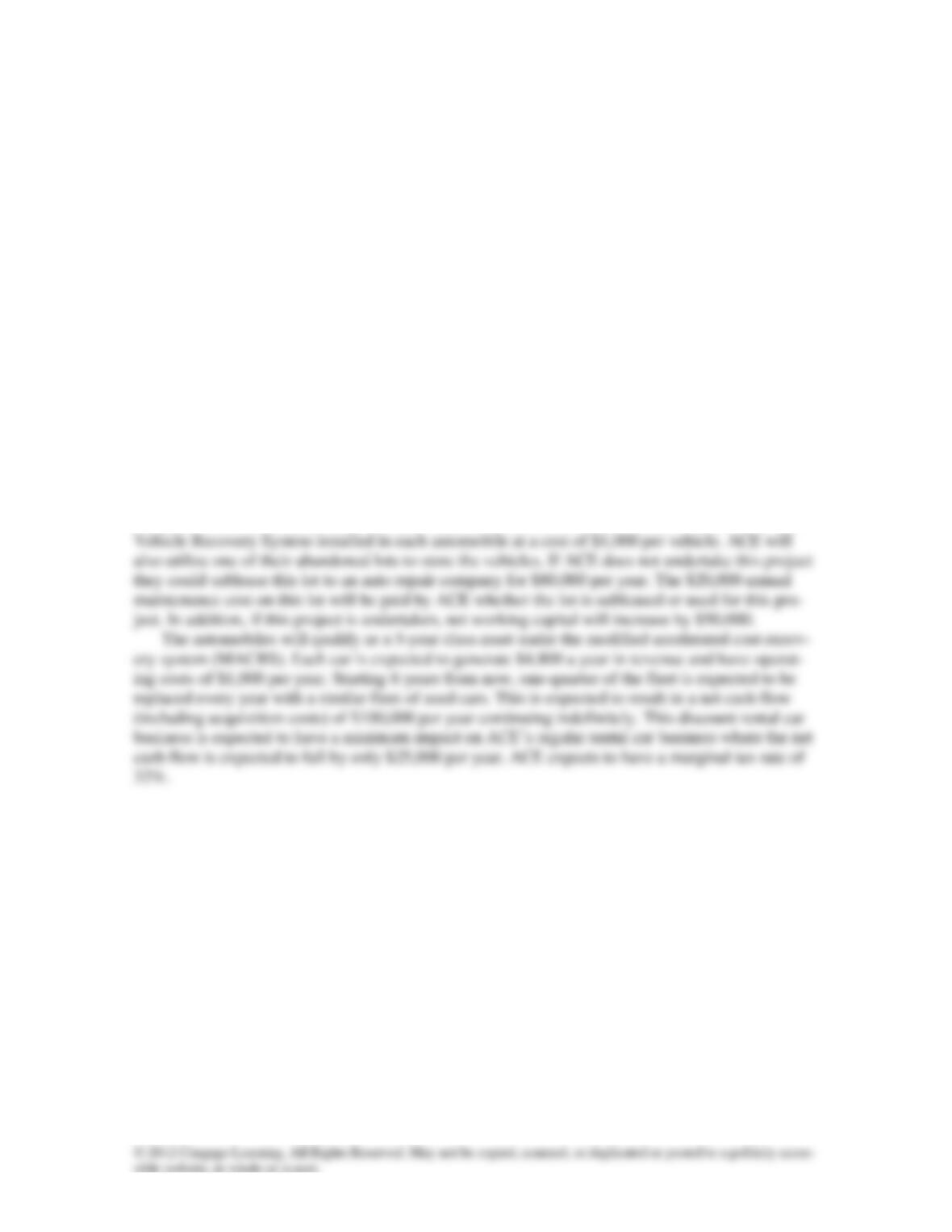
P9-23. A firm that manufactures and sells ball bearings currently has excess capacity. The firm
expects that it will exhaust its excess capacity in three years. At that time it will spend $5
million, which represents the cost of equipment as well as the value of depreciation tax
shields on that equipment, to build new capacity. Suppose that this firm can accept addi-
tional manufacturing work as a subcontractor for another company. By doing so, the firm
will receive net cash inflows of $250,000 immediately and in each of the next two years.
However, the firm will also have to spend $5 million two years earlier than originally
planned to bring new capacity on line. Should the firm take on the subcontracting job? The
discount rate is 12%. What is the minimum cash inflow that the firm would require (per
year) to accept this job?
Chapter 9 Cash Flow and Capital Budgeting 275
THOMSON ONE Business School Edition: Because P9–24 and P9-25 are based on using a live
data base, answers will vary from moment to moment.
P9-24. Compute the annual depreciation tax savings for BASF (ticker: D:BAS) over the last five
years. Use an average tax rate (income taxes divided by pretax income from the income
statement) for each year. How has depreciation tax savings changed for BASF over these
years?
P9-25. Calculate changes in net working capital for Circuit City Stores, Inc. (ticker: CC) over the
last five years. For each year, determine if the change represents a cash inflow or a cash
outflow for the company. From the balance sheet, identify source(s) for this change.
Answer to MiniCase
Cash Flow and Capital Budgeting
ACE Rental Cars, Incorporated (ACE) is analyzing whether to enter the discount used rental car
market. This project would involve the purchase of 100 used, late-model, mid-sized automobiles at
the price of $9,500 each. In order to reduce their insurance costs, ACE will have a LoJack Stolen
Assignment
Based on this information, answer the following questions.
1. What is the initial cash flow (fixed asset expenditure) for this discount used rental car project?
2. Is the cost of installing the LoJack System relevant to this analysis?
3. Are the maintenance costs relevant?
4. Should you consider the change in net working capital?
5. Estimate the depreciation costs incurred for each of the next 6 years.
6. Estimate the net cash flow for each of the next 6 years.
7. How are possible cannibalization costs considered in this analysis?
8. How does the opportunity to sublease the lot affect this analysis?
9. What do you estimate as the terminal value of this project at the end of year 6 (use a 12% dis-
count rate for this calculation)?
10. Applying the standard discount rate of 12% that ACE uses for capital budgeting, what is the
NPV of this project? If ACE adjusts the discount rate to 14% to reflect higher project risk, what
is the NPV?
276 Instructor’s Manual
Answers
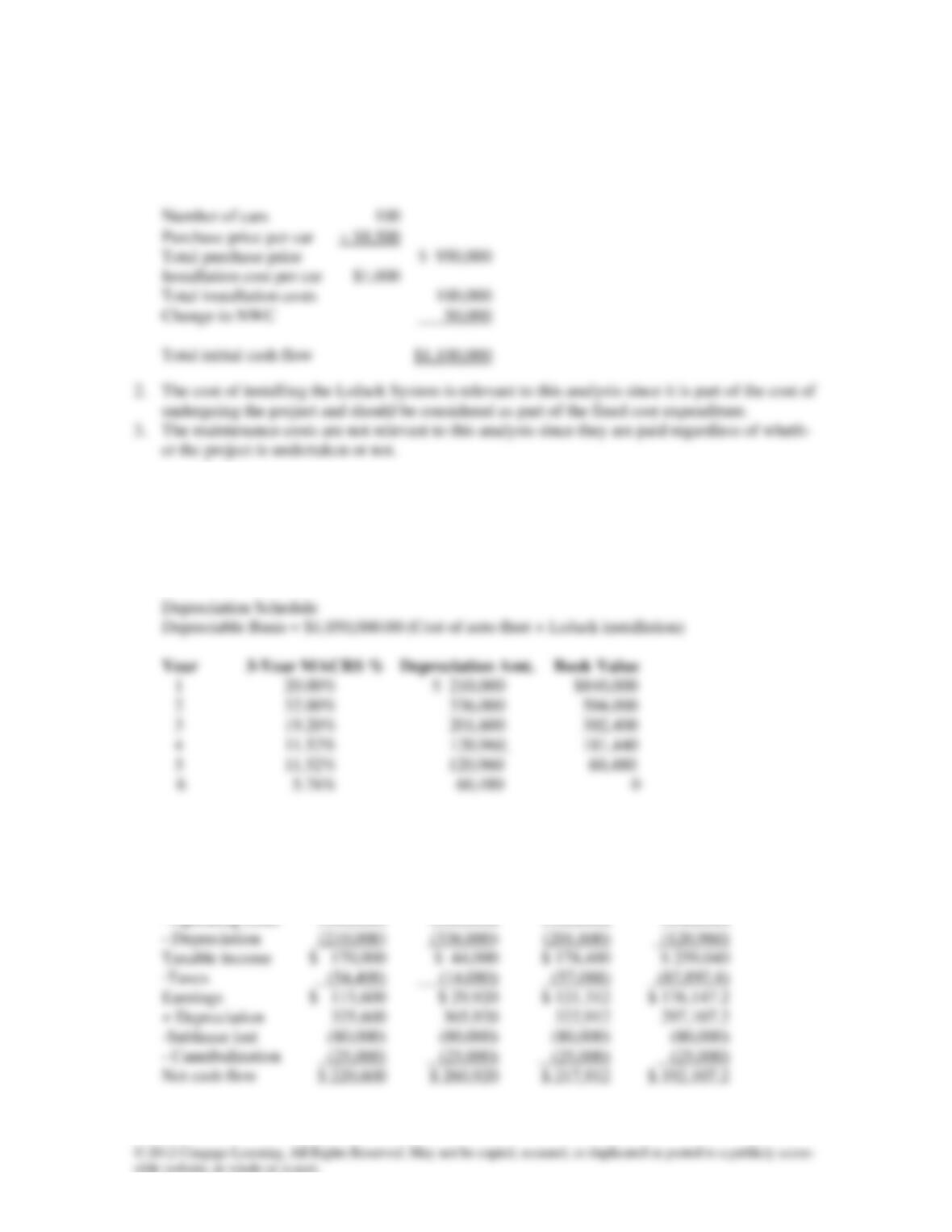
1. The initial cash flow of the discount used rental car project is $1,100,000.
Initial Cash Flow:
4. Yes, the change in working capital should be considered and included in the fixed cost ex-
penditure.
5. The depreciation costs are calculated based on the modified accelerated cost recovery system
(MACRS) for a 5-year class asset.
6. The net cash flow for each of the next 6 years are as follows.
Year: 1 2 3 4
Revenues $ 480,000 $ 480,000 $ 480,000 $ 480,000
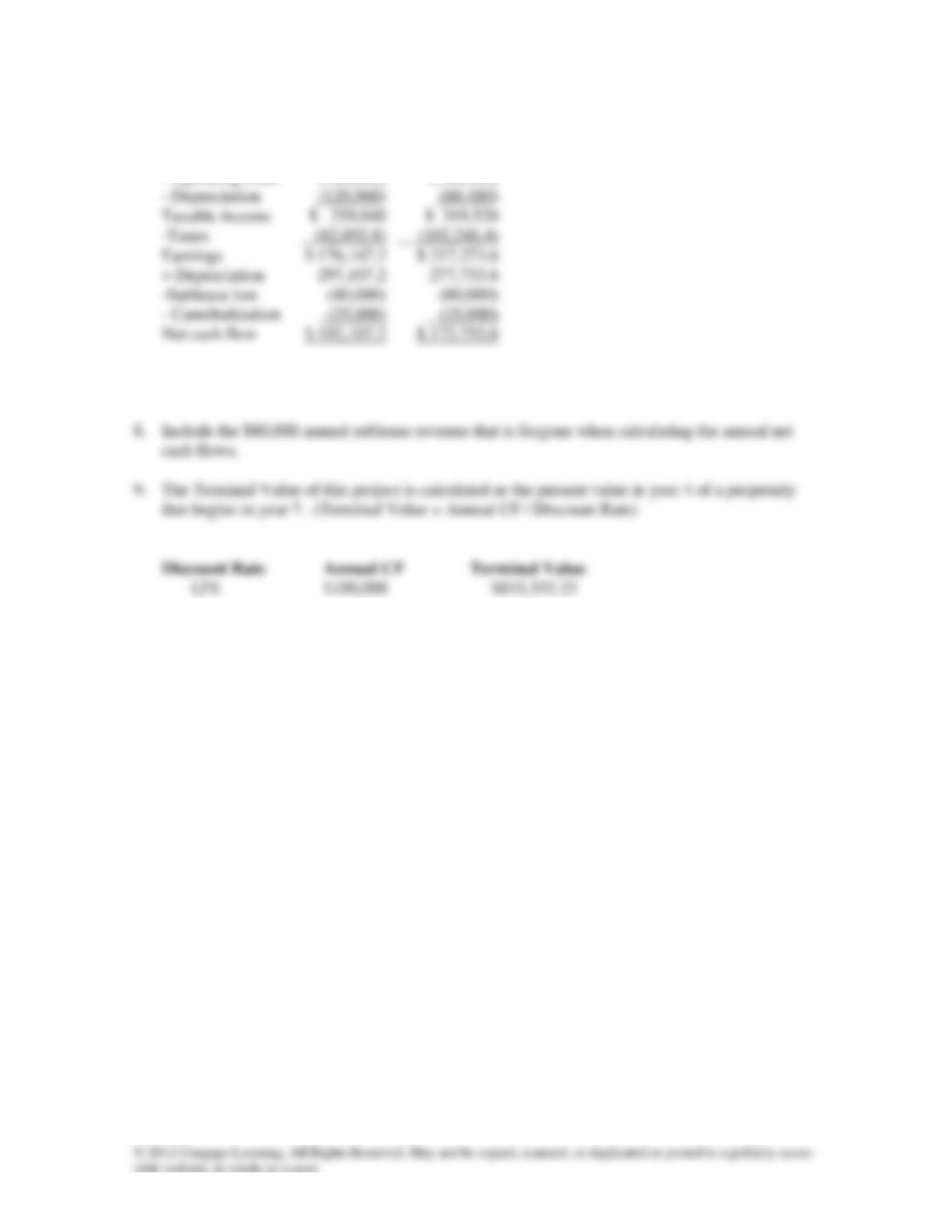
Chapter 9 Cash Flow and Capital Budgeting 277
Year: 5 6
Revenues $ 480,000 $ 480,000
– Operating costs (100,000) (100,000)
7. Include the $25,000 annual loss in business to ACE’s regular business as cannibalization costs
and consider when calculating the annual net cash flows.
10. Using the standard discount rate of 12% the NPV of this project is $250,882.90.
Using the standard discount rate of 14% the NPV of this project is ($109,003.16.
Remember the terminal value in year 6 changes to $714,285.71 ($100,000/.14).