Introduction to Corporate Finance, Fourth Edition Booth, Cleary, Rakita
Chapter 9: The Capital Asset Pricing Model (CAPM)
Multiple Choice Questions
1. Section: 9.1 The New Efficient Frontier
Learning Objective: 9.1
Difficulty: Intermediate
2. Section: 9.1 The New Efficient Frontier
Learning Objective: 9.1
Difficulty: Intermediate
3. Section: 9.2 The Capital Asset Pricing Model (CAPM)
Learning Objective: 9.2
Difficulty: Intermediate
4. Section: 9.3 The CAPM and Market Risk
Learning Objective: 9.3
5. Section: 9.3 The CAPM and Market Risk
Learning Objective: 9.3
6. Section: 9.3 The CAPM and Market Risk

Introduction to Corporate Finance, Fourth Edition Booth, Cleary, Rakita
Learning Objective: 9.3
7. Section: 9.3 The CAPM and Market Risk
Learning Objective: 9.3
8. Section: 9.3 The CAPM and Market Risk
Learning Objective: 9.3
9.Section: 9.3 The CAPM and Market Risk
Learning Objective: 9.3
Practice Problems
Basic
10. Section: 9.1 The New Efficient Frontier
Learning Objective: 9.1
Difficulty: Basic
Solution:
a) Risk loving – the expected value from buying a lottery ticket is much less than the cost of the
11. Section: 9.1 The New Efficient Frontier
Learning Objective: 9.1

Introduction to Corporate Finance, Fourth Edition Booth, Cleary, Rakita
Difficulty: Basic
Solution:
12. Section: 9.2 The Capital Asset Pricing Model (CAPM)
Learning Objective: 9.2
Difficulty: Basic
Solution: Any three of the following:
13. Section: 9.2 The Capital Asset Pricing Model (CAPM)
Learning Objective: 9.2
Difficulty: Basic
Solution:
A portfolio or security is correctly valued when the required rate of return is equal to the
14. Section: 9.3 The CAPM and Market Risk
Learning Objective: 9.3
Difficulty: Basic
Solution:
a. Zero; by definition the return on the risk-free asset is constant and therefore, the covariance

Introduction to Corporate Finance, Fourth Edition Booth, Cleary, Rakita
15. Section: 9.3 The CAPM and Market Risk
Learning Objective: 9.3
Difficulty: Basic
16. Section: 9.2 The Capital Asset Pricing Model (CAPM)
Learning Objective: 9.2
Difficulty: Basic
Solution: Determine which line consisting of the security and the RF produces the greatest slope.
17. Section: 9.3 The CAPM and Market Risk
Learning Objective: 9.3
Difficulty: Basic
Solution:
18. Section: 9.3 The CAPM and Market Risk
Learning Objective: 9.3
Difficulty: Basic
Solution:
19. Section: 9.3 The CAPM and Market Risk
Learning Objective: 9.3
Difficulty: Basic
Solution:
20. Section: 9.4 Alternative Asset Pricing Models
Learning Objective: 9.4

Introduction to Corporate Finance, Fourth Edition Booth, Cleary, Rakita
Difficulty: Basic
Solution:
Roll argued that the CAPM cannot be tested empirically because the market portfolio, which
Intermediate
21. Section: 9.1 The New Efficient Frontier
Learning Objective: 9.1
Difficulty: Intermediate
Solution:
22. Section: 9.2 The Capital Asset Pricing Model (CAPM)
Learning Objective: 9.2
Difficulty: Intermediate
Solution:
Portfolio
Expected
return
Standard
deviation
Sharpe
Ratio
Required rate of return
23. Section: 9.3 The CAPM and Market Risk
Learning Objective: 9.3
Difficulty: Intermediate
Solution:
Security 1 beta
Security 2 beta
Weight in Security 1
Portfolio beta
Case
.50
1.50
.40
=.4*.5+.6*1.5

Introduction to Corporate Finance, Fourth Edition Booth, Cleary, Rakita
24. Section: 9.3 The CAPM and Market Risk
Learning Objective: 9.3
Difficulty: Intermediate
Solution:
a.
25. Section: 9.3 The CAPM and Market Risk
Learning Objective: 9.3
Difficulty: Intermediate
Solution:
26. Section: 9.3 The CAPM and Market Risk
Learning Objective: 9.3
Difficulty: Intermediate
Solution:
Security
Expected
return
Standard
deviation
Beta
Recommendation
Required
return

Introduction to Corporate Finance, Fourth Edition Booth, Cleary, Rakita
27. Section: 9.3 The CAPM and Market Risk
Learning Objective: 9.3
Difficulty: Intermediate
Solution:
a)
28. Section: 9.3 The CAPM and Market Risk
Learning Objective: 9.3
Difficulty: Intermediate
Solution:
29. Section: 9.3 The CAPM and Market Risk
Learning Objective: 9.3
Difficulty: Intermediate
Solution:
30. Section: 9.3 The CAPM and Market Risk
Learning Objective: 9.3

Introduction to Corporate Finance, Fourth Edition Booth, Cleary, Rakita
Difficulty: Intermediate
Solution:
31. Section: 9.3 The CAPM and Market Risk
Learning Objective: 9.3
Difficulty: Intermediate
Solution:
Begin with the dividend discount model to determine the required rate of return. Then use that
32. Section: 9.3 The CAPM and Market Risk
Learning Objective: 9.3
Difficulty: Intermediate
Solution:
33. Section: 9.3 The CAPM and Market Risk
Learning Objective: 9.3
Difficulty: Intermediate
Solution:

Introduction to Corporate Finance, Fourth Edition Booth, Cleary, Rakita
34. Section: 9.3 The CAPM and Market Risk
Learning Objective: 9.3
Difficulty: Intermediate
35. Section: 9.3 The CAPM and Market Risk
Learning Objective: 9.3
Difficulty: Intermediate
Solution:
36. Section: 9.3 The CAPM and Market Risk
Learning Objective: 9.3
Difficulty: Intermediate
Solution:
37. Section: 9.4 Alternative Asset Pricing Models
Learning Objective: 9.4
Difficulty: Intermediate
Solution:
Challenging
38. Section: 9.1 The New Efficient Frontier
Learning Objective: 9.1
Difficulty: Challenging
Solution:
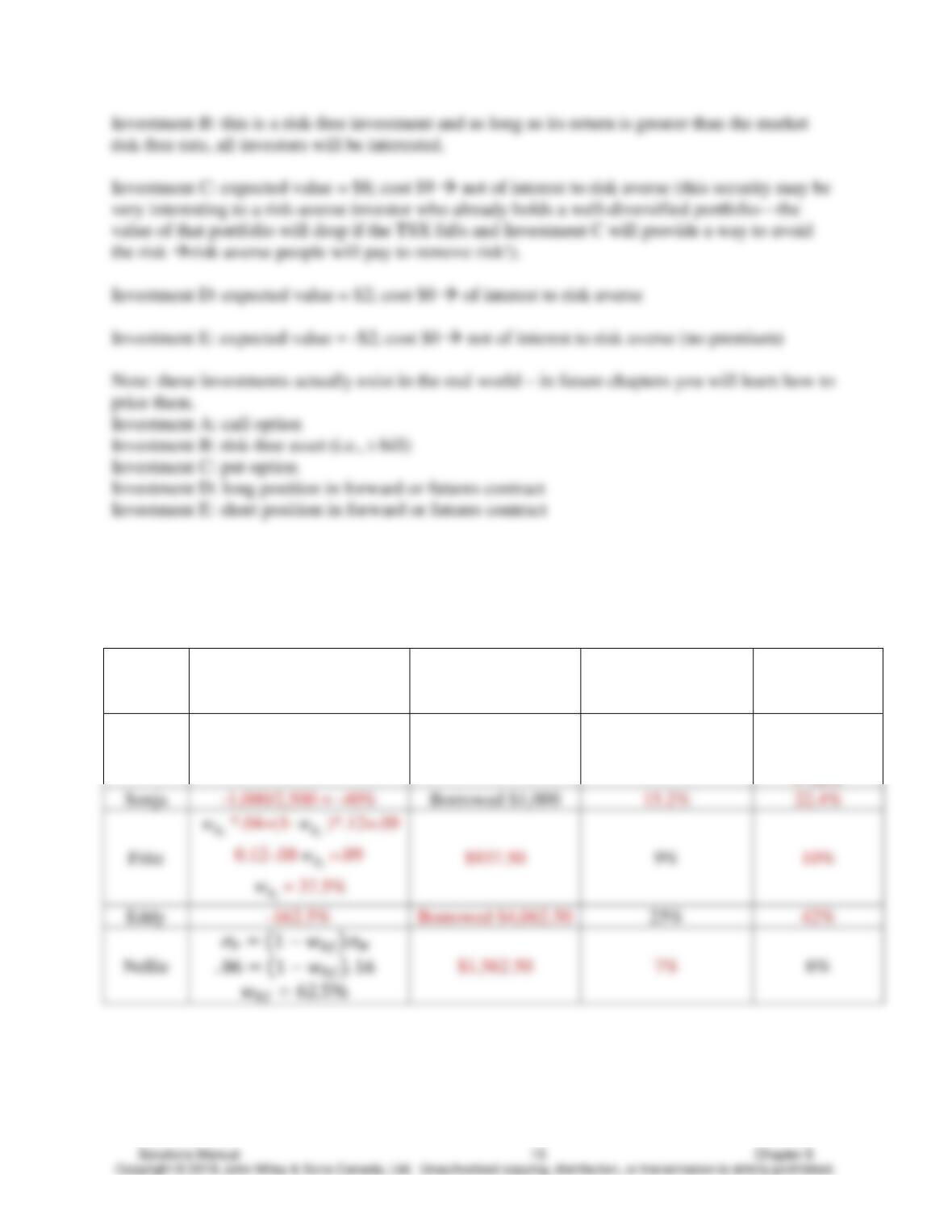
Risk-adverse investors are only willing to invest in a risky undertaking if the expected value is
Introduction to Corporate Finance, Fourth Edition Booth, Cleary, Rakita
39. Section: 9.1 The New Efficient Frontier
Learning Objective: 9.1
Difficulty: Challenging
Solution:
Investor
Weight in risk-free asset
$ amount invested
in risk-free asset
Expected portfolio
return
Portfolio
standard
deviation
Charles
25%
.25*2,500=$625
=0.25*4+0.75*12
=10%
=
MRf
w
)1( −
= .75*.16
= 12%
40. Section: 9.1 The New Efficient Frontier
Learning Objective: 9.1
Difficulty: Challenging
Solution:
Introduction to Corporate Finance, Fourth Edition Booth, Cleary, Rakita
a)
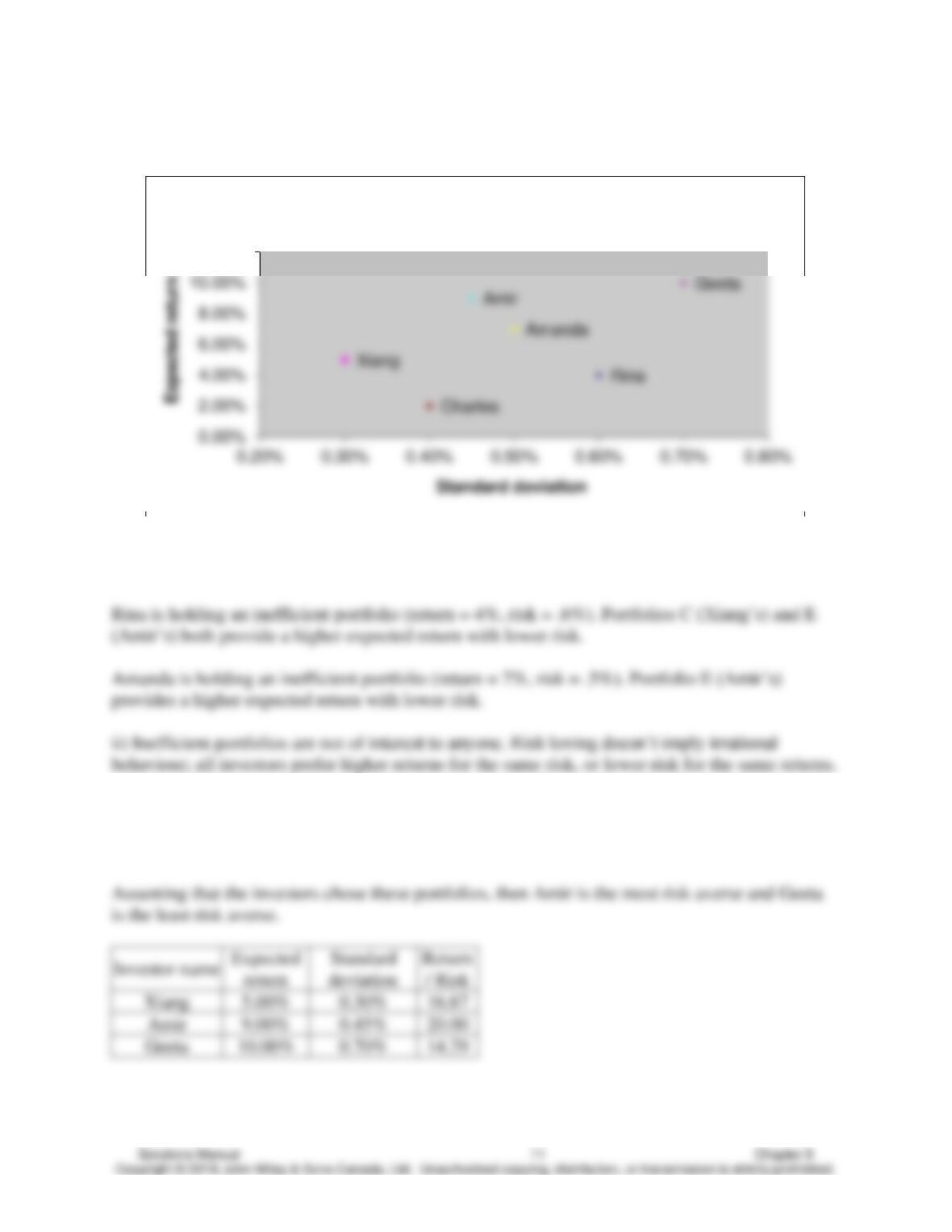
i) The easiest way to evaluate the efficiency of the portfolios is to plot them on a graph:
Charles is holding an inefficient portfolio (return = 2%, risk = .4%). Portfolio C (Xiang’s) is
better—higher return (5%) with lower risk (.3%).
b)
The more risk averse an investor, the greater the expected return they will demand per unit of
risk. There are three efficient portfolios: C, E, and F (Xiang, Amir, and Geeta respectively).
41. Section: 9.1 The New Efficient Frontier
12.00%
The Brokerage Company
Introduction to Corporate Finance, Fourth Edition Booth, Cleary, Rakita
Learning Objective: 9.1
Difficulty: Challenging
Solution:
a) No. To recommend a portfolio for these people one would need to know their levels of risk
c)
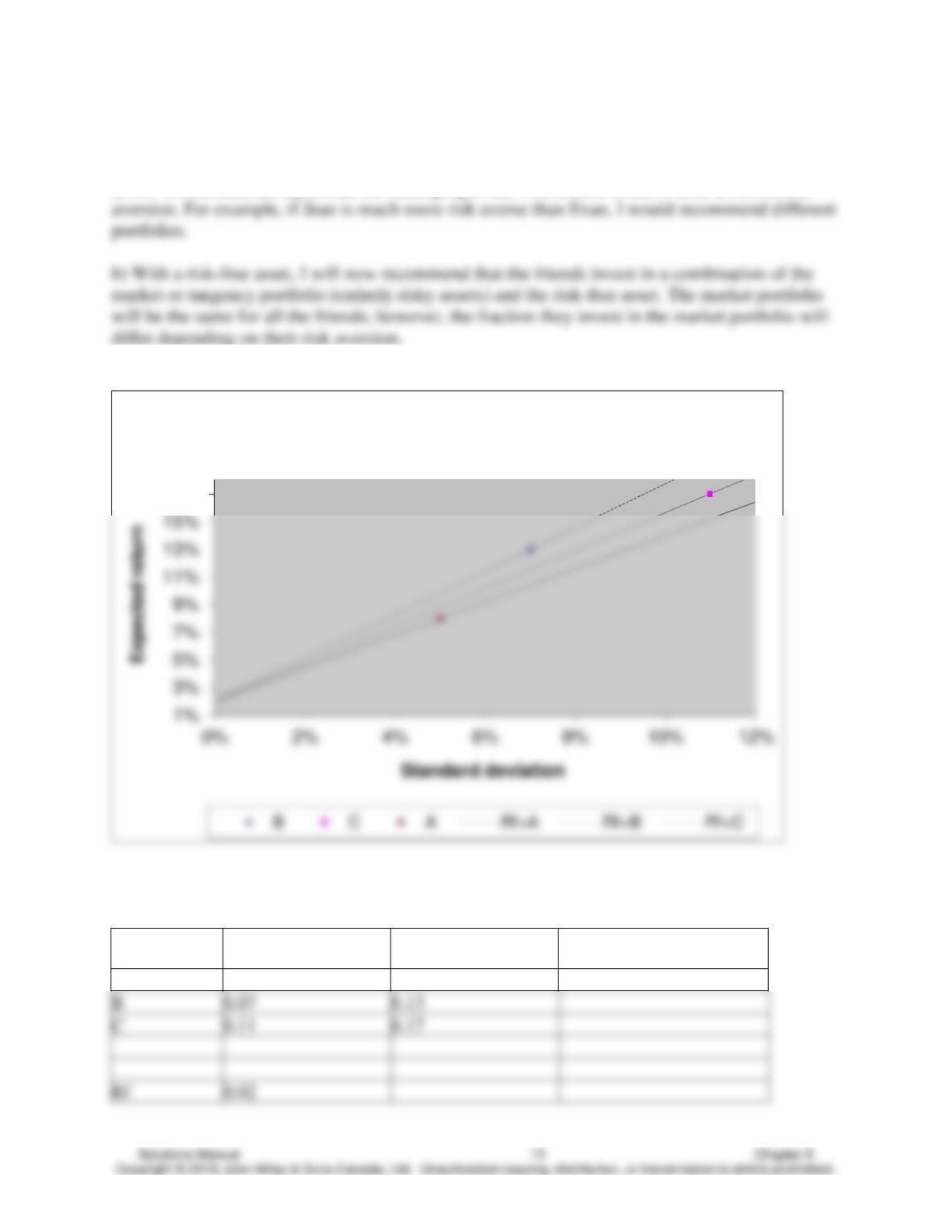
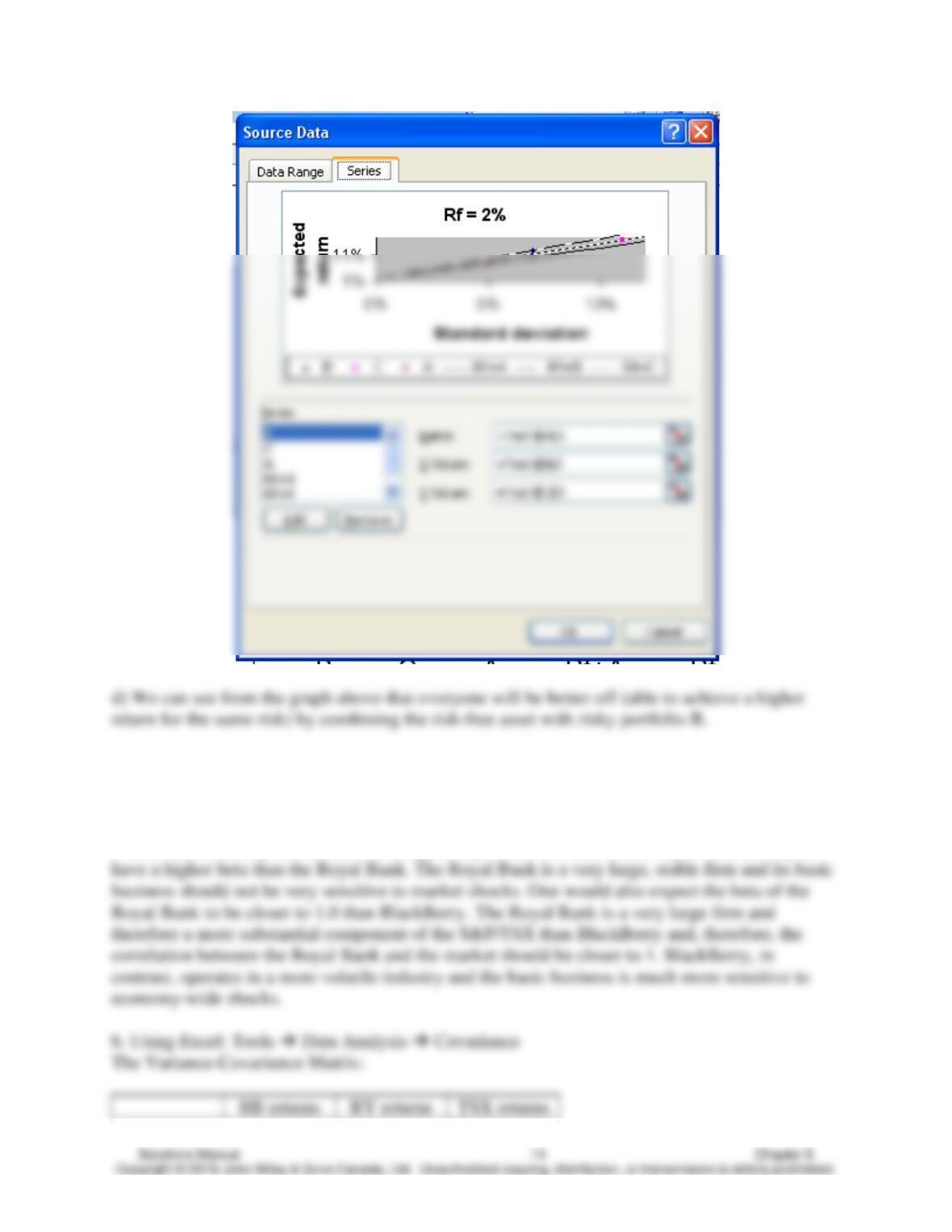
To create this chart in Excel (note: setting it up this way makes it very easy to redo the
calculations for different risk-free rates).
Portfolio
Standard deviation
Expected return
A
0.05
0.08
B
0.07
0.13
C
0.11
0.17
0.02
17%
Rf = 2%

Introduction to Corporate Finance, Fourth Edition Booth, Cleary, Rakita
Rf = 2%
Rf+A
Rf+B
Rf+C
Standard
deviation
=$B$7+(($C$2-
$B$7)/$B$2)*A10
=$B$7+(($C$3-
$B$7)/$B$3)*A10
=$B$7+(($C$4-
$B$7)/$B$4)*A10
=$B$7+(($C$2-
$B$7)/$B$2)*A11
=$B$7+(($C$3-
$B$7)/$B$3)*A11
=$B$7+(($C$4-
$B$7)/$B$4)*A11
=$B$7+(($C$2-
$B$7)/$B$2)*A12
=$B$7+(($C$3-
$B$7)/$B$3)*A12
=$B$7+(($C$4-
$B$7)/$B$4)*A12
Portfolio
Standard
deviation
Expected
return
A
5.00%
8.00%
B
7.00%
C
2.00%
Rf = 2%
Rf+A
Rf+B
Rf+C
Standard
deviation
Expected
return
Expected
return
Expected
return
0.00%
2.00%
2.00%
2.00%
1.00%
3.20%
3.57%
3.36%
2.00%
4.40%
5.14%
4.73%
3.00%
5.60%
6.71%
6.09%
4.00%
6.80%
8.29%
7.45%
Introduction to Corporate Finance, Fourth Edition Booth, Cleary, Rakita
42. Section: 9.3 The CAPM and Market Risk
Learning Objective: 9.3
Difficulty: Challenging
Solution:
a. The data is already downloaded in Chapter 8 Question 50. One would expect BlackBerry to

Introduction to Corporate Finance, Fourth Edition Booth, Cleary, Rakita
The diagonal terms are the variances and the off-diagonal terms are the covariances.
Beta=COV(r, rm)/VARm
Beta:
43. Sections: 9.2 The Capital Asset Pricing Model (CAPM) and 9.3 The CAPM and Market Risk
Learning Objective: 9.2 and 9.3
Difficulty: Challenging
Solution:
The client does not understand the difference between the Capital Market Line (CML) and the
Security Market Line (SML). The CML represents the relationship between the expected return
44. Section: 9.3 The CAPM and Market Risk
Learning Objective: 9.3
Difficulty: Challenging
Solution:
a) To value PVC, find a comparable firm. ABC, while having the same total risk, is not
necessarily appropriate because we do not know if the market risk is similar. Remember, we are

Introduction to Corporate Finance, Fourth Edition Booth, Cleary, Rakita
b) Now that we have the required rate of return, we can use the dividend discount model to value
PVC:

Introduction to Corporate Finance, Fourth Edition Booth, Cleary, Rakita
Answers to Concept Review Questions
9.1 The New Efficient Frontier
Concept Review Questions
1. What is risk aversion and how do we know investors are risk averse?
2. What is the risk of a portfolio consisting of a risk-free asset and a risky security?
3. Why is the tangent portfolio so important?
Portfolios composed of the risk free rate and the tangent portfolio offer the highest expected rate
4. How do we generate a portfolio with a higher expected rate of return than that on the tangent
portfolio?
9.2 The Capital Asset Pricing Model (CAPM)
Concept Review Questions
1. What is the slope of the CML, and why can it be reviewed as the market price of risk for
efficient portfolios according to the CML?
The slope of the capital market line is the incremental expected return divided by the incremental
2. Assuming the CAPM holds, if the expected return on a diversified portfolio lies above the
CML, should an investor buy or sell the portfolio?
If a portfolio has a high expected rate of return, relatively low risk and lays above the CML. The
3. When is the expected return equal to the required return?
4. Why is the Sharpe ratio frequently referred to as a ‘risk–adjusted’ measure of performance?

Introduction to Corporate Finance, Fourth Edition Booth, Cleary, Rakita
9.3 The CAPM and Market Risk
Concept Review Questions
1. Why is beta a measure of market risk for a security?
Consider a security with a beta of 0. This means that its return is unrelated to the return on the
2. If a security’s correlation with the market return increases, will its beta get larger or smaller?
3. What is a characteristic line, and why is it useful?
A characteristic line is typically estimated by first plotting the returns on an individual security
4. If the market risk premium increases will securities become over or under valued?
9.4 Alternative Asset Pricing Models
Concept Review Questions
1. Why is the CAPM called a single-factor model?
2. Describe some of the criticisms of the CAPM, including Roll’s critique.
It is often criticized since it is developed based on several assumptions, many of which are called
into question in the real world. In addition, a substantial amount of empirical evidence has been

Introduction to Corporate Finance, Fourth Edition Booth, Cleary, Rakita
3. Briefly describe the strengths and weaknesses of the Fama-French model and the APT.
Strengths of Fama-French model: Fama and French (1992) find that their model does a much
better job of explaining common stock returns.
Weaknesses of Fama-French model: It is not based on sound economic fundamentals as
is the CAPM. Further, many believe that it is simply an example of data mining, where the data